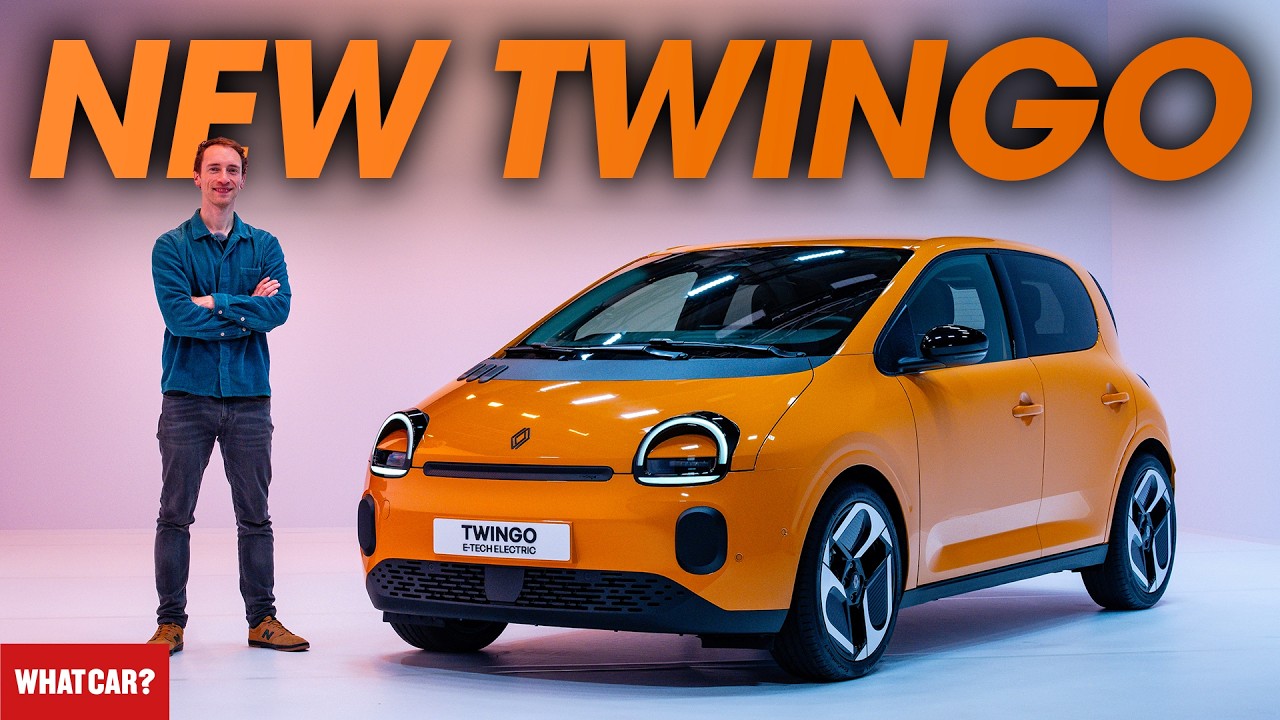
NEW Renault Twingo revealed! EVERYTHING you need to know | What Car?
Just a few years ago, the majority of new electric cars were pretty big and pretty expensive. But recently, we’ve seen a huge explosion of new options at the more affordable, smaller end of the market. Today, we’re in Paris to see what could be one of the best of them. This is the new Renault Twingo. Will this be the best new cheap electric car? In this video, we’re telling you everything you need to know. And keep watching until the end because we’ll be explaining why this is the fastest Renault ever, but not in the way you might expect. To see lots more videos like this, subscribe to our channel. Now, you probably already know the Twingo name. It was, of course, a city car, smaller than the Renault Cleo, first launched in 1992. But that first generation model was never available in the UK with right-hand drive. For the second generation model in 2007, that did make its way over to the UK, as did the third generation model in 2014. For the time that it was around, it was never an absolutely brilliant car in its class, to be honest. However, expectations for this new Twingo should be absolutely sky-high. But why is that? Well, it’s because Renault has shown it knows a thing or two about making brilliant small electric cars. Its history in that department goes back to the Rena Zoey, of course, but more recently, we’ve had the Renault 4 and our 2025 car of the year, the Rena 5, which is a truly exceptional EV. So, does the Twingo take the ingredients of the Rena 4 and Rena 5, but translate them into a smaller package? Well, we’ll talk mechanicals later on, but for a start, this does look different from those other cars, doesn’t it? We were shown a concept of the Twingo a while ago now, and at the time, Renault said the design was about 90% representative of the styling of the production ready version, and it does appear as though the French manufacturer was true to its word. Now, we’ve seen with other new Renault models, particularly with the Renault 5, that the French manufacturer has taken inspiration from its past in the design of its new fully electric versions. And it’s the same story for this Twingo. This doesn’t actually look like the most recent third generation Twingo. Instead, this clearly takes inspiration from the original from the ’90s with these circular headlights, a clear nod to that car. This new version is available in a range of new colors, by the way, including red, green, and this mango yellow. Now, the shape and the proportions of the new Twingo are also very similar to the looks of the original from the ’90s, but of course, this is overall a bigger car. It’s now 3.79 m long and so even though it’s a small electric car, it is a little bit longer than a Fiat 500 electric. It is though, as you’d imagine, shorter than a Renault 5. It also promises a very tight turning circle of 9.87 m. And the entry- level model weighs 1,200 kg, which okay, is still over a ton, but by modern new electric car standards, it’s pretty lightweight. So, it’s small, it’s lightweight. Does that mean it’s got a terrible boot? Well, the first thing to point out is that Renault quotes an official boot capacity of 305 L, which is actually more than the 277 L on offer in the Renault 5, but there is quite a bit to unpack with all of that. First, let’s look at the actual space on offer here. So, it might seem as though there’s not really much to go through here, but there is. So, yes, the actual space doesn’t seem particularly big. It’s enough for a few soft bags, a big weekly shop, but you’re not going to get your family holiday luggage in here. There’s also quite a big loading lip at the front, but you have a useful amount of extra storage under this split boot floor here, more than enough for the charging cables and some other soft bags, which is very handy. And a standout practical feature of the new Twingo is the fact that these rear seats can slide forwards by 17 cm. And with them all the way forwards, you can see it frees up quite a lot of extra room back here. And presumably that is how the 305 L boot capacity measurement was made. And that’s why it seems bigger than the Renault 5, even though that’s clearly not the full story. What is handy about those rear seats is that you can slide them forwards and backwards from the boot itself. But if you actually want to flatten them, then you do still need to go around the side and pull on the tag there. Now, getting sliding rear seats as standard is something that’s incredibly rare in this class of car and at this price range as well. But when you’re actually sat in these rear seats, if you do want to maximize boot space available to you, then you can see legroom is not particularly great. But if you slide the seats all the way back, then actually leg room is pretty impressive in the Twingo. I am 177 cm tall, about 5′ 10. The driver’s seat is in my driving position, and leg room, as you can see, is really not bad at all. I’ve also got some decent space for my feet under the seat in front. But it’s headroom that lets the Twin go down in this rear seat area because you can see I can’t sit up straight without having my head pressed up against the roof lining here. So, on a long journey, I’d have to really maximize the leg room and slouch down to be able to be comfortable in these rear seats here. You’ve also only got pop out rear windows rather than ones that slide all the way down. And you’ve probably noticed this is a fourseater rather than fiveseater. So you can only get two people in the back here. But you do have a flat floor which makes things feel a little bit more spacious than if you had a big central transmission tunnel in the middle there. You can adjust the angle of the back rest as well, but the range of movement available isn’t particularly vast. And even in the most reclined position, headroom is still pretty poor. So overall, rear seat space isn’t amazing, but it is still more than what you get in the back of a Fiat 500 electric. And given the footprint of the car and the cost, it’s actually not bad at all. Now, up front, what do we have in the Twingo? Well, there are certainly some familiar Renault traits to point out, like these stalks on the steering column here, very similar to what you get in the Renault 5 with your gear selector up here. And also, as with all Renos, this classic media controller as well. You’ve got physical buttons on this steering wheel here. And look, physical dials for the air conditioning, which is brilliant to see that they haven’t just been thrown onto the touchscreen infotainment system. And you do get a touchscreen infotainment system and a fully digital driver display. Both of those things coming as standard, which is really impressive. But in terms of interior quality, now look, there are lots of hard plastics all over the interior. Basically, there aren’t any soft touch materials or soft touch finishes to point out anywhere. But bear in mind, of course, that this is priced towards the entry point of the electric car market as a whole. So, of course, it’s unlikely that this car would be able to challenge the most luxurious electric car interiors out there, given the price that it’s sold for. And to be fair, thanks to the look and the design and some of the color that you can get on the dashboard, it’s a fairly cheery interior, even if it doesn’t feel particularly luxurious. And it should have an infotainment system that is impressive by class standards as well because we know from using Renault’s latest software in the Renault 4 and the Renault 5, for example, that it’s intuitive and it’s sharp in the way that it responds to your touch inputs. So hopefully it’ll be the same for this car here. Now, in terms of storage, you can see you’ve got this cubby on the bottom of the dashboard. You got some more storage on the center console here, but is all open rather than being closed. You’ve got two cup holders. And overall, really, this does feel like an electric car interior that’s towards the entry point of the market as a whole, but it still definitely doesn’t feel incredibly cheap and nasty in the way that a Dach Spring interior does. Instead, lots of things are pretty good about this interior of the new Twingo. Now, what about batteries and range? Well, the Twingo will come with a 27.5 kWh battery, which is fairly small, and it’s an LFP unit, which is said to be more durable and cheaper than an equivalent and more commonplace NMC battery. And the official WLTP range on offer from the Twingo is 163 mi. And bear in mind that in real world driving conditions, of course, the distance you can cover between charges will be less than that. Now, that is further than the 115 miles on offer from the entry-level version of the Fier 500 electric, but by modern EV standards, 163 miles isn’t particularly great. However, the point to make here is that this is not some seven seat SUV that you’re going to take away on some far away family holiday. Instead, it’s a small city car that’s clearly been designed for running around town. So, for most people looking to buy this car, the official range on offer will probably suit them, but it is something to keep in mind. When it comes to charging up, if you’re using a 7 kW home wallbox, you’ll go from 10 to 100% in 4 hours and 15 minutes. It will also be able to accept a charge from an 11 kW charger. And if you’re plugged into one of those, then you’ll get the same 10 to 100% in 2 hours and 35 minutes. If you’re out and about and want to use a public rapid charger, this will accept a CCS rapid charge, but the maximum charging speed it can accept is just 50 kW, which isn’t great. But because the battery is so small anyway, to get from 10 to 80% will take 30 minutes at its maximum charging rate. You also get a vehicle to load function with the new Twingo, which means you can essentially use this charging port to power other electrical items like charging up a laptop or using a kettle. Every version of the Twingo will get an 80 brake horsepower electric motor driving the front wheels. This will not be rearwheel drive like previous versions of the Twingo. And the official not to 62 mph time is 12.1 seconds, which isn’t particularly quick, but again, like the range, that is likely to be enough for the types of journeys that this car is going to be doing. And the top speed, for the record, is 81 mph. Now, the electric motors and the batteries are different in the Twingo than what you’ll find in the Renault 4 and the Renault 5. And this is obviously a different size compared to those cars. It looks very different as well, but fundamentally all three cars have very, very similar mechanical underpinnings. And so, it is quite good to see that Renault is sharing this platform among different cars, but still letting them be quite distinct from one another. It is likely though that the trim lineup will mirror that of what’s available in the Rena 4 and the Renault 5, which means for the new Twingo, the entry- level version will be Evolution and above that there’ll be a range topping techno. But the exact breakdown of what equipment you’ll get in each trim is yet to be fully confirmed for the UK. Likewise, we don’t have fully confirmed pricing for the new Twingo, but Renault has said that in the UK it’s targeting a starting price of less than £20,000. And that would make it very competitive indeed. For some context, a Daca Spring, which is a smaller, much more compromised car, starts at £14,995. And the Renault 5 is currently priced at £215,000. So, could this be another small EV smash hit from Renault? Well, what we’ve seen so far seems pretty compelling. And yes, we mentioned at the very start that this Twingo is very fast, but that is to do with its development speed rather than its straight line pace because this took 2 years or 100 weeks to develop, which is around half the time it took to do the new Cleo. And the Renault 4 and Renault 5 both took a year longer than the Twingo to be developed. And this is all part of a push from Renault to reduce its development times. The French manufacturer says one of the many benefits of doing this is being able to react to market trends quicker. Let’s hope the French manufacturer hasn’t cut any corners in reducing the development time. Though this car is due on UK roads by the end of 2026 or early 2027. So that is everything we know about the new Renault Twingo. Thanks very much for watching this video. If you want to see another one, then click up there. Make sure you subscribe to our channel while you’re at it. And if you want to read more about the Twingo and every other car around, click on that link to go to whatcar.com.
The new Renault Twingo has been revealed! Will it be the next small electric smash hit from Renault? Watch to find out what it has to offer.
Save thousands on your next new car with What Car? at https://www.whatcar.com/new-car-deals/
New videos are uploaded to What Car? each week. Don’t miss a single one. Subscribe now: https://bit.ly/2Obgxjd
Visit our website at https://www.whatcar.com/
New videos are uploaded to the What Car? channel every week. Subscribe now so you don’t miss a single one: https://www.youtube.com/whatcar
What Car? is the UK’s biggest car-buying brand and has been helping buyers for more than 50 years. Our tests are widely regarded as the most independent and in-depth.
Our YouTube channel brings you trusted reviews on all types of car, plus car news, reveals and features.
In-depth written reviews are available on our website whatcar.com, where you’ll also find advice features and the latest new and used car deals.
Follow What Car? here:
LIKE What Car? on Facebook: https://goo.gl/yv5jF8
FOLLOW What Car? on Twitter: https://goo.gl/SJzmT8
Check out our full video catalog: https://bit.ly/2W81iu9