
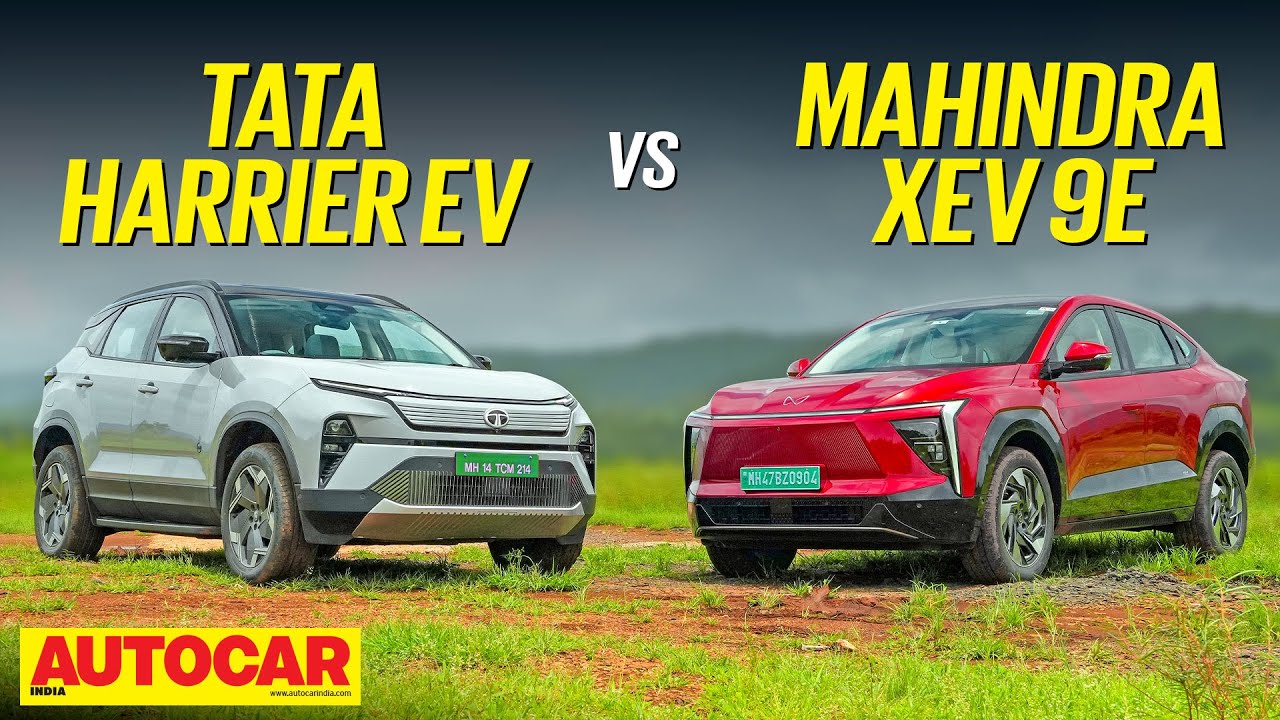
Tata Harrier EV vs Mahindra XEV 9e – Which is the better Rs 30 lakh electric SUV? | Autocar India
What we have here today are two homegrown electric SUVs. This is the Mahindra XCV90 and this is the allnew Tata Harrier EV. Now both of them are priced at around 30 lakh rupees. Both are loaded to the gills with features and tech and both of them have a claim range of over 600 km on a single charge. Question is which one’s better? [Music] The Harrier EV resembles its IC version, which means it’s a well proportionate, handsomel looking SUV. But don’t let its looks deceive you. The Harrier EV is a completely re-engineered product. It is not just a mere derivative of its IC version. And yes, it shares its body, the top hat, as well as certain interior parts with the IC version. However, its floor pan, the suspension, and other components have been re-engineered to accommodate the electric powertrain. And where the IC version is primarily frontwheel driven, this one is primarily rear wheel driven. And the car we have here today is the dual motor version. So, it is an all-wheel drive version. And in this company, the Harrier is both wider and taller than the Mahindra XV. But while the Tata Harrier EV’s design can be classified as conventional, the Mahindra XVs is far from it. In fact, this Born Electric SUV’s design looks radical. It looks futuristic, and this car garners attention on the road like no other car in its price bracket. Of course, looks are subjective, but which design appeals to you more? Let us know in the comments below. Now, let’s talk interior. You really get a sense of the car’s sheer width when you step into the cabin of the Harrier EV. What also adds to the fact is that the dashboard is horizontally oriented in its design and that enhances the sort of width, the sort of space on offer. What I really like in the Harrier EV’s cabin is this 14 1/2 in QLED Samsung screen. It’s really crisp and clear and the user interface is very easy to understand. In fact, much easier than the Mahindra XV9E. Also, the 360 camera display is crisp and clear. Another really thoughtful function in the Harrier EV is the Land Rover like digital inside rear view mirror. Now, this doubles up as a camera display or a straightforward mirror. The Harrier also gets physical buttons to activate or deactivate the front seat ventilation. Why am I mentioning it? You’ll know in just a bit, but Tata Motors has still not sorted some of the known Harrier ergonomic issues. As an example, to place your phone in the wireless pad, it’s still a bit of a struggle, and sixfooters will still find their knees fouling against the thick center console. What I also don’t like about the Harrier EV’s front seat is that thigh support is a bit lacking. So, on long drives, this seat won’t be as comfortable as the Mahendra Xeds. From the front, let’s move to the rear. What I really like about the Tata Harrier EV is that you get a completely flat floor. And despite this being an EV, you’re not seated in a knees up position. As you can see, space is plenty. You have ample knee room. You have ample headroom. And to liberate, even more room for the rear seat passenger. You can move the front seat forward electrically and free up more space. What’s more is that you get these nice winged cushions that protect your head from being tossed around when the driver is getting a bit enthusiastic. What I don’t like, however, is the fact that the lumbar is a bit excessive and the seat base is a bit short, so that thigh support is a bit lacking. Time to see what the XV’s cabin is like. The XCV’s bright upholstery really enhances the sense of space and the sense of premiumness inside this cabin. What first catches your attention is the three screen layout. And while we thought it’ll be a bit of a gimmick initially, however, users are loving this third screen out here. Personally, I preferred the Mahindra XV’s front seats to the Harriers because they are a bit more supportive and a bit more accommodating and a bit more comfortable. However, not everything is perfect in the XV. For starters, the front seats do get a ventilated seat function. However, you have to go through the touchscreen menus and find that function which is rather inconvenient. And speaking of inconvenience, the user interface of this touchscreen infotainment system is very very confusing. I mean, simple functions are buried inside multiple menus and you will have to spend a lot of time getting yourself acquainted with this user interface. One other small irritant are the haptic keys on the steering. Now, every time you try to access some function, you might just trigger the horn by mistake. And how is the Mahindra’s back seat? An advantage of this Bone Electric platform is that you get 90° wide opening doors for easy ingress and aggress. You also get a completely flat floor. And what’s nice is that even this seat base is completely flat and it’s wide enough to seat through your breast in comfort. In addition, the middle passenger will also get a head restraint which is missing in the Tata Harrier EV. What’s also nice is that you have good amount of space on offer. However, if you are on the taller side, your head might just brush against the sun shade. The rear seat passengers also have the option to recline the back rest to a more comfortable angle and gaze outside the massive panoramic sunroof. And if you are traveling at night, you’ll also see this nice LED light pattern on your panoramic glass. Additionally, passengers have the option to adjust the front seat, although it’s manually in this car to liberate more knee room and more leg room. But if I’m being honest, the X series floor is a bit higher than the Harriers. So you are seated in a slightly more kn position than the Harrier. Having said that, there’s good amount of thigh support which is somewhat missing in the Tata Harrier. There are plenty of storage and phone charging provisions across the cabin on both cars. But how do these stack up in terms of outright cargo capacity? And on the topic of boot space, the Tata Harrier EV’s boot space is much smaller than the Mahindra XVs. As you can see, the boot floor is slightly raised, and that’s because the rear motor is placed beneath, and you also get a space saver spare tire. Tata says that it has a maximum luggage carrying capacity of around 502 L from floor till the ceiling. On the other hand, the Mahindra XV being a Bond electric car has a completely flat floor despite having a rear motor underneath and also getting a space saver spare tire. interestingly is the Mahindra XV that has a larger front loading area with a maximum capacity of 150 L. Before moving on to their drive impressions, here’s a list of all the equipment they pack in. As you can see, both are absolutely loaded with tech and new age features. The XEV though has a slight advantage with its advanced heads-up display and a third screen for the front passenger. [Music] As mentioned earlier, for this comparison, we’ve got the dual motor version of the Tata Harrier EV, which makes a combined 313 horsepower and a whopping 504 Newton m of torque. Now, while these numbers are impressive, do keep in mind that the Harrier is a heavyweight and it tips the scales at over 2.3 tons. In this company, it is 134 kilos heavier than the Mahindra Xed. Despite that, in our performance tests, it was the Harrier that proved to be the quicker car. We recorded a very impressive 6.7 seconds 0 to 100 time in the Harrier EV. Mind you, the Mahindra isn’t slow to 100 km/h with a time of 7.4 seconds. Another point of comparison is that the Tata Harrier maxes out at 180 km/h. It’s and 75 km/h as per our GPS testing gear. However, the Mahindra XV breaches the 200 km per hour top speed. The Harrier is very smooth to drive and its ride comfort, especially at low speeds, is rather impressive. It is only on the open road that you can feel a bit of that vertical movement, a bit of that floatiness, particularly coming from the rear suspension. The Harrier steering to is quite pointy and it makes this car feel quite sporty. With the handling and the chassis balance, it really infuses confidence in the driver to drive in a spirited manner. Body roll too is well contained and there’s a good amount of grip coming from all the four corners of this car. There’s also a cool animation on the instrument cluster which tells you where the power is coming from. Now for the most part it is the rear motor which is in action. However, demand for a quick power surge or when you are cornering and the car detects wheel slippage, it is only then that the front motor kicks in and pulls you forward. [Applause] So in normal driving conditions, this all-wheel drive version will perform as a rear wheel drive in order to boost efficiency. We’ve also put both the cars through a real world range test. And what’s interesting to note is that the Harrier is a bit more efficient in the city in terms of kilometers per kilowatt hour. However, out on the open road on the highway, it was the Mahindra XV that proved to be more efficient. As far as range is concerned, neither of the two EVs come close to their claimed range figures. However, it is the XEV90 that fares better than the all-wheel drive Tata Harrier EV. Also, we tested their regenerative braking and the Harrier’s regenerative braking is a bit stronger than the Mahendra XVs in all the modes in level one, level two, and level three. Whether the stronger deceleration results in more energy recovery, thus helping the Harrier city efficiency, that is a study for another day. And no, before you ask, the Harrier will not come to a complete halt using just regenerative braking without you pressing the brake pedal. With that, let’s discuss how the XV9A feels from behind the wheel. [Music] Mahindra deploys a larger 79 kWh battery and the XCV is only available as a two- wheelel drive with a single motor mounted in the rear axle. So yes, the XV is a rear wheel drive. Now, the first impression that you get behind the wheel of an XV is how incredibly smooth and how easy it is to drive, and that is thanks to its super light but super precise steering. This variable gear ratio steering makes maneuvering the XCV a breeze. And what is truly remarkable is that despite having a longer length and a longer wheelbase than the Harrier EV, the XV’s turning circle is only 10 m or its turning radius is only 5 m, which is truly commendable, especially considering the size of this car. Immediately, the XV feels a lot lighter and a lot livelier than the Harrier EV. Well, the weight difference between the two cars is only 130 odd kilos. However, the XCV’s motor feels a lot more energetic in the way it delivers its performance. And if you want to make that quick overtake, the boost function has you covered. But yes, the XV is slower than the Tata Harrier to accelerate from 0 to 100, if only by a few milliseconds. Compared to the Harrier EV, there are five regenerative braking levels. level zero where the car will roll freely and then there’s level three where the regen braking is at its stronger setting. In addition, this car also gets a single pedal mode where regen is at its strongest and the car will also come to a complete halt without you pressing the brake pedal in the single pedal regen mode. The Harrier EV does get paddle shifters whereas the XEV gets buttons to adjust the regen braking. Now, I think the paddle shifters is a lot more natural, a lot more convenient option. These buttons just take some time to get used to. And while both these EVs use multi-link rear suspensions, it is the XCV that gets semi-adaptive dampers which are linked to the drive mode. So, in the everyday and in the range setting, the dampers are on the slightly softer side. Whereas in the race mode, it does firm things up. It gives you better body control, and the car does feel sharper and sportier to drive, especially while taking those bends, and the XV’s handling is surprisingly confident for such a tall car. Now, don’t get me wrong, it doesn’t feel as sporty as the Harrier. However, its steering does make you feel a lot more confident, and this car feels a lot nimler, and it nicely shrinks itself around you while taking those corners. The Mahindra’s brake pedal inspires more confidence while slowing down. However, it is the Harrier’s brakes which bring the car to a complete halt in a panic braking scenario in a shorter distance. We’ve discussed their performance range and what they’re like to drive, but what about DC fast charging? One interesting factoid is that the Tata Harrier EV’s 377VT architecture accepts maximum DC fast charge at the rate of 120 kW. Whereas, thanks to the Mahindra’s 409 volt architecture, the XCV accepts charge at a maximum speed of 180 kW. What that means is despite having the larger battery pack, if you’ve plugged in a 150 kW charger to both of these cars, it is the XCV’s battery that will charge quicker. Now would be a good time to mention neither manufacturer provides an AC wallbox charger. Instead, buyers may opt for an AC charger at an additional cost. And while on the topic, let’s look at their X showroom prices. The Tata Harrier EV checks most boxes. Style, technology, comfort, and performance. That said, Tata deserves credit for pricing the Harrier EV aggressively, placing it below the XCV90, which makes it a value proposition. But where the Harrier EV is a well-rounded option, the Mahindra XV90 feels like a segment redefining EV. Big on road presence and even bigger on tech. The XCV90’s real world range is healthier, which is something owners will appreciate. Further, it is smoother, easier to drive, and it delivers a truly world-class drive experience. Yes, it is pricier than the Tata, but for the sheer emotional appeal it exerts, you will be more than tempted to pay the premium it commands. [Music]
The Harrier EV and XEV 9e are the electric flagships for Tata Motors and Mahindra, respectively. But which is better? Saumil Shah compares across parameters to give you a definitive answer.
Camerapersons: Harshad Panchal, Ranjeet Nigudkar
Editor: Deven Bhalla
Chapters –
0:00 – Introduction
0:35 – Design and styling
1:44 – Interior, space and comfort
6:28 – Boot capacity
7:13 – Features overview
7:33 – Harrier EV driving experience
10:00 – Range
10:40 – XEV 9e driving experience
14:00 – Charging performance
14:20 – Prices
14:40 – Verdict
SUBSCRIBE to Autocar India for the hottest automotive news and the most comprehensive reviews ► http://bit.ly/AutocarInd
Autocar India is your one-stop source for test drive reviews & comparison tests of every new car and motorcycle launched in India. We also offer a great mix of other automotive content, including weekly news, motor show reports, travelogues and other special features.
Website: http://www.autocarindia.com
Facebook: http://www.facebook.com/autocarindiamag
Instagram: https://www.instagram.com/autocar_india/
Twitter: http://www.twitter.com/autocarindiamag
New car reviews ►http://bit.ly/ACI-NewCarReviews
Comparison tests ►http://bit.ly/ACI-Comparison
New bike reviews ►http://bit.ly/ACI-BikeReviews
Features ►http://bit.ly/ACI-Features
#autocarindia #tataharrier #mahindraxev9e #tata #harrier #mahindra #xev9e #evcars