Let’s Be Real About Long Journeys In EVs!
How long does it actually take to charge one of these things up? A full electric car. It’s something that’s often misunderstood or at least wildly exaggerated, certainly online. Technically, it’s correct. It may indeed take 45 minutes to add another 200 miles of range into one of these things or, I don’t know, 8 n hours at home. But that’s not the correct question. That’s not what you should be asking. How long this takes to charge is immaterial because you don’t have to stand next to it when it’s doing it. It’s how much time you take out of your life. Now, I’m not saying that these aren’t particularly inconvenient or they’re better than petrol when it comes to purely refueling, but it’s probably not what many many many people out there think in terms of how long or how much time is lost. Now, let me be very very clear at this stage. If I couldn’t charge from home, and I’ve said this for the last decade of owning EVs, I wouldn’t have one. It’s simply way too inconvenient. Possible, but it’s not something that any realistic person would ever do. I’m not saying there aren’t people out there that can own an EV and do today without home charging, but it’s a massive, massive advantage. So, going forward, everyone I’m talking to right now in this video is someone that can charge from home. So, let me clarify what I’ve just said there. It’s not something that you have to worry about how long it takes the car to charge so much. It’s how much time you waste waiting for it to charge. That’s the only thing that matters because again, with a petrol car, you’re stood there waiting for it to refuel and it only takes several minutes. But that’s several minutes where you can’t do anything else. Whereas an EV takes many hours at home anyway. And well, you can go and do other things. The best analogy is the mobile phone analogy. You don’t worry how much time it takes to charge your phone because you do it overnight and you just plug it in at your bedside table. And it’s never been a factor in purchasing a phone, I don’t think, is it? How long it takes to fill the battery. 95% of the journeys that I do, 95% of the miles should I say, is done by home charging. And it takes me what? 30 seconds to plug it in and 30 seconds to unplug it. So I spend one minute, let’s say I charge three times a week. And I do 25 to 30,000 miles a year. So three times, that’s three minutes a week I waste by refueling. But it’s the long journey, isn’t it? That’s the one that people worry about. You read the technical things and it says, I don’t know, 200 miles of range added in 40 minutes or something like that. Even though you’ll only do that journey probably two or three times a year at best, it’s it’s always a factor. It’s the whatif scenario. People always find the worst case scenario that will almost never happen and then decide on that. What I’m saying is it’s not realistically like that. There’s real world examples I’m about to give you now, but I can’t do it outside here. I have to go somewhere a little bit more uh truthful. Now, of course, when I say that word, I do mean the whiteboard of truth. All hail. So, this is a journey that we have done for many, many years. It’s down to my parents house. We live in North Yorkshire. They live down south and it’s something we’ve done in many petrol cars and electric cars over the years. So, we’re very familiar with it. So, this is just one one example to highlight my point that what you might think happens sometimes will, but the vast majority of time won’t. So, this is a 500 mile round trip from our house to my parents house. 250 miles each way. We do go the same way both directions. I’ve just split this up on the white board to make it easier to see. So, let’s start with the petrol engine first, which again, we’ve done this many times in. You would probably think, well, you would fill up at home, so you’re losing what, six, seven minutes, and then you would drive there. And certainly in the car that we had uh for several for about six, seven years, it wouldn’t do 500 miles, it do about 400. So, we’d fill up there as as you would expect and then just drive all the way back. So, essentially, we’re losing, let’s say, 15 minutes in a petrol car by refueling once before, once when we’re there, just cuz it’s convenient, and then the journey is just there and back again. Now, let’s switch to an EV. Even if we go off a modern EV that can do 250 miles in the real world, and there’s plenty of them now, that has modern charging standard, should we say, speeds, you’re not going to be doing that in one go. Even if it does 250 in the real world, you don’t get it down to zero. And my parents can’t don’t have a charger either. You know, they can’t charge at their house. So, effectively, what would happen, we would probably charge, in fact, what we do do is we’ll charge about here either Peterborough or Cambridge if anybody’s interested. Peter’s got a nice kebab place. There you go. Uh and then we would charge enough to get us there and then back again essentially to the same place and just go home. So what someone would perceive is well the petrol thing has no stops. It it’s literally zero stops for fuel even though in reality quarter of an hour. Whereas the EV that’s got let’s say 45 minutes there, 45 minutes there. It’s an hour and a half worse in an EV. Now let’s look at the reality of the situation. by moving my little counters. Give me a second. This is on a good day. 6 and a half hours each way. And that’s again if the traffic is kind. It’s been 11 hours at worse when there was a bad accident, but I would say the average is about 7 to 7 and 1 half hours to complete this journey because we’re doing it at the you during the day essentially. That is something that you are. No, nobody out there is doing six, seven hours or more without stopping. That would be ridiculous. It would be dangerous for you, the people in your car, and everybody around you. The highway code, I think by from memory, it’s been a while, uh, suggests that you stop every two hours. No one really does that. A professional driver, HGV driver, they by law have to stop, is it every four, four and a half hours? There is, there are some variables in this. So, by the law, they couldn’t do this entire journey without stopping for like 30, 40 minutes. So, what I’m saying is even in a petrol car, even when we did this exact journey in our Mini or uh well, anything we had Octavia, we would stop at the same place to get something to eat and just for a break in a petrol car, especially if you’ve got a child or children, you’re going to be stopping at least once on a six and a half to seven and a half hour journey. You would be it would be ridiculous to say that you don’t do that. And again on the the same on the way back. So although you don’t have to stop in a petrol car you do according to government statistics these are official statistics 99% of journeys in the UK are below 100 miles 99%. So if you’re not getting an EV because of these long journeys it’s literally just a handful of times a year where you may lose out. But if you can charge at home you’re winning every week. In fact, you’re probably saving 5 minutes, 10 minutes a week by not having to visit a petrol station because charging at home is literally just going like that. Now, let me give you another scenario which is in the future. It’s not right now, but is not far off. Now, most modern EVs, certainly ones that you would, you know, family size would do this without stopping. So, I upgrade our standard range Model 3 for whatever something brand new. We can drive all the way there without stopping if we were stupid enough to do so. And because it’s the future, my mom and dad now have a charger. So, we drive all the way there. We stay night a couple of nights as we usually do and charge whilst we’re there. And then we just drive all the way back, which if anything is more convenient than a petrol car because you don’t have to visit the petrol station at either end. One minute there, one minute there. We are the the limiting factor now, not the car. Yes. If you got an EV that does 100 miles, 130 mi, it’s going to be a very different kettle of fish. But I’m talking about modern stuff now and going forward from today. And of course, if you can charge from home, because if you can, then I wouldn’t recommend getting one at this stage. So, what if you’re doing a 500 mile trip in one go, as in it’s 500 miles just to get to where you’re going, which we do at least once a year when we go and do the North Coast 500 or or thereabouts. And that’s I don’t know 10 hours or something from us. It’s again, it’s it’s an obscenely long journey where you’re going to be stopping a minimum of twice. One will be an enforced stop at TB services because they do the nicest pints. And the other one will be because we need to get out and stretch his legs. We need a pee. Uh we need something to eat. Take your pick. If you got kids, it it changes all this. So yes, if you’re a traveling salesman, an EV is probably not for you. Nobody is saying it is. It’s not there yet. But for the majority of people watching this who can charge at home, again, that’s who this video is aimed at. Don’t look at the statistics and think, “Well, hang on a minute. If they’re telling me it takes, let’s say, 45 minutes to add 200 miles of of range to a car, so that’s 500 miles. So that’s 45* 2 plus the extra 100. It’s two and a bit hours of charging to complete that journey.” Well, no, because you’re leaving with a full tank, as it were. So that’s takes 200 miles off straight away and then you’re charging or rather the car’s charging whilst you’re doing something else. It’s a bit of a cliche these days, but it is something that completely changes the picture of what people perceive as 45 minutes for an extra 200 miles of range. I don’t think so. When it comes to reliability, I wouldn’t worry about it. So we’re talking about service stations. The the big kind of motorway stops here when you’re doing a long journey. The reliability isn’t so much a problem anymore. occasionally crops up but for the most part it’s not an issue. However, what sometimes is an issue certainly on bank holiday Mondays or something like that is that the charger may be busy or chargers may be busy. I came back from Farra for example last week and uh that was a fully charged show and I got to I don’t know a services I can’t remember where it was somewhere not far from London and I had to wait seven or eight minutes for somebody to vacate the charger. You know there were eight nine something like 10 charges. So that is 10 minutes that you’re not going to get back. That’s 10 minutes worse than this scenario I’ve just shown you. Again it doesn’t really happen that much and it only really happens at peak times at worst if it ever does. And uh things like bank holiday Mondays, they’re the worst because the services themselves are rammed. You know, just before the school holidays uh start, you know, when people all travel wherever on the Friday when schools break up, then yes, that could be an issue. In the same way that sometimes you go to a petrol station and there’s a queue or there’s a run on the petrol stations and they run out or as I’ve seen recently Costco because it’s 4 p 4 p per liter cheaper than the others there’s there’s people queuing up 20 30 minutes to get cheaper petrol. So let’s not pretend this doesn’t happen in petrol world. It’s just it’s definitely worse in EV world. So I will concede that today 2025 uh some journeys will be not as nice as the scenario I’ve just presented here. There may be 15 20 minutes added on to that but the majority of them will be fine. So this is the takehome from this and it’s a phrase we say all the time when it comes to EVs in general. they suit most people most of the time when again 99% of journeys are lower than 100 miles and your EV can do 250 say how many times are you going to be inconvenienced then balance that with how much time you save by not having to visit a petrol station which let’s face it they’re not particularly nice places to go they stink there’s always some idiot doing a weekly shop in the petrol station shop um and uh it’s freezing in winter and all that sort of stuff and it’s a lot more expensive than home charging. So, this is the key, isn’t it? If you can’t, again, the home charging is is this the massive advantage, but I would rather have 95% of my refueling done at home uh and have the occasional inconvenience of a long journey. To use the mobile phone analogy again, if I said to you, we’ve got two phones. This one and this one are identical in every way apart from the battery in this lasts a week. The battery in this lasts just a day or two. Which would you go for? You’d go for this one, wouldn’t you? Because it lasts a week. Who wouldn’t? But what then if I told you that this would be more expensive to charge up and you have to go to the phone shop whereas this you can charge at home. Which would you pick? All of a sudden, this is the obvious choice because, well, yeah, I have to charge it more often, but it’s so easy to charge. So, the problem isn’t so much long journeys with EVs. It’s not, you know, the the modern range or the modern charge speeds, which is only going to get better. It’s the fact that home charging is such an advantage. It’s like the main deciding factor on whether someone gets an an EV, a full electric car. So, there we go. Thanks for watching. Uh, if you’re a member, you get these videos earlier, usually on Sundays. Uh, and don’t forget about driving on podcast. When we finally resurrect it, it will be well, it’s on its own channel, which is driving. So, please do subscribe to that or listen to it on your podcasty places. So, again, let me know what situation you’re in. Are you anti-EV? Comment. Are you pro Eevee, but it just doesn’t work for you? Have you got an EV now, but thought that it was going to be a lot worse before you got it, and then actually I prefer it now, or have you got an EV and you hate the thing? Let me know where you are. Anyway, thanks for watching. See you soon.
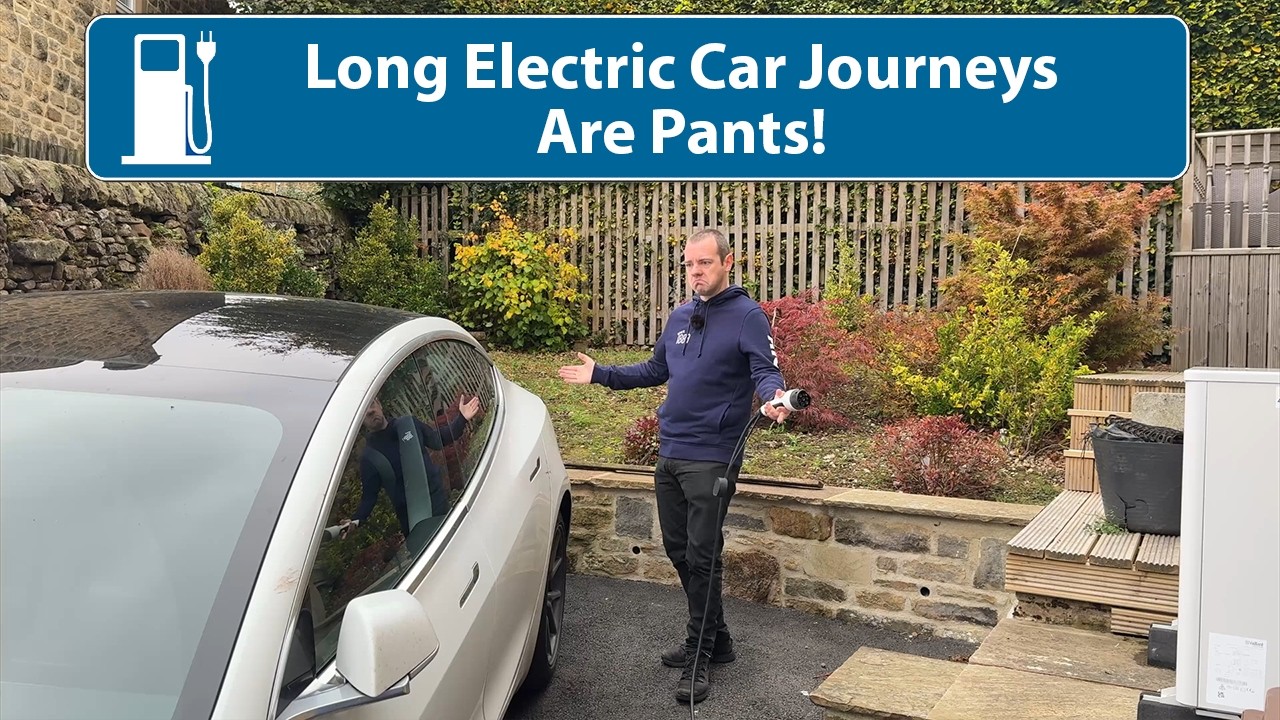
I’ve driven electric cars over more than 250k miles since 2015, this is the reality of long journeys in a modern EV.
2nd Channel: https://www.youtube.com/@drivingohm
Website: https://www.ev-man.co.uk
Twitter: https://twitter.com/evmanuk
Tesla Referral: https://ts.la/andrew31112
Octopus Referral: https://share.octopus.energy/ore-cobra-425
#michelin #electriccar #evs