I Turned My Eride Pro SS 3.0 Into An Electric Motorcycle
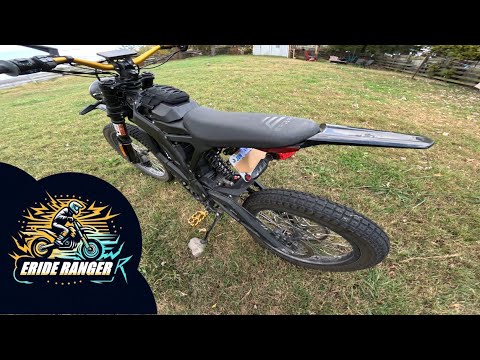
Hello everyone. My name is E-Ride Ranger and behind me is my E-Ride Pro SS 3.0 and now it is an 100% legal electric motorcycle. It is titled, it is registered, inspected, insured, everything. I can ride it on the streets and not worry about fines or getting impounded. And I’m going to share with you how I did it. Before we get into it, let’s quickly go over why. Because it’s just an ebike, right? No, not exactly. They’re technically not street legal. In most states, and particularly Virginia, where I live, there are only legal classifications for ebike, moped, and motorcycle. And these high power ebikes cannot be street legal ebikes because they are above 750 watts and they go faster than 20 or 28 mph depending on the ebike classification. They can be street legal mopeds if locked in eco mode so that the motor is limited to 1500 watts or less and they’re not driven above 35 mph. And if I have it plated as a moped and I’m going faster than 35, then I’ll be considered a motorcycle and I’ll be driving without a motorcycle license, insurance, motorcycle registration, all this mess. But those limits are boring and I want to go fast. So everything above a moped is a motorcycle and I decided to go for it. Let’s see if we can get this registered as a motorcycle. I decided to see what it would take to register this e-ide as a motorcycle. And it’s surprisingly almost straightforward. I just had to stop calling it an ebike and start calling it a dirt bike. And suddenly, the DMV tells me it can be converted and registered as a motorcycle. -id’s own website even calls it an off-road motorcycle. Step one was checking my state laws. Virginia does allow this conversion, but my backup plan was South Dakota because they allow non-residents to register and they allow dirt bikes to be converted to motorcycles. So, after finding out that I can do this conversion, I started looking into what all it would take to obtain a title and what changes I would need to make to this bike to make it meet state and federal motor vehicle safety standards. Step two, I needed a title. I was going to need to bring a photo of my VIN to the DMV. I was going to need to bring proof of purchase. So, I just printed off the email for my purchase. And I was going to need a manufacturer’s certificate of origin, also called an MCO. Now, I ordered this directly from the – Pros website, and it didn’t come with one. So, I called their support line and they directed me to send their support team an email requesting an MCO and include in that email a picture of my VIN, my order number, and my payment confirmation. So, I pretty much just forwarded my order with the confirmed payment and the picture of my VIN and sent on that email. After a few days of not hearing back, I followed up by phone. They said they’re just a little bit busy and they confirmed they’d get right to it. And a couple days after that, I had my MCO received in the mail. Awesome. That’s everything I need for a title. Step three was actually doing the conversion to the bike. There were a few requirements that the bike already meets. uh like it came equipped with a horn, speedometer, odometer, DOT tires, and two good brakes. It also needed two ways to activate the brakes, and they can be independent. So, this bike with the lever for the front brake and the lever for the rear brake was perfect. I did need to add DOT certified lights and reflectors. The big one for this was a DOT type M headlight which has high beams and low beams, a brake light and a tail light, a tag light, two amber reflectors for the front forks on the sides, and three red reflectors in the rear. Two, one on each side and then one in the rear that is separate from the brake and tail light. Virginia does not require turn signals if you’re going to use hand signals. I just opted to use turn signals. The other things I was going to need to add was a switch to control the high beam that has an indicator light to tell when the high beam is on. That is a very specific legal requirement. And I also needed somewhere to mount the plate. And Virginia requires at least one mirror. So, I got all that stuff mailed, and wiring all that up was probably the most technical part of this process, but I was able to accomplish it myself with very basic wiring knowledge. On the front end of the bike, I removed the stock headlight, and this 12vt connection is where I got my positive and negative connections for all the front end lights I was adding. Same thing for the rear with the stock tail light. Since I was replacing it anyways with one that doubled as a tail light brake light, I just used that 12volt connection there as the positive and negative for all the lights going on in the rear. So, pretty much everything that was always on was going to be positive power from the connection to the light and then the uh negative connection from the light back to the negative wire. Everything that had a button like turn signals, high beam, that kind of stuff all went from power to the switch to the light and back to negative. Now, to get the brake light to work, I actually repurposed the brake sensors that came on the bike, I had taken them off since a lot of people like to remove their brake sensors anyways, just so that the motor doesn’t completely cut out if you tap the brakes, you know. Plus for wheelies and burnouts or what have you, a lot of people remove the brake sensors. So, I put them back on, but I didn’t wire them back into the harnesses they were supposed to go into and use them in parallel as switches that could activate the brake light. And that’s very important that each of the two brake systems can both independently or together light up that brake light. One more thing I want to mention is that if you’re using this switch to control the high beam because it’s one of the few that has the indicator light, you need both the red wire and the white wire connected to power for the indicator light to work. The last thing I needed to add to the bike was a federal motor vehicle safety standards or FMVSS decal. So, one thing this decal needs is the manufacturer. And as a person converting the bike, you are the endstage manufacturer. So, if the manufacturer is usually the one that supplies these, where do I get one? So, I talked to the DMV and they said, “I just make one.” Cool. I talked to law enforcement and they said the same thing. I just make one. So, it does have to be something that’s weatherproof and tamper resistant or tamper evident. So, what I did was I tried to source a few different companies. They wanted bulk orders, but I found one that just had a $30 minimum order. And I was able to order a custom engraved machined aluminum like machine decal sticker with really really strong adhesive and thus tamper resistant. And since it’s aluminum, it’s weather resistant. And it was only like 12 bucks. So, I ordered two and then they just rounded up my order to make 30 bucks. And great. Step four is where I should have gone and got the title, but I just wanted to do the title and registration form as one form because they’re often the same. So, what I did first was I went and I got my state inspection. And thankfully, they didn’t ask for the title, but later on they did tell me that they should have checked. Step five was insurance. It was an easy call with Progressive. I have no idea how other insurance works, but Progressive was basically like, “Give me the VIN and answer some basic questions. Here you go. Motorcycle insurance. Easy.” Step six was going to the DMV. So, I prepared and printed all the documents and forms I was going to need because Virginia DMV will not look at a single thing on a phone. I printed out a picture of my VIN. I printed out a picture of my federal motor vehicle safety standards sticker, although no one ever asked for that one. I printed out the email of my proof of purchase. I brought with me the manufacturer certificate of origin. I filled in the conversion form that has me listed as the manufacturer again because I am the endstage manufacturer making this a road street legal vehicle that has completed this conversion. The title and registration form I brought filled in. I brought the inspection paperwork. I printed out a piece of paper that had my insurance information on it. And I brought my ID with me. And I left the DMV with everything I needed. I got the title. I got the registration in the mail. I got a plate right then and there, although it was only temporary until they could mail my custom one. And everything went relatively smoothly. Step seven was just the final details. I needed a motorcycle license. Here in Virginia, you can take a two-day motorcycle safety course, MSF, and with a passing grade, you take that voucher to the DMV and you get a motorcycle endorsement on your driver’s license. And then another thing I needed for me was a helmet with eye protection, which I already have. Great. And that’s important because with the federal motor vehicle safety standards, it is required to have eye protection when the bike does not have any windcreen or windshield or anything to block the wind. You need something protecting your eyes. And Virginia laws require a helmet, which is great. All states should have the law to require a helmet. Don’t be stupid. Wear a helmet. And it’s got to be a helmet that meets the DOT’s safety standards. And that was it. I am completely 100% street legal on my E-Ride Pro SS 3.0. I’ve tried looking. I haven’t seen anyone else that’s done this. I think this is the first E – 3.0 motorcycle out there. But really, this is a process that would probably apply to most high-powered ebikes like Surons, Tarias, Altus, Stark, and the like. You name it. It seems like it would apply. And it seems like the steps for states would be fairly similar, although I haven’t looked deeply into it. So there you go. That is how I got my -ide pro SS 3.0 100% street legal. Thank you for watching. I’ll catch you next time and ride safe.
In this video I go over how I got my Eride Pro SS 3.0 titled and registered as a 100% legal motorcycle!