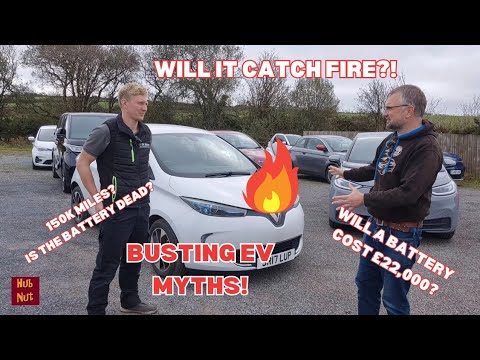
Busting Electric Car myths! With EV Wales – also what does an EV service entail?
Electric cars catch fire, the batteries last 5 years max, and then they’re done for. No. Uh, we’re going to do some EV myth busting here. Today we are with Jake from EV Wales. Hello. And, uh, we’re going to explore the reality of, uh, electric cars with someone who works on them every day. So, first of all, let let’s talk battery degradation. That is kind of the key one. People are convinced that batteries just die after a few years and are no use whatsoever. We see it daily when customers come up looking at vehicles or talking about servicing their car, they don’t think their batteries are going to last more than 80,000 mi or 100,000 mi or whichever. Part of our service, we do battery testing on vehicles when they come in. And we’ve got cars with 150,000 mi still on 80 90% capacity. Uh and in some cases with the Kia 100%. Wow. They’re still doing 250 mi plus as they did when they came out the factory. Amazing. and still going strong. So, yeah, don’t believe everything you see online. And notably, none of these cars are on fire either. They haven’t seen any of that either. No. So, although it happens in the media a lot. It does, but I think it gets reported a lot. Yes. Cuz they know it’s news to say, “Oh, look at this electric car on fire.” But that that fire um at the was it Luton Airport destroyed a multi-story car park. Yeah. Electrical fault on a Range Rover, but wasn’t an EV. Wasn’t anything to do with it. Yeah, there’s a a website called EV Fire Safe. If you look on there, they’ve got data back from 2010 when the likes of the first Leafs came out. Oh, wow. There’s been less than a,000 battery related fires since records began. Amazing. And you think there’s I think 1,500 cars, petrols and diesel that go up every year. Well, quite exactly at least. So, petrol being quite flammable. Yeah. Uh so, yeah, they are in far safer than anything else. Let’s look at an EV that is 11 years old and see how it’s stacking up. So, here we have a Nissan Leaf from 2014 roughly. So, 11 years old. If the hype was to be believed, the battery in this must be absolutely ruined. I feel quite nostalgic at this point cuz the very first video on this channel was a 24 kWh Leaf just like this. And uh back then there was no infrastructure at all. Uh, I could only test it within a 30 mile radius of home because 60 miles was about all it could do in the winter. So, let’s see how it is now. Uh, with your clever little scanner and, uh, we can see what the battery health is and what the range is now 11 years on. And 97,000 mi. 97,000 mi. That is impressive. Okay, let’s interrogate the 97,000 mi leaf then. So, pull off the little cover. that kind of genericy sort of a code reader. Yeah, this is a generic code reader. Um, sorry, it’s beeping cuz we’ve got the door open. And we can uh connect to that then and we can see all of the different cell voltages in the pack. Mhm. Uh so we’ve got 14 molts difference across all of the cells in the pack, which is absolutely fine. Anything under 20 is okay. start going over that, you might see some degradation loss on your range. But we’ve got a state of health there of 87.08%. Oh gosh. Yeah, right there at the top. Struggling to focus on it. Uh, which for its age and mileage is perfectly healthy. No reason to change it. No reason to do any work on that pack. Um, and you can see there 97,320 or 340 mi. Brilliant. So what sort of range do you think it has now compared to when it was new? Uh so realistically we would say 50 60 miles. Okay. So not a million miles from where it was when it was brand new. When it was brand new you might have got 70 80 maybe in the summer. Yeah. Um but yeah 50 60 is generically what we see with the 24 kW hours. Um, and again, that degradation isn’t going to drop off the cliff or or completely fail at any point. It’s a it’s a steady degradation all around. It’s still got 11 of the 12 health bars that it has on the front there. Oh, yeah. It’s a bit low at the moment cuz it hasn’t been used for a while. This one has been in for some work. Yeah. Um, but but not the work you might expect. It wasn’t in for anything battery related. Nothing battery related. Uh it’s been in to have a subframe changed on the front as the edges of that had just started to corrode um to a point that it wasn’t safe anymore. Couple of holes in it. Um so we’ve replaced that with a used part that from a newer vehicle. Mhm. And sealed underssealed all of that. So it should be good to go for another 10 years. Good. Good. So it could be good value for someone. And you do have the option with these to upgrade the battery if you do want an older car. Mhm. And you can put the 62 kWh battery in. So you could give it 200 miles of range if you wanted to. My gosh. For So is that physically the same size of battery pack? Uh so the 60 is slightly uh deeper. So there’s a couple of um suspension modifications you need to do just to take them carry the weight, but other than that, it’s it fits in the same space. Yeah. And what sort of figure are you looking at for any increase of battery? So, the actual packs are between 2 and 3,000. Um, oh, not not the 8 to 10,000 people think they are. Not the 8 to 10,000. That would be a pack from a low mileage vehicle. Um, and then it’s less than 500 quid to do the job really usually. So, um, we’ve done a few battery upgrades on Zoies as well, but wanted to extend the range. So, it’s a viable option. probably worth having a conversation generally about what actually goes wrong on EVs cuz it’s not what people expect. No. So Jake here also works on the cars. It’s not just um selling EVs. So I’m intrigued to know what is it that actually goes wrong on EVs? What what do they need fixing? See a lot of suspension components going. Uh Teslas suffer from bush failures on a lot of the suspension rear suspension. Uh I don’t know whether it’s the weight. I think they’re just not always ideally built if you like. We do see some bigger faults with uh inverters and chargers and things like that where circuitry component has failed. Yeah. Zoe seem to suffer a little from that. I think uh we’ve had a couple of chargers fail. Uh there’s a thermister in the charge um charge plug and that fails and stops it charging. It’s, I don’t know, £400 I think something like that for a new socket from Renault. We can repair it with a 20 p new thermister and put it back in again. And it’s one of the things I love that people are saying, “Oh, well, electric cars, there’s no one who looks after it.” We’ve been waiting for the aftermarket to come along. People like Jake are out there and know their way around these vehicles. You’ve done all the training and you’ve done a lot of learning yourself from owning EVs as well. Yeah, we we’ve I’ve done, you know, EV masters course, level four trained technician in EV and just yeah, physically working on them and just learning about them. I’m passionate about them and trying to keep them going for as little as possible really and maintain them sustainably is the biggest thing really. You don’t really want to be putting brand new components in for thousands of pounds if we can help it. Yeah. Um so things like Yeah. like that for we’ve replaced repaired chargers on old Mitsubushies uh with again a 20% 20 pence capacitor and things like that. There’s there’s often a a simple fault that’s caused a big issue. Yeah. Well, you had a Tesla Model S in recently with a what was that? It just completely died. Uh yeah, owner came drove across a junction. Uh he said he went over a bump uh and then it just died. Lost all power. He got it recovered to us and we found the main high voltage fuse in the pack had blown simply down to it the fact that it was 10 11 years old. Uh done 120 odd,000 miles and the fuse had just worn slightly and blown at a lower rate than it should have. Um so we replaced that with the newer version which is controlled by the car with the pyrofuses. So that now again shouldn’t see any issues with that. The rest of the battery was healthy. Didn’t have any cell voltage issues even at that age. So, it would be easy to think, “Oh, no, the battery pack’s dead. It’s all broken.” But again, just a small relatively small part. Uh, again, a couple months ago, we had a key in uh it had some wiring faults within the pack, some connectors that had gone loose, and the main BMS was throwing a fault that we couldn’t get rid of. Um, so we replaced the BMS and the car worked perfectly. again that had done 105,000 mi 100% state of health on the battery and it was down to a 150 lb BMS component in the end. So I guess some of this you are literally going around with a voltmeter trying to find where the issue is testing and working from diagrams and in a lot of cases building our own diagrams with the likes of he to help find out how some of these things work cuz some of the manufacturers aren’t great at getting an overall body for the aftermarket EV. Yeah. We’re hybrid and electric vehicle repair alliance. So they’re a group of members across the country or worldwide actually uh who are fixing these cars day in day out and we share knowledge between the group um so we can understand and fix them better, easier, cheaper, brilliant, more sustainably. Yeah. So why is this Hyundai um got the top with this one? Uh this one uh we see quite a lot 12vt battery failures. Uh unlike a normal car where you crank the engine, you get a slow start and you’ll know, oh, my battery is going flat. Um with EVs, they’ll keep going because you haven’t got that surge of power needed to start it until it l just components just stop and there’s no voltage for the circuitry to power up. So, uh, it’s a really common thing and I guess we test it on our services to make sure the battery is healthy to try and stop people from having breakdowns with it because it’s difficult to tell when that’s going to happen otherwise. Yeah. Yeah. Hard to predict. But yeah, just in case you don’t know, 12vt battery is in all EVs and powers lights, wipers, all all the sort of ancillary stuff that you’re kind of used to on a normal car. There is still a 12vt system that is charged from the battery. Yeah. Yeah. That’s fascinating stuff. So, we just pulled the uh top cover off so we can actually look what is in an EV engine bay. I must admit I I don’t really know, but my my first assumption would be, well, this must be the motor, but no. No, the motor is only this big buried underneath all of that. Mhm. Um, so you’ve got uh high voltage cables here going in from your charge on the front. Uh, you’ve got junction box here, which also controls some of the charging. Uh, and your inverter module there, an onboard charger. Uh, you got the inverter underneath the charger on the top. Uh, which sorts all your DC and AC charging out. Uh, your motor is buried underneath. You’ve got obviously air con components for all the battery cooling and the cabin cooling and heating. And then we’ve got brake fluid, uh, coolant in this one, and your 12vt battery and the rest of it. It it’s worth talking about the the battery cooling because something like the Nissan Leaf wasn’t particularly advanced when it came to battery temperature management, but stuff like the Hyundai and the Kia seem a lot better in that regard, which makes the battery last longer. Again, it was one of the shortfalls with the Leaf, they didn’t put the battery cooling in, which they did in the Nissan ENV200s. It just meant on longer journeys, if you’re on a motorway, the battery gets a bit hotter cuz it’s under constant load, and then you go and rapid charge it, which gets it hotter again. Yeah. Yeah. It then starts throttling your power and your charge currents and it’s not ideal for longer journeys. Absolutely fine on a dayto-day basis. You’ll never ever get it hot really, but on those longer journeys, it can limit it. And it’s when you get that heat in the battery pack that the the battery is getting hotter and it doesn’t like that’s when you lose capacity and lose life on the battery. Then another slightly dirty car, but this is your courtesy car. This is our courtesy car. It goes out almost every day. Yeah. So, it’s a Rena Zoey. What is it? 2017. 2017. And, uh, how many miles has it done? It’s 152,000. Uh, just under 800. So, near the 153,000 mi. Yeah. Yeah. Uh, it’s come down from Scotland, I think, this one. So, it did uh have a journey down here, but uh it still goes, as I said, it goes out nearly every day. It still does between 100 and 120 mi range. It’s the 40 kWh battery, so the older the older shape. And last time I tested the capacity, which wasn’t that long ago, it was on 80% state of health, which I’m not going to argue about. So even with 80%, you can still comfortably get over 100 miles. Yes. Yeah. And I was using this as my daily car for a while. I was going with command and everywhere in it. The thing is a lot of people only think of the long journeys they ever do. And yeah, sure, every time I’ve done a long journey, there’s been some hassle with rapid charging, but most people are just pottering around locally. They’re not doing huge miles. You’re probably not getting the oil warm in your conventional car. No. So, electric makes so much sense. Makes a lot of sense. Makes it a lot easier. Cool. Right, we’ve got to finish cuz this is instantly going out on on a courtesy loan. So, uh yeah, fascinating. That’s a lot of miles. Right, let’s look at some actual EV components. What have we got here? So, these are a few bits from an iPace. Uh we worked on a couple earlier on in the year, and I’ve I’ve kept the old units just for reference. So, we’ve got the onboard charger. These are one of the battery modules. And then we’ve got the BCM, which is the control for the battery pack. So in here we’ve got contacttors to turn the power on and off and fuses for protecting the circuits. Okay, let’s bring you in for a closer look. Uh this one we’ve had uh one of the fuses out of it. Um and for the drive unit. Mhm. Uh these ones are for the climate. And then we’ve got the contactctor packs here for turning the power on and off. Mhm. We had an eye place which had uh one of these had failed and it had blown the fuse. So this unit has actually come out of a battery that was stripped to build uh a solar battery energy storage which is something that can happen with your batteries once they come out the car. So that can happen and I do on the side. So yeah that this was spare parts and we managed to utilize them to repair the other car that we had in. Mhm. Uh these are the battery modules and you’ve got uh nominal 11 volts on these. How many of those in the car? You’ve got 37 of those to make up the 90 kWh battery pack. Mhm. Some of them do suffer with failures um on the early cars, but again, you can strip the pack, replace the module, put it back together, and all is well. It doesn’t have to be a new battery pack. And then this was an onboard charger. We have seen quite a few of these fail. Uh this particular one we got we had a bit of corrosion on the circuit board. Um and it had kind of burnt and failed. Wasn’t much we could do to save that board unfortunately. But we were sourced a good secondhand one from a lower mileage vehicle and repaired the car. I think the unit was in the region of £400. Um it wasn’t a majorly costly repair. Well, no, you can spend a lot more than that on a conventional car. Yeah. Yeah. So, we’ve got a Zoey in on the ramp. Uh what is the Zoey in for today? So, this is in for annual inspection. It’s a B service or minor service this one. So, it’s a visual inspection of everything. We remove all the wheels, making sure the brakes aren’t binding. We see a lot of rear brakes binding on EVs in general. Oh, just cuz they’re not getting the use just cuz they don’t get used. Um they they tend to stick in the calipers. So, we I just say not cuz the car is not being used. That’s because you’ve got the regen braking is effectively using the motor as a brake to put power into the battery. Uh yeah. So, we just we just see pads sticking in the calipers. So, we strip the strip the calipers down, clean everything up, making sure it’s all working smoothly. Uh, we go through all the levels, brake fluid checks, coolant check, screen wash, silly things like that. We also do 12vt battery tests, as we talked about earlier, the problems. We’ll do the main high voltage battery test as well. And we’ll go through the diagnostics and plug it in and making sure there’s no faults on the car that’s going to cause any issues. And the general bits, then lights, wipers, and we’ll go underneath for suspension components as well. Yeah. kind of like an or an ordinary car, but you haven’t got to do filthy engine oil. Exactly. Yeah. An ordinary service. There’s, you know, on on a normal car service, it’s the same checks plus an oil and filter, you know, it’s the same sort of thing. How often do you have to do like coolant changes on these? Um, each manufacturer is slightly different. They tend to be around the kind of four year mark that the coolant gets changed. Some of them are 10 years. It depends on the vehicle. So, yeah. And is it the same sort of coolant as a conventional car or is it a different mix? Yeah, pretty much. Some of the cars are slightly different. The Kia and H Highendai have their own special coolant cuz it’s nonconductive because of the way the batteries are made up. But yeah, generally it’s it’s similar sort of thing. Brilliant. We also go around all the high voltage wiring and low voltage wiring, making sure everything’s still in place, intact, there’s no corrosion on any wires because we see a lot of faults like that where wires have pulled apart or corroded or things like that on Yeah. We can lead on these, but lead you to think there’s a much bigger problem than there actually is. Exactly. Yeah. Um Yeah. And and just give the vehicle a general health check, making sure everything’s working as it should. Super. Some vehicles are annually, some are by annually. So, it again depends on the vehicle. I don’t know if you’ve had enough in yet, but obviously talking of brakes, the ID3 has gone back to drum brakes. Yes. On the back. Yeah. Have you found whether that’s any better or not? There must be a reason they’ve chosen to go that route. I I I I would say the reason is probably because they don’t need the power for braking like you do in a normal car. Uh you’ve got the motor to give you that braking as much as anything, which on the ID vehicles is rear wheel drive on those drum brakes. So, um, they do, uh, they’re not going to suffer from corrosion quite as much. And they, I don’t know, it’s 50 of one, 50 the other really, whether they’re better or worse. Um, cuz one of the amusing things that people are like, I mean, people are literally grasping at anything to hate on EVs these days. And one of the things is that, oh, well, they’re so heavy, so they wear tires out and wear brakes out much more quickly than any other car. No, they don’t tend to. Uh the the tire thing comes from EVs have generally got more torque. So if you’re using that torque and pulling away faster, you’re going to shred your tires faster. And you know that’s obviously seen front to rear wheel drive vehicles. You can tell which way around they are sometimes cuz people are are pushing them. Yeah. So but there’s also I think the case for some of the bigger SUVs um probably wear the tires and brakes out just as much as a big conventionally powered car. You know think the Land Rover Discovery is weighing two tons. Exactly. Bit of EV. Yeah. There’s there’s no real reason why they should degrade any faster if you’re driving it normally. So, in terms of reliability, um, are you finding they have sort of broader appeal than just people wanting them as private transport? Yes. So, obviously you’ve got thousands less things to go wrong. Don’t need to go through cam belts and all the rest of it that you have on a mass flywheels. Yeah. everything on that you know that can go wrong or cause issues on petrols and diesels. We’ve got a local uh holiday park uh Blue Stone in Arbath who have had 30 vehicles off us. Wow. They’ve replaced all but I think two of their diesel fleet that they had which were giving them no end of trouble. Uh DPFs blocking up, clutches going, gearboxes going cuz they were only ever in first or reverse. No end of trouble. They were breaking down all the time. Uh, and we’ve supplied them over the last four years, vehicles every year, and they’ve I believe they’ve got more to come next year. Wow. Um, and they’ve had a fleet of Nissan ENV200s. They’ve got a few Kangoo. They’ve got a Nissan Leaf and they’re all working fantastically. Perfect for a holiday. Yeah. Yeah. And they’re nice and quiet as well, so you’re not disturbing people. They’re quiet around the park. Uh, they’ve been reliable. They’ve they’ve not had any major faults with them. M and and saved them a fortune in the long run maintaining all of these diesel vehicles and less time where vehicles are in the workshop. So it’s really it’s it’s made a big difference to them. Yeah. Well, I mean we talk about reliability there are issues. The Zoies can have motor issues I believe for nothing major. They can have a couple of motor issues. There’s bearing issues and you know there are issues here and there with you know motor failures. Um, some of the Kia and Highendai vehicles suffer a bearing failure on those motors. Nothing detrimental. Uh, nothing that can’t be repaired. And there’s more and more garages like us who are working together to find easier and and better solutions for repairing these to keep them going. So, yeah, there’s nothing really that we can’t fix. And although if you go to a main dealer, they might say, “Oh, yeah, that’s needs a new battery and it’s a stupid amount of money.” In reality, there’s a component within that battery that’s failed. Well, not the entire battery. This is not an EV thing only, is it? The main dealers are always going to just go, “We’re just going to replace that big thing. We’re not going to fault find. We’re not going to try and replace the small thing. It’s just easier for us to charge you loads of money to replace the big thing.” Yeah. A good example was one we did a year or so ago, Renault Kangu 2013. It died on the customer driving along, broke down, got it recovered to Renault, and they said, “It’s a problem with the battery. It’s £22,000 plus V and on a £3,000 van, you’re just not going to do that.” No. So, we brought it into us and we had a look around. We tested a load of things and eventually we found it was down to the main pins on the connection into the battery that had corroded and moved so that they weren’t making contact. And that’s all it was. it just wasn’t delivering the power out. So, we repaired the connector, replaced it, and it’s been working since. That was a 40 connector. Admittedly, there was a bit of labor on it, but it’s Yeah, but it’s also a crazy price for a battery pack as well. 22 grand. The That was an old battery pack that I don’t even think was available anymore. So, if he had said yes, I don’t even know whether he would have ever got it. Yeah. Yeah. So, yeah, the main dealers, and it’s not their fault. They’ve been given parameters where they just got to replace an entire module or whatever and they’re not allowed to delve in to repair it like we can in the aftermarket. Yeah. A new way of tinkering just as when onboard diagnostics came in and everyone was crying then, oh, you can’t fix it with a hammer and a spanner. But it’s just a different way of doing things. It’s just a new mentality. And yeah, you’re not getting oily. You’re looking at electrics. Yeah. Brilliant. And you’ll notice we’re touching the car and we’re not getting shocked. Oh yeah. Yeah. I’m not getting electrocuted. Yeah. Obviously, there must be precautions you take when you’re working on them. When we’re working on the high voltage batteries, yes. Um but it’s funny when you’re being trained. Uh you’re you’re trained on how to deal with these things safely. And often half of the insulated tools and the insulated gloves aren’t necessary because as long as you’ve made that pack dead Mhm. you’re safe to work on it. Now there’s there are cases and and certain when you’re pulling out modules that you need the high voltage things and in certain cases but majority of the time you’re working safely to make sure that you never get a shock in the first place. Yeah. And it’s not like a conventional car you can put stuff across the battery terminals that gets quite exciting. Petrol fires or you know working on cars is inherently a bit dangerous anyway. So it’s just a different kind of just be careful different way of doing it. Yeah. Brilliant. So there we go. I hope you’ve enjoyed that little bit of myth busting here at EV Wales. I I found it absolutely fascinating. It’s worth pointing out one of his side projects is taking car batteries and using them to build stacks for solar energy at home. So, you can power your house by batteries that were in an electric car and now don’t need to be. So, um that’s another nonsense that uh the batteries are unrecyclable and unusable after they’ve been in a car. They can have a very long life after they’ve been powering a car down the road. So anyway, I hope you’ve enjoyed that. Thank you very much for watching. Huge thanks to Jake here at EV Wales. Got a big presence on Facebook if you want to go and see what he gets up to on a daily basis. And you can see what cars he has for sale. But yeah, thank you for watching. We’ll see you in a future video. Farewell.
Do EVs catch fire? Are batteries dead after five years? What does an EV service consist of and what are the problems seen on EVs?
We visited Jake at EV Wales (https://www.facebook.com/share/1ASSqAdagX/) for some fascinating insights into the world of electric cars, from someone who works on them and who owns them.
HubNut Merch store! https://hubnut-shop.fourthwall.com – shipping to The EU and Ireland now possible.
Become a Channel Member! Just £1.99 per month for continuous support, access to weekly videos and emojis and more. We now have a £4.99 level too! https://www.youtube.com/channel/UCfxlBQnvNXX6o-2KbCMszWQ/join
Want a quick way to support us? Right here! https://buymeacoffee.com/hubnut
Thank you.
#ev #myths #electriccar