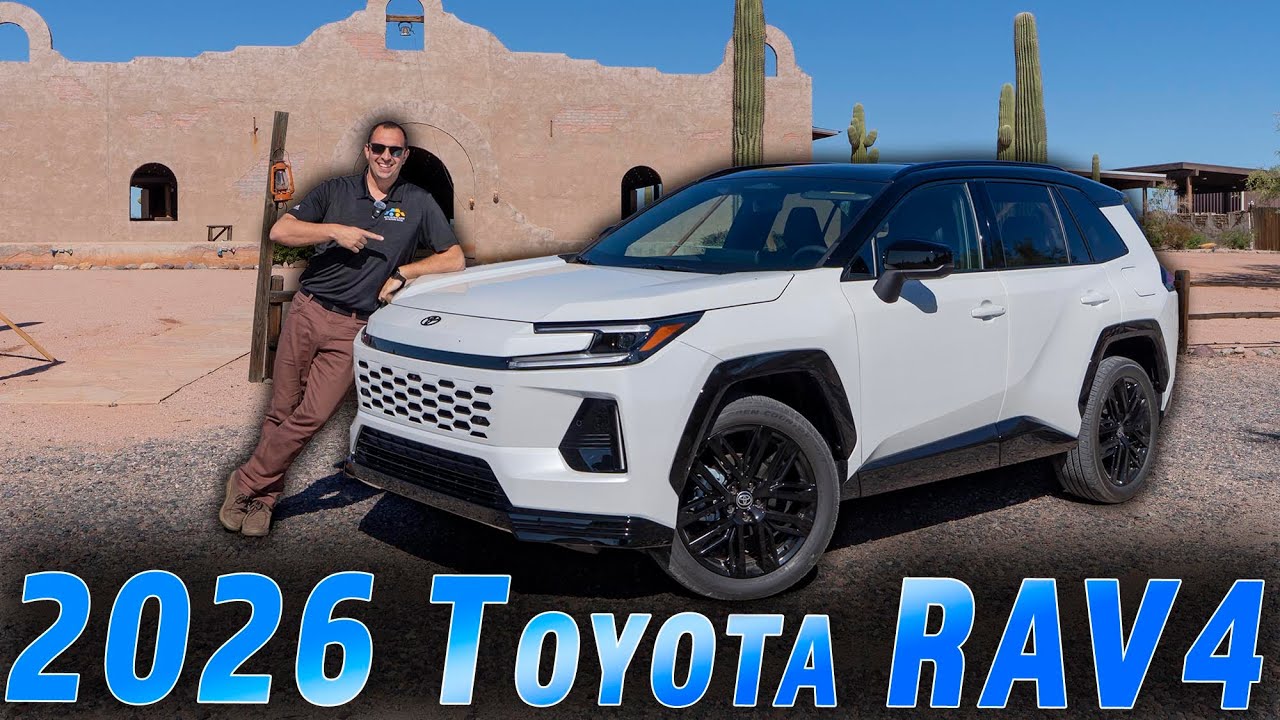
2026 Toyota RAV4 Review | All Hybrid, All The Time
The 2026 Toyota Rav 4 is finally here. And not only are there a ton of changes, but a whole slew of trims available. If you want something a little more special and stands out against the crowd or maybe used for a more particular purpose, you’ll find that in a Woodland or a GR Sport trim, but we will cover those in a separate video. You’ll find links down in the description. What that means is we have five other trims available that will have roughly the same look. But don’t worry, there are plenty of differentiators, and we’ll cover that for you here. not just on the outside and the inside, but also under the hood. Different power trains, power configurations, plugs, no plugs. There’s a whole gambit to cover. And we’re gonna do that right now. Let’s start up front. And this is going to be the look you see more often than not out on the road, not just on the RAV 4, but versus the rest of the Toyota lineup. Now, the other two models I mentioned at the beginning, those are further differentiated. But this design is now more synonymous what we see on the Prius, the Camry. It’s made its way to the Corolla Cross and here on the RAV 4, and it entered in with the hybrid models because this is all hybrid. Whether it’s got a plug or not, you’ll be able to tell from different angles. But up front, since it doesn’t need the same kind of cooling, they’ve gone with a totally different design, and I really like the way this looks. But let me know if I’m alone there in the comments below. Of all the changes that have been made throughout the vehicle, its essence is still the same. So, more updates rather than a radical redesign of what a Rav 4 is, especially in profile. This is still recognizable as the Rav 4 you may already have in your driveway. But I do think they’ve made some changes that have made it more aesthetically pleasing, especially with that front end. Things should be a little bit smoother, maybe a little bit sexier, and especially with the two-tone paint options like we have here with the black roof that matches the lower cladding. I think this is a very, very nice look. When it comes to wheels and tires, it’s mostly dependent on the trim of the vehicle, not so much the power plant. So whether it’s plug-in hybrid or a regular hybrid, it’s always going to be a 235 width tire and either a 17, 18, or 20inch wheel. Here we have the 20-inch wheel in this glossy black look. You’ll also find a 20 available on the Limited and standard on the GR Sport, although that is a very different wheel in and of itself. The 18-in model is going to be exclusive to the Woodland, although other 18s exist, just they get their own special wheel and tire combination. But for the best range, you’re going to want to go ahead and get the 17-in wheels that you’ll find on the SE and the Ellie. Around back, this is probably the stripiest version of the Rav 4 and maybe the sportiest in that because not only do we get these vertical stripes here in the tail lights, but also down in that lower bumper. Now, if we open this tailgate up, which is powered on most models, you’ll find at 6t tall, I can just barely fit under here without worrying about hitting my head. I can try and I just won’t. And you’re taller, you are going to want to watch out a little bit. Now, to my favorite part, but admittedly, there are a lot of numbers, so we’ll have them up on the screen here so you can follow along. There are two powertrains, either hybrid or plug-in hybrid. Both of them are 2 and a half liter four-cylinder engines. On the plug-in side, you’ll have 324 horsepower available. That’s obviously with a full charge and everything raring. And that’s going to get you about 50 miles of pure EV driving range. Depending on your trim, it will vary a little bit. Here on the XSSE, it should be about 52, but it’s going to still get you 41 m per gallon when that battery is depleted. Though, that is a little bit lower than you find on the regular hybrid version of an XSSE. You lose about 1 mile per gallon there, but you also lose a lot of power. all-wheel drive hybrid 236 horsepower. If you get one of the front-wheel drive hybrids, of which they are there, but few, you can get about 226 horsepower and about 44 miles per gallon. Like I said, a lot of numbers out there. Let me bounce back to that plugin for just a second because charging that happens in two different ways. You will not be able to get a plugin with the LE, the XLE, or the Limited, just the SE, XSSE, Woodland, and GR Sport. But here in this case, the XSSE can be had with 11 kilowatts of level two charging capability and 50 kilowatts of DC charging. If you get an SE, that’ll be about 7 kilowatts. But either way, plug it in overnight and you should be fine. I don’t know how many people are going to plug it in at a DC charger, but if you can, about 35 minutes, 10 to 80%. One downside, according to Toyota, right now, you won’t be able to offboard any of that power, but who knows what happens in the future. Up front, these seats are plenty comfortable, and there’s lots of room, at least vertically. I have to admit from side to side things do feel a little bit tight mostly because the center console feels like it’s pinching just a little bit. But you have eightway adjustable power seats, two-way adjustable lumbar. You can get power seats over there on the passenger side and position memory if you go ahead and get the limited trim. But at every single level, you’re going to have to go ahead and adjust the steering wheel on your own. Now, at 6t tall, if I sit bolt upright, I have just about maybe two 2 and 1/2 in. And that includes the model with the moon roof. But the moon roof doesn’t really affect the headroom a whole lot. It just means you can or can’t open the space up. As far as the space in the back, it actually feels more roomy than it did for me up front, but that’s mostly because I don’t have that center console here. And there is a ton of room up front. Now, there is sort of a weird bump there for the moon roof, but this space above me is still maybe 2 and 1/2, 3 in tall, and I can go ahead and recline this seat back. Just one position, but at that point, things are pretty comfortable. I know you can’t see my head, but I promise I’m fitting here pretty nicely. Let me go ahead and slide on over though. There is going to be a hump here in the middle, which is a little bit unusual because even though it’s all-wheel drive, there isn’t a drivetrain running to the rear. That’s just going to be its own electric motor. But with this seat all the way back in its tracks, and if I misspoke earlier, you can get the XSSE with the power seat as well. If this is all the way back, I still have just about an inch or so of room. You can see vertically, I still have that space. And go ahead and fold down this armrest. This turns into a pretty cushy place to be considering this is not an enormous vehicle. climate vents here for the rear and two USBC ports, so there’s power as well. When it comes to the cup holders, those are found here in the middle and there’s room in the doors for something like a larger water bottle. Up to this point, it hasn’t mattered much which powertrain you have. But when it comes to cargo volume, well, a big battery ends up taking up a little bit of space. This is the hybrid version, so we’re coming in at just about 38 cubic feet of capacity. Though, if we put that battery in there, it drops down to just under 34. If you fold down the seats in this model, you get just about 70, but you will see the same sort of loss obviously on the plug-in side. Either way, there’s a lot of space. And this room is incredibly easy to get into and use. These are my carry-on bags, and they look small in here. You can fit an enormous number of them, although obviously I don’t travel with a ton of luggage, or I try not to. But what’s more important, I think, is that in this hybrid model under this floor, you will find a spare tire. It may not be a full-size spare tire, but it is certainly not a tiny tiny donut. and it’s going to get you unstuck if you find yourself on the side of the road not being able to drive away. This is going to be the car to have. And there are a number of hybrids that just don’t have this feature. Let’s take a look inside the RAV 4. And remember, depending on your different trim level and interiors, you may end up with a slightly different look, but the layout is of course going to be the same. In this case, we are in the XSSE and we do have that larger screen. We’ll get to that in just a second. Let’s take a look at our seats for just a moment. In this case, they are going to be kind of a multi-exture design. I know it’s a little bit tough to see here in the lighting. We have soft text on the outside and sort of a cloth interior insert there in the middle. We also have blue stitching which I absolutely love. And the lighter color here in the seat also carries into that door panel where you can see mostly a dark light combo but it’s a little bit darker in here and much brighter outside. So that might look a little bit lighter in the camera than it does in real life. Either way, things are pretty easy to access. Obviously your door handle up there in the top, your window switch and your locks on the side. There is a bit of a cubby in there. Careful what you put in there. you might forget it’s there, but your bigger cup is going to be down below, including room for a larger water bottle. Up in the dashboard, we do have a split design here as well. That is going to be sort of an integrated shelf. You can put something like a phone in there without too much issue. But if you’re looking for additional storage, it’ll be down here in the glove box. In this case, a cloth to try and keep these clean, but it is a little bit dusty out. Now, let’s talk about this large screen because the screens, no matter which trim you get, are going to be bigger. You’re either going to get a 10 and 1/2 in screen as standard or a 12.9. And that’s what we get here on this top end trim. You’ll find that on most the top-end trims. You’ll also find something like this over on the Limited, but not on the XLE as standard. And this infotainment has seen an update. Toyota’s got a 2.0 version of their audio multimedia. We’ll have a deeper dive video into that you can find down in the description. But let’s just say the screen here is large, the responsiveness is there, and there are a lot of different ways you can utilize this, especially when it comes to making changes to your charging. Now, because this is the plug-in hybrid, we can go ahead and do things like schedule charging. And Toyota has gone to lengths to make sure this is easier for their customers. What has changed though is a number of buttons. Down below here, we have temperature up and down. We have volume up and down here on the knob, your front and rear defrost. Those to me are sort of a safety feature. And then of course just below that, you have your emergency flashers. But we don’t have a scroll wheel anymore for your tuning. That’s going to have to happen within the menu. And if you want to make bigger changes to where the air is blowing, again, that happens within this touchcreen. Just below this, we’ll find our center vents and a few more controls. Drive mode and your EV mode, whether you want to turn that on or off. Different modes there. You also have traction modes like trail, snow, or normal. Obviously, normal should be the one you’re in most often. And then we have on the left side here a chi wireless charging mat. On the right side, a slot that looks like it could be. If you get the limited, you’ll get two chi wireless chargers. In this case, just an extra storage slot. And that’s not the only storage slot there. You can see way back down here. I have to stick my hand all the way in. You can go ahead and find another storage cubby. There’s a lot of hidden storage here, but less hidden are going to be your charging options if you want to go ahead and plug in. To the left and right in the same spot there are the 45 watts. You also have your camera view. And on the right side controls for downhill assist and your traction control, though hopefully you’re keeping your traction control on more often than not. This shift lever is pretty simple. Park versus neutral and drive. And if you want to go into a manual mode, a manual sport mode, you can kick it over to the left. I know the car is beeping at me, but don’t worry, we’re not going anywhere. And then just below that, you’ll find your parking brake and your auto hold. Something I press every time I hop in a car. We haven’t had too much time to put water bottles in here, but they do seem like they’re fairly large to begin with. And you do have a little bit of support here. So, whatever you do put in there should not be rattling around too much. Now, moving slightly back, we have a dual open center console. So, this will open either to the left or to the right. And you can actually go ahead take this out and swap it. So, it has the more textured side up instead of the slightly more padded. I don’t know exactly why you would, but you certainly could. And then within here, you’ll find some more storage. And importantly, if you don’t want to do wireless CarPlay or Android Auto, that comes standard, you can go ahead and plug in on this connection here. The ones up front are just for power. And then we do have a 12volt power located in there as well. Now, let’s take a look at your driver display. This is going to be standard in every single model. It’s a 12.3 in unit, and it is going to be adjustable. Again, you’ll see that more so when we dive into the infotainment screen, but you can go ahead and put different things basically in different quadrants. In the center here, we have our navigation. It would also be your turn byturn directions. And that’s not just for the built-in navigation for the system. It’s also going to be there if you’re using Android Auto or Apple CarPlay. And that one is a big one for me because whenever you can integrate your phone further into the system and don’t feel like you’re punished or have to use a system that may not be to your liking, it’s nice to have options there. Now, on the steering wheel here, this is fairly typical Toyota, but not in a bad way. Our buttons are laid out in a pretty obvious and logical layout. You can go ahead and control mainly that driver display screen with these buttons here. Track forward, backward, volume is going to be this rocker, up and down, your voice commands, or you can go and say, “Hey, Toyota,” and have the system listen in to you. On the right hand side, mostly controls for your driver assist functions. So, things like your adaptive cruise control, your steering assist. Up here above the driver, we do have lit vanity mirrors. Those will slide out instead of flip open, but your light will flip on right there. We also have an extension, but not the one I was looking for. This won’t slide all the way out. It just has an extension piece there, but some is always better than none. And then here in the center console above us, we have room for sunglasses tucked up there. We also have your SOS and controls for your lights and this moon roof. It’s going to be a manual shade to open backwards, but if you actually want to tilt or open this, that of course is going to be powered. Now, to get this out on the road, and we’ve driven so far three different versions of this mainstream RAV 4, and that’s the front-wheel drive, the hybrid all-wheel drive, and then, of course, the plug-in hybrid all-wheel drive, which is what we’re driving in right now. So, it’s the one you should hear less motor in because it should be on less often. Though, unfortunately, for our testing, this battery was almost completely depleted, which means it just doesn’t quite have the same ump that it could have if it was a full battery. But again, those things are going to be tough to measure, especially out here on the fly, and you’ll have to wait until we get it at home for further testing. But let me tell you how quickly each of them went so far. The front-wheel drive model did it in about 7.9 seconds. The all-wheel drive model did in about 7.7 seconds, and 0 to 60 in this model was about 5.8, which means this thing is lightning fast comparatively. It’s not to say that this is not humming down the road, because it is. But this isn’t even meant to be the sporty one. They’re all just pretty quick, and that’s what happens. You put 320 horsepower in a vehicle this size. But besides how quickly it can go 0 to 60, I have to say this has been a really enjoyable vehicle to drive. It’s pretty upright and boxy, so it’s not like this is designed to be the most sportsoriented version. I haven’t driven that GR Sport just yet, but I’m expecting that to feel a little bit different than this. That’s what that other video is for. But either way, for folks who want to get to and from work, get out and go on an adventure, take the dog to the groomer, or settle up for a picnic, this is going to be a great vehicle to do it in. And the space in here is fantastic. I mentioned it felt a little bit tight, and it does when you have to look at every little nook and cranny and see what does or doesn’t work for you. But sitting up here with a good view out front, I think Toyota is going to continue on the trajectory they have been and even pull some customers away who’ve been very loyal to their previous brands. Something that pops immediately to mind is something like a Subaru where it really feels like they made an effort to cast their net a little bit wider and really that just means increase the appeal to a wider variety of folks. We’re here in this core grouping of it between some of the sport models and the standard models that you already know SE XSE etc etc in that lineup. I think this is going to stand out amongst the crowd. But if you’re looking for something that goes farther off the beaten path, one that stands out even further, they’ve got that for you, too. And I think that’s what’s going to be most impressive and most curious to see how many folks jump in. The Woodland trim used to be a package. Now it’s its own thing. And it also allows the SE models and the LE models to differentiate themselves even further. The SE are more sportsoriented. The LE are more premium experience. And while none of this feels like it’s a Lexus model or anywhere close to competing, it does feel like the materials that you touch more often are of good quality. If you’re looking for screen real estate, you certainly have it. And the only downside so far has been that it does seem a little bit noisy. But these are not roads that I’m super familiar with. And I expect when we get home, we’ll find out that maybe it was a little bit less than I would have anticipated. Of course, in most cases, we’ve had these AC cranked up here because it’s getting a little bit warm for this time of year. The other downside is that I haven’t had enough time to do significant driving in a way that I could be comfortable in sharing what our average fuel economy is because it just hasn’t been representative of what you might expect dayto-day. But now that these are all hybrid, it’s also going to be the most efficient these RAV 4s have ever been. And considering pretty much every model has an average MPG over 40 m per gallon. And even if they don’t, they’re also going to have a plug-in option, which means that you’re probably not using your gasoline very often. These Rav 4s should be available for you to purchase before the end of the year as long as what you’re looking for is a hybrid model. If you want to plug it in, you’ll have to wait till Q1 of 2026, but that’s not too far in the future. My biggest question has been what are they going to cost? Toyota says it’ll start in the low30,000s, but that means there’s no more information on the pricing, and I suspect this is the most expensive RAV 4 lineup we’ve ever seen. But I’ll have to argue I think it’s for good reason because not only do we have expanded opportunities to get the plug-in version, which is obviously going to be more expensive than the regular hybrid. It gives us more electric range, more power, and there’s more variety of RAV 4 than there has ever been. If you want to go more off-road, that Woodland’s there. The GR Sport is the fun, sporty boy racer look. But if you just want a nice RAV 4 that’s really efficient or more powerful than any you’ve ever driven, they’ve got it for you here in 2026. It’s just whether or not you’re willing to pay the price. But honestly, I think it’s probably worth it. And if it were my money, I would likely be looking at this XSE. But I would go ahead and get the plug-in version because more power and less fuel cost is something that I can’t really ignore. Although, again, depending on what the price differential is, that might be a deciding factor. Let me know down in the comments which one has sparked your interest. If it’s not one of these that we looked at in this video, go ahead and check out our others on the Woodland or the GR Sport. If it’s not there, I’m not sure what it is you’re looking for. And if you haven’t found it, again, let me know in the comments because I’m genuinely curious. The range of RAV 4s has never been wider, and hopefully this time we don’t have any issues with plug-in availability. That’s going to be it for us today. Time to get out of the sun, get a little bit more water, enjoy a few more miles with this hybrid model. Until next time, we’ll see you down the road.
The RAV4 is seeing some major changes in 2026 but they all seem to be for the better. Following in the footsteps of the Camry, all models will now be electrified with either an HEV or PHEV powertrain. That means great gas mileage is standard and up to 324hp is available which is the biggest punch the RAV4 has ever provided.The bulk of the 2026 models will wear the “hybridized” front end design that started with the Toyota Prius and has made it’s way through the lineup but there are 2 more front grilles available in the Woodland and GR Sport trim. All models will be able to tow (minus the GR Sport) with the standard rating at 1,750 lbs up to 3,500lbs. If you select a PHEV you’ll be able to charge with a minimum AC rate of 7kw but if you pick the right option you can get 11kw AC and 50kw DC charging for truly rapid PHEV refueling. The HEV models will be available before the end of the year with the PHEV to follow in Q1 of 2026. Pricing will have to wait a little longer but we know the 2026 model will start in the “low $30,000s”.
#toyota #toyotarav4 #toyotarav42026 #rav4 #hybrid #hev #phev #awd #fwd #compactcrossover #300hp #familycar #40mpg
Here’s why we don’t talk about reliability much: https://youtu.be/WicesuUvTXo
And resale value? Same thing: https://youtu.be/635cX7A3E_Y
Join this channel to get access to perks! https://www.youtube.com/@AAutoBuyersGuide/membership
Support on Patreon: patreon.com/autobuyersguide
Buy Merch! http://aoamerch.com
The Pod: https://www.youtube.com/c/AutoBuyersGuidePodcast
EV Buyers Guide: https://www.youtube.com/c/evbuyersguide
The Mountain Garden: https://www.youtube.com/c/TheMountainGarden
Follow us on Facebook: http://fb.me/theautobuyersguide/
00:00 Introduction
00:43 New Nose
01:16 Size and Profile
01:42 Wheels and Tires
02:15 Rear and Hatch
02:35 Powertrains
03:58 Seating
05:30 Cargo Space
06:23 Interior Tour
11:52 On the Road
15:19 Pricing and Availability
15:40 Final Thoughts