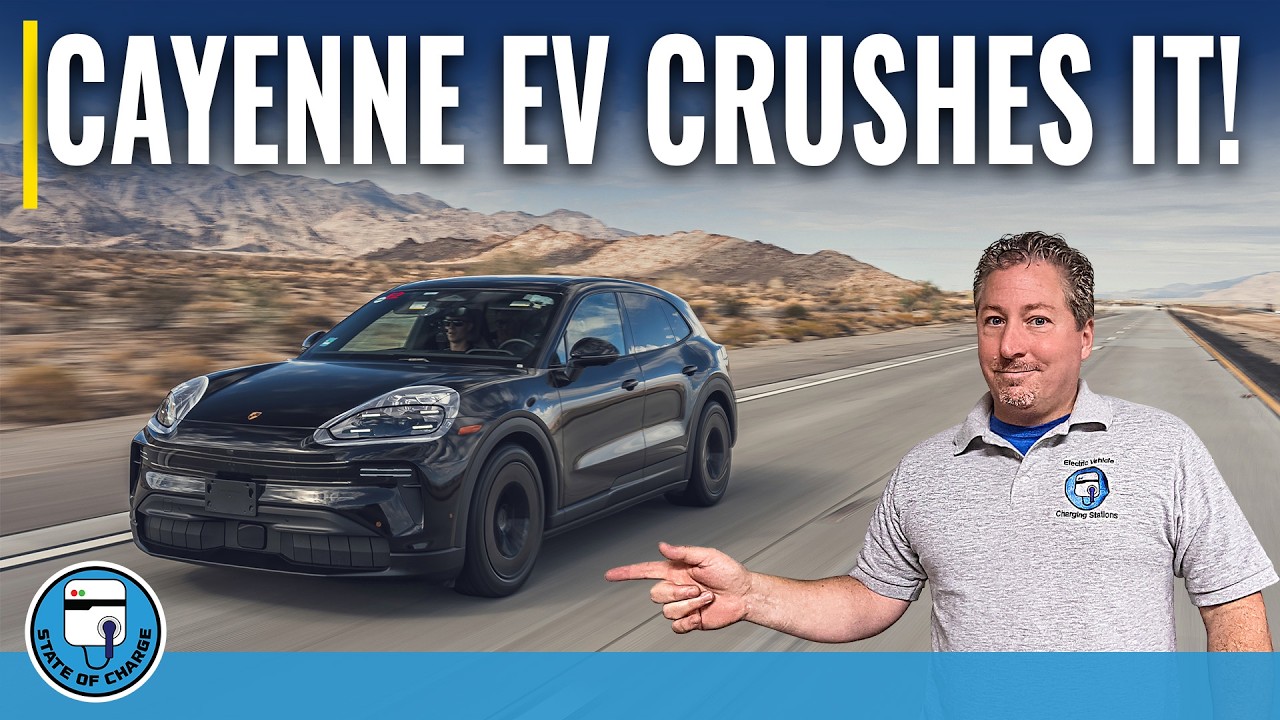
Porsche Cayenne EV Goes The Distance In First-Ever Range Test
I’m going to take that mile an hour advantage over Kyle because I started out with the disadvantage of having the off-road package. So, so that should have been my handicap anyway. So, there we go. There we go. Hello from almost sunny Southern California. I’m out here for a very special event. Behind me, you can see there are three Porsche Cayenne EVs and myself, Kyle Connor from Outer Spec and M. Hogan from Inside EVs were selected to be the first three people to drive the Cayenne EV on US soil outside of Porsche employees. Obviously, we’re going to be doing a range test today. The three of us are going to be hopping in these cars and driving them out into the desert. We had to find a route that wouldn’t be too much traffic. It’s hard to do that in California, but I think we have one. We’ll be we’ll be able to drive pretty much 70 m an hour uh for the whole day. and we’ll see just how far the Cayenne EV goes. Now, it’s not EPA range rated yet. It’s not available yet. It’s not going to go on sale in the US for another 7 or 8 months. Uh so, there’s a little bit of time for that. And these are prototypes, but Porsche did tell us that they’re very close to production. They have the production tires on them. And uh what we get here today, they feel is representative of what the uh Cayenne will get in real world tests for production vehicles when they’re in customers hands. Range tests are always different. I say this every time I do a range test. You could drive a vehicle on 10 different range tests and get 10 different uh results. But uh here today, we’re going to take these out and uh see what it gets in the conditions we have today, which I’ll talk about as we’re driving. This is not a standard 70 mph range test like I usually do. The route has a lot of elevation change, which is going to hurt the results. We’re going to be climbing, I think, 1,600 feet and then descending that much. So, we will get a little bit back in that. But, uh, it’s it’s not like the basic 70 mph range test that I usually do where everything’s controlled. But, this is going to be a good, uh, representation of what, uh, Cayenne EV owners will see in the real world in similar conditions, which we’ll talk about once I get in the car. So, with that said, we’re just about ready to take off. The three of us are hopping in our respective cars. We have Porsche representatives in the vehicles to talk to us about the vehicle, which you’re going to see uh, really soon. We’re going to talk to uh Porsche reps while we’re driving and uh see exactly how far the Cayenne EV will go uh at roughly 70 mph in the conditions that I’ll describe in a few minutes. So, let’s get into it. [Music] All right. So, I’m out on 10 East heading towards the desert cruising in the Cayenne at 78 mph. I’m here with Marco Schwerbeck from Porsche and also another PCNA colleague in the back, but I’ll be talking to uh Marco uh most of the time here today. Uh before we get into that, first of all, thanks for coming on. I appreciate it. Um uh let’s talk a little bit about this range test cuz it’s different than the range tests that I typically do. I typically do 70 mph highway range tests and I control as many variables as I can. I do them on New Jersey Turnpike where there’s no elevation change. I try to pick days where there’s not a lot of wind, where the temperature is just right. Uh but uh out here because this was such a special occasion, we have a set course. The day was the day. Although the weather’s actually pretty good out here today. We’re uh in the 70s already. It’s going to probably get up to about 80°. So pretty good range weather. However, the course we’re on is anything but flat. Uh we’re we started off at an elevation of about 1,200 ft and we’re going to climb up to like 2600 ft. So we have about a 1,400 elevation climb and then we go down to sea level and then we climb back up to 900 ft I think or actually 1,700 ft uh before going down to 900 ft and then turn around and come back. So uh this that’s going to have an effect on the Cayenne. We’re not going to see the consumption rate that we would see if we were on, let me fix this now, a flat surface. So, I would speculate after looking at this uh map of the elevation that we’re going to be going here today, I’ll probably be able to go at least 20 m farther if I was on flat uh ground with the the Cayenne. So, we’re going to take that into consideration. We’re in the climb right now. And I can tell you up until the point where we started to climb, I had a 3.1 m per kowatt hour consumption rate, which is similar to Macan EV. When I did the 70 mph highway range test, I was surprised we were doing so well at 70 mph. But now that we’re in the middle of this monstrous climb, we’re down to 2.5 m per kilowatt hour. So this 1,400 uh foot elevation climb is taking its toll on the Cayenne. And let me get over here because I want to pass this truck and stay at 70 mph. We’re trying to maintain 70 mph. Uh it’s it’s been a little challenging, but uh for the most part, I’ve been at 70 mph and I actually have a recording of the speedometer that I’ll be able to put in the video later on. So, you’ll be able to see exactly how much of this trip we did at 70 mph. So, uh Marco, listen. Uh thanks for doing this. I appreciate uh the opportunity to have uh uh me, Mac, and Kyle be the first three uh Americans outside of Porsche to drive this vehicle on US soil. Uh my first question for you is um you know, Porsche does so well in my opinion with efficiency considering it’s such a power such powerful vehicles. Every time I do a range test with a Porsche, it far exceeds its EPA range rating. It’s the only manufacturer that every time I drive it at a 70 mph um range test, it beats the EPA range rating by anywhere between 9% and 15%. Um what’s what’s the secret sauce? Oh, there are not the one secret sauce. Maybe the one secret sauce is we’re doing the best and the best engineering on the efficiency, but there are a lot of parts to get the complete vehicle in this efficient car. So let’s start maybe at the terminal system for each car. We’re doing the best on the t thermal system. So it’s the Cayenne as you mentioned. It’s a bigger car. So we have to do more improvement on the terminal system also on the battery system. A bigger battery too. It’s got 113 kWh. That’s the biggest battery you have in any of your electric vehicles. That’s right. But even in the same space as the auto batteries. Okay. Well, the cells are getting they’re they’re getting more advanced. You’re able to get better energy density. that and we’re going more on the edge, more on the technical edge. So, this has different cells than the other vehicles. That’s a different cell. It’s the the biggest cell we ever developed for for for the car. For example, we have coming from the TYON. We have more than 300 cells in the car. We have these uh cells in 33 modules and we put the modules in one battery pack. So in the Macan we’re doing the next step we have 12 modules in in in the battery pack and now the next step doing for efficiency and space efficiency we do have only six modules in the Cayenne. Okay. In this large 113 it’s 113 kWh is gross capacity. Usable is what? 108 I think. Uh 108 that’s right 108. It’s um to be precise it’s 17.8 but sum up yeah 108. Yeah, that’s right. Very good. So um uh another thing that uh you always seem to do extraordinarily well is charging. And I guess that goes back to what you just mentioned is thermals. Um you know how what what can we expect charging wise with uh with with the Cayenne? Now, the the TYON can charge 10 to 80% in I know Porsche says 18 minutes, but I’ve tested it a few times and it’s actually does it in 16 minutes. Now, this battery is bigger. Yeah, it’s about 10% bigger. Almost 10% bigger than the TYON battery. So, yeah, you’re right. It’s more What What would What What are we going to see? What is Porsche going to say that this charges 10 to 80% with? Yeah, that it’s very very crazy. So, we’re going about 15 minutes 15 seconds. That’s nuts. That’s for for a battery pack with over 100 kWh usable, you know, 70% of that is, you know, 72 kwatt hours, something like that. And then there’s always charging losses. So, so you know, you’re going to have a a charging station dispense 80 kilowatt hour around with the losses in 15 minutes. Yeah. 15 minutes. 15 and we will we will um announce the 60 minutes 10% to 80%. Because it’s it’s of the of the regulation you have to sum up to the next full minute. So we will go with 60 minutes but in real it’s 15 minutes 15 seconds. Yeah. And well that’s what I found with Macan and TYON. I was able to charge both of those vehicles faster than what you uh say it will charge at. Yeah. And and the peak charging rate on this is 400 kilowatt. Oh yes it is. Yeah it is. So but you have to find a 400 kW charger which are being installed now particularly the Alpatronic HYC400s which a lot of charging uh infrastructure companies are using. Iana even America is starting to use it. Mercedes network uses it. Um yeah and it and those are solid at 400 kow. Yeah. So there are four and we can we can even use more because the 400 kW charging lots from the alit running you mentioned they have 500 amp. Yeah. So we can use more than 500 amp. So if there can be a peak performance in the alpronic up to 600 amp for example, we can use even more so that you can see up to 400 kohz for sure and maybe if it’s possible from the infrastructure you will see a little bit. Yeah. Yeah. That that that that’s great. Um uh you know and this again is an 800 uh volt architecture. That’s right. Um, the interesting thing I remember when I did the first TYON drive way back in was it 2019? I forget when when the first drive was over in in uh Germany. I remember talking to a Porsche engineer and what he said was uh cuz I asked him are all Porsche vehicles going to be 800 volt architecture and he said not necessarily. He said it depends on the use case. He said I can see an instance where we might want to use a 400vt architecture. It depends on the expected performance of the vehicle. Um, but now every vehicle that’s come out has been 800 volt architecture. Is is that going to be the plan? Do you think you’re that that that you’re pretty much, you know, dialed in with 800 volt or could we see uh a 400vt architecture Porsche at some point in the future? Oh, we’re offering in the cases both still still now because uh we have the opportunity to put the 800 W system in two 400 W systems. So you can go for a Tesla not only at a supercharger, you can go to the 400 W. Mhm. And we can split the battery and the architecture in two times like the Macan. Like the Macan. Yeah. So that actually is a 400 volt architecture. Yeah, but when it charges it’s 800 volt. That’s Yeah, exactly. So, I should have I actually should have uh phrased it differently. The qu I should have phrased the question of, you know, could you see you offering, you know, it uh just straight 400 volt, not having a split pack with 800 volt charging, or do you think you’re always going to want that charging performance and have it uh you know, 800 volt? Yeah, I think in the reason of efficiency, it’s the best way to go with 800. Yeah. Well, you know, and Porsche is a premium brand. The customers expect a premium uh experience, and that’s not just performance, you know, which, you know, it kind of before this electric era, you know, Porsche meant performance and also the the driving experience, how it’s connected to the road and also, you know, people wanted to sit in a premium environment. You need all that with electric vehicles, but you need more. Now you need range and you need charging performance because that is like right up there with the driving performance. Absolutely. And you’re at the top of the game as far as this side of China. Now, we know there’s some some pretty wild things going on in China now with the advanced uh megawatt charging systems and so forth. But but for you know anything over here and in Europe the US and in Europe you know you’re pretty much doing it better than anybody so far and uh you know that’s something that I appreciate being a a bit of a charging guy. Yeah. And so you will me you will see or you will have noticed we doing big steps on the charging power and the charging yeah how to say the charging comfort by the customer from the TYON and the Macan and now to the Cayenne we’re going up to 400 kW even it’s a bigger car so you don’t have to miss something even if it’s a BF or it’s a bigger BF no it’s still a Porsche our customer expect and they will get all they know from the past and there is no we say German there’s no for model you do not have to say okay it’s a B it’s a Cayenne even bigger and so I can use this not and this not and that’s okay for me no you will have all the features even more it doesn’t depend how big is the car how much is the consumption we’re doing it on efficiency and the Yeah, a lot of measures to to get that there is no there’s nothing missing for the customer. Yeah. And I know this is a a driving event for range test, but uh if you know me, you know I have to talk about charging, which is which is is uh is paramount to me always. And there’s another thing that you’re doing with Cayenne that I’m really interested in and I know we we can’t really talk a lot about it because you haven’t revealed a lot of details yet, but uh you’re going to offer inductive charging and hopefully we’ll be able to do some sort of a deep dive technical review of that at some point in the future. I’d look forward to that. But um just, you know, 30,000 ft level discussion here. Uh what could you talk a little bit about um maybe why you feel that this is something that Porsche customers might want? Yes, we we showed the system at the International Automotive um in the EIA at Munich these days and I think it’s the easiest and comfortable most comfortable way for the customers. You know it from your from your cell phone or from other devices. You put it on the on the charge. You don’t have to plug it in or anything. So, it’s the easiest and comfortable way. So, it will be as easy to charge um a cell phone as charging the Cayenne EV. So, you can drive on the conductive ground plate and you do have to do nothing. No, no plug in, no put the cable out of something, getting your hands maybe dirty. You just get on the on the charging plate and the charging will start automatically. Yeah. And speaking of driving on the blade, you don’t you don’t have to practice a lot and have to look for the ground blade. Now you will be guided and lined up. Additionally on our park assistant, the customer knows still our parking assistant and in in the existing parking assistant. We put on the function for the wireless charging, conductive charging and you will be guided by lines to the target. So it’s pretty easy to charge your car by doing nothing, just parking and leaving. Yeah. Well, I’ve never found it difficult to plug in my EV, but I understand there are people that would like to be able to just pull in their garage, hop out, and walk in their house, not even touch a connector or do anything. That’s a premium experience. And again, Porsche is a premium brand, and it appears that you’re going to really be the first ones to bring um an inductive charging method to market uh on their production vehicle and widely make it available. So, um that I’m looking forward to uh to checking that out. All right, getting back to the range test now. We are at uh 85%. So, we’ve only gone uh we’ve only used 15% of the battery. Actually, 86%. I thought it said 85%. Yeah, it’s 86. And we’ve already gone 50 mi. Yeah. So, and we we’ve been maintaining 70 mph pretty well here today. So, we’re tracking more than 300 m at this point. Yeah. So, what I will do is I’m going to check back in when we’re at 75% state of charge. I always check in when I do my range tests every quarter of the range test at 70 at 75% 50% 25 and then at the end. So, that’s what we’re going to do. I’m going to check back in when we’re at 75% state of charge. We’ll see how far we’ve gone at that point. But, um, I’m encouraged because we are we’re in a climb and we’re still, you know, tracking over 300 mi, which is, uh, good, uh, good news for, uh, future Cayenne EV owners. State of Charge is powered by Cumer, North America’s premier installer of electric vehicle charging equipment. After I’ve helped you decide which charger to buy, follow the link in the description of my videos and have Q Merit install it. And if you do follow that link, Cumer will wave the $150 installation deposit. But this is an exclusive offer for State of Charge followers. So in order to get that offer, you must follow the link in the description of my videos. All right, so we’re checking in at 75% state of charge. A quarter of the range test is over and we went 98 miles now. Now with the consumption rate is 3.3 miles per kilowatt hour. That’s gone up. We was we were actually up to like 3.7 for a while because we crested that mountain that we climbed and then we went down the mountain. But now we’re going back up a 1,700 uh foot climb. So now my consumption rate’s dropping down, but I can’t believe we went nearly 100 miles. Well, it’s at 100 miles now and we’re at 74% state of charge. Now, Porsche has said they’re expecting the H to have an EPA range rating of around 320ish. I think that that hasn’t been confirmed yet, but right around there. Marcus, are are we going to go 450 mi here today? That would be No, I don’t think so. That’s really too too much. It’s it’s it’s really Yeah, I I that’s nuts, you know? I mean, it’s so crazy. Yeah. So, I I can’t explain it. I was thinking maybe the terrain, the fact that we went up and down, but that should hurt us more than help us. I’ve done a lot of range tests frequently. We’ll I get more range in the first quarter of the range test than I do in the other quarters. So, I’m assuming that’s going to be what happened here. I asked you if you were certain the battery state of health was was set correctly, like, you know, maybe cuz it’s a prototype. We really are down to the 68% when it’s reading 75. But you said no, that’s dialed in. The state of charge is correct. Yeah, the state of charge is correct. Yes, as I mentioned, we did the last 10 days extensive test drives with a main topic on the state of health and the maintenance and we are absolutely right and true. We are on a good way with the with the state of charging the battery. It’s complex, but we are we are right. Well, well, if we get anywhere near that consumption for the other 3/4, it’s going to be a super long day here. Now, th this is a large it’s it’s a a full size SUV, you know? I mean, this is this is much bigger than a Macan. So, and the battery is bigger than a Macan, but not that much bigger. So, I I can’t imagine us getting more than my thought process was 300 to 320 somewhere around there. Maybe 3 3 um 30 or 40. And I knew that this terrain was going to hurt us, not help us because we’re going up and down mountains. I think on flat terrain, if the EPA range rating on this is 320, I would expect to do 350 because Porsches always outperform their EPA when I do my 70 mph range test. But here we are driving through the mountains and uh you know, we’re we’re pacing over 400 miles. So, uh, I assume that at the next check-in at 50%. We’re the things are going to start to correct themselves and, uh, you know, we we’re not going to go 98 miles from 75% to 50. If we go 80, I think we’d be lucky. So, uh, well, that’s what we’ll do. Uh, we’re going to keep driving. We’ll check in when I’m at 50%, maybe we’ll talk a little bit more about powertrain and batteries and stuff like that once we’re at 50% state of charge. Perfect. So, we stopped at our turnaround and uh all three vehicles are parked over here. Got the last one down there. Crazy thing is we’re all at 59% state of charge. So, I mean, I know many people might say, “Well, you should be. It’s the same car and you drove it the same amount of distance, but we know with range tests that’s not how it always works out.” I figured it out, Tom. We didn’t tell you about this. Okay. No, not yet. We are driving 70 GPS and you’re driving 70 indicated. Kyle is angry that I should be last place here because I have the only Cayenne with the off-road package and I should have a 10 to 15 mile range penalty except we pull in here and we’re all equal. We’re all equal. So So he’s got he’s trying to figure out what exactly is the difference. A mile an hour faster. So you you you locked in at 71. 71. I didn’t do that like I usually do on this this Yeah. I mean, it’s not like a certified range test that we’re doing, but I locked it in at 71. Yeah, you locked it in at 71. And and and but how you got here like a minute before me. How long did it three or four minutes? Three or four minutes before me. Okay. So, I tell you what I’m going to do just to be totally fair to Kyle. I’m going to lock it in at 71 for the rest of the trip. How’s that? See? Yeah. Although we’re not quite at 50%. No, I’m So, what I’m going to do is drive to 50% at 70 and then turn it to uh No, that still won’t even make up for You got to go to 72. Yeah. Yeah. But then then your drag is exponential. It doesn’t work. I’m going to take that mile an hour advantage over Kyle because I started out with the disadvantage of having the off-road package. So, so that should have been my handicap anyway. So, there we go. There we go. All right. We’re going to we’ll check in when we’re done and uh Matt, Kyle, and I will all have a little conversation about where we’re all at and our thoughts on the Cayenne. Yeah. Cuz I was talking and I was like, “Oh, wait a minute.” So, this is bad news for Kyle, though, because that means he’s covered the shortest distance and we’re still all the same. So, he’s in first, I’m in second, and you’re in. Well, we’ve been maintaining 70 better than you guys. We’ve been getting stuck behind less trucks. Well, I’m happy with that. being tied at SOC 50 it’s not more less than 50% point and uh you know I really expected that I’d be behind you guys with the the uh the off-road pack. So have you checked what the route planner thinks you’ll get to the hotel limit? Yeah right right now um 6%. Ours says four. Yeah. Yeah. I haven’t looked mine says six. The route planner which is really good by the way. It’s nice. At first it said 20%. And I was like, we can’t. We’re going to have to spin around. But then we checked the rapid. It had a stopping to charge cuz we we had it set at not minimum. Minimum SOC 20%. So we slid it down to 2%. Which is the end. And uh and that and then it came up 6%. So right now it’s saying 6%. Okay. Well, that’ll be interesting. So let’s see what we’re all at when we get back there. Okay. No time for delay. Time to roll. All right. We are halfway home. We’re at 50% state of charge. We’ve gone 187 m and we have a 3.2 m per kowatt hour consumption rate. Now that miles per kowatt hour consumption rate has been going up and down wildly during this test. I’m not used to seeing that when I do my range test. It’s always on a flat, but because we’re we’re climbing 1,600 ft, we’re going down 1,200 ft up 700 ft. I’m I’m watching it go up and down. So, it depends on where we are. When I hit the 50% and 25% and 75%, whether we just went down a hill or up a hill, that determines the the consumption rate. So, it’s going to be interesting when we’re done. But, we’re at 3.2 now. Now, 187 mi at 50% would mean that we should be able to go, if we could go the same amount of distance in the second half, uh, 370 something miles. But, we we we’re not going to get that. And even the vehicle knows we’re not going to get that. It has the remaining miles of 144. So, I mean, I think we’re going to end up around 330ish somewhere around there. Oh, now we have a nice uh the La Raza motorcycle gang is passing us. Um at least that’s what they have on their leather. So anyway, um still uh that that even if we end up around 320 is that that’s fantastic considering the course that we’re on. This is a super challenging course for for a range test. This isn’t how I usually do them, but this is real world. This is what people drive. So that was great um that we were able to do this in an environment that I don’t usually do my range tests. And what’ll be really interesting is when I get one of these eventually down the road when the production versions are out and I do it on my course, I’ll be able to compare a strict 70 mph range test on flat terrain with one done out here. So that that’ll be really cool. Now temperature- wise has been great. It’s 84° now. So we were in the low 70s when we started. We got up to 84. So temperature is great. Wind is great. Wind is less than 5 mph. So other than the fact that we’re going up and down these huge elevation changes, this is a great day for range. Um so you know the the we’ve set the uh Cayenne up for doing as well as it can provided this course that Porsche plotted out for us. But let let’s talk a little bit about the battery cuz we were talking about it while the camera was off and you seem to be very proud of the improvements that Porsche continues to make on its battery pack. And um it’s funny how you said uh you know you talked about how this new engineering is better than TYON and you said but you know TYON’s great you know which it is but that’s the way it should be. You should continue to make improvements in battery. So let’s talk a little bit about the battery cooling which is uh unique to the Cayenne to any of the Porsche EVs. Yeah that’s right. Yes. I said we’re trying to pushing the limits and so we’re going better and better and better and doing not only evolution on the battery, we’re doing revolution on each step to getting better and improve the range and the efficiency. And so we put the first time not only a bottom cooled battery in this car, we put an additional cooling area and another plate on top. So we have a top and a bottom cooled battery systems so that we can cool down or even in the cold temperatures heat up. So in some to condition the battery from the top and from the bottom to get the hot spot optim optimized uh cooled or heated what the car or the passenger needs at the situation which which helps improve range efficiency and also uh charging speeds you know having the battery at the right temperature for sure. So Cayenne has the first time for Porsche. It’s got two cooling plates, one on bottom of the pack, one on top of the pack. But that’s not the only difference that this pack has over the other vehicles. It only has six modules, you were telling me, which is unusual. And the modules aren’t in a battery tray. No, that’s So talk a little bit about that. Yeah, that’s uh that’s what I think what I said with the revolution, we we killed the state-of-the-art concept in course of the efficiency. also the efficiency of the space the batteries needed. So we put away the cell in a separate box and put that box in another box and then put it in a battery box and put the battery box in the car box. So that’s too much overlay. So we engineer it back and so we put as you said we put a cell in the module and put the module to the car. The module is tight. The module is rigid. The module is integrated in the car for stiffness also for the crash path and the load capacities through the car. So, it’s a full integrated cell module with no overhead and the cell just get as much material as it needs and we improved it completely in the car. So, it’s a structural part of the car. It’s absolute structure. Now, how about if a module fails? Can you can you replace it? Yeah. Yeah. It’s so designed you can replace each of the modules in the case of it’s needed in the in in in the in the customer case. Interesting. And these are pouch cells. Yeah. These are pouch cells and it’s the largest form factor I think of any cell that you’ve used on any vehicle. Absolutely. Yeah. It’s it’s the same power cell, the same technology as in the TYON, but even more improved. There are bigger one. There are more powerful and we’re putting also the cells to the edge to the possibility. And so there are the biggest pouch cells ever been built um and ever integrated in a car. Okay. Well, listen, keep improving. I’m going to keep driving and we’ll check in when we’re at 25% state of charge and we’ll see how far we’ve gone at that point. Looking forward. All right, we are at 25% state of charge now. We’ve gone 269 miles and we still have a quarter of the battery left. This a pretty good showing for the Cayenne so far. We’re at 3.2 m per kilowatt hour. Now, the vehicle saying we have 82 mi of estimated range remaining. Uh we’ve been going about 90 mi for each quarter. Uh so I’m I’m guessing that that they’re hiding some low-end buffer in there, but that’ll still put us at 250 350ish miles. So uh super um actually I have to get over here. Super showing so far. Uh 350 mi will be fantastic if we can get close to that. It looks like we’re going to um you know the we talked a little before about the battery. Uh but arrow plays a big role in uh electric vehicle efficiency. Well, any vehicle efficiency, you know, like your gas mileage depends also on your arrow. But with with EVs, we focus a lot more on uh this. Might have to get over here. Let me see. No, I’m good. With with EVs, we focus a lot more on efficiency. So, why don’t we talk a little bit about what you guys did to make the vehicle as aerodynamic as possible because this is a big vehicle and we’re we’re averaging over 3 m per kowatt hour at 70 mph. That’s not an easy feat. No, that’s right. As you said, it’s even more important that a big car is as the Cayenne. So we did a lot on the aerodynamics and we have active aerodynamic parts not only at the back of the car where we used to it and know it. We have for example also at the front of the car aerodynamic um parts so we can open and close automatically the inlets for the fan from the terminal system. We talked about that when we stopped before about the active louvers in the front that they only will open if the battery calls or if something in the vehicle calls for for cooling. Anything over uh 15 km an hour, they’re going to close. Uh and uh you know that that absolutely is going to be helpful. But that’s not the only thing you guys did. You did you streamlined the rear of the vehicle too, right? To uh to to increase a efficiency. Yeah, that’s right. In in in some of our terrains at the at the Turbo, for example, we have the so-called side plates, they’re going automatically out and often a wider car and put the the CV um we call it in Germany. Maybe I’m missing the German word at this day. That’s nice from you. So that it’s farther and further away from the car for the better aerodynamics. So you you low you longer up the car like the racing car. No, we’re not driving the He’s talking about the turbo trim. This is the base trim uh that we’re driving here today with the off-road package, which gives us a little bit of a different front end than the other two Cayenne that Kyle and Mac are driving. We’re actually at a range disadvantage because of that because there’s going to be about a 10 to 15 mile range penalty with this package. But we’re still doing good. We’re holding our own against them in this range challenge. I guess it wasn’t supposed to be. Porsche didn’t build it as that, but of course Kyle and Mac and I are like, we’re going to see who can go farthest. So, I think we’re we’re holding up pretty well considering we’re at a disadvantage from the get-go because of the design of of the vehicle. Um, so, all right. Uh, we’re going to keep driving. We’re going to check back in when we are getting close to the end and maybe uh turn the camera on when I’ve got a mile or so to go to get to the hotel and then we’ll talk about uh you know what we thought uh the results are and if we thought we did a good job. I I think that the Cayenne is doing remarkably well here considering uh the estimated EPA range is going to be about 320. Uh we’re going to crush that. We’re going to go at least in my estimation 20 m farther. We might go 30 m farther. Uh, and at 70 mph and on this challenging course going up and down, which um, uh, I know I’ve talked about it throughout this uh, range test, but now let’s take a look at it because I’ve mapped out the range test uh, topographically and uh, the elevations. So, O. Oh, that was close. That was close. motorcycle just split lanes between us and man, he almost kissed our rearview mirror. But um let’s take a look at exactly how much elevation we gained and then lost throughout this range test. So we started out in Rancho Cukamonga and the elevation there is 1,200 ft. We drove up to 2600 feet to Bowmont, which was a 1,400 foot elevation climb. And after that, we went all the way down to sea level in Desert Palm. We then climbed 1,700 ft up to Cactus City and then about 900 ft descending down to the desert center. That’s where we stopped and uh got out of our cars, talked a little bit, and then turned around and headed back. So, as you can see here, this is not the optimal course for a range test at all. And the Cayenne is doing a great job even with this challenging course that Porsche laid out. All right, Marcus, we’re off the highway and the Cayenne did fantastic today. Let me tell you, I am so impressed. Um, this is turn only lane. No, it’s not. So, we’re off the highway. We’re driving to the hotel where uh our where we’re all meeting up. We got off the highway at I think it was 348 miles and we were at just 4% state of charge. So I figured we’d circle the hotel a little bit, bleed it down a little bit more and get it up over 350 mi, which we have. We’re at 352 mi now and we’re one mile from the hotel. We’re at 2% state of charge. Um, this uh I think we could actually squeeze out 260, but uh the guys don’t want me to brick the battery, which is totally understandable. So, we’re going to end at 353, I believe. Uh it looks like it with the Yeah. 1.1 milesi. We’re at 35 uh2. So, we’re going to end right around 353. Um a great showing. Congratulations and a good job on this. This is a big, you know, heavy SUV. Uh and while it’s a big battery, 107 or almost 108 kilowatt hour usable. That’s not a monster size battery when you look at some of the uh the competitors uh that have really big battery packs in their long range SUVs. So, um you know, you guys did a good job with this and besides the range, this has been a comfortable, quiet, smooth drive. You did a great uh job with NVH and uh u I’m impressed. And this isn’t even the production version. You still have to do some tweaks and so forth with it, but uh um you know, for that kind of range and this kind of comfort and the performance that you get with it, although I wasn’t able to really juice it much uh in this uh I think when I get one on loan, I’ll see exactly uh a little bit more about the driving dynamics. We didn’t get too much of a feel on driving dynamics, just cruising at 70 mph. But um are you happy with the results? Oh, yes. Yes. And thank you so much for having me, Tom. It was a nice drive. I’m really happy. I’m proud to be with you on this seat and and get this uh get this experience and and this mileage. Uh thank you. Thank you so much. Well, it’s been a long day. We’ve been driving, it says here, for 5 hours and 44 minutes so far. So, we got up nice and early and started first thing. Um and uh I’ve got uh I’ve got a few hours that I can relax, then I got to get on a plane and head back to Jersey. But uh this has been a really fun day. I want to thank you uh and thank Porsche for inviting me and uh and Kyle, you know, and and Mac to be the first people to drive the Kion on US soil outside of the company. That’s a good honor and I appreciate it. I I know there’s a lot of people out there that you guys could have invited. So, um I want to let I think I turn here. Yes, I want And here we are. We’re in the hotel. So, we are pulling up and it is 353.0. It just clicked over to 353. And let’s see. Are both Yeah, both guys are here. So, Kyle and Mac have already arrived. We’ll see what their final results are. And uh there’s no parking spot here. So, I don’t know if I should pull in the middle here. Just stop it here. I’ll stop it here. Okay. So, um I’m going to get out. We’re going to talk to Kyle and Mac. I want to get their opinions, put it in park, and then uh I’ll do a wrap up and uh you know, we’ll talk a little bit about the results here. It’s great results. Congratulations. And by the way, it’s saying we have an estimated 4 miles of remaining range when 2% state of charge. Let me get a picture of that. Oh, and the consumption rating that we’re finishing up with is 3.3 m per kowatt hour. If you do the math, this has 107 kWh usable battery pack. it plays out. You know, that’s where we should be after driving this much. So, uh, let me take a picture and then we’ll hop out and talk to the guys. I want to get their impressions on the range system. Thanks a lot. Thank you. Thank you so much. All right. Well, we are all back here. It’s a long day. We drove for about 6 hours, guys. Um, I finished up 353 miles, 2% state of charge. We are all clustered right in there. I mean, within a couple miles of each other. Um Kyle, what did you finish up with? Yeah, I went the least far actually. Uh 344 343 something, but with 4% remaining. And also keep in mind I was a mile an hour quicker than you guys were. Um which there’s a little speed discrepancy there, but it’s all good. We should have talked about that before we started cuz when Kyle and I do our range test, we always set the speedometer to GPS. Yes. Always. For this range test, I I didn’t check with Kyle. I assumed we were all just going to set it to speedometer cuz it was a Porsche range test. So, I set it to speedometer. I didn’t do GPS. Kyle set it to GPS like we always do. So, he was going 1 m an hour faster than us. Right. Exactly. But, uh, I think we’ve learned it doesn’t really make it makes definitely a difference in terms of time. So, it’s incentive if you’re a driver to drive as fast as you can on the road because you’ll get there quicker. We already knew that. And this is a charging beast like all Porsches, of course. Uh, but the range and the efficiency was good. So, I was 3.3 m per kilowatt hour. So was I. So was I. We all finished with 3.3. And who would have thought? You take the same car, same road, same conditions, we got the same result. Essentially what what we really learned is the Cayenne is a 350 mi plus highway capable vehicle. Um, and that like Tom mentioned, even though we started and end at the same elevation, there’s still a lot of heat loss going up and down those hills. And uh, very very impressive from my side considering it’s a small battery. Kyle, I think on flat terrain. Yeah. Smallish. Yeah. 108 kW hours. A Rivian does about the same uh with 144 kWh power. Yeah. But I think Kyle, when we get these on flat roads and do our 70 mph range test, which won’t be till next spring or early summer probably, I think 370 is in reach uh with the arrows. I think so. I think 370 is in reach. So, we’ll we’ll have to see about that. Okay. Mac, what’ you finish up with? I did 351.9 with 3% remaining. Uh, I was like set to 70 miles per hour Porsche speed, although I think I hit a little more traffic because of the way things went around. But, uh, yeah, I was pretty impressed by that. Also, 3.3 miles per kilowatt hour. I would also add that I think the range estimation in general on this was really good. It was very, very accurate, leaning a little bit towards giving you some wiggle room, which I like. Um, and I also really like just that was my first time using that curved screen infotainment system, which was I really like that a lot. I think I really like what Porsche is doing with the software. I think they’re definitely taking a good step forward on that. So, overall, I’m excited to see, you know, learn more about this car. Uh, you know, we don’t have all the details yet, but so far from what I’m seeing, this is definitely a 350 mi road trip car. And what I’m super excited for is, you know, the TYON is already an absolute charging monster. This, they’re saying 400 kW, but the fact that they’re also cooling the battery from the top and the bottom means that like, I mean, they were already some of the best at managing the thermals of charging. I feel like this thing is going to they tend to underpromise and overd deliver as they probably will on range. So this uh I’m very excited to get this hooked up to a charge test as well. I can’t wait. I think the 10 to 80 is going to be 15 minutes or less. Yes. Yeah. Which is a monster. It’s even better than TYON with a bigger battery. Yeah. So, but it’s got the better cooling and you know that Porsche just keeps trying to make things better and better and it’s in the body style that people today actually buy which love crossovers or hate them. This is what people want. Pull into a parking lot. That’s all you see. So, all right, Mac, thanks a lot. Talk to you soon. All right. And well, if it looked like we were having a lot of fun there, your eyes weren’t deceiving you. It was actually a really fun event. I do a lot of these driving events with different automakers, and some are better than others. This was a really fun event, and I want to thank Porsche for including me in it, and uh allowing Kyle, Mac, and myself to be the first three people to drive the Cayenne Electric here in the US outside of the company. Uh, that was a nice honor. Uh, so what do you think? 353 miles. And you could see even what the other guys finished up with. We’re all pretty tightly packed there. Uh, the Cayenne EVs legitimate 350 to 370 mile, 70 mph vehicle for sure. I’m certain when I get that thing here on my course in New Jersey in good weather on flat terrain, uh I’m I’m certain that I’m going to push 370, 375, maybe even 380. Uh 3.3 m per kilowatt hour. That’s pretty good average considering it’s a decent size SUV. Uh so let’s take a look at the summary of this range test uh by the numbers. All right. So, from 100% down to 75% state of charge, I went 98 miles. And at that point, you may remember, I was asking Marco if it’s possible that the vehicle could do 400 miles in this range test. And we were averaging 3.3 m per kilowatt hour at that point. And then from 75% down to 50%, we drove 89.5 miles and we’re starting to come back down to earth. So, we were at 187.5 miles driven. when we were at 50% state of charge and at that point we were averaging 3.2 miles per kilowatt hour. From 50% down to 25% we drove 81.5 miles for a total of 269 mi. And we were still averaging 3.2 m per kowatt hour. And then from 25% down to 2% which is when I ended the range test. We drove 84 miles to finish up with 353 mi and a consumption rate of 3.3 m per kowatt hour. and ending the range test at 2% state of charge with four miles of estimated remaining range. I’m sure I could have squeezed out five or six miles and ended up with 360 mi in this range test, but the Porsche folks did not want us to brick the cars and uh we couldn’t run them down to zero. But we did a good job at the end driving around a little bit for a few miles off the highway and uh you know that uh squeezed out the lead for me on this range test. Not that we were really competing, but we all kind of were competing on who would go the farthest and who would end up with the best consumption rate. We all finished up with 3.3 m per kilowatt hour. I happened to just drive a little bit farther because once we got off the highway, I drove around for a couple of miles and the other guys kind of just went right to the hotel. But in any event, uh this kind of proves that the Cayenne’s going to be a really great range vehicle. And don’t forget, I had a handicap. We mentioned this in the video. My Cayenne was the only one that had the off-road package, and Porsche is estimating that that off-road package is going to have a range penalty of between 10 and 15 miles. Now, the interesting thing was after finishing this range test, even the Porsche folks were like a little takenback by this and they’re like, you know, maybe we need to rethink. Maybe it’s not going to have that much of an effect on the range because we all finished right in that same ballpark, you know, and uh we’re all driving about the same speed. Yes, Kyle was going a mile an hour faster. That would have a marginal effect on this, but I was surprised at how much of the range test I could manage 70 mph at. Um better than 98% of this drive was done at 70 mph. There were very few times where we had a slow at the very end when we were going back to the hotel. Uh what what I did was we were going to end up at the hotel at like 10% state of charge or something like that. So I got off in an exit, looped around and then drove I think 5 or 10 miles and then came back and drove uh the rest of the way. Once we got back to where I got off the first time, traffic was starting to build up a little bit. So there was a few miles that we drove at like, you know, 60 mph, maybe even 55 mph, but it was just for a couple of miles. I mean, would have such a small effect on the range test. The rest of the way I was driving 70 mph pretty much the whole time. So, uh, this was a legitimate 70 mph highway range test, which at the beginning, I didn’t think I was going to be able to maintain. I thought for sure there’d be traffic and, uh, we would just, you know, compare each other’s results on the same course. But this was a legitimate 70 mph high range test except for the fact of that elevation change. So, and um you know there was a lot of elevation change. So I think when I get this thing on flat ground, I’m going to do 20 or 30 miles more for sure. And uh that means that uh the Cayenne EV is going to be an incredible road tripper because of the fact that it has such long range and it charges so well. It’s going to be perhaps the best charging electric vehicle on the market here in the US when it comes out. You know, the there’s no other vehicle that can charge from 10% to 80% in 15 minutes, you know, wi-i with a large battery. You have to understand this is 108 kWh battery pack. So that means you’re adding about 80 kilowatt hour in 15 minutes. Uh you know, and and that’s like a 3C charging rate. So, uh, you know, between the long range and how fantastic it charges, it’s going to be a great road tripping car. All right. Well, that’s pretty much all I have here on the Porsche Cayenne EV range test. Had a lot of fun and uh I hope you guys had a little bit of fun uh watching the video. And don’t just watch my video. Head over to Out of Spec and watch Kyle’s video on the same event and also to Inside Eve’s YouTube channel and watch Mac’s video on this range test. And uh you know, each one probably has its own perspective and views and all that. So, I think they’re all worth watching if if you’ve got enough time to watch these videos. I know this is a very long video for me. I am certain Kyle’s video is going to be even longer. Uh M will probably edit it out and cut it. His will probably be the easiest to digest. But hey, if you stuck around and watched this whole video, you can watch the other ones, too. Listen, if this is your first time here at State of Charge, please hit that subscribe button and ring the notification bell so you don’t miss any upcoming electric vehicle news and reviews. And as always, thanks for watching. [Music] [Music]
I had the opportunity to participate in an exclusive Porsche early-access event, working with Porsche engineers to conduct a 70 mph highway range test with a pre-production Porsche Cayenne EV. The Cayenne will be available sometime in 2026 and comes with a 113 kWh battery pack and the ability to recharge from 10% to 80% in only 15 minutes.
This video is powered by Qmerit, North America’s leading provider of installation services for EV charging equipment. Follow this unique link, and Qmerit will waive the $150 deposit: https://qmerit.com/ev/charge
Kyle’s Out of Spec video: https://youtu.be/IwrYwFPn0pc?si=eHd0HmYvgAw2dEfB
Mack’s InsideEVs video: https://youtu.be/ZYLUd3eQV1c?si=_2FhH-7cCijBLqzJ
Use my “STATEOFCHARGE” coupon to save on your NACS adapter here: https://a2zevshop.com/?ref=lsh8xAcYPbdmNg
Order the Lectron Vortex NACS adapter here: https://shareasale.com/r.cfm?b=2540907&u=2912074&m=96492&urllink=&afftrack=
Check out my new EV charging website: https://evchargingstations.com/
Order one of my currently top-rated EV chargers:
Grizzl-E Ultimate 48-amp: https://grizzl-e.com/products/grizzl-e-ultimate-48/?hr=KRHU2MRQGI2A
Grizzl-E MINI: https://grizzl-e.com/products/grizzl-e-mini/?hr=KRHU2MRQGI2A
Emporia 48-amp: https://amzn.to/3EgDRGS
ChargePoint Home Flex: https://amzn.to/2V3Ye79
Wallbox Pulsar Plus 48: https://amzn.to/4fTQqbR
Autel Maxicharger W/Integrated Holster: https://amzn.to/3TVd20G
EVIQO 48-amp: https://eviqo.io/?ref=c0nLwakF8tvZBN
Tesla Universal Wall Connector: https://amzn.to/3DZWKBx
Chapters:
00:00 Intro
02:41 The range test begins
06:36 The Cayenne EV battery
08:00 Charging the Cayenne EV
14:44 The Cayenne EV’s inductive charging option
18:52 At 75% state of charge
22:04 We stop at the turnaround point
25:07 At 50% state of charge
28:05 Thermal management system and battery modules
31:12 At 25% state of charge
32:26 Aerodynamics
35:56 The elevation changes on the route we took
36:51 Off the highway – the final drive to the hotel
41:00 Comparing my results with Kyle’s and Mack’s
44:30 Summary
50:21 Outro
Note: I earn a commission on sales from the above links.