The One to Buy? BYD Sealion 7 Premium RWD 2026 review
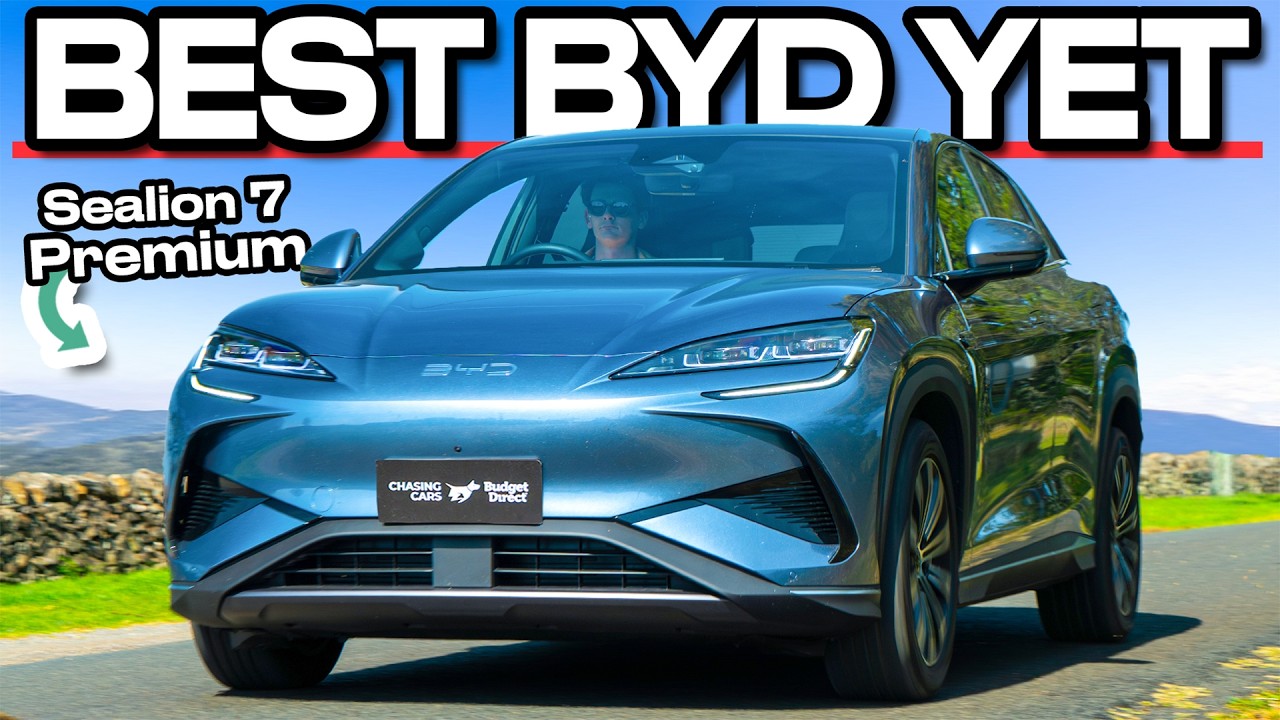
I’m John Law. This is Chasing Cars and this is the BYYD Sea Lion 7 Premium. Now, we’ve already taken a look at the Sea Lion 7 Performance, but this is the base car and it’s about 15 grand cheaper and probably is the right car for most people. We’re really interested because this is Australia’s second most popular electric car right now behind the Tesla Model Y. So, we want to find out what all the fuss is about. So, we’re going to do our usual thing. Check out the interior practicalities, running costs, talk about how this car drives, and of course, hand out our 100% fully independent verdict. I’d love to hear your thoughts in the comments section down below. Hit subscribe if you haven’t done so already, and let’s get right into it. Chasing Cars, honest reviews of your next car, brought to you by Direct. Pricing is one of the areas where the Cine 7 gets a good amount of cut through. $5490 before on-road costs means it sits below the Tesla Model Y and Kia EV5, two key competitors for this car and two big sellers in the segment. It’s not quite as cheap as the GE EX5, of course, but BYD is obviously doing pretty all right in standing out because at last count from me, there were 18 other rivals you could have bought in this same segment for roughly the same price. I’m going to list a few of them and it’s not going to be an exhaustive list. things like the Volkswagen ID4 Pro, the Scoda Enyak, the Xpong G6, the Zika 7X, the Kia EV5, I already said that one, EV6, Ioni 5, and many, many more. So, you can see that BYD really needs to stand out, and some of that comes through styling. This car here, I actually think looks quite handsome. I really like a few of the details at the front here. These nice intricate LED lights look really good, look really sharp. It gives it almost a sea creature-like appearance, which makes a lot of sense because this is from BYD’s Ocean Range. We’ve got 19inch alloy wheels fitted with quality Continental Eco Contact tires, which is really good to see from a Chinese brand like BYD. It was one of the first to realize that Australians care about quality tires. And speaking of quality, under the skin, there are some really good things about this car. If we look at the brakes, for example, they’re proper multi-piston with cross drilled and ventilated front rotors. There’s also really decent suspension systems underneath. We’ve got frequency selective dampers, double wishbones, and to complement the front suspension, there’s even a multi-link rear end. But I think one of the best parts about this car, and the first thing you really interact with as you come up to it, is how you get into it. The door handles are really nice. Press the button, easy proximity unlock. Pull that, and there’s just this feeling of solidity and quality to this car that I really wasn’t expecting. Let’s jump inside and see what it’s like. hop down into the seat and close the door and it has a really satisfying thunk. Obviously, this doesn’t tell you anything much about the car, but it does add a sense of positivity to the experience and it’s one that pervades the whole cabin of the Cine 7. It feels really wellbuilt, quite banklike. Once you shut the door, you notice that everything’s nice and sturdy, even this quite funky sort of door handle design. It’s all quite nice, interesting, and a little bit different without being bad, which is a good thing. Technology is taken care of by a 15.6 in touchscreen, which does the classic BYD thing where it rotates for some reason, and sometimes when you’re up on the road, if you get enough geforces through a corner, it actually rotates on the move by itself. You’ve got a digital driver’s display here, which is pretty legible, crisp. You’ve got speed readout and a bunch of little warning signs in there. You’ve also got a head-up display on this car as standard, which is really good to see. Wireless charging pad, easily accessible. Starting to see this configuration in a lot of cars where you’ve got the wireless pad, shifter, and a separate little storage bay down here. But it’s not rubberized. It’s actually felt lined. Feels really quite high quality. Back to this little pad here because it really separates this car from something like a Tesla Model Y in terms of usability. You have things like drive mode adjustment right here. You’ve got a bunch of shortcuts for the HVAC system here. Auto hold, blind spot monitoring, hazard lights, a physical scroller for the volume, and also a button for your regenerative braking settings. That’s really nice to see. All gathered cleverly around the gear stick. Makes this car just that little bit easier to interact with than some of its rivals. You also got buttons on the steering wheel which interact with the digital driver’s display. You’ve got a shortcut that brings you to the really crisp 360 camera which you need because rear 3/4 visibility in this car is terrible. Come back to that later. And on the whole, it all feels really quite well thought out. That is until you come to some of the infotainment systems kind of annoying quirks. We’ll start with one which is trying to turn off some of the driver assistance things. So, for example, the driver attention monitoring in this car, you don’t actually turn that off through the ADAS tab here. You have to go into vehicle and across into in cabin perception. Just seems a little bit strange, a little bit clunky. That said, there is a shortcut menu that you can pull down and adjust. Now, there is a bewildering number of settings in here that you can choose from. I haven’t entirely figured this out, even over a week of testing this car. I think that’s something that you’d have to sit down and really have a think about in here. But at least you can configure it to what you want. And it’s really good to see BYD listening and implementing things like that. But my favorite thing in terms of ADAS is the ability to really quickly turn on and off the speed chime. It’s right here. This tiny little button at the top, but you can turn it on, turn it off, and it defaults to whatever you had it when you started the car. All great stuff. Now, back to the interior. I’ll talk about the seats and materials because these Tombstone seats are actually really comfortable. I’ve got good under thigh support, which is not always something you take for granted in a Chinese car. I’ve got really decent lateral support and they’re nice and cushy. BYD’s spec sheet says genuine leather, and I feel like that’s correct. They don’t feel sweaty. They don’t feel clammy or sticky. It’s really nice. They’ve also got heating and ventilation, which again is accessed through the touchcreen here. Again, a little bit laggy, but you get there in the end. And lots of electric adjustment for the driver, including lumbar adjust. Practicalities are pretty good in here, too. You’ve got decently sized door bins. They take a 600 mil bottle, but they don’t expand quite enough to take a one L camping bottle. Really deep center cubby in there. These cup holders that are adjustable, so you can slide them down for taller bottles. Press this button, they pop back up. That tray I talked about before, USBC, USBA, and a 12vt socket. And back to materials as well, because again for $5490 before on-road costs, this car feels really wellappointed. You’ve got this classic squidgy leatherrett material up here. Some pretty nice consistent stitching, and you even have a bit of an offset stitching with the blue that nicely reflects the optional Atlantis gray color on the car that we have here. Finally, we have a sunroof that lets more light in. So, as you can see, this thing’s pretty fully featured, pretty usable, and really well screwed together. And now to the best part of the Sea Line 7’s interior, and that is the back seat. It’s a big car for a midsize SUV, and that really pays off back here. I’m 188 centimeters tall, and I have so much room. It’s positively palatial. This is my driving position, and look how much knee room I’ve got. I’ve got a reasonable amount of headroom under this sunroof and decent tow room, which is rare for an electric car, especially considering the CLIN 7 has a blade battery pack with vertically stacked cells. So, very good packaging back here indeed. The bench is pretty comfortable, reasonable under thigh support, and I’ve got a good amount of lateral support as well. I think it’d be really comfortable to sit back here on a long journey. Vision out’s pretty good of the side windows. Of course, we’ve got the sunroof, and you can see quite well between the tombstone seats, too. Leather upholstered or faux leather upholstered tops of the doors here continue. Got a nice comfy armrest, door bin for about 600 mls of drink bottle. And you’ve even got your own little dine audio speakers back here for the surprisingly warm sound system. Amenity continues with this pull down armrest, which is nice and sturdy. Two more little cup holders there, perfect for a little coffee. You’ve got air vents back here, just as the same in the front. They’re manually adjustable with physical buttons as opposed to having to wade through touchcreens because why would you want to adjust a vent through a touchcreen? And you’ve also got this little pop out, very slow pod here that houses the USBA and USBC charging ports. Finally, these two pockets here. Great for a smartphone and a standard mat pocket on the back of the seats. You do get heated back seats if you spend a little bit more to get the performance, but honestly, that feels like a luxury that isn’t really worth it. You still get genuine leather back here in the base model. And I’ve done all of this without the back rest in its most reclined position. Check it out. All the way back, super lounge. So to sum it up then, the Cion 7’s back seat is comfortable, wellappointed, and possibly best-in-class. Jumping back outside again, we’ll talk briefly about styling because although it does look a little bit busy on first impressions back here on the Sea Lion 7, it actually all comes together in quite a cohesive package. Now, Nathan Ponchard when he reviewed the performance said he saw Porsche Cayenne. I actually see a little bit more Mercedes-Benz in the back here. I mean that as a compliment. Got this nice little spoiler up top. Lots of badging of course, but at least no not to 100ks an hour and no more build your dreams, just BYD. Nice and simple. Now, let’s open the power tailgate. Standard as you’d expect, I guess, from a Chinese electric SUV, but not necessarily what you’d expect all the time for a $55,000 family combustion SUV. So, the game’s definitely moved on. We find a 500 L boot. A good space on paper and pretty usable. It’s nice and long thanks to this car’s length of 4.8 8 m plus, but it is a little bit narrow. There’s a dine audio speaker here for the sound system I discussed in there and a little bit of storage off to the side here. Not super wide, but still very practical. I’m told that this car can fit two surfboards side by side, which is nice. You’ve also got a little bit more storage under the boot floor here, and it all feels really sturdy. Twin height as well, so you can balance a little bit of practicality versus flatness for the load bay. And one thing I’d really like to call attention to is how nicely finished down here is where you find the inflation kit. It’s actually really classy and I like that attention to detail. And I was surprised to find it in a car that costs this much money. It does feel more than the price it’s asking, which is always a good thing in my book. The Cine 7 also has a frunk or fruit in British English, which is actually a little bit nicer to open than many others because you just pull the tab twice and you don’t have to go fishing around for the latch. Good to see 58 L of space, perfect for charging cables or a small suitcase. And there’s even a nice little bit of carpet at the bottom there so stuff doesn’t rattle around and get scratched. Let’s talk about Cine 7 running costs. And it’ll start with battery and driving range because that’s its worst aspect. With an 82 1/2 kWh battery, you’d expect to be able to go pretty far. And the WLTP rated range is 482 km, which isn’t too bad for this size of vehicle. But in real world testing, we saw a lot worse efficiency than the WLTP rating. Nearly 19 kwatt hours in a mix of urban and suburban driving conditions. And when we were out on the highway, nearly 22 kwatt hours per 100 km for only 380 ks of roving range when you’re touring long distances. Compare that to a Tesla Model Y which achieved 500 km thanks to a 15 kWh per 100 K’s highway average and you can see the Cine 7, whether it’s battery efficiency, motor efficiency, tires, aerodynamics, whatever it may be, it’s just less efficient than some rivals. So, we’d love to see that fixed in a midlife update. Charging is rated at 150 kW DC, which will take you from 10 to 80% in about 32 minutes, says BYD. And it seems to be about right in the real world for our testing. 11 kW AC charging means 9 hours from zero to 100%. And because the Sea Lion 7 uses a lithium ion phosphate blade battery pack, it means you can more readily take this car up to 100% charge when compared to a regular Turner lithium ion battery pack, which is generally rated to about 80 or 90% to prevent degradation. So, it means you can use more of this battery more of the time, which is nice. Other running costs aren’t too bad either. Servicing is due once every 12 months or 20,000 km. And servicing for 5 years or 100,000 ks will cost you 1,543. Warranty is 6 years and 150,000 km which isn’t too bad. And the battery is warranted for 8 years and 160,000 KS. It’s also good to see that there are more BYD dealerships popping up and that should add a certain amount of peace of mind to you as a buyer if you’re looking at a car like this. There’s more on the road than there were at the start and that’s never a bad thing. Like so many electric cars on the market, the Cine 7 is remarkably easy to get into and start. No need to press the button. Just pull the Volkswagen like shifter backwards into drive. Nicely damped, I must add, and you’re off and away. And from there, you’ll notice that everything about this car is quite user friendly. The brake pedal is long travel and squishy. The accelerator is floor hinged and very long travel as well, which means that you don’t get any of that weird spikiness in this car that you can get in something like a Model Y for the first time you jump in or even a Polestar 2 with those cars sharper throttle calibrations. Partially as well, that’s down to the fact that this car doesn’t have any sort of one pedal drive mode. You’ve got two regen modes, standard or high, and both are well pretty lackluster in my opinion. So, this car is one you really have to drive like a normal vehicle, like a normal combustion vehicle or a hybrid car using the left pedal. And for a lot of people, to be honest, that’s probably fine. But for those who are already transition to EV lifestyle, you may miss the ease of one pedal braking. It’s quiet in here, too. Really good road noise insulation for the most part with two little caveats. One is that there’s a little buzzy rattle that comes from the dashboard here. And you can hear the whistle from the wing mirror, which isn’t correctly adjusted for right-hand drive markets when you get above 80 km an hour. But apart from that, as I said, it’s pretty quiet. Ride quality is also mostly good. around town. It can be a little bit abrupt and I feel like the damping could be due for another round of revisions just to make this car extra smooth and extra nice because yeah around town it’s a bit bumpy and abrupt. I will say that adjusting the tire pressures has made a big difference. When we picked this car up it had 45 PSI in all four. We dropped it to the placard pressure of 42 PSI and then for experimentation’s sake I actually went 2 PSI below that to 40 PSI and found that to be 5 or 10% more comfortable than the Black Eye pressures. Probably comes with a bit of an efficiency trade-off, but I think that’s one that I would say is worth making. When you’re out in the country like we are now, the Sea Lion 7 is really quite impressive in how it absorbs bumps. It feels soft and has a lot of stroke in the suspension, which is a good thing. It moves smoothly through its travel, and there’s a real sense of heft to this car, reflecting its 2225 kg curb weight, which is chunky, but it kind of is quite charming in its chunkiness. It rolls down the road and kind of steamrolls over a lot of bumps like you’d expect from, say, a heavy old Mercedes-Benz sedan on slightly tired dampers. And I say slightly tired because this car does lack a little bit of body control. can feel all at sea and it is a little bit seasick and also the ride frequency is a little bit funky. It’s shorter travel and stiffer at the back and softer with longer travel at the front and that just means especially coming off speed humps around town, the rear axle can actually induce a secondary movement in the front end. It’s almost like a sort of pping action which isn’t exactly particularly refined. What about handling? The steering is okay. 2 and 1/2 turns lock to lock. Not hyperreactive. Waiting is pretty good. You can jack up the weight by going into sport mode, but it doesn’t really solve the fact that there is a bit of on center squitch there. Ultimately, it’s pretty user friendly, but don’t expect a laser sharp feeling like you get in a Tesla Model Y. Though, this may come as a benefit to many buyers because it just feels a bit more relaxed on a country road. Being rear wheel drive, it is also quite athletic. You can induce a little bit of rear steer with the throttle, which is nice, but also the ESC does step in a long way before anything goes too far arry. It’s a very conservatively tuned stability control. And I think that’s a good thing because coming back to the body control, when you do go towards and beyond the limits of the Cine 7, you do really feel the weight of this car. So, I think it’s probably a good thing that the stability control kicks in early and kicks in pretty well. Speaking of safety systems, the active ones are well behaved in this car. Driver attention monitoring feels pretty fair when it pulls you up. Lane keep assist doesn’t bother me on these country roads. The only real complaint I have about driver assistance is the fact that the lane trace assist combined with adaptive cruise control is pretty poor. Makes the steering go all concrete and it’s just not very nice to use. So, I wish you could separate the adaptive cruise and the intelligent cruise programs cuz I think that would just make this car an easier thing to live with dayto-day. And then we come to the major reason you’d want to choose a Tesla Model Y over this and a raft of other competitors that may ride and handle a little bit better. It’s the full self-driving supervised now available in Australia. It does feel like the game has moved on a little bit from just adaptive cruise control and lane trace assist. All the stuff works fine in this car, but the fact that Tesla offers that is something that is going to be really hard for manufacturers to keep up with. So, let me know your thoughts and comments on that sort of advanced driver assistance system in the comments section down below because I’m really interested to hear your thoughts. Is that enough to turn you off buying something like a Sea Lion 7, even if it is a pretty mature, good, easy to use electric car? Or is something like a Model Y with that extra technology a no-brainer for you? Time then for the honest verdict on the BYD Lion 7 Premium, which has proven to be a really easy car to like over a week of living with it. It’s not perfect. The efficiency could be better, the urban ride quality could be improved, and some of the drivability does leave a little bit to be desired. But on the whole, I can really see why you’d pick this car over something like a Tesla Model Y. Mainly because it feels more conventional to live with. It’s not a slave to technology. It nicely integrates technology with a genuine easy usability with good control hierarchy in the cabin. Speaking of, it’s really well built, really spacious, and feels quite high quality. And all of those things are big ticks for BYD. And combined with a sharp price, again, I can really see why this car stands out among its 18 rivals. I’d love to hear your thoughts and comments on the Cine 7 below. For my money, I’d skip the performance and just go for the premium because I think it’s plenty fast enough. But let me know your thoughts. Hit subscribe to Chasing Cars if you haven’t done so already. And as always, thank you very much for watching.
The BYD Sealion 7 is a medium/family-sized electric SUV that is a direct rival to the Tesla Model Y, VW ID.4, Kia EV5 and more. Built in China it offers a lot for the money, at $54,900, before on-road costs, for the Premium tested here.
For that, you get 4.8 metres of metal with a single rear-mounted electric motor developing 230kW and 380Nm for 0-100km/h in 6.7 seconds, with up to 482km of WLTP-rated driving range. BYD also sells a twin-motor Performance grade which ups the power and expense ante.
Road test editor John Law takes a look at the Sealion 7, Australia’s second-most popular electric car, to find out what the fuss is about. It is not perfect, but there’s a lot to like about BYD’s mid-size EV — and the Premium is clearly the value pick.
Time codes:
0:00 – Intro
0:42 – pricing
1:02 – crowded segment
1:26 – crisp styling
1:56 – strong credentials
2:20 – door goodness
2:46 – cabin impressions
3:48 – cabin usability
4:30 – busy multimedia
5:36 – seat comfort
6:30 – material quality
6:57 – huge back seat
8:03 – physical buttons!
8:50 – rear-end styling
9:20 – boot size
10:24 – frunk/froot
10:45 – poor efficiency
11:42 – charging speed
12:16 – after-sales
12:47 – driving impressions
13:48 – mostly quiet
14:07 – ride quality
15:05 – heavy but charming
15:49 – handling
16:42 – active safety
17:19 – vs Model Y
17:56 – honest verdict
As always, we don’t accept advertising from car manufacturers, and we’re powered by Budget Direct.
Subscribe now! https://www.youtube.com/user/ChasingCarsAustralia?sub_confirmation=1
Chasing Cars on Facebook: https://www.facebook.com/chasingcarsaustralia/
Follow Chasing Cars on Instagram: https://www.instagram.com/chasingcars.com.au/
Chasing Cars is Australia’s most independent source of new car reviews, car industry news, comparisons and car guides. We give you a critical look at every new car you should consider!