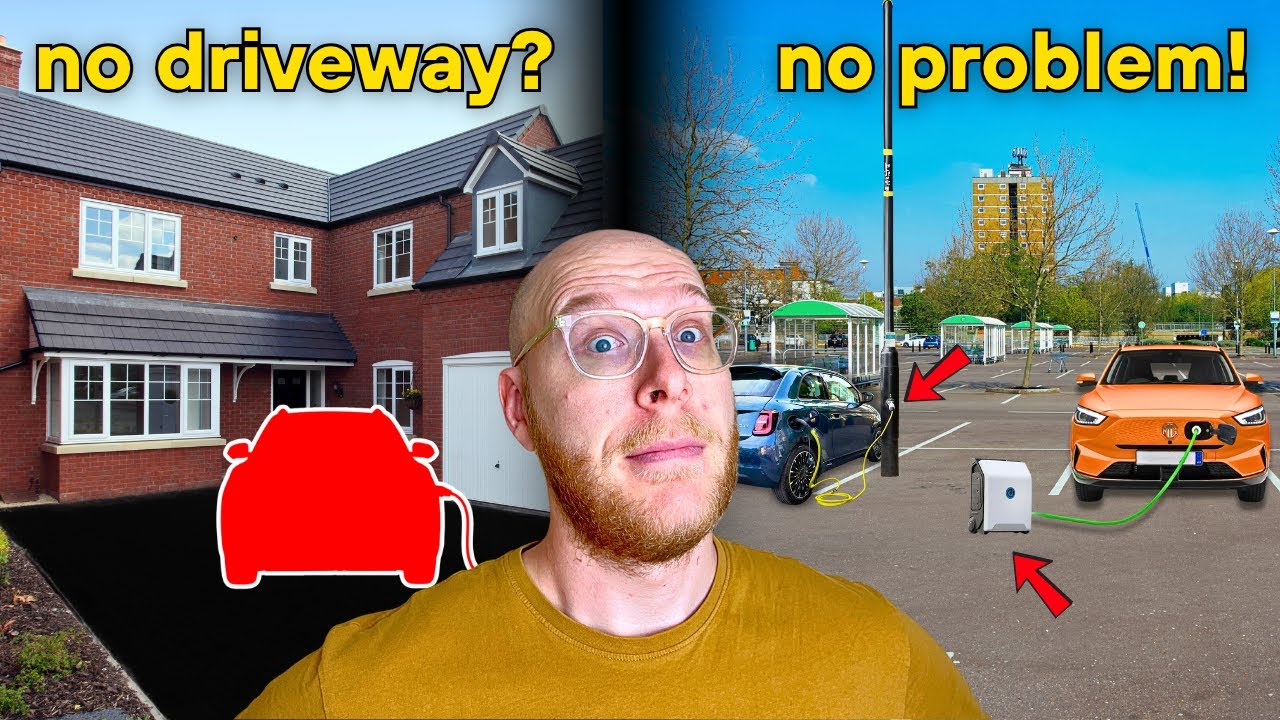
How To Charge Your Electric Car with No Home Parking
If you’re one of the 9 million UK households without one of these, you might be thinking, “How on earth can I charge my electric car?” As of April 2025, there are now over 1.5 million electric cars on the UK roads. And that number is obviously climbing fast. But here’s the problem. Around a third of UK households don’t have off- streetet parking. And for a lot of people, that’s a deal breaker if they want to switch to an electric car. So in this video, I’m going to show you exactly how to charge an EV when you don’t have a driveway. We’ll start with what you do if you’re renting. Then we’ll go through the real practical day-to-day solutions for you. And finally, I’ll get some brand new futuristic ideas that are really, really exciting in this industry where you can charge your electric car without a driveway. So, if you ever thought that EVs aren’t for you because you haven’t got a driveway and you can’t charge it at home, this might just change your mind. Let’s start with renting because this is where most people get stuck. If you own your house, things are a lot easier, but if you’re renting, you haven’t got much control. A friend of mine living in London summed it up perfectly. He said that we’d love to go electric, but we live in a firstf flooror flat and it’s all on street parking. Plus, we could move in 6 months anyway. Installing a charger is just a faf. If this sounds familiar to you, there is some good news. So, here’s what you can actually do. Ask your landlord. There are government grants like the EV charge point grant for flat owners and renters. This grant covers £350 towards the cost of installing a charger. And your landlord might not even know about this. And also, it’s important to know that landlords can benefit from this, too. By installing an EV charger, you’re adding value to the property and it makes it way more attractive for future tenants. In London, for example, many new build flats are advertising as EV charging friendly and that’s a great selling point and a landlord without an EV charger could be missing out on thousands of rental income over time. Of course, permission matters and if you live in a flat, your landlord may need an agreement from the freeholder or management company. It’s not impossible to install an EV charger if you’re renting. It’s just a little bit more paperwork. And of course, if you’re a tenant, you can’t force your landlords to install an EV charger, but you can influence them. If you show your landlord that the government will pay part of the cost, and it makes their property much more future proof, you’ve got a decent chance of getting one installed. But let’s be honest as well, most renters won’t get their EV charger installed tomorrow. So, let’s look at the solutions you can actually rely on today. First up is, of course, public charging. Now, the UK has got over 82,000 public chargers available now, and that’s one added every 30 minutes on average. Every motorway service station has rapid chargers. Grid server popping up with fantastic dedicated charging hubs with coffee chains and stuff like that inside. And they really look the part as well. In places like Costa Coffee and McDonald’s, Instava has over 2100 rapid and ultra rapid charges for you to use. Osprey and BP Pulse are popping up at petrol stations and at retail parks. And for a lot of people, the strategy is simple. The average commute is 20 to 30 m a day, and the average range of a new electric car in the UK is around 250 mi. So, all you need to do is have one weekly rapid charge, and you might not even need to charge that much. 30 to 40 minutes on one of these 150 kWh plus rapid charges is all you need for the entire week. However, of course, it’s not perfect, and public charging costs a lot more than home charging. In fact, I worked it out to be about 20p per mile when I recently worked out my charging costs and my efficiency numbers for this car. But if you drive more efficiently and use BP Pulse subscriptions or Tesla subscriptions, you can save a lot on public charging as well. Check out my other video on that after this. Of course, it’s not impossible to charge only using public chargers. It’s just like as if you’re going to a fuel station to fill up on petrol. You just have to wait a bit longer with an EV charger. Of course, it is a solution if you haven’t got a driveway but want to drive electric cars. Now, let’s get on to a better solution, shall we? If you’re employed and you drive to work and you park up where a business owns the parking lot, you might be able just to charge at work. In the UK, we’ve got a workplace charging scheme in place, which has funded over 60,000 charge points since 2016 alone. Employers get up to 75% off the install of the charger. So, if your office does not have EV chargers installed yet, but you drive electric car or want to buy one, just ask. It’s heavily subsidized and it’s a big perk to you as employees and future employees that might want to join the company. Plenty of NHS hospitals, universities, even Amazon warehouses and big businesses offer EV charging for their staff. In fact, I drove past this place the other day where I saw lots of EV chargers. Even the business next door to your office might have one or a few chargers available for you to use. Just keep your eyes out. Who knows what you might find. Quick one before we move on. Over 90% of you have not subscribed. If you’re enjoying this, please hit subscribe button. It’s totally free to do, takes just 5 seconds, and it really, really helps out this channel. All right, back to the clever solutions. Now, if neither of these work for you and you have access to road parking, there are companies like Uberity, which is now owned by Shell, and Chargy, which convert ordinary lamp posts into EV chargers. They are typically slower than rapid charges, up to 7 kW hours, maybe, and that’s fine, though, if you plug in overnight. Now, London has over 10,000 lampost charges available, making electricity one of the largest charge point operators. Entire streets like Southerntherland Avenue and Maid Vale have been turned into electric avenues. It’s not just London either. Birmingham and Oxford are cities that are triing these lampost charges, too. But what if you have direct access to parking outside of your home, but you don’t have a driveway? There’s a solution for you as well. Well, there are some clever companies out there, one of which appeared on Dragon’s Den and offered a really good solution for charging if you don’t have a driveway. Turbocharge and Gully have actually designed grooves in the pavement where you can run a cable through. In Suffuk, for example, six gully cable gullies were installed as part of a trial and the government even announced a 25 million pound fund to install these gullies for people that do not have a driveway and want to charge their electric car. That also means you get the benefits of cheap overnight charging with a different electricity tariff and you can charge at home. If all of this seems a bit too much and you don’t like the idea of installing a gully to run a wire through, then let’s talk about charging where you might be doing something normally in the week and integrating it as part of your routine. When I first bought my car and drove it home, I stopped off at a Sainsbury’s charger. And as I got a few bits that I needed to shop, the car was already charged up by the time I got back. Now, this is something called destination charging. Now, this is different to the public rapid chargers, as I mentioned earlier, as they’re designed to seamlessly work and integrate with your daily or weekly routines, as well as sainsburries having their own chargers. In the UK, Tesco have now got over 500 charges that they’ve paired up with VW and Podpoint to provide. Little and Aldi are doing the same. So, while you shop, you can get at least 30 m of charge. And in some places where they’ve got rapid charges, you can get even more. Hotels, gyms, cinemas, pubs all across the UK are signing up to getting their charges. and those are the ones that haven’t got charges already. So, think of your EV like your phone. Just plug it in every time you need a little bit of a top up and in places that you know that you’re already going to stay for a while. Later, I’ll show you the best technology solution that I found and it might even remove the need for chargers altogether. But first, the next solution might not be something that everyone thinks about. Now, the next one is a bit outside the box, but we’re seeing this more and more and it’s becoming more popular nowadays. The idea is simple. You don’t have a driveway, but your neighbor does, and they got a charger there sitting idle that’s not being used for most of the day. With apps like Co-Charger and Just Charge, they can rent out the charging for you to use. You just open the app, search for nearby chargers, see which ones are nearby, and you can book a slot to charge your electric car. Now, when you turn up, the charger is guaranteed to be free and available to you, and you just plug it in as if you were using a home wallbox charger just on someone else’s driveway. It’s everything’s handled through the app as well. The booking, the payments, the the fees, everything that you need to know is in the apps as well. This is not sponsored, by the way. And for the host as well hosting the charger, it’s a way for them to earn extra income. Some people report earning hundreds of pounds every year on this and they only have to rent their charger out a few times a week. And for you, it’s a way to get reliable charging in a residential street that might be a bit less to charge than using public chargers. And there are thousands of these charges listed on different apps across the UK as well. And also, people on the apps actually have an agreement with their neighbors, so they come and charge at a routine, a regular time every week. So, if you’re renting or in a terrace house with no off- streetet parking, then community charging could be an option for you. Some councils are going bigger on something called on street charging hubs. Instead of one or two chargers, they have a hub of six to eight on the street. Companies like connected curb have rolled out so many of these hubs that they’re now one of the biggest UK charge point operators as well. In Comry and Liverpool, whole neighborhoods have these charging hubs where petrol cars used to park. But as clever as that is, it’s not my favorite solution because what’s coming next could remove the need for a charger altogether. So, let’s look at the future of charging without a driveway. Now, first of all, there’s portable chargers. A UK startup called Zip Charge have these big battery packs where you can keep it inside your house or your flat. You plug it into a normal socket to charge it up and then wheel it out to your car when you need a boost. You can add 20 to 40 mi of range depending on the car and the efficiency of the car in under an hour. and it’s perfect for city drivers who only need short bursts of charge. It’s a bit like carrying a power bank for your phone, but it’s much bigger and it’s for your car. Now, perhaps it’s not the best solution in my opinion because they can be quite expensive and it is basically carrying a big suitcase around all the time, but I like their thinking and their idea. Next is pop-up pavement chargers. Companies like Trojan Energy have trialled things in London and Abedine where they’ve got essentially a flat road surface where people come in and they plug in a charging plug. So when they’re not in use, they’re completely level with the ground and you don’t even notice it on the floor. When you need them, you slot in a connector you bring out from your boot and then there you go. You’ve got an EV plug ready to go and you can plug in your car. Okay, if that’s not the solution, then what about mobile charging vans? Now, this is more if you break down. Say the AA or the RAAC will come out and they’ve got a battery pack in their vans ready to go and they essentially offer a solution if you’re stranded without any charge. Now, they’re all clever and innovative and sort of slightly offer different solutions to different problems, but they’re not the most exciting one in my opinion. But right now, even the best chargers take time. A rapid charger might take 20 or 30 minutes if you’re lucky. An overnight topup takes hours. But what if you didn’t have to charge at all? What if in the time it takes just for you to grab a coffee, your car is ready and charged, ready to go? Now, that’s exactly what battery swapping promises. So, here’s how it works. You drive into a station, robots slide out your depleted battery, and they slot in a fully charged one. And less than 5 minutes later, you’re back on the road ready to go. There’s no cables, there’s no waiting around, and of course, there’s no driveway needed. It’s not science fiction, either. Neo, which is the Chinese brand, have already tried this and are using it in hundreds of different bays across China, and they’ve opened sites across Europe. In fact, Fiat has also triled their 500E electric car with battery swapping stations in Madrid. And UK startups are looking into this for fleets and vans and things like that. And in recent research, 73% of UK motorists say they’re happy to have battery swapping as an alternative to charging, which is huge because it means drivers are ready for it. They just need to build the infrastructure. Let me know if you like this battery swapping solution in the comments or if you find something else alternative on this list that you prefer. Watch this video next on getting the best price to charge your electric car. And see you on the next one. Peace out.
If you are someone without a driveway, how do you charge your electric car?
This is a problem for MILLIONS of homes in the UK.
So here are practical real world solutions to those without a driveway….
Which one do you like the most?
Hit the SUBSCRIBE button for lots more EV content coming up!
🍿 Exactly How To Pay Less To Charge Your Electric Car: https://youtu.be/NAU32Tk2vjE
🆓 £50 For Switching to EON Energy: https://mention-me.com/m/ol/hk1sd-alexander-bull
🚙 My EV Driver Essentials: https://www.amazon.co.uk/shop/drivenbyalex/list/TJ0YCA738C74?ref_=cm_sw_r_cp_ud_aipsflist_PPNDTM83QX2QMBSV3XVM_1
📸 My Camera Gear: https://www.amazon.co.uk/shop/drivenbyalex/list/3MW6YJZRO1MN6?ref_=cm_sw_r_cp_ud_aipsflist_PPNDTM83QX2QMBSV3XVM_2
🎥 Instagram: https://www.instagram.com/alexcarsmedia/
🎵 Music: https://share.uppbeat.io/8ryasnm0fs85
—
👋 Who Am I
I’m Alex, a British guy sharing what it’s really like living with a budget electric car.
Former automotive engineer turned traveller + digital nomad.
Please hit subscribe if you want more real-world EV content.
📖 Chapters
00:00 Intro
00:48 what if you’re renting?
02:15 public charging options
03:43 can you charge at work?
04:43 on the street?
06:03 destination charging
07:02 charger ‘sharing’
08:14 charging ‘hubs’
08:39 the future of charging?
PS: Some links are affiliate links — I may earn a small commission ✌️