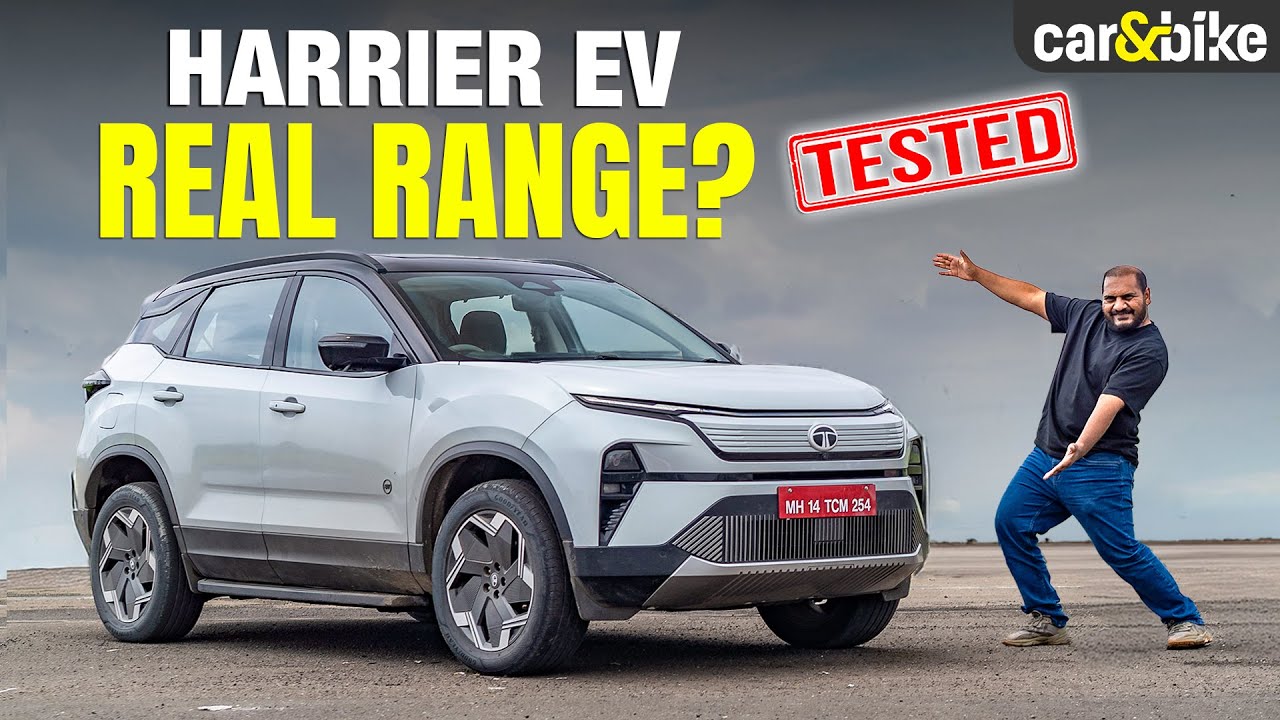
Tata Harrier EV Real World Range Tested | How Many Kilometres For 75kWh QWD? | C&B Range Test
Hello everyone and welcome back to Car and Bike. I’m Balaal sitting behind the wheel of the all new Tata Harrier EV. This is the first time I’m driving the Harrier EV which created a lot of buzz on the internet since its advent. Now in this video, we are doing something special because a peak on Mumbai Monsoon is upon us. But before starting out, I’ve charged this car to 100%. And throughout the course of this video, we will be talking about everything that you need to know about this new Tata Harrier EV while also discussing the real world dreams which I’ll tell you at the end of this video. So stick around. But before we go ahead, you know the drill, like share and subscribe to the channel by Q Like most modern Tata cars, this one is also available in different personas. You have 3 to choose from Adventure, Fearless and the one that we have here, the Range Topper Empowered. There are 2 battery pack options too. You have a 65kW with a rear wheel drive only. And then you have the bigger 75kW battery pack with a rear wheel drive and one we are driving here, the all wheel drive version. Our Tata likes to call the quad wheel drive. Luckily, Tata’s official website in India lists out just 11 trims for the Harrier EV that you can buy, apart from 4 stealth edition trims based on the range topping empowered trim. It’s a lucky because we know how many variants other Tata cars like the Nexon have on offer with different powertrain combination. Between you and I, it’s a lot. But on the upside, it also gives you a variant for every budget. The prices for the Harrier EV starts from 21.5 lakh for the base trim and goes up all the way to little over 30 lakh rupees at Trorum. Do you want a separate video telling you everything about the variants, the pricing, the variants vice for feature distribution on the Harrier EV? Let us know in the comments section below. So let’s talk about the driving aspect of the Harrier EV and let me begin by saying that after having driven cars of all shapes and sizes, this one, it feels like a sweet spot. It’s big, but it’s not intimidating, especially in the city confines and especially during parking. Now you might wonder why I didn’t realize this when I drove the Harrier diesel. But because in the diesel powered Harrier, there’s so much thing grabbing your attention, the vibrations and noises. But over here in the Harrier EV, everything is so eerily calm. It’s so silent. There’s no vibrations at all. The controls are so light and comfortable that you get used to it pretty quickly. Now, although everything is carried over from the standard Harrier, be it the controls, the ergonomics or even the visibility, you sit quite tall, but not too tall. You feel like you’re sitting in a proper SUV, which is something which is really good, especially when you compare to other cars, for example, the Treta, it feels such more of a car or a crossover rather than a proper SUV. Over here, you get a good commanding position. Now I’ll stop comparing this one with the standard diesel powered Harrier, because for someone who’s looking to buy an EV and might consider the Harrier EV, they should know that this is a big, comfortable EV, especially at this price point. Now at around 25 to 35 lakh rupees bracket, the Harrier EV is a big car. It’s a lot of car that you get for your money. And if you go even slightly higher, the premium EVs that you get at this price point, they feel small and they aren’t as quick as this one. Now the sport wheel drive, it has two electric motors, one mounted on each axle with a combined output of over 300 BHT. But the more interesting figure here is almost 500 newton meter. This isn’t exactly a light car. In fact, it is 300 kilograms heavier than the diesel powered Harrier. Sorry for bringing up the diesel Harrier once again, but you need to know that this one exceeds the scale at almost 2.3 ton. But the acceleration is quite brisk for such a heavy SUV. It can clock 0 to 100 kmph in the boost mode in little over six seconds. And to give you a perspective that’s as fast as the new gen Golf GTI, the BMW 330i, or isn’t the Scoda Octavia VRS 245. What else do you want from a family SUV, a family electric SUV that can smoke some of those driver’s car in a straight line. And the Harrier EV is not just made for the straight line. This one is a proper Tata SUV. So while the road manners are well sorted, it’s phenomenal when the roads start to disappear. In fact, over the rain washed Mumbai roads with moon sized portholes, the Harrier EV it felt invincible. The small irregularities were shot off without a shrug and the large ones were digging a stride with some real professionalism. Well actually that didn’t surprise me at all. But what did surprise me was how good this one is when we went off-roading. Getting off the main road into the unknown, the all-wheel drive keeps a good composure. Now there are selectable modes here, which gives you different terrain choices that you should select depending on where you are. But honestly, I barely used it and the Harrier still managed to get me to the other side, feeling like a hero. You are the real hero here Harrier. Now before we talk about the next segment, a quick stat check. Now we have driven close to 230km since morning and the battery is down to little over 50%. Let’s see how the rest of the day goes. But the next segment that I need to talk about is the quirks and features. And the first fork off feature that I need to address is this IRVM. Now this is taken directly from a Land Rover. Now this is one of the many features which we first saw in a Land Rover which are directly borrowed over here in the Harrier TV. This one is not just a simple IRVM, it has a projection of the rear view camera mounted on the rear shock fin antenna. The best thing is at night you have a really good HD projection on this which feels brilliant and very sci-fi. But in the daytime, there is a lot of reflection that puts on the IRVM apart from the projection. So at times it’s really really hard to see what’s at the back. In fact I felt like I need to see a doctor for my eye because I could barely see anything. The head nams, the DRS or the rear cars, they are reflected quite heavily. Because it also has a recording and it acts like a rear dash cam which is a really good feature to have in India. So I’m not complaining over there. More importantly if you are followed by a car which is a smaller car than the Harrier TV and it is very close to you. Since the camera is mounted really high, you can barely see the car at the back. You can’t see it from the IRVM, you can’t see it in the projection. So that really creates a big blind spot. But apart from that, I’m not complaining. There are two more features which are really a Tata first which includes a transparent bonnet and auto parking. Now auto parking, it works brilliantly. I actually love that feature and it gave me no problem whatsoever. When I tried it a couple of times, the transparent bonnet, it looks good. Although it could be a bit more high definition. Thirdly, there is this party piece which is called the summon mode. Now summon mode is another thing that you will surprise your guest with because it is a feature which is not usually seen in Indian cars. The only complaint being that button which is really hard to press and that really gives that car that not so smooth movement when there’s no driver inside the car. But when it does really work properly at time, it’s a feature which gives me giggles every single time. Now if I were to nitpick, the only thing I would say is this is the most expensive Tata EV that you can buy in India right now before the Sierra EV or the Safari EV comes along. More importantly, it is one of the flagship offering. With everything you see here is taken directly from the less expensive models. Here the entire dashboard layout, the element, it’s taken from the standard Harrier. But even the EV elements which we’re seeing in the lower spec Tata, for example, the driver’s display, the digital driver’s display, it’s exactly from the Nexon EV. Now I wish for a flagship EV, you could have gotten something new or something novel. Now this isn’t exactly a born EV. Data changes both inside and out be it the styling, the ergonomics or few more elements here and there would have gone a long way to make this Tata had it easy, feels special, more expensive. However, it also goes on to prove that Tata is doing exactly what German giants have been doing for quite some time now. Taking the BMW, Mercedes or even Audi, they use similar elements throughout their lineup. So if you’ve seen one, you’ve seen them all. Tata is doing almost exactly the same. But what’s your opinion about it? Do you want your more expensive flagship EV to stand out from its lower variant? Or are you fine with the economies of scale and the shared parts bin for your cars across the lineup? Let us know your opinion in the comment section below. And finally it’s time to talk about the real world range test. And before I tell you about the tested range, let me give you some facts and figures. Now this one, it has a bigger battery pack with all wheel drive with a claim range of 622 kilometers. If you get the rear wheel drive only with a bigger battery pack, the claim range is slightly marginally better at 627 kilometers. If you get the smaller battery pack, which is 65 kilowatt hour, the claim range is little over 530 kilometers. These are the figures that don’t trust me because all Tata cars, they come with a figure called as C75. The C75 is basically a figure that Tata says 75% of the owners who have actually bought the cars will be getting from their car in the real world condition. As we know Tata is the highest selling electric car maker here in India. So they know what they are talking about and the C75 figure, that’s what I am interested in. And the Harrier EV, its C75 figure is ranging between 460 and 490 kilometers. Before I started this test, I charged it up to 100% and the displayed DTE that’s distance to empty was showing me around 380 kilometers. That’s not this car’s fault. Let me clear that it’s us enthusiasts car journals, they are to be blamed because we have driven this car quite enthusiastically so that displayed range was very inaccurate. But once I started driving at 100% in the sedate condition, like a normal owner would, within the city confines, it started to normalize. Now more importantly, if you have owned a Tata EV or have driven a Tata EV, you would know that there’s not one indicated DTE or the indicated range, because it depends on various other factors. For example, there are three regions setting level one level two level C and everyone has a different indicated range. It also changes whether you have the air conditioning on or off. There are three tri modes as well. So if you have a B-core city or sport, the indicated range it changes. Now for this test, you need to know that we did it in the standard setting. Now the standard setting here we use is level one for the region because as I said it’s standard every time you get in the drive mode was set to city neither eco nor sport. Secondly, the air conditioning was turned on throughout the test and the fast speed was set to two to three and the temperature was set at 23 degrees Celsius. This is setting we use throughout the test and we have driven it throughout the entirety of this battery definition. Let’s see what the real world range is really like. Between you and I, I didn’t go all the way down to zero percent for this range test and I had to stop it at five percent and you’ll agree with me for three reasons. Now the first reason is at five percent the limp mode kicked in which meant the top speed was limited to 60 kmph and the AC performance it dropped as well. Secondly, at five percent all Tata cars have this annoying beep that kicks in and gets a bit irritating after a few kilometers. And thirdly, I was using a public charger for this range test and I didn’t want to push the car alone if the car stopped dead at zero percent. That five percent is properly calculated and extrapolated so you don’t have to worry about it. And finally, what you’ve been waiting for, the real world range of the Tata Harrier EV quad wheel drive and it went, drum roll please, 460 km in a full charge. Now that’s around 60 km more than what we got from the KIRV EV 55 and even the Kreta EV which both of them they topped at 400 km. Now I haven’t yet tested the Mahindra EVs but the 460 km in the real world range is not a bad figure. It went almost as close to the C75 figure and if you drive it slightly more judicially in the real world range where you don’t have to test it in the ideal condition, you can actually inch towards 500 figure and that for me is a really good figure to have in your one car EV garage. So there you have it, the Tata Harrier EV. It’s big, it’s comfortable, it’s very feature loaded, it’s quick when you want it to be and it’s capable enough to make you feel like an explorer even if the only thing that you’re conquering is a metropolitan traffic. Now as I said earlier 460 km of real world range is good enough for most of the owners and what the Harrier EV has got going for itself is despite all its quirks and features, this one it feels familiar yet futuristic. And that’s all from me in this video, I hope you liked it and if you did do hit that like button and share this video with someone who’s looking to buy an electric SUV and they might be considering the Tata Harrier EV for it. And if you have any other questions regarding the Harrier EV which I didn’t cover in this video do write them down in the comment section below and I promise we will address them all personally. So that’s all from me in this video, this is Vilar signing off, until next time.
With all the hype around the new Tata Harrier EV and its capabilities, we put it through test. Not just the real world dynamics, but also real-world range test. Along the way we also looked at some of its quirks and features. How many kilometres did it go on a full charge? Bilal Firfiray will tell you in this video.
TIMESTAMPS
00:00 Introduction
01:02 Price and Variants
02:25 Driving Dynamics
06:05 Quirks and Features
10:15 Real World Range Test
14:59 Conclusion
MORE FROM C&B:
For more from the world of auto, visit our WEBSITES:
ENGLISH: www.carandbike.com
HINDI: www.hindi.carandbike.com
Subscribe to car&bike YOUTUBE Channels for your daily dose of Auto:
ENGLISH – www.youtube.com/@carandbike
HINDI – www.youtube.com/@carandbikeHindi
Follow car&bike on INSTAGRAM:
ENGLISH – www.instagram.com/carandbike
HINDI – www.instagram.com/cnbraftaar
Follow car&bike on FACEBOOK:
ENGLISH: www.facebook.com/carandbike
HINDI: www.facebook.com/carandbikeHindi
Follow car&bike on TWITTER:
www.twitter.com/carandbike