
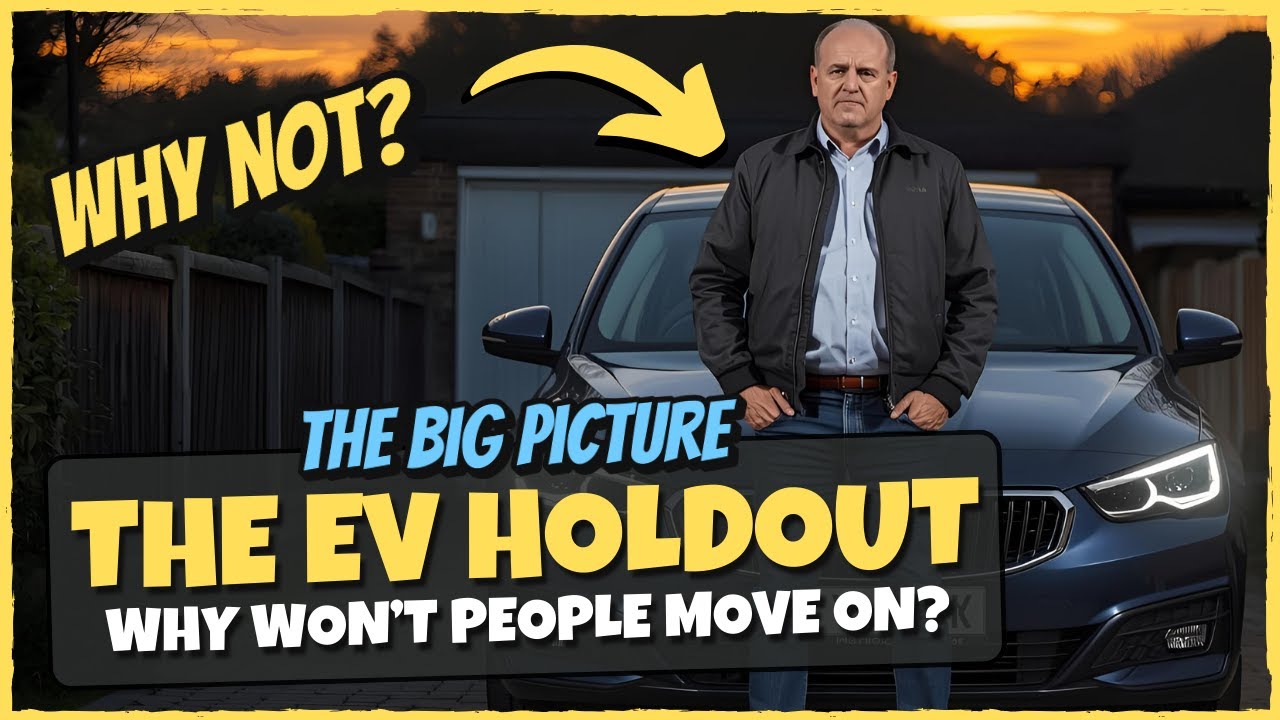
Electric Vehicles Won’t Take Over… Until THIS Happens!
Or picture an electric car that can drive 800 miles on a single charge. Now imagine it recharges in about the time it takes you to grab a coffee. For years, that’s been the holy grail, the stuff of science fiction. But it isn’t science fiction any longer. This technology is already here with battery giants like CL and BYD showing off launches that make it a reality. It’s the innovation that by all logic should make the petrol car obsolete overnight. It feels like it should be the final nail in the coffin for the petrol car, but it won’t be. I’m Dave. I’m going to reveal what the final nail will be and when that Eureka moment is likely to kill off the petrol engine for good. Well, for decades, the argument against EVs has rested on multiple pillars. Cost, charging infrastructure, range, and charging time. The petrol car had two great strengths. First was the relentlessly toted convenience of a fiveminute fillup that could give you three, four, even 500 miles of range. The second was that we’ve driven them for all our lives up to this date. We know them. We trust them. And many can’t or won’t see any reason to change. Electric vehicles with the long charging sessions and worries about finding chargers that are working just felt like a compromise too far for many people. Is there any real reason to change and change so quickly? Why not just let those who want to change just get on with it and leave us alone? But that argument is being systematically taken apart. Companies are already rolling out batteries that don’t just exceed but demolish what the LEVs could manage. We’re now seeing battery makers who claim their charging speed nothing like what it used to be. It’s over 300 miles of range added in as little as 10 minutes. And it’s not just about speed. Total range is hitting numbers once thought of impossible. Even with even budget EVs getting up towards 250 mi. While for family EVs, that figure is now regularly 3 to 400 miles. and future models offering 800 miles or more on a single charge are already on their way. This is all thanks to smarter battery chemistries like advanced LFP, silicon carbon, sodium aluminium, not to mention solid state that are safer, last longer, and cramm way more energy into the same space much more quickly. This leap forward neutralizes the functional advantages of a petrol car. When an EV can travel from Glasgow to Penzance on one charge and then get ready for the trip back in the time it takes to grab a sandwich, the practical case for sticking with petrol seems to crumble. Logically, this should be the end of the line for the internal combustion engine. It becomes the horse and buggy at the dawn of the automobile age, a relic. So why, when the technological war is seemingly won, is the cultural war just getting started? Well, people simply do not understand that while petrol cars have had over 100 years to develop, to reach the state of perfection, the EV is only at the very beginning of its development. mass-produced EVs have only been with us a mere decade, and the top tech petrol car at that same age was still the Ford Model T. People’s knowledge and perception of EVs is still way back, maybe 20 years ago. In fact, for a huge part of the population, it’s actually a non-starter. A recent REC survey found that only about half of young motorists will consider an EV next time, while less than 30% of older drivers would be interested. Far more men than women would consider changing anytime soon. There’s still some way to go before the majority of buyers will consider an EV as a realistic option for their next car. Not necessarily choose it, but it’s an option. Well, this isn’t just a few stubborn holdouts. There still remains a massive chunk of the traditional industries like car makers and oil companies who are perfectly happy where they are. They don’t want you to change. They don’t want EVs at all. In fact, if car makers could rethink their all electric plans and reinvest heavily in hybrids or in the short term even get back to what they do best, get back to making petrol cars, they’d be delighted. So, what’s really going on? Well, our main problem is while those who are already driving driving driving EVs actually know the truth and reality, the majority actually still don’t. They still cling to the old debunked myths even when they can see the evidence with their own eyes. Take the first of the charging myths. There are several. Let’s look at charging speed. They still argue, “Okay, well, this new battery chemistry may be just on the horizon. It’s not actually here today. If I buy one now, it’ll be buying an outdated technology. No thanks. I’ll wait.” than when we look at public charger speed. They argue, yes, but even when the latest cars get here and they’re able to do that, we’re going to need a whole new infrastructure of bigger, faster public chargers capable of doing that. And of course, that’s going to take quite some time. Well, in the meantime, there’s going to be more and more EV drivers chasing very few really fast charges. That means cues. Thanks a lot. I’ll wait. And then they follow up with, and of course, the grid will never be able to cope. Millions of EVs, all with massive batteries, all charging at huge speeds, all chasing after a very small number of ch. We’re going to need a new grid. And that’s not going to happen anytime soon. No thanks. I’ll play safe for the moment and see what happens. See, public EV charging in most people’s mind is still nowhere near where it needs to be to convince them. Yet at most motorway services, there are now far more EV chargers than petrol pumps. They see them, they drive past them, they see people charging there, and they see plenty of vacancies. Yet still, they cling to the belief, oh, there’s not enough. The infra in infrastructure is not in place yet. Well, then what about the time it takes to charge? You see, most people cling to the notion that to be worthy of even consideration, an EV must allow me to be able to pull into any public charging station, top up in 10 minutes, and go. Until then, it’s not for me. Well, as for range, they would say, well, only the very top end, the most expensive models will get anywhere near 800 miles, and I can’t afford them. Besides, what about in the winter when the range drops to half? Oh, and by the way, you can only charge to 80%, so that’s 400 divided by two in the winter, that’s 200 miles. Yeah, not enough. Now, we really are on a losing streak. Those myths are well and truly drilled in. So, what will finally get through to people? Well, this is the real reason that tech specs and spreadsheets just can’t explain it all. For over a century, the car has been more than just a tool. It’s a piece of our identity, a symbol of freedom, and for some, it’s a work of art. For millions of people, a car is not an appliance like a toaster. It’s an experience. And this isn’t just nostalgia. It’s a deepseated cultural thing. Car culture is based on a shared passion for engineering, design, and sound. This psychological barrier is one of the strongest. It explains why the classic car market is booming and why many see their car as a hobby, not just a utility. They don’t want a computer on wheels. They want a machine with a soul. And for them, that soul has run on petrol ever since they learned to drive. So, what will change? Well, there are going to be several tipping points along the way. See, first is the gradual one. They’re just going to see many more EVs on the road. A certain point, their mind will ask, “Hang on a minute. If they’re so bad, why does so many people seem to have them?” They’ll see their neighbors and family members and work colleagues colleagues driving them. They’ll see them in their road. They’ll see them on motorway services packed with public chargers and realize they easily outnumber petrol pumps and they’re all charging. Some motorway services we film have in excess of 50 charger bays. Far more than the total number of petrol pumps. Far far more. But still they ask for more. Well, another big change will come with price. We already have price parity in some EVs. Take the Vauhall Fronta. It is absolutely identical in price whether you choose a hybrid or a full full EV. As more and more EVs reach this point price par that argument is just going to fade away. That of course is massively helped by the latest EV grant which now makes the Ford Pummer Gene E battery car cheaper than the cheapest petrol version. Money talks and that will open some buyers eyes. But it is a combination of technology and common sense that will win through at the end of the day that will see the end of those old myths when that new EV does have a real world range of far in excess of 800 miles. When you can drive from London to Cornwall for a weekend, then back again and not have to stop to top up the battery. Sunny your old petrol car could never do. And when you do charge up the battery in less than 10 minutes and there are so many chargers that you will never never find them busy, you’ll always find one vacant. I say nearly always because we all know bound bank holidays or even petrol cars queue up to fill. Well, the technology for total EV dominance is no longer a distant dream. An 800 plus mile range and a super fast charge will in reality finally begin to dismantle the last practical arguments for the petrol car. But technology doesn’t provide the whole answer. The second part of that equation will come when the average motorist suddenly realizes that well they can now buy an EV that does 800 miles. They think they might want one or need one with 800 miles and tens of thousands of ultra rapid high-speed chargers are out there. Once they get all that, they might finally realize that, hey, they don’t actually ever need that. The average UK motorist drives 17 m a day. 1717. And about 80% of EV drivers can and do charge at home. Yeah, I know 80% of EV drivers do indeed charge at home, but the official figure for households with off- streetet parking suitable for home charging is only £66. But we recently met up with Kurbo and it’s now recognized and accepted by almost a third of all councils. They’re working on the others that’s going to offer off- streetet parking to people who can’t park off street. That video is out shortly. So, most people will just plug in every night. That’s it. No public charges ever. What do they need 800 miles for? The average UK driver also considers 100 miles to be a long journey. Even the once a year road trip to Scotland, Cornwall, or across Europe can probably be completed without ever having to charge up out on the road at a public charger. So, a range of 800 miles is clearly ridiculous. And at last, someone will ask, why am I paying so much extra for a massive battery that I never use? Don’t they do one with a smaller range and a cheaper price? That’s a turning point. And also prices are heading downwards at a scary pace as well. New tech when it appears generally means much better performance at a cheaper price. At some point fairly soon, your average EV will be much cheaper than your average petrol car yet offer so much more. So ultimately, this technology will become mainstream. The choice will no longer be about range or charging speeds. EVs will be the clear leaders in both of those. It will be about what you value. How about a nice quiet, comfortable EV, masses of acceleration, no pollution whatsoever with really cheap home charging so you never have to go anywhere else. So, let me ask you in that world, what will you choose or and why? Uh, let me know in the comments below. Well, thanks very much for watching. If you have enjoyed this breakdown, make sure to hit the like button and subscribe for more content that looks at the future of EV driving. Uh, we’ll see you in the next one. I’m Dave. [Music]
Discover the truth about the future of electric vehicles and what needs to happen for them to become the dominant form of transportation. The world is moving towards a more sustainable and environmentally friendly way of living, and electric vehicles are at the forefront of this movement. However, despite their growing popularity, electric vehicles still have a long way to go before they can truly take over the automotive industry. In this video, we’ll explore the current state of electric vehicles and the challenges they face, as well as the breakthroughs that need to occur for them to become the norm. From advancements in battery technology to changes in government policies and consumer behavior, we’ll examine the key factors that will determine the success of electric vehicles in the years to come. Whether you’re a car enthusiast, an environmentalist, or simply someone interested in the latest technological trends, this video is for you. Learn about the exciting developments in the world of electric vehicles and find out what it will take for them to revolutionise the way we travel.
// About The Channel
Dave Takes It On is presented by Dave and produced by his son Jonas.
// Referrals
Dave’s Octopus Energy Referral code: https://share.octopus.energy/wheat-robin-44
Jonas’s Octopus Energy Referral code: https://share.octopus.energy/rich-ibex-885
Tesla Referral code: https://ts.la/dave87278
// Socials
Email: davetakesiton@gmail.com
Twitter: https://twitter.com/davetakesiton
Patreon: https://www.patreon.com/DaveTakesItOn
// Join this channel to get access to perks:
https://www.youtube.com/channel/UCp-jajUP-0qmEMJohiNFKLA/join