
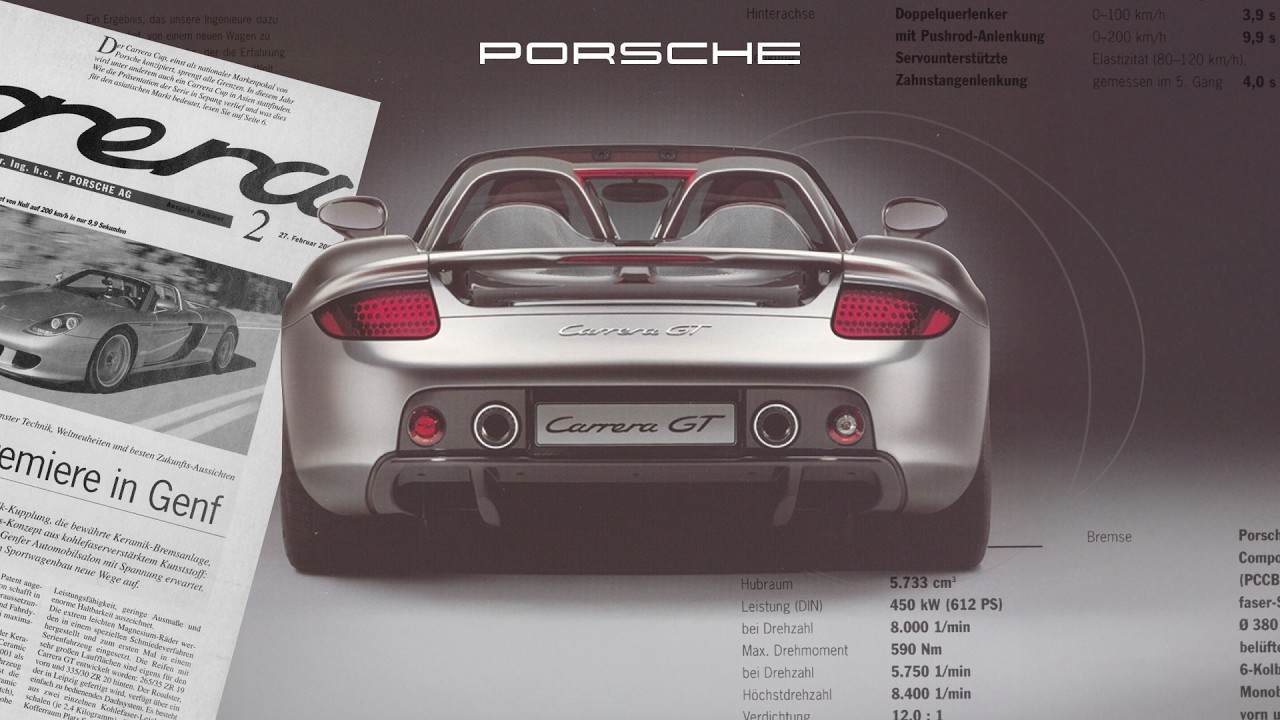
25 years of the Porsche Carrera GT | Untold Stories
And all of a sudden you hear the sound. The car is pure. Excuse my language, but that is the most incredible engine sound. The decision was made, to go full speed ahead. So I was in this jumbo jet, where this box was sitting in the back alongside some race horses. And the pilot, he said “okay, can you give me a hint what’s in the box?”, you know. And he kept nagging me, you know, let me know what’s in the box. I said, I can’t tell you anything, but next week or two weeks from now, when you pick up a car magazine, you can be sure it’s going to be on the cover of every one of them. That was, for me, probably the most exciting project that I could think of at the time of any car company. You not only do a super sportscar, but you do it for Porsche. The engine was already the original engine. That was the whole reason. The engine had been developed for Le Mans. Then the regulations were changed and suddenly we had an engine
but no car to go with it. And that’s how the Carrera GT
came about in the first place. Norbert Singer looked and said, we could also make a road car. Something along those lines. Could that work? Yes, he said in his Franconian way. Yes, yes, we can do that. At the time, there was really no finalised design and there was no finalised model yet. And we knew that time was running out because the board members of Porsche had announced they were coming over at the beginning of March, and the idea was to make a decision that day for the Paris show in October of the same year. The phone rang and Mr. Marchart asked whether I might like to make a super sportscar. I’d say, that takes a bit of thinking time. Well, I needed about five seconds, and then of course I said yes. That was in 1999. By the year 2000, the show car was ready to be unveiled. We had rented a hangar at Santa Monica airport and the whole design team was there, of course. The board members came in and we had prepared a presentation with a full size exterior model, full size interior model, and we had prepared several comparison cars. I remember there was a Ferrari F50, there was a Lamborghini, and some other cars. I think a Dodge Viper. And we took the risk. The decision was made. Okay, we’re going to go full speed ahead for the show in Paris in October. I’ll never forget the entrance in front of the Louvre, 300 journalists gathered there at six in the morning. Just getting them out of bed that early was an achievement in itself. And of course, everyone expected us to be showing the Cayenne. We were not where the journalists were, we stood on the side in one of the arcades with our umbrella, and it was pouring down and it was such an incredible scene. You have to imagine it’s still dark, and then all of a sudden you hear the sound… It was like, incredible. You can still hear it in your head. And excuse my language, but it really was the greatest engine sound ever put into a production car. We knew that if we were going to reveal the car in Paris, we had to show people: This isn’t just our concept of how we imagine the car, we can actually build it. So I was given a team of about ten people. We set ourselves up in Flacht, in the racing department, working out of an old barrack that was actually due to be demolished. By then, the monocoque was already quite far along. We knew almost everything would be completely new: carbon fibre, the bodywork. Our aim was to realise a true racing-car concept. At Porsche, the tradition has always been to win races not only with sheer engine power, but with the best overall concept. That’s exactly what we wanted to achieve here. And there was only one man who could give
the final approval for it to go to customers. His name is Walter Röhrl. I was thrilled. But for ordinary people, it’s practically undriveable in its current form. The car is pure. Every single movement is transmitted directly whether you accelerate, brake, or steer, just like a racing car. Very sharp. It was all “grip, grip, grip – snap.” Roland still knew the people from motorsport very well. In a racing department, you’re used to working together to achieve a goal – and to do it within a certain time. With this car – for the first time, we had the chance to work with these proportions. There was no electronic system on the market fast enough. We had ABS and traction control, but everything else had to be solved mechanically. I did a lot of driving, especially on the Nürburgring. We tried to tune the car so that anyone could drive it. Some cars, when they reach the limit, break away very abruptly – a “snap-over”. Others give you a softer transition. That had to be the goal. This was a true Porsche concept car and also a statement about the future. That’s the Porsche level: every piece of technology I put into the car, it must master without compromise. And that made it clear to me, this was going to be an incredible project for everyone involved. It’s only when you rev it hard that you truly get the sound. It reminded me of Monte Carlo, watching them drivers blasting through the tunnel. The sound was identical – that ten-cylinder. We carried out factory tests with different wing settings and all sorts of things. The car consistently hit just over 325 km/h. But that wasn’t enough for us, we wanted to see 330 km/h. At that time, a new line was created called Porsche DNA. It began the 959, then the GT1, and afterwards came the Carrera GT. To have been responsible for a part of Porsche’s DNA – well, there’s really nothing more to add, is there? I think it really proves that the design language of Porsche is timeless to a certain degree. If this car had never been shown before, would turn up today. I think the community would applaud.
The Porsche Carrera GT is more than just a supercar – it’s a story of innovation, courage and passion. To mark 25 years of its legacy, we’re uncovering the untold chapters behind its creation. From concept to reality, discover how a motorsport-inspired dream became a legend on the road.