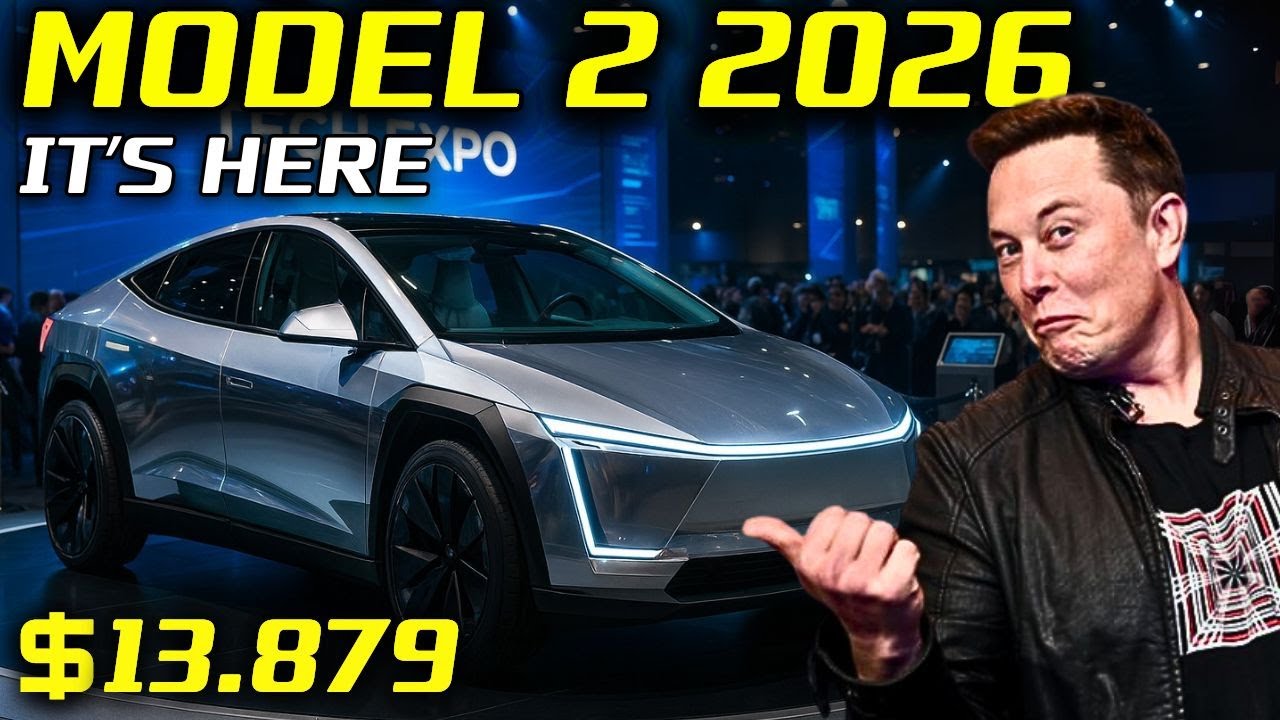
IT’S HERE! New 2026 Tesla Model 2 Us$15,990: Solar Recharge + 300 Hp- Elon Musk Puts Pressure On BYD
Imagine waking up in 2026 and discovering that Elon Musk actually did the unthinkable. Launched a brand new Tesla for just $1590. It’s not a rumor nor an exaggerated fan prediction. It’s official. The Tesla Model 2 has finally gotten off the ground and is taking on the competition headon. While much of the market is still struggling with entry-level EVs in the $30,000 range, Musk decided to pull the rug out from under everyone with an almost unrealistic price tag. And the best part, this price is for the standard version with 280 mi of range. The long range, which promises 310 mi, costs no more than $20,000. Can you believe it? Not even the experts believed it at first. But when Elon decides to make history, he doesn’t mess around. And what seemed like madness turned into a calculated strategy against none other than Chinese giant BYD, which has been dominating the affordable electric car scene with models like the Seagull, launched for around $10,700. But as the saying goes, not everything that’s cheap is worth it. Despite its tempting price, the seagull suffers when you look closer. Its actual range, for example, plummets when it leaves the Chinese standard and tries to navigate American or European roads. And when we talk about comfort and technology, well, that’s another story. The Model 2’s great thing is that it doesn’t offer a barebones car just to compete on price. Tesla is offering a car that comes with the brand’s technology suite, including integration with full self-driving, FSD, the famous advanced autopilot. This isn’t just a nicity. It’s a leap in safety and convenience that competitors simply can’t match in this price range. While BYYD is still trying to address issues like peeling paint and fragile plastics, Tesla is already delivering a standard that the American public trusts and demands. In fact, anyone who follows the market knows that the biggest obstacle has always been price. Many people even dreamed of owning a Tesla, but only wished. Now, with the Model 2, that dream has become a real option for a huge portion of the population. It’s a move that could redefine the entire game. Comparisons with rivals are inevitable, and the domino effect has already begun. Traditional automakers and electric startups have gone into panic mode, trying to understand how Musk managed to break the $16,000 barrier. And it’s not just price and range that factor into this equation. There’s also the trust factor. Does Tesla have flaws? Yes, it does. But the brand has created an ecosystem around the user that few have been able to replicate. This includes constant software updates, a network of superchargers, specialized technical assistance, and an engaged community that helps sustain the product. Meanwhile, BYD still faces serious problems with logistics support and adaptation to Western standards, such as the flood of complaints in Europe and Israel, for example. Interestingly, the Seagull emerged as a symbol of the democratization of electric vehicles. A $10,000 car seemed like the future knocking on the door. But it seems the future isn’t in extremes. It’s in balance. And that’s where the Model 2 hits the nail on the head. It’s not the cheapest, but it delivers quality, range, software, and structure that justify every penny. The perception of value changes completely when comparing cost benefit and considering the car’s life cycle. What’s more, entering the US with a cheap Chinese electric car is nearly impossible. The government imposes extremely high tariffs, such as a 25% import tax on EVs made outside the United States. This alone makes the competitive entry of models like the Seagull impossible. The Model 2, however, will be produced locally with optimized costs and tax incentives in play. It’s a surgical strike to win the hearts and wallets of American consumers. Elon Musk knew exactly where to aim. He understood that if he wanted to beat BYD in the affordability game, he’d have to do more than lower the price. He’d have to redefine the concept of an affordable car without sacrificing Tesla’s soul. And by all indications, he succeeded. The Model 2 isn’t just a cheap product. It’s a strategic response, a declaration of war, and maybe, just maybe, the beginning of a new era in electric cars. When the first images of the Model 2 leaked, the impact wasn’t just the price. What really made waves was the look. Many people expected a car with its own identity, something new, perhaps even a completely redesigned futuristic hatchback. But what appeared there before the world’s eyes was something much more familiar. Elon Musk got straight to the point. It’s basically a Model Y, only smaller, simpler, and with a very different feel. And this, of course, immediately divided opinion. Some felt cheated, as if they’d promised an aesthetic revolution and delivered a slimmed down copy of a familiar car. Others, however, saw it more practically. An affordable Tesla with the Model Y DNA for a third of the price. It sounds like a bargain, and it is. Musk’s idea wasn’t to reinvent the wheel. It was to make it viable for millions of people. And reusing the Model Y structure was a master stroke in that regard. Tesla already completely masters the platform, the production processes, the molds, and even the cost of each bolt. This cuts steps, reduces risk, and speeds up the time until the car hits the streets. Musk’s comparison was even poetic. If the Model Y is a robust novel, the Model 2 is like its pocket version, lighter, more direct, and portable. This analogy fits perfectly because it accurately captures the essence of the new car. It’s not meant to replace, but to compliment. It’s like offering a grandstand ticket to those who dreamed of being at the stadium, but couldn’t afford the VIP seat. It delivers the Tesla experience only in a more compact package and with a total focus on efficiency. The design also reflects this mindset. No bold lines or wing-shaped doors. The Model 2 is clean, minimalist, and functional. No frills, but still with that futuristic feel that Tesla strives to maintain in all its models. Inside, the materials are simpler, but the interface remains modern with a central screen, voice commands, and the entire smart hub the brand has already established. It’s the basics with a premium touch, a blend few automakers can manage without seeming forced. Of course, this didn’t please everyone. Some say it lacked boldness, that they expected something more disruptive, more striking. And you can’t blame them. The marketing surrounding the Model 2 was heavy on mystery and promise. But when you consider the industrial logic, it all makes sense. The goal wasn’t to shock with appearance, but to impress with the final product, price, performance, technology, and mass production. Looks in this case were secondary. Another important point was the decision to maintain the proportions inspired by the Model Y. This facilitates production on existing lines, saves time and money, and also ensures familiarity for those already familiar with the brand. This standardization is the kind of strategy that may seem lazy at first glance, but reveals surgical reasoning when considered on a global scale. Instead of inventing something new from scratch, why not optimize what already works? In fact, this clever repurposing is something Elon Musk had already anticipated in internal meetings. He always made it clear that to reach the promised price, he would have to give up certain luxuries, and that includes a unique design. The focus was on efficiency, not aesthetic vanity. Those seeking visual innovation can continue dreaming about the Roadster or the Cybertruck. The Model 2 is for those who want to enter the Tesla universe without selling a kidney in the process. Even with this simpler approach, the car hasn’t lost its identity. It still carries that Tesla Janice Sequa that makes people turn their heads when it passes by. And that in the end is perhaps the most important thing. The Model 2 didn’t need to be revolutionary on the outside. It already was on the inside through the idea it represents and the impact it promises to make. And that’s precisely where the real difference lies in the way it will be produced on a global scale with technology that promises to be a gamecher. Behind the affordable price and compact design lies an industrial secret that made it all possible. The gigantic 50,000 ton Giga Press. Just to give you an idea, this machine is more than eight times more powerful than the one previously used in the Model Y. With it, Tesla managed to do the unthinkable. Cast the entire underbody of the Model 2 into a single piece. This means fewer welds, fewer screws, less labor, and of course, lower costs. Elon Musk wasn’t kidding when he said he wanted to assemble a car in under a minute. With this new colossal press, well, he may have come pretty close. The Texas factory has practically become a playground for engineers. The new production line was designed entirely around the Giga Press, eliminating traditional processes and drastically shortening the time between the start of assembly and the car being ready for the road. The speed is so great that compared to traditional automakers, Tesla seems to be playing a completely different game. While others are still debating changes to their production lines, Elon is already casting five Model 2 frames in a single mold. Yes, five. All at once. And the most impressive thing is that this solution doesn’t just cut costs, it also improves the product. By casting the car’s base into a single piece, Tesla gains structural rigidity, weight reduction, and even crash safety. The unique structure reduces failure points, vibrations, and even noise. In other words, the Model 2 is not only cheaper to build, but can also be more solid and quieter than many cars above $30,000ers. This is a complete gamecher. This entire industrial structure seems like something out of a science fiction movie, but it’s operating in real time. And it’s no coincidence that Tesla has already announced an absurd production target for the Model 2 42. 42 million units, surpassing the combined figures for the Model 3 and Model Y. Many were skeptical when Musk released this number, and rightly so. But with a production line of this scale, that doubt is beginning to fade. The scale Elon is seeking has never been attempted in the modern automotive market. The curious thing is that all of this was born from an almost childish idea. Musk saw a Hot Wheels car being molded from a single piece and thought, “Why don’t we do the same with a real car?” Simple as that. And then Idra, an Italian company that created the Giga Press tailored to this new industrial dream, entered the scene. Today, this press has become a symbol of a new era in car manufacturing, putting Tesla in a very difficult position to achieve. The Gigapress’s efficiency is so great that it not only reduces costs but also drastically reduces the number of parts. A traditional Model Y has about 70 parts in the rear of the frame alone. With the new technology that drops to just one, fewer parts, less inventory, fewer failures, less rework. This directly impacts the final price and allows Tesla to maintain its 15390 promise without compromising quality. Another striking point is how this strategy fits into the vision of a global mass market car. The model 2 is smaller, lighter, and has fewer variations. This facilitates export, standardization of parts, and maintenance in different countries. Even those who have never owned a Tesla can benefit from the robustness and simplicity of this new engineering. Tesla has essentially created a modular car on a global scale with a cost effectiveness even for emerging markets. If the Giga Press is the beating heart of the new production line, the rest of the body was shaped to adhere to the same principle, speed, simplicity, and efficiency. And this philosophy extends far beyond the metal structure. It extends to the engine, the electrical systems, and even the way power is distributed within the car. Everything was redesigned to fit this new concept. And it’s precisely here that the Model 2 surprises again, showing that despite being compact and affordable, it can still deliver performance that would make many a sports car envious, the surprise begins under the hood. Despite its compact size and affordable price, the Model 2 didn’t skimp on performance. Its impressive 300 horsepower, equivalent to 224 kW, allows it to go from 0 to 100 km Rh, 62 Toyota Mavath, in just 5.6 seconds. This puts the little Tesla on par with much more expensive sports cars, and effortlessly so. For a model designed as the brand’s most simple model, delivering this kind of acceleration is a real slap in the face to the competition. Tesla has essentially shown that a low price doesn’t have to mean mediocre performance. And it doesn’t stop there. While many electric vehicles consume around 20 kowatt per 100 km, the model 2 covers the same distance with just 15 kilob. This represents 25% higher energy efficiency than the market average. Sounds small? Do the math. With an average annual driving of 15,000 kilon, a Model 2 owner saves around $112 per year on electricity alone. And that’s using the average price per kW in the US. Over 10 years, that’s over $1,000 saved simply by driving smarter. This efficiency comes from a set of technical choices that demonstrate Tesla’s progress in motor design. The Model 2’s asynchronous motor not only consumes less, but also has an estimated lifespan of 300,000 km. This is 50% longer than conventional motors, which typically last up to 200,000 km. For someone who drives around 15,000 km per year, this represents about 20 years of use without needing a replacement. Less headaches, less repairs, and less expense in the long run. A car that will last, literally. And as if the engine itself weren’t enough, Tesla took the vehicle’s electrical system a step further. It completely abandoned the traditional 12vt system, still used in virtually all cars, including electric ones, and adopted a 48vt architecture with auxiliary lithium ion batteries. This change seems overly technical, but the impact is enormous. With 48 volts, the car requires less electrical current to power internal systems like headlights, displays, sensors, and connectors. Less current means thinner, lighter, and cheaper wiring. Reducing wiring weight by up to 15% may seem like a small detail, but in an electric car, every pound counts. A lighter car requires less energy to move, which in turn helps save battery life and maintain performance. And that’s not all. The new architecture also improves thermal management, reduces electrical losses, and simplifies maintenance. It’s as if Tesla had replaced the car’s circulatory system with something more agile, cleaner, and more efficient. Another technical advancement in the Model 2 was Tesla’s handling of semiconductor materials. Engineers managed to reduce the use of silicon carbide, SIC, in the drive system, a highly efficient but extremely expensive material by 75%. This generated two reactions. First, general surprise that they were able to maintain performance even with less SIC and second relief as this represents a huge cost reduction in the production process. It’s the kind of decision that only those who fully understand the product can make. It’s worth remembering that silicon carbide is essential for minimizing energy losses in the conversion between the battery and the motor. Reducing its use without compromising performance is an engineering feat that demonstrates how Tesla is refining every aspect of its system. Less conversion loss means more energy is harnessed.
The impossible just happened: Elon Musk has officially launched the Tesla Model 2 for only $15,990, shaking up the global automotive market. With a nearly unbelievable price and sports car-level performance, Tesla’s new vehicle delivers 300 horsepower, 0–60 mph acceleration in 5.6 seconds, and 25% less energy consumption than the industry average. And that’s not all: the Model 2 can recharge using solar energy, fully integrating with Tesla’s Powerwall and Megapack systems—giving owners virtually zero charging costs. It’s a true game-changer that directly threatens BYD’s dominance, especially with Tesla’s plan to produce up to 42 million units using the new 50,000-ton Giga Press.
With a design inspired by the Model Y but optimized for a cost-conscious audience, the Model 2 aims to democratize electric vehicle access. Elon Musk didn’t just break the $25,000 barrier—he delivered a full tech package, including optional FSD, 48-volt electrical architecture, and a long-lasting motor. Tesla has outpaced its rivals in every aspect: price, innovation, mass production, and energy independence. While BYD faces international criticism over quality and logistics, Tesla charges ahead with a bold and strategic plan. The future has arrived, and it has a name, a legacy, and a price tag: Tesla Model 2 for $15,990.
___________
Here on the EV Briefing channel, you’ll get the latest updates on Elon Musk, Tesla, new Tesla Model 2, Model 2, Tesla Model Y, Model Y 2025, Tesla Model S, Model S, Model X, and Model 3. Our focus is to bring you everything about each Tesla EV, whether it’s an affordable Tesla, a potential Tesla cheap car, or a new Tesla car on the horizon. We cover daily Tesla news, EV news, Tesla update, and tech advancements coming straight from the Gigafactory.
If you’re into electric car, future EV, Tesla 2025, improvements in Tesla battery, increased Tesla range, and everything involving Tesla innovation, you’re in the right place. We also track every Tesla reveal, Tesla launch, and of course, all major Elon Musk news and developments shaping the world of electric vehicles.
_____________
#tesla #elonmusk #teslamodel2 #teslamodely #modely #gigafactory #electricvehicles