BMW Neue Klasse – The Sound of BMW HypersonX Explained | Inside Neue Klasse.
One of the intention with the no class is be humanentric. It means that we start from the human experience and human feeling to explore new words inside Noa Classa a video series with people at BMW shaping the future. Hello, welcome back to Inside Nea Classic. This is your front row seat to the future of mobility. Now, I’m absolutely delighted to say that this is a series all about unlocking groundbreaking innovation and really getting inside the minds that have built and designed these incredible machines. Now, along the way, we’re going to have some fun, too. We’re going to play some games. We’re going to be getting inside the minds of the experts. You can get involved, too. This episode is all about sound. Now, when I talk about sound, I’m not talking about noise. Noise is something that my toddler does when he throws his toys across the floor. This is about sound. This is about evoking emotion. This is about going on a journey, taking you somewhere. And I am absolutely delighted to say that I have here with me a very special guest. He is the creative director of sound design at BMW, Renzo Vitali. Hello. How you doing? Hey, Nick. I’m doing wonderful. I’m so happy to get to see you again. Yes, we hung out together seven years ago when you were designing just at the beginning of designing sounds for BMW. Exactly. That was uh actually the first sound for the electric vehicles that went in series with the BMW electric. It was a BMW 7 series and that’s where I got the chance to meet you for the first time. Picture you going on a road trip. You’re in your car. You whack up the stereo. What song have you got playing? Oh, that’s uh I know. I mean, it’s very hard to pick, right? But okay, there I mean I’m Italian and there is one song uh that is kind of iconic. It’s called which means yes um driving and it’s from Lucho Batisti. So it’s like it gives you this move of going with the road, forgetting all the thoughts, just being open and tickling in in. And what kind of emotion does that evoke when you hear it when you are in the driving seat on an open road? Lightness, exploration, surprise, joy. I have to now mention, can you hear that soundtrack? We are currently recording this at a hanger at the BMW Driving Academy and we have the most beautiful soundtrack here I think. Exactly. I mean this is the world we we live in also as uh sound designers. Our cars are evocative in that sense and uh they basically punctuate our daily activities. So let’s get into the kind of details I suppose about today’s main topic which is you know a how do you come about with designing these incredible sounds and what the ambition is ultimately there is so much emotion isn’t there when you own a car you know part of that journey that you have the relationship that you have with it and stepping in switching the engine on and driving off sound is such a big part it’s not just about how the car handles it’s about how it sounds So how do you then come up with the right sound for the right car? It is a big challenge. It is very complex because it touches on so many aspects that are relevant to the driving action per se and to what we want it to be as a BMW because we do have a story of communicating emotions to people. We do have a story and intention of bringing joy to the people. So having that in mind, it’s about finding the right balance between information and emotion because these are the two main elements that a sound is capable to communicate to people. So first and foremost the function is to be clear. What is the sound for? What is supposed to say? What do we want people to act upon if they are listening to this? And the second part which then becomes relevant depending on also the type of of sounds. Which kind of mood we do we want to communicate to the person as we are asking to do something. You might well consider that a collision sound is different from a blinker sound that is different from a start sound. And uh the attempt that we always do to never forget the emotion next to the function. This opens up quite a few questions also because this enters the domain of subjectivity. It’s just like music. There are there is one or few music that you might not like or you might not like for a specific moment. And uh this is what also goes into the designing process in which we question what is relevant and how can we be as universal as possible and still being absolutely recognizable as BMW. So next to the identity part, the information part, emotional part, there is this um wish to say something new to people. Where do you find like inspiration for different sounds? It comes often from the most unexpected places. But what I am very attentive to is to search for things that move me in the first place because sound is the ultimate entity that moves people and this is what we are trying to do. So if we are not moved on the first place there is not much chance that we can move other people. And uh this being said most of the times it comes from the unpredictability maybe also turbulence from human expression that can uh be uh seen in um be it art, be it architecture, be in in performance. Um, for instance, also the performative part of an expression leads being a dance piece or performance art, something that I’m really keen to observe. I like to see the driver as a performer. Nice. So, if we for a moment consider the car as an ali complex performative installation. Mhm. And we see the driver as the one who can control, elevate, explore this installation. All of a sudden that the way we approach to the sound composition is completely different. And this open ups a world of possibilities that not only expand the language that we have known so far. Going back to your question about the mechanical versus the the analog um it is a transformation and we can lead and we want to lead this transformation into the future especially with the no class and we do have with some this opportunity. So if you just think for a moment, you sit in a car, you have your steering wheel and it’s as if with your pedal, you are in the control of the emotions that you can and won’t feel and you and you can communicate to the ones are next to you. That’s how we design mostly driving sound for electric vehicles. We try to make sure that we explore areas that unfolds depending on the intensity that you interact with it. So it’s more about the surprise that we can create. And obviously it’s so critical, isn’t it? Because you know electric cars naturally they don’t really have any sound. Correct. So to be able to gauge that and suddenly bring that emotion and pitch it at just the right point depending on how the car’s handling, how you’re driving it, it needs to be right to reflect the moment and what you’re doing in the car. Um, which is not going to be easy, I’m sure. I mean, I I relate to that and I’d like to touch on also a very relevant point that electric cars have introduced in the human experience um, in the automotive world, which is the silence. Yeah. For first time these cars are very quiet and silence is precious. Silence is the connection with the self. Silence is pondering and we do protect this condition um also with our sounds. And it comes down to how do we build the narrative between the silence and the sound, the presence and the absence. It just comes to my mind this this quote from it’s attributed to Mozart who said that the music is not just in the notes but it’s in the silence in between. So is the narrative between modulating these two elements and that’s the reason why for instance when we we designed the the the sound for the personal experience for the car also for the main cluster it always starts from silence. Yeah. When you drive on a constant speed, the sound disappears and the sound suddenly emerge whenever there is an information that you need to know that is related to your that the gradient that you are driving with your um pedal and so on. I love it because it’s so clever. It’s like if I if I’ve got my kids in the back and I’m doing school run, it’s like I’m in eco mode and the sound will help me then drive, you know, appropriately for in the moment. And then once I’ve dropped them off and I go on my own journey, I can put it into sport mode and it will naturally go with the flow of when I’m driving a bit more dynamically. There you go. We want to give people the possibility to create their mood, to follow their mood whenever they are feeling a specific way. Yeah, you’ve got to tell me more about designing hypersonics as well. I mean, it’s absolutely fascinating. What have we got to look forward to? Absolutely. Hypersonics is the name that we have chose for the sound family for the Noi Classer and it’s a word that is made up of two single words which is hyper and sonics. the idea that we want to sublimate the the sonic experience to the next level. But at the same time, if you look at the word in the middle, there is the word person. I personics and one of the one of the intention within our class is to be humanentric. It means that we start from the human experience and human feeling to explore new words. And we wanted this to be a claim, a manifesto already in the name that the human centricity, it’s part of our intention. It’s part of our target. It’s part of our base understanding of what we want to provide people with. I mean, it is absolutely fascinating the layers to the sound of the machines that we drive. I don’t think I will ever step into a car and not listen to that sound again. I’ll be paying full attention to it. Um, but how do you actually go on to test it and to work out whether it’s going to go into production or not? The sound design process, it goes for uh around about two years and it involves dozens and dozens of people. So it starts with conversation with um colleagues from the marketing sale um corporate identity design engineers. We gather information. We picture a world to find the best sound for that. And then we begin to develop in the studio. Once we develop in the studio, then we open the doors and we begin to share. We see what our colleagues think. We see the reaction. We track them down. We finalize them. We sculpt the sound on and on and on and on. And this convergence process it um it’s carried on for a couple of months up until we see that there is something that is emerging out of what we have presented that it’s leading the way and then we come to a point where we prototype this sound. We introduce this in in a prototype cards and we drive on and on and on. We we drive for instance here in Misak. drive in our test facilities and um we check for what we call the the test of time because one of the most difficult thing in sound design for cars in not the sound per se but it’s what German likes to call translation things which means how much something can stand the test of time like on the long run it’s something that you would still be there and and listen without being annoyed by it. And of course, you have to think that the horizon is not one day in one that one drive one day, one week. It’s here. It’s people buy cars and keep them sometimes for for a decade. And what we aim to is that the sound is data can stand this test. But also first and foremost is that the sound feels innovative. Not in the moment where you’d buy the car, but every time that you jump in a car, there is always a surprise, always a sense of novelty that the sound is capable to to provide. This is BMW. This is the way we like to drive the transformation. I love it. I love it. Thank you so much for giving us a bit of an insight into your world and I feel like we’ve really got into your mind during this session. Pleasure. Thank you for listening. Um, but I have a question for you. Do you like games? Depends on which kind of games. Do you mind losing? Yeah, I guess so. With you would be easy. Well, I’m quite competitive, but I have some games for us to play. You guys can join us as well. Uh, if you are up for the challenge, of course. Let’s try it. Okay. challenge has been accepted. So, this is a game called Guess the Sound. And I feel like as you are a composer, you have an advantage cuz you’re going to have a very good ear. Well, I am not sure, but let’s see if that is the case. Okay, let’s do it. [Music] Indicator. Yeah. Well done. Well done. See? Okay. Got this. Okay. Um, windscreen wiper. There you go. Very good. Okay. One. All opening of the window. Very good. Put your seat belt on. Oh, that’s awesome. Very good. Very good. Very good. I wouldn’t get it. Can you tell I’m competitive? Next sound, please. We’ve already had the window. Oh, now you in first. Uhhuh. Uh, what is it called? The moving of the seat backwards and forwards. Yeah. Yeah, that’s a red one. Awesome, Nikki. Closing out the rear door. Yes, in German. I got that one. Okay, I got this one. Switching the engine on. Is it star sound? Okay, I need to get back in it. Putting your coffee in the coffee cup holder. What? What was that? It was putting your coffee in the coffee cup holder. You know what? I don’t drink coffee. Awesome. Next sound, please. [Music] Uh, touch click. Ah, display. I was going to go for an indicator, but we already had that. Um, important notice. Okay, come on. Last sound. I’ve got no idea. I don’t have a clip. I don’t know. Uh, it might be um maybe when you take the headrest. Oh, okay. Taking the headrest. Say it. Yeah. everyone together. I think you helped me on that one, but I’ll take it anyway. That was a good game. Brilliant. Yeah, that was intense. I would I would really say you are more than welcome to join our sound design team anytime. Great. Well, Renzo, that was absolutely brilliant. Thank you for being such a great competitor, but also allowing us into the mind, your mind, and really understanding the sound of BMW. Absolutely fascinating. Thank you so much. Thank you so much for being here, for listening. It’s been lovely. We really hope you guys have enjoyed listening, watching. Remember, spread the word, share this with your friends. Um, and if you do have any questions, pop them in the comments below. We will, of course, answer them as soon as possible. Um, and we look forward to seeing you for our next episode. It’s a good one. And that’s all I’m going to say. See you then. [Music] [Music]
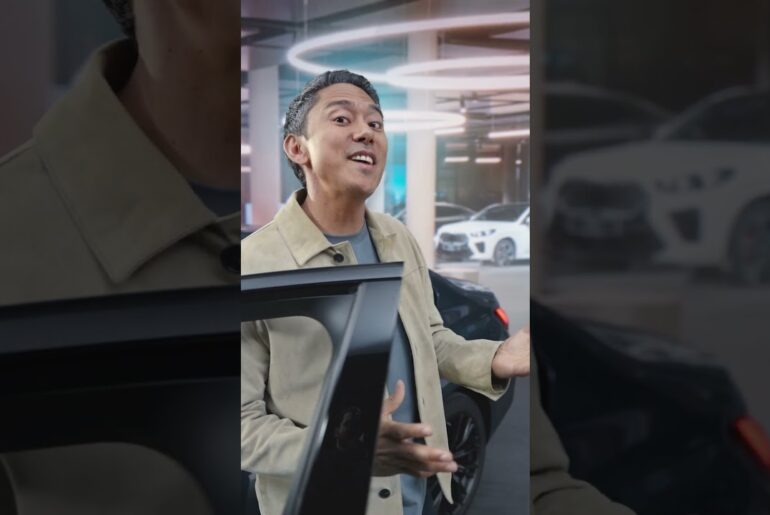
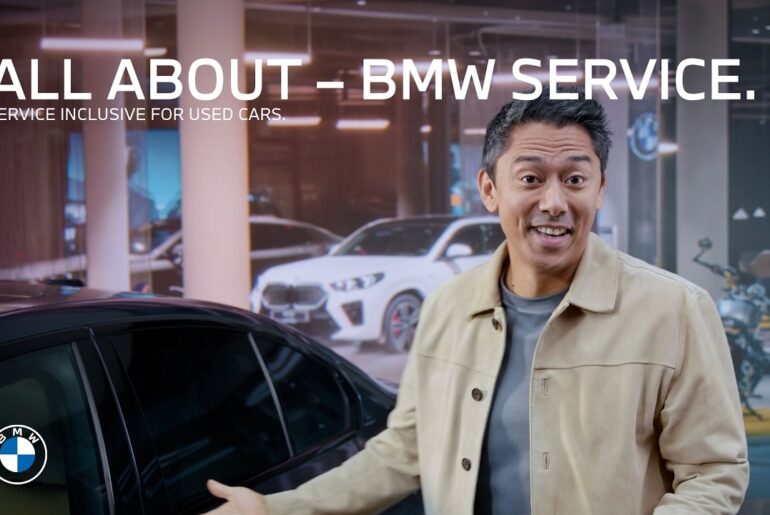
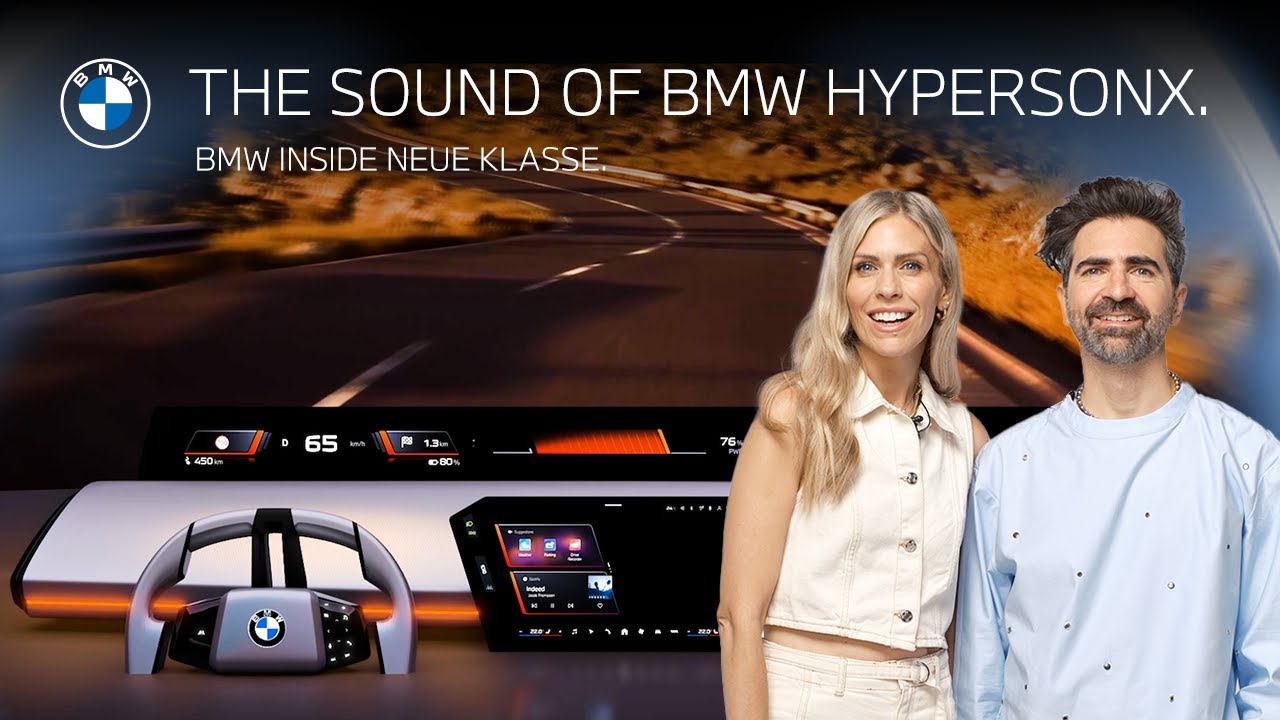
Nicki Shields talks with Renzo Vitale, Creative Director Sound BMW Group, about the future sound of mobility.
In this episode, you’ll discover HypersonX – the innovative sound concept of the Neue Klasse. Powered by BMW Operating System X, it adapts seamlessly to your driving style, from calm in Personal Mode to dynamic in Sport Mode. More than just sound, HypersonX creates an emotional connection between driver and vehicle. The episode ends with a sound recognition challenge – can you guess the tones with Nicki and Renzo?
Inside Neue Klasse is a four-part video series offering exclusive insights from BMW experts into one of the most significant transformations in the history of BMW – from intelligent systems to visionary design.
🎯 Key moments
• 00:00 – Introduction
• 01:51 – Renzo’s favourite road trip song
• 03:10 – Emotion and resonance in electric driving
• 08:13 – The element of silence
• 10:30 – Designing BMW HypersonX
• 14:15 – Sound recognition challenge
• 17:57 – Outro
🔔 Subscribe for more BMW content!
👉 Visit our website: www.bmw.com
📱 Follow us on social media @bmw
#NeueKlasse #BMWiDrive #BMWOperatingSystemX