Ford’s New Affordable Electric Truck Platform Could Change Everything
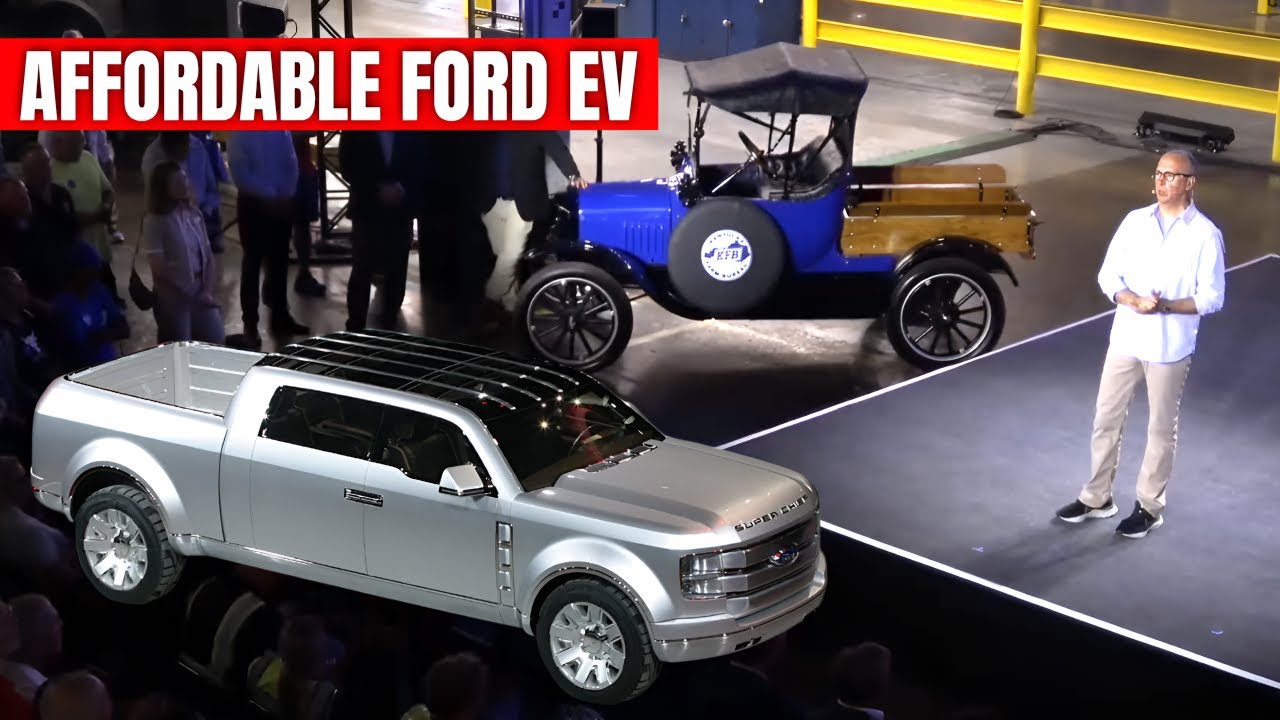
How awesome was that to have Mitch and Pat coaches? Uh I’m so excited about today. We’ve been waiting three years for this for this moment. So, thanks for everyone for being here for all of you on the live stream. It’s great to be here in Kentucky. This is home away from home. And you could debate whether it’s Wildcat country or Cardinal Country, but the one thing that we all have in common, it is Ford country. Uh Let me get serious for a moment. In our careers as automobile people, we’re lucky if we get to work on one, maybe two projects to really change the face of our industry. And I believe today is going to light the match as one of those projects for all of us here. We finally get to tell what we’ve been working on for three years behind the doors. We call this the Ford universal electric vehicle platform. It represents the most radical change on how we design and how we build vehicles at Ford since the Model T. And I’m especially pleased to announce that the first vehicle off this new platform will be a midsize truck built right here at Louisville and will reach customers in 2027. Now, the automotive industry in America is at a crossroads. We’re at a crossroads about new technology and about new competition from everywhere. We saw this coming for years. We knew that the Chinese would be the major player for us globally. Companies like BYD, new startups from around the world. Big technology has their ambition in the auto space. They’re all coming for us, legacy automotive companies. We needed a radical approach and a really tough challenge to create an affordable vehicle that delights customers in every way that matters. design and innovation, flexibility, interior space, driving pleasure, and lower cost of ownership. But we need to do it and be sustainable and make money. And we need to do it with American workers. We looked at the past for innovation. When we looked at the Model T and the the flathead V8 that Mr. Ford installed in our cars in 32, these were times when Ford broke with tradition and broke the rules and we made a leap forward. So back three years ago, we did something that no one really saw. We empowered a tiny skunk works group of people in California, a tenth of the normal people we would hire to do this kind of work. three zone time zones away from Detroit and we gave them the keys to the kingdom. We tore up the moving assembly line that you see here today and we came up with a brand new concept, a brand new vehicle and a better way of making a car after 122 years. We found a path to be the first automaker in the United States to make prismatic LFP battery cells here in the US and not importing them from overseas. And that’s right. You are right. We will spend $2 billion here in Louisville modernizing this plant. And that’s 2,200 hourly workers that have a future for decades to come. And we didn’t stop there. We built a Blue Oval battery park in Michigan. We spent $3 billion building a brand new battery plant and almost 2,000 new jobs for those people. That’s $5 billion and 4,000 American jobs. And what do our competitors do? They build their affordable vehicles in South Korea and Japan and they import them. But not us at Ford. We made a big bet on our country and we made a huge bet on the state and the Commonwealth of Kentucky. Now, why do I say bet? That’s an intentional word. Because there are no guarantees with this project. We’re doing so many new things. I can’t tell you with a 100% certainty that this will all go just right. It is a bet. There is risk. The automotive industry has a graveyard littered with affordable vehicles that were launched in our country with all good intentions. And they fizzled out with idle plants, laidoff workers, and red ink. And at Ford three years ago, we set out to break that cycle. No more compliance cars, no more loss leaders that require a big check from the company to make. We’re talking about a vehicle that can sustain itself, have strong profits, so all of our workers and the community here has actually a sustainable future. We could have followed and packed up our bags and moved this kind of project to South Korea or Japan or somewhere else for lowerc cost labor, currency advantages, lowcost suppliers. But that is not the way we do things at Ford. We took on the challenge many others have stopped doing. We’re taking the fight to our competition, including the Chinese, with teams across the United States. Designers from California, engineers from Michigan, American workers right here in Louisville. And after 40 years in the industry, I could tell you for too long, legacy automakers played it safe. It wasn’t always that way. You know the beginning of our industry, do you know steam and electricity and gasoline were a third, a third, a third of sales. There was no clear winner on the technology side. It was up for grabs. But two things happened. We found oil in West Texas and Henry Ford came out with the Model T and it was game over. The internal combustion engine took off. The Model T became the true first universal car. It was affordable. It was adaptable. Like this pick beautiful pickup truck from the Kentucky Farm Bureau. I mean, it came in different body styles. You could put rail car wheels on it. You could use it as a sawmill. It changed society. And if you had a wrench and some common sense, you could even fix it. Now is time to change the game once again. The new pickup built here in Louisville is going to cure a lot of problems like all those generic two row crossovers that dominate our industry. So, I want you to close your eyes metaphorically and think about a product. This new truck based on this universal platform are going to be more spacious inside than the RAV 4, the bestselling car in the United States. But it will have a frunk and it will have a whole pickup truck bed behind it. No one has seen this kind of flexibility. Tons of room for five adults, bikes, surfboards, work equipment, whatever you need. You don’t have to put it on the top. You don’t have to put it on the tow hitch. It’s all in the vehicle. It will be faster than our Mustang twin turbo. It will be fully connected with a brand new digital experience. no one’s seen in our country. It will offer for the first time fast charging. It will have amazing range. It can power your house for 6 days. You don’t need a generator. You just buy this truck. And we’re going to start the vehicle at $30,000. [Applause] Just like old Henry, our idea is that the people work here at Louisville will be able to buy this car and spend money on other things they love like vacations and their home and their kids’ education. We’ll eventually make multiple body styles for work and play. And Doug and Bryce are going to tell you more about actually how we did that. Our goal again was to put a affordable, unbelievably great product within reach of millions of Americans built in the US by US workers and not be imported. Why hasn’t anyone done that? Because it’s really, really hard. And it’s now time to write that next future and chapter for Ford. So, all I’d have to say is let’s go Louisville. Come on. Now, this project is a lot bigger than Ford Motor Company. This project is about our country. Look, I couldn’t be more proud of all of you. Thank you for being here to share this special moment, but this is the beginning of the moment. This is not the end. We have a lot of work to do. And I’m so honored today to be joined by the first lady of Kentucky, Britney Basher. And oh, by the way, she brought Thank you. Thank you for being here. And by the way, she also brought her husband. He’s a man who knows something about building a future. He’s a strong partner for us here in Kentucky. He’s done amazing jobs for your state and commonwealth. He has trans helped to transform forward. It is my honor to introduce a great leader of our country born right here in Louisville, Governor Andy Basher. Awesome. [Applause] Awesome. Hello everyone. What an exciting day for Kentucky and especially Louisville as we mark another historic milestone with Ford Motor Company. Today, Ford Motor Company and team Kentucky are introducing the world to the future of automotive production. Just like Henry Ford entrusted Kentucky to build his Model T a century ago, today, Jim Farley and chairman Bill Ford are putting that same trust in us. Once again, folks, nearly $2 billion is being invested in Louisville, Kentucky. That investment is going to transform the Louisville assembly plant to create the future of auto manufacturing with Ford’s universal electric vehicle platform. This cutting edge platform will be the foundation for the next generation of vehicles. The best part is these vehicles will be affordable. They’re going to help so many American families keep more money in their pockets for groceries, medicine, school supplies, and yes, even that family vacation. This is a massive investment in our Commonwealth. Even more important, it’s securing an incredible 2,200 full-time jobs for our people. After decades of rumors about the future of LAP today, the news has arrived. Jobs will be here in this plant in Kentucky for generations to come. Current Ford employees, kids, and grandkids will have an opportunity to work right here at the Louisville Assembly plant. One day, this partnership between our state and Ford has continued for decades because in Kentucky, we know how to get the job done. And since I became governor, this relationship has only strengthened. Throughout our history, Ford and Kentucky have announced 22 projects totaling 14.8 billion. Together, we’ve created more than 16,000 jobs. And folks, over half of that investment, $8.4 billion, has come since I’ve become governor. and we’ve added 5,500 new jobs for our people. That includes the single largest economic and jobs announcement in Kentucky history, where Ford and SKON are creating one of the biggest EV battery plants on Earth in Harden County. From the start, we knew this was an investment so bold and so big it could create its own gravity as more companies work to be a part of the EV supply chain in Kentucky. Now, 13.1 billion dollars in EV investments later from companies across the globe, we know that Kentucky has become the EV battery production capital of the United States of America. For most companies and most states, that’d be enough for say a decade or maybe more. But Ford isn’t most companies, and Kentucky ain’t your average place to do business. Together, we’ve rolled out some of Ford’s most important vehicles, the Model T, the Ford F-S series Superduty truck. Uh, a day so exciting we even proclaimed September 27th, 2022 as Kentucky Truckucky Day in the Commonwealth. Yes, it was so big they convinced me to do that. The Lincoln Navigator, the Ford Expedition, and they’re all built Ford tough by our tough and talented Kentucky workforce. Let’s hear it for all these Kentucky workers that helped drive Ford. Today, Ford is again showing that Kentucky not only builds the toughest vehicles, but we’re also the best place for the highest technology and the most advanced manufacturing on planet Earth. And that trust in our workforce is why we’re seeing so many incredible winds across Kentucky. Over the past five years, we’ve now announced a record $40 billion in new private sector investment. A record amount nearly doubling what any other administration has accomplished. Last week alone, we celebrated over $5 billion of new investment in our Commonwealth. Together, we’ve created over 62,500 new jobs in Kentucky at the best three-year average for new wages that we’ve ever seen. This is the first time that those have all happened at the same time. What’s good for our companies, what’s good for our workers, and what’s good for this commonwealth. So now, our success is going to grow. This universal electric platform is Ford’s bet on the future, and they’re counting on Kentucky workers to make it a reality. So, Jim, I want to thank you and Ford for helping us achieve this unprecedented economic success. It takes a lot of guts and a lot of trust to make these types of generational investments. I also want to thank every single Ford employee who has been there for us. And I want to give a big thanks to the thousands of United Auto Workers who are here with us today building a better Commonwealth. They provide the backbone for our construction, advanced manufacturing, and more. Think about it. Ford is literally putting its future in your hands. So, let’s give all these workers one more big round of applause. Today is a historic day for our Commonwealth and this great iconic American company. Together, Kentucky and Ford are bringing the future of the EV industry to this world. Folks, I love our Commonwealth. I love our country. And today is a big day for all of us. No left, no right, no red, no blue, no Democrat, no Republican. Just an amazing announcement for Kentucky and the United States of America. So, thank you. God bless all of you. What a day. And next, we’re going to hear from Doug Field, Ford’s EV Chief of Digital and Design. Thank you all very much. [Applause] Thank you, Governor Basher, not only for joining us at this event, but all of the incredible things you’ve done to support Ford Motor Company. Thank you. We are so excited to show you what we’ve done here. It’s a peak into the future. It’s been really hard to remain quiet, but it’s also really special special for me to be here. My family goes back over a century in Lexington, and I spent a heck of a lot of summers on a hog and tobacco farm uh somewhere between here and Lexington. So, I’m team Kentucky, too. Now, so the reason I came back to Ford was I wanted to figure out how we could combine the innovation of the startups like Tesla and Rivian with the industrial might and the storied 122 history of Ford. And this quote here from Henry Ford was our constant inspiration. The Model T was affordable not because it was a thrifted version of other cars that were out there. It was the result of brilliant minds taking fundamentally new approaches to old problems. We had to do the same thing. So we started very small. We hired a person named Alan Clark who you’ll see on video. And we started to build a very small team around that. Handpicked talent. the best from outside of Ford, the best from inside of Ford. We looked for people who were not only the best in their field, but that also had been dying for a chance to ch challenge convention. And we ran the team differently. It had a fraction of the typical oversight and much lower numbers of people. We didn’t allow people who needed to be managed on the program. We wanted leaders. Every member was expected to understand how their work affected the entire work and to prioritize the total cost and to prioritize the way it was built. Here for example in our old systems a chassis engineer might be actually penalized for spending an extra $5 on brakes. And in cases like this project, that $5 could have saved us $20 in batteries, $25 in batteries because they were lower drag. So our team worked that way constantly and tirelessly. One of our mantras was simple. It was the best part is no part. So we locked the doors. We kept the project secret to shield it from well-intended but sometimes disruptive corporate oversight. Um, even Jim would joke that he wasn’t sure his badge worked on the building. And we gave the team access to everything that Ford offers, but we also gave him the permission to question everything from old obsolete requirements to actually having to use a brand new computerated design system. So the engineers could see their part every day at the beginning of the day in the entire assembly. So they could keep think system thinking. So to ensure focus, we also made sure the entire team was in one building in California. The designers, the aerodynamicists, the people doing the manufacturing work and decisions were made really quickly, either by Allen in a bi-weekly review that I had or straight to Jim to make the final call. And we wouldn’t have gotten this far with this much innovation otherwise. On the topic of efficiency, the same obsession with efficiency goes across every part to make the hole. So we can actually compared to a typical generation one electric vehicle, we can get the same range with a third less battery. And that’s the kind of ingenuity we need to compete with the Chinese. Are we going to compete on labor to make batteries? No. But if we use our brains to have a third smaller battery, we can compete. So just like the Model T, this innovation is going to be how we deliver affordability and as Jim said, a sustainable project, not a charity case, not a compliance project. But I want you to hear more now from the actual team. [Music] This was not easy at all. We’re fighting a battle globally that is ultimately testing our capability. It’s really not about chasing a singular magical secret change is is is necessary. [Music] The mission is to design, develop, architect a new EV platform to build affordable vehicles for Ford Motor Company. We had involvement with both product and manufacturing. Bring us together to optimize every system, every component, every part with this one end goal. And that’s the motivation that drives everyone. Back’s against the wall and you got to make it happen. And it became very clear that there’s no silver bullet really. That’s kind of where we started to figure out, hey, maybe we could actually build the vehicle differently. Traditionally, all the way back to the Model T, vehicles are built on an assembly line. It’s one straight line and you just bring all the parts to the car and the line continues to move. Been around assembly lines for 21 years and they’re built the exact same way and the same problems are always there. Um, for me, wiring is always this nemesis, and if you don’t change that input, then nothing else is ever going to change. There were tons of doubts. Teams would come back and say, “Well, you’re going to fail here, you’re going to fail there, you’re going to fail here.” We came up with the Ford Universal EV production system. So, it’s more of a tree formation. So breaking up the vehicle into three different subasssembly lines in parallel. And what that’s actually doing is shrinking the overall time to go from start to finish with fewer stations and coming together seamlessly. And because of those modular sections, there’s no obstruction. You have now full access where typically we would be reaching in through the door, twist, turn in order to install parts. Now everything is right in front of you. Uniccastings are very important to this architecture. We can have one large casting as one process saving time, weight and cost. This gives you a once in a generation opportunity to architect an entirely new platform with an entirely new powertrain and lower cost for our customer. It saw this as more than an experiment. They saw it as an opportunity to make their mark in automotive. The biggest factor that affects the cost of an electric vehicle is batteries. But reducing the size of the battery makes its way into every other part of the vehicle and allows us to make a lot of cost gains. We are going to use lithium ion phosphate batteries. They are cobalt and nickel free. It also serves as the floor which means better ride isolation from road noise, better handling. This really allows for a much better fun to drive experience for the customer. The battery, the drive units and everything are so much smaller that for the same size outside, you actually get more space on the inside of the vehicle. You can put the powertrain in the front or the back. So, as a result, we could give the customer more legroom, more headroom, and ultimately makes a better vehicle. Developing this affordable EV architecture has been the biggest challenge of my career, but also give us the profound opportunity to really set Ford up for success in the next 120 years. Such a great team. So to pull this off, we had to make a lot of new investments. The uniccasting process that you saw, that giant massive piece of aluminum comes from very new machines and new processes. But when you build a vehicle that way, if you just look at the body and compare it to a traditional pickup, 3/4 of the parts are gone. It has one quarter of the parts. 2/3 of the welds are gone for those of you who run the body shop. And half of the fasteners are gone. But we didn’t stop with the body. In the electrical system compared to typical Gen 1 electric SUVs, the team removed 4,000 ft of wiring. Over 3/4 of a mile of wiring is gone. And the disruption to how we build this whole vehicle is every bit important to us as the product itself. You saw the straight singular assembly line. When we now build this in the tree with the three pieces and bring them together, everything is going to change. If we can pull this off, you will never put an instrument panel or a seat through a door opening again. And this way of building a vehicle, we’re confident, is the first time anyone’s done this anywhere in the world. So, this will be a very special place. Now, you might be wondering why we decided that our universal vehicle should be an EV. It enabled a lot of the revolution you’re going to see in the assembly, but we also believe EVs are the best product by far the customers we’re going after. You charge it at home. It’s always ready in the morning and you never visit a gas station. It’s a really surprising experience once you own one. Incredibly low maintenance and it’s really, really fun. In this vehicle, we have a really low center of gravity from the battery, instant torque from the electric motors, obsessive chassis engineering by a Ford team, and it will be unbelievable to drive. And it’s more than a truck. As Jim mentioned, it’s a it’s a mobile power plant. Outlets in the back can give you high power and let you plug in anything from tools to a refrigerator, and it can provide backup power for your home. And over the time that you own this vehicle, it’s affordable at the beginning, but it also beats the cost of ownership, even if you were to go buy a 3-year-old Tesla Model Y, and you should look it up. Those are pretty cheap. We haven’t even started to get into the innovation in the interior, in the digital space. The groundup zonal architecture that we’ll talk about, it doesn’t just cut those 4,000 ft of wires out. It’s going to have features that the industry has never seen. It’ll start with things like Blue Cruise, which customers are already really finding transformative for their daily travel, but it will keep going a long ways. This is not going to be a stripped down old school vehicle as a path to low cost. But unfortunately, you’re going to have to wait for that chapter. I don’t think there’s many legacy car companies that could possibly pull off a project like this. That’s why I’m here. And I don’t think that the new EV startups will be able to keep up with the kind of innov uh innovation that you’re seeing in in manufacturing and how they can actually turn this into a reality. But new ideas are easy. Innovation is actually delivering ideas and delivering those ideas in a way that millions can access them. As Jim said, success is not guaranteed. When you take these kinds of risks, you sign up for a whole hell lot of work and we’re going to need all of your help. But I know Ford is the company that can and will pull this off. So, next up, I’d like to invite UAW Vice President and Director of the Ford Department, Laura Dickerson. Please welcome. Thank you. [Applause] Hello, Louisville Assembly Plant. I’m Laura Dickerson, newly elected vice president and director of the UAW’s Ford Department. I’m here today with my good friend, Director Tim Smith, UAW Region 8 Director Tim Smith. Louisville Assembly Plant has a proud history assembling a number of vehicles since opening in 1955, including Escape, Corsair, Explorer, Ranger, and F-Series. This plant also strengthens the Louisville community through fundraising and volunteering. And the UAW and Ford are working together on the future of this plant. I’m pleased to introduce two leaders who are going to talk some more about the future of Louisville Assembly Plant and what it means to you as employees and to you our UAW members. Please help help me welcome Bryce Curry, vice president of America’s manufacturing for Ford. And it is my honor to welcome Brandon Riceinger, UAW chairperson, Louisville Assembly Plant. [Applause] Thank you. Thank you. Thank you everybody. Having a good day. All right. Thank you, Laura. And congratulations on the new role. Also a shout out to Chuck Browning on his retirement and the years of service that he did to all of the members. It’s an exciting day here in Louisville. In Ford manufacturing, we live and breathe continuous improvement every day. We call it Kaizen. But sometimes you need to take a dramatic leap forward. You add to the continuous improvement and you go bigger and bigger. And that’s what we’re going to talk about today. We have a chance to build our manufacturing approach here straight from the ground up. And so we’ve listened to all of your feedback and you’re going to see some of the things here that are going to really change the game. All of the things that you haven’t liked that have caused problems and we always start with safety. We know we start with safety, quality, delivery, cost of people. SQDCP safety number one. And so here is some of the things that we’ve been working on out in California and with the manufacturing team. The result is the ergonomics with this process are going to be simply completely different. As you saw, we’re going to build this in a tree formation where the modules are coming in which keeps, as Kevin said on the video, completely open. The vehicle will arrive in front of you with all the components in the right orientation, the scanners, the power tools, the screens built right there as you move it on forward. There’ll be hardly any stock at all in back. So, you don’t have to worry about reaching. If you look at it, there’s less twisting, turning, bending because that’s the foundation on safety is our of our people. And that also then helps on our quality and our costs. Think of this. 84% less 24 in reaches over the front fender or elsewhere. Gone. Okay? 63% less ingress getting into the vehicle both from a safety and from a quality standpoint. That’s been designed out. Reaching above the 5T the 62 in above us over 60some% improvement on there. It’s all intended. And as Doug said, and think of this again, 3/4 of a mile of the wiring harness gone. 22 pounds taken out of that. That’s like carrying two bowling balls for almost a mile. That’s a lot of wear and tear. Gone. We’re making changes not only on this, but also from the quality standpoint. When we think of it, the platform is going to allow us to assemble in a way that’s 40% quicker. Okay, we’ll have more operator density in there so we can do it in a way that’s better for our customers and better for quality. And we’ve reinvested some of that so we can do more insourcing and also automation that helps our operators in these new areas. This decision will give Louisville Assembly the highest level of automation within all of Ford globally. It means now that we’ll on a net be 15 to 20% faster on producing and you’re ready pretty fast. The complexity now that Doug talked about is something that’s really great because if you don’t have the part you can’t make one that has wrong you can’t you can reduce the cost. So 20% fewer parts 50% fewer cooling hoses and hose connections. They’re gone. Pop clamps. Does everybody love pop clamps? Gone. They’re all quick connects now. Better quality, better erggo, better cost. That’s a big deal. It adds up and it ties to the Ford production system of respect for people and stability and flow. It all adds up on making it easier for you so you can focus on the quality and the processing. We’ve reduced the workstations as I said and we’re making the the workstations in a much more efficient way dock to dock so we can get it to the customer faster. The partnership of you and your ideas are going to continue to be needed because as Doug said, it’s going to be hard, but it’s going to be something that’s rewarding and we’re going to keep learning and learning because we’ve got the best innovative ideas out there from all of you. And Brandon and I are going to work that together to the next Guys, we’re proud of what we do here at Louisville Assembly Plant, right? So, I’m excited to be a part of this future. I hope that you guys are excited to be a part of this as well. Uh we’re this is a grand innovative idea here that’s going to push us into the future. It’s going to be great. Uh it’s clear that this product and the plant is going to be designed more around the employees. Um, ergonomics has been taken into it a whole lot more. We should have a a healthier workforce, should be able to go home to your families and not be sore at the end of the day, which is going to be great. Uh, with this new product comes new opportunities for employees as well. Our skilled trades employees are going to work throughout the retool. They’re going to be learning and training on the new equipment that’s coming in the building. Our production employees are going to spend time learning the systems and the a better way of working. There’s going to be all new jobs and a lot of training with those as well. So, we’ve got a lot of good stuff coming to us. I’m going to turn it back over to Bryce. Yeah. No, we’re excited. I mean, training is the core. We’re going to be doing it with respect to the kill trades, skilled trades, with respect to our assembly. We’re going to be using virtual reality and real life training. So there’s a lot of investment going on here because we’ve got to learn this new manufacturing approach and we’ve got to perfect it. What we want to do is make sure that we’re the most efficient, best quality plant out in the market coming from here from Louisville. And we also know that the only way to truly get there from a high-tech product and a high-tech plant is we have to also invest in the digital infrastructure here. So this infrastructure that’s going to be at Louisville will be the fastest globally of any of our Ford plants. Meaning we can do quality checks. We can do things that with the AI that you’re already using today to improve the quality which you’ve done a tremendous job this year. Thank you. Goes to the next level with what we’re going to put in here. Okay. So we’re excited working together. This is a big deal and the partnership that we’re going for. This new product and the investment means a lot to us here in Louisville. This truck will be another signature vehicle here in Kentucky. I can’t wait to get it started and I hope you guys are excited about it as well. As you all know, when we have a thriving plant, we can help build thriving communities. So this is one of the reasons I came to Ford. I’ve been with Ford two and a half years. My wife’s family’s fourth generation. Ford gives back. They give back to the communities. They help change the world and they invest in the US. Since 2020 here in Kentucky, Ford and it its employees have donated over $8 million and over 10,000 hours in the local community right here. And that doesn’t include our 48 dealers and their 2,300 people. So this is where it goes. And the next chapter of our journey begins right here today in Louisville. Brandon, thank you so much for coming on here. Louisville, we’re going to get there. So, to help me wrap the program, I’d like to invite a very talented Louisville Assembly plant employee. She works on the trim line. She’s been recognized for living out what we call our Ford OS behaviors. You can tell it by her disposition, but everybody calls her sunshine. Please join me in welcoming Sandre Hanley to the stage. [Applause] Good morning, LAP. I said good morning. I’m proud to have been a Ford employee for 18 years. So many of us have dedicated our careers to Ford and Louisville assembly plant. This is family. And let me tell you, we are ready for the challenge. Right team? Hey, I know we can count on you. I know we can count on all of you out there to get to the level we need to be. But one of the things, sunshine, you got to sneak peek. We sent you out to California with with some of your colleagues to take a look at the vehicle, meet with the engineering and the manufacturing team. What What did you learn out there? Well, I did get a sneak peek, Bryce, and I can’t wait for the day when everybody in the plant can see the truck and we can show the world. Until then, I’ll say this. When the engineers created this truck and the production system, they were clearly thinking about us, the operators, and that includes me. Let’s wrap up today by hearing from a few other members of the team and their first impression of the vehicle in the new platform. [Applause] They call me sunshine in the plant. Been employed with 30 years. Second generation Louisville assembly plant. I hired in 2019. The next products that Ford make on this platform are lower cost and better for our customer. Traditionally, it’s an assembly line. This is more like an assembly tree. Everything is less wires, less travels of A to B, and then this wiring is going to get a lot smaller. Wow. In trim, all of the parts are inside the vehicle. If we make the vehicle easier, better to build. I think it’s going to help us retain employees. So, the stuff you saw in the PowerPoint before exists. It’s here. You can touch it. You can feel it. That is the size of the main body wire harness. Wow. And it is not needed with a hoist to pick it up, to dump it, to then move it. A lot of the trim components in the interior have undergone design optimizations to make things easier to assemble. The front clip, when you tie this all up, things are right in front of you. You need to make an electrical connection right there in front of you. That’s amazing. When it came to the ergonomics, I’ve been there for 25 years and I’ve never seen anything like it. This is the weight of this part. Oh, that’s a new one. Wow. Right. That is nothing. The other part of it too that we’ve seen is the the middle, right, which is the battery. It’s a lot easier to put the seats on, huh? It’s going to take so much stress off my body. I cannot wait. I never thought it could be made better, but it did. We couldn’t have you guys come all the way here without seeing the truck for the first time. So, why don’t you come with me and we’ll take a look. That’s his middleman. He goes middleman. Oh my god. Oh, wow. Wow. That’s nice. That’s awesome. So, the thing’s like the right size. I think I want one. Just watch how the quality is going to be on this vehicle. We’re going to be number one. It’s going to impact manufacturing for years to come. The amount of innovation that I saw here today going to be huge. revolutionary. [Applause] [Music] That That’s just a sneak peek. And for those of you out there, Tempered Air will be in here in 27 also, so you won’t have to sweat. All right. First of all, thank you everybody for joining us today. We have a lot of work to do. This is the right team to do it. I am super confident. I’m so excited. So, let’s get ready and let’s bring it forward. Well done, Louisville. [Music]
Ford is building a brand-new electric vehicle platform aimed at making EVs more affordable, starting with an all-new midsize electric truck. This innovative approach will allow Ford to create multiple models, including future SUVs, all with competitive range, fast charging, and everyday practicality.
The first model from this platform, a midsize electric pickup, will target drivers who want capability, efficiency, and a price that makes sense. Ford’s in-house development means more control over production, innovation, and affordability, setting the stage for a big shift in the EV market.
Stay tuned as we bring you the latest updates on this exciting project. Do not forget to like, comment, and subscribe for more news and in-depth coverage.
#FordEV #ElectricTruck #AffordableEV
Get More Great Car Videos – Subscribe: https://goo.gl/BSIaFc