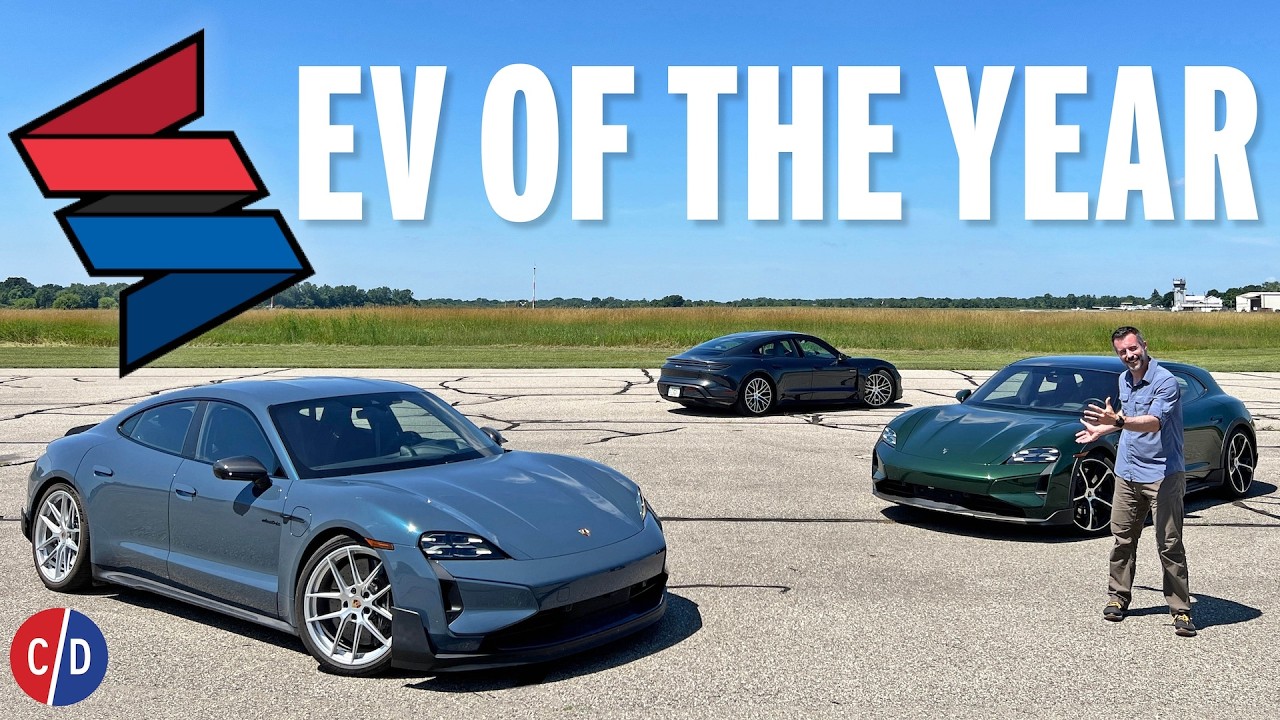
The Porsche Taycan is Car and Driver’s 2025 EV of the Year
Welcome to Car and Driver. Each year, we gather the newest and most recently updated EVs together to test and evaluate to find which one of those matches our criteria for the EV of the year. This year, we have 30 vehicles, which we’re going to whittle down to just one winner, or let’s say an entire lineup. The Porsche TYON in its bewilderingly numerous iterations is Car and Driver’s EV of the Year. The TYON doesn’t have the biggest battery and on one of our four key criteria, value. Well, let’s just say it’s not its strength. And yet, the TYON was our overwhelming favorite. Why? Well, the TYON proves that the best answer for the future of the automobile isn’t merely a faster EV. It’s a car that remembers what makes driving great in the first place. The TYON was Porsche’s first dedicated EV, and it hit the market early, maybe a little too early. In our EV of the year evaluation in 2021, we adored driving it, but it came up short in EPA rated range and it charged a premium. We noted that at the time, a Tesla Model S could take you further on a charge and accelerate just as quickly for significantly less money. Not much has changed on the outside since that initial foray. This Cross Turismo variant joined the lineup for 2021 model year, and it somehow manages to look both functional and profoundly cool to my eyes. It’s the changes underneath the sheet metal, though, that gave the TYON a new Nissan life for the 2025 model year. We’re talking more range, bigger batteries, lower weight, fancy new suspension tech, and so on. For some reason or another, Porsche rated the initial TYON at just 192 to 203 mi of range, depending on the trim. Never mind that the realworld results were much higher. If you look at our test figures, those low EPA range figures were a turnoff to a lot of shoppers who didn’t know better. Now, well, both of the available batteries are larger. The 97 kWh performance battery is lighter, as is the rear electric motor. There’s a whole host of other efficiencies, too, that stack up. The result, EPA range ratings are now 20 to 35% higher, depending on trim, and the effect is obvious in the real world. The TYON 4S we tested in our real world highway range test at a constant 75 mph did 330 mi where the previous one only did 220. Now, with that out of the way, let’s be clear about something. No one else right now is building a better driving EV. This is the base TYON. It’s rear wheel drive. It costs a hair over a hundred grand. And of course, in usual Porsche fashion, there’s the 4, the 4S, the GTS, the Turbo, the Turbo S, the Turbo GT, and then all the Cross Turismo wagon variants. The list feels almost exhaustive at times, and each one gets more expensive and more powerful and more capable of going fast in a straight line. The key thing though is the inherent qualities in terms of handling and ride and the stuff we enjoy about driving, you can experience with the base TYON. That’s what really stands out. And it’s not like this is slow or anything. You get a little bit over 400 horsepower. And in our testing, this did 60 miles an hour in 4.1 seconds and a/4 mile in 12 and a half seconds. That’s still pretty quick. But what I really enjoy though is the overall feel of the driving experience. It’s the way everything works together in harmony. The steering feedback, the steering feel, the steering waiting, the ride, the overall expression of the car as you balance it through corners is one that’s very, very enjoyable. And that rings true for the entire TYON lineup. Although it does get a hair better once you get to the 4S. There’s an ingredient that you can get starting with the TYON 4S that we have to talk about. That’s the result of Porsche’s active ride option. Not only does it make the car greet you like an excited puppy, it makes the ride and handling experience even better. Where adaptive dampers can only react to an input, active dampers can push back. They can actively move the suspension. Each damper has an electric motor and a hydraulic pump that can continuously add or subtract force based on the nuances of the road or what you’re doing at the wheel. Forgive the hyperbole, but the effect is like magic. It turns the TYON into one of the smoothest and perhaps to my rear end, one of the more enjoyable things on four wheels. The way it transforms what the pavement’s doing to what you’re feeling at the steering wheel and in the seat is is incredible. It like deletes bumps like the way I don’t know Elon deletes an embarrassingly tweet. It’s instant. You never knew it even existed. It makes our lumpy Michigan pavement feel like freshly zambonied ice. I’m sorry. Forgive the hyperbole. I started with that. Just keep in mind that our very own Dan Edmonds, a former suspension engineer, called it quote sublime, a gamecher, end quote. All those variables gave the engineers a ton of work. And we’re told the team spent 3 years dialing it in. Their work was worth it. The way this handles pitch and roll still feels natural because Porsche has actually kept some of those body motions in the system. It turns out when you keep a vehicle perfectly flat, that feels weird. It feels like a simulation. It doesn’t feel like a driving experience. And Porsche is all about the driving experience and going a gajillion miles an hour. It isn’t perfect, though. The recent obsession some manufacturers have to include Porsche. Uh to put climate controls on tactile feedback screens is to put it mildly dumb. Like look what I have to do in order to change the air flow from the vents. I have to hit this menu AC button and then I have to play this kind of game of operation up here to change the direction of the air flow. that requires focus and dexterity depending on how frequently I want to change the vents, which can be often depending on the weather outside. And more importantly though, it takes my attention away from the road and the driving experience, which is kind of why I’m driving a Porsche in the first place. Right now, let’s turn to the regenerative braking or lack thereof. Porsche insists to its credit that a proper sports car needs a proper brake pedal. And we get it. We love the feedback from a dialedin brake pedal. It feels good. It’s part of the driving experience, but we also like the ability to choose. Right now, the TYON gives you this sort of token regen mode that you could turn off or on or auto, but it doesn’t really feel like it does much outside of being, I don’t know, philosophically stubborn. Now, to be fair, Porsche is correct that coasting is more efficient than using regenerative braking. But if I really cared about efficiency, I probably wouldn’t spend a4 million on a sedan that has over a,000 horsepower. That’s right. This TYON Turbo GT costs over $200,000, topping the range. And you might be looking at this interior and thinking to yourself, that doesn’t look like a $200,000 interior. And you’d be right. But let me tell you that all interiors blur the same way when you’re doing 60 mph in 1.9 seconds and a quarter in 9.2 seconds at over 150 mph. That’s our test results which are just staggering. This is one of the quickest vehicles we’ve ever tested. It was the first vehicle that we’ve ever tested that did 60 mph in 1.9 seconds. That’s insanely impressive. And launch control, I don’t know. It doesn’t quite feel like acceleration. It feels like instant relocation. It’s the sort of acceleration that’s so immediate and so violent, you really have to ensure your head is planted against the headrest or else you’re going to like want to call a chiropractor. It’s nuts. We’ve already talked about though the rest of the handling characteristics. This just adds more capability to them. You still have the pleasing handling and steering augmented by that suspension tech. Now you’ve got a thousand and some odd horsepower when you’re in the right drive mode. But wait, this doesn’t have drive modes. It has attack modes. Yes, it actually says attack modes on the gauge cluster. Other car companies like let’s say Tesla might be a cheeky joke, but remember Porsche is a serious German company. When they say attack modes, neighboring countries should get nervous. Despite how it might look on the gauge cluster, their turbo GT specific attack mode is actually a temporary power boost, providing an additional 160 horsepower for 10 seconds. We’ve touched on how the inherent driving characteristics of the TYON are so supremely enjoyable, how they’re improved by the active ride, how they’re even more improved when you have 1,00 horsepower. What the Turbo GT does is just it expands the capabilities and increases the excitement, but is just as satisfying. The acceleration is obviously immense. The ride and handling is pleasant, engaging, everything you would hope a Porsche to be. The brake pedal feels nice. It’s easy to modulate. This is just a very pleasing vehicle to drive whether you’re on a back road or just commuting through town. That’s the magic of the suspension, but that’s also the qualities of a Porsche. It just feels good no matter the experience. Whether you’re stuck behind somebody who really thinks going the speed limit on a two-lane road is just the morally correct thing to do. God bless them. Or when they’re gone and you can go full, not going to say throttled, full boogie, let’s say. And this has a lot of boogie to give. You don’t need to get the turbo GT, of course. This one just has all the power. The whole range is going to give you some degree of this driving experience. And that’s what’s so nice about driving a TYON. This year, the field was stacked. We’re at a point where the spec sheets for some of these vehicles reads less like a statement of facts and more like some kind of fever dream. Consider that 20% of the entrance this year had 850 horsepower or more, right? One of them, the Lucid Air Sapphire, actually gives this Turbo GT a run for its money in a straight line. There’s advancements everywhere. These vehicles can charge quicker. They can go faster in a straight line. They can go further on that charge. The list goes on and on. It’s becoming this sort of like digital arms race where the numbers can lose meaning. But that’s why we kept coming back to the TYON. Let’s go through the criteria. Fun to drive. Yeah. Technology advancement and mission fulfillment. Yep. Value. Well, let’s just say it’s an investment in joy. But that’s actually the key. If the automotive future is indeed electric, Porsche is ensuring that we won’t arrive there at a million miles an hour, but bored out of our minds.
Once again, a bevy of the automotive industry’s newest electric vehicles descended upon an unassuming office in Ann Arbor. And once again, a single nameplate rose to the top like a layer of sweet cream in heterogeneous milk. It represents the application of the latest technology in interesting ways, superlative fulfillment of its mission, and, importantly, a lineup that is simply fun to drive. After many near-silent laps around our local evaluation loop, the Porsche Taycan emerged with a crown on its hood.
The Porsche Taycan needs little introduction. The German automaker’s first dedicated EV went on sale for 2020. However, first-run models weren’t quite up to snuff in the efficiency department. In the Taycan’s first appearance at our EV of the Year test—with range anxiety dominating the EV ecosphere—it lost to the Ford Mustang Mach-E. But we love a good redemption arc, and the changes Porsche made for 2025 address the original Taycan’s shortcomings.
Read more: https://www.caranddriver.com/news/a65520209/porsche-taycan-ev-of-the-year-2025/
Subscribe to Car and Driver http://bit.ly/SUBSCRIBEtoCARandDRIVER
00:00 Intro
00:43 Why the Taycan won
01:08 Improvements
01:59 Range
02:49 The driving experience
04:22 Active suspension
06:18 Flaws
07:48 The Turbo GT is one the quickest vehicles we’ve ever tested
11:00 Final thoughts