
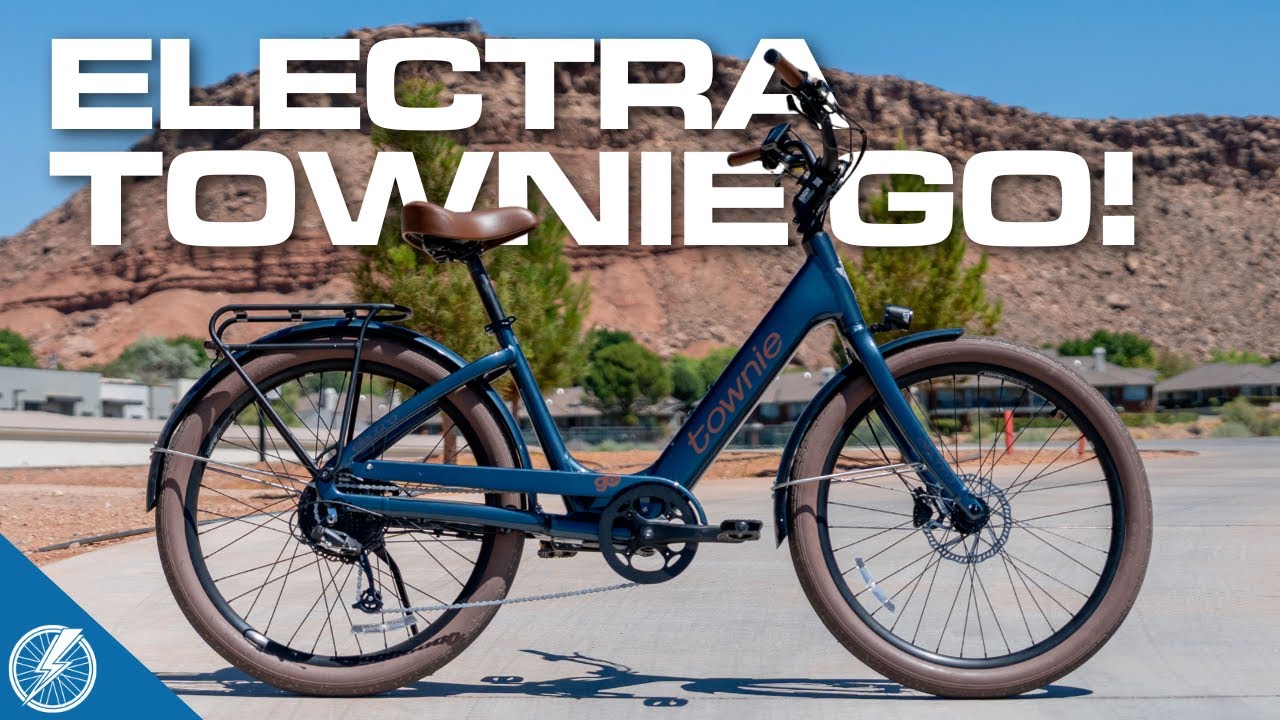
Trek’s First Throttle Cruiser? Electra Townie Go! S Review | Best $2,000 Cruiser E-Bike of 2025?
This electric cruiser ebike is the Electra Towny Go S, and it’s a big deal for a few reasons. First, Electra’s parent company is the global brand Trek, so it’s essentially guaranteed to be welldesigned and constructed. Second, this is one of two new bikes made by Trek to include a throttle, whereas all previous ebikes by Track and Electra were limited to pedal assist only. And finally, with a price tag of around $2,000, this bike is extremely affordably priced for everything that it includes. All that sounds good on paper, but how does this bike actually ride and perform? Let’s go for a ride and find out. [Music] [Music] Welcome to Electric Bike Report. My name is John and I’ll be your host for this review of the Electra Tony Go S. If you’re new here, we’re known for our detailed ebike reviews based on realworld performance tests. So, please make sure you’re subscribed if you’re shopping for a new ebike and that way we can help you out. and then when you do land on one, please use the affiliate link in the description box below when making a purchase to help support our channel. Introduction out of the way, let’s take a tour of the Towny. As a heads up, there are two versions of the bike. The standard Towny Go, which has a 20 mph speed limit for both its throttle and pedal assist system, and the Towny Go S that we’re going to be talking about, which is a class 2 and 3 bike. So, its throttle goes to 20 mph, but it can pedal up to 28 mph. There aren’t any differences aside from speed, but depending on where you live, that factor may limit which bike you can purchase. In any case, let’s start off with some highlights about this bike. The first thing to cover is the pedal assist system, which does a really great job of blending an active ride with a fun and generally loweffort experience. The Towny combines a helpful 500 W rear hub motor and a torque sensor. So, its motor responds to the amount of pressure you put on the pedals, but it also kicks out a pretty high baseline of power with only casual pedaling, so you can get around easily without feeling like you’re working too hard. Another highlight is the bike’s overall feel and geometry. As you might expect for a cruiser, the Towny has an upright riding posture along with a soft yet supportive saddle and a set of swept back handlebars. So, it has a good baseline for comfort, but on top of that, the Towny was engineered with so-called flat foot technology, meaning that the pedals are moved somewhat forward, and the seat tube is slackened or angled back. The goal of this is to allow riders to pedal comfortably and also touch the ground without hopping off the saddle when they’re stopped. And for the most part, I think the design team succeeded. Another highlight is the Trek Central app that pairs with the Town Go S. Now, smartphone apps aren’t anything new or different these days, but Trex app has some really cool features. It does relatively basic things like tracking ride data and giving you turnbyturn navigation, but it also goes above and beyond in a few areas. Among other things, you can take advantage of some cool new charging and battery life extension features. You can tune the motor’s output and sensitivity, and you can see a visual representation of how far you can ride on a single charge using the GPS map. I’ll walk you through the app later in the review, so be sure to stick around to see all of those features. But next, let’s walk through the rest of the Town Go specs and components. The 500 W motor I mentioned peaks at 600 W and generates up to 60 Nm of torque. And that’s paired with a 48vt 520watth battery that’s UL2271 certified and sealed in the bike’s down tube. The Town Go has an 8-speed mixed microshift and Shimano drivetrain, which includes a 44 to chain ring, a KMC chain, and an 11 to 34 to Shimano cassette, as well as a Microshift Medzo derailure operated by a trigger style shifter on the right handlebar. There’s also a set of Rush hydraulic disc brakes with two piston calipers and 180 mm front and rear rotors. There are a couple of parts that will vary depending on the frame size, including the fork, wheels, tires, and seat post length. So, there are two frame sizes. The small medium frame comes with 26-in wheels and tires, a fork to match, and a 330 mm seat post. But then the medium large that we have has 27 1/2 in wheels, a fork that fits those wheels, and a 400 mil seat post. In either case, the Towny comes with 2.35 inch wide street tires. And it’s also decked out with front and rear fenders, a chain guard, and an Mik cargo rack with a 60 lb weight limit that’s compatible with tons of standardized accessories, including child seats, storage bags, pet carriers, and more. The bike also includes an LED headlight, and a tail light with turn signals, and a brake light. Up in the cockpit, there’s a set of 700 millimeter handlebars on a custom stem that includes a quad lock mount. The bike’s throttle lever and combination control panel and display sit on the left handlebar, and there’s a module to control the turn signals on the right handlebar next to the shifter. A few final details. The Town Go S weighs around 58 lb and is UL2849 certified. It has a total weight limit of up to 300 lb, which includes the weight of the bike. So that means it can handle up to 242 lbs between the rider and any cargo. And finally, the bike comes in four color options. This one’s called Shark Gray, but there’s also Aloe Vera, Vapor, and Orchid, which are a teal, a white, and a fuchsia color, respectively. All right, now that that’s all covered, let’s get into our test sections and see how the Towny Go S performed. [Music] Starting things off with our brake test, we put those Rush hydraulic disc brakes to the test by pedaling up to 20 mph, applying the brakes at a predetermined line, and then measuring how far the Towny Go S traveled before stopping. We ran through this process three times, and then took an average of the bike’s results, which turned out to be 22 ft. Even the average stopping distance of similar cruiser style ebikes we’ve tested is currently 20t 11 in. So, the Towny Go’s result was 13 in beyond average, but it’s still very much within the zone of expected results that we consider safe and effective. I think the bike’s tires were the biggest reason for its slightly longer than average results. First, because it sort of bounced on its tires when stopping, but also because I noticed that it could skid a bit with the relatively smooth street tread. I had zero complaints in my personal testing of the Towny. I thought the brakes felt great. They had good modulation and they kept my speed in check effectively when I was riding downhill. They also stopped the bike quickly a couple times when cars were involved and I really needed them to. So, I think it’s more than fair to say they did their job. We give the Tiny Go S two thumbs up for being well equipped with great brakes. [Music] Our speed test has the goal of seeing how fast a bike can be, but we also use it to get an idea of the bike’s programming and the force of its throttle acceleration. I took the Towny Go S out to our local shared use paths for this test along with a GoPro. So, let’s see what happened and we can talk about what the results mean once we get back here. All right, we are here for speed test on the Electra Towny Go. So, we’re starting things off here with no pedal assist and you can see I’ve got both the bikes display and the Trek Central app here. So, this is the ride panel within the app uh that shows basically the same ride data as the display just a little bit of a different format. So, um, we don’t have ten of a mile per hour here. So, we’re just going to kind of have to estimate based on both of the readouts here, but that looks pretty steady in the 9 mph range. Well, okay, call me a liar. Let’s say let’s say maybe about 9 and a half. We’ll kind of take an average of these two with no pedal assist. And, you know, pedaling feels good, but um, you know, we’re on an ebike, so let’s go up to eco mode. This is the lowest power level. Um, the bike felt good to pedal before, but it just this just took basically all the effort out of it. Um, very relaxing here. Not really having to put much work in. The motor kicked in right away. It’s very smooth. It’s super quiet. I really can’t even hear it. I can definitely feel it though. Um, making a big difference. Obviously, we are going quite a bit faster. So, yeah, let’s say up towards 15 mph, up towards 16. So, I guess we’ll average that for about 15 and 12. Yeah, let’s say 15, 15. Let’s go up to mid. That’s of course the middle power level out of three. We will shift up a couple gears here. And I mean, as easy as the ride was in eco, it’s even more so here. Um, but it does still feel pretty natural. like I’ve got um a good amount of I guess bite on the pedals is a good way to describe it where I feel like I’m you know still contributing to the ride but uh the motor is just giving me a lot of bang for my effort. So yeah, getting up here kind of around 20 m hour looks like. Yeah, we’ll say 20 and a half or so. And then let’s go up to high, the third and highest setting. Shift up to eighth gear. Again, not really putting much pressure on the pedals. Pedaling pretty leisurely. Um, but another big difference in speed. We’re up to about 25, 24 and a half, 25. Yeah, that feels good. Let’s say 25 and a half maybe. We got up to 26 there. So, okay. And then just for fun, I’m going to put a little bit more into the pedals. Just make sure we can get up to the class 3 speed. Yeah. Okay. Very easy. And I put a little bit more muscle into it, but not a whole lot. So, yeah, if you want to cruise fast, this thing can definitely do it. But, all right, let’s uh turn around and do the throttle test. All right. And then the last thing to do here is the throttle acceleration test from 0 to 20. Let’s go ahead and start in 3 2 1 go. All right. Nice and easy off the line, but then picking up steadily. We’re going 16 18 19 20. Okay, let’s uh go ahead and head back to the studio. So, running through the numbers one more time. I started off pedaling fairly casually at about 9.5 miles per hour without pedal assist. Going up through the bike’s three power levels, I averaged around 15 and a half miles per hour in eco, 20 mph in mid, and then with a little extra leg work, I reached 28 mph in the high assist level. Now, first of all, I have to say that I personally appreciate having just three assist levels. both because it makes our testing process simple and more importantly because I think it makes finding the right power level for where and how you’re riding very quick and easy. But anyway, looking at a graph of my data, you can see that the overall shape is pretty linear, which reflects fairly consistent increases in speed and power between each of the assist levels. And I think that definitely lines up with how the bike felt. I spent most of my time on the Towny in eco mode, which felt active but not tiring. Although I think if I were using it daily, I’d probably want to get around a little bit faster in the mid power setting, I didn’t really find myself needing the full power of high mode, except when specifically trying to go as fast as possible. And of course, that power level also helped out the most when pedaling uphill. In the throttle portion of the test, I think the bike’s acceleration was exactly what I’d hoped it would be. It didn’t take off too fast, so it felt safe and approachable, but it still got up to speed relatively swiftly. So, it still felt very usable for getting off the line when I was stopped. All in all, everything worked out great here. So, the Towny Go S gets another two thumbs up. Range is a big factor in most folks buying decisions, so we test every bike’s minimum and maximum range in two separate tests using their lowest and highest power levels. In both cases, we start with a fresh battery and ride until the charge is fully depleted. And we use Straa to track our mileage. So, in the Town Go S’s case, our team covered 35 miles in the high mode test and 55.6 mi in the eco mode test. I compared those results to our data from a group of similar cruiser and commuter ebikes we’ve tested, and those other bikes average 32.6 and 65 miles. So, the Towny came in roughly average to a little below average in comparison. Now, there were a few factors that came into play during this test, including battery capacity, the relationship of battery capacity to nominal motor power, and the bike’s overall programming. Going by the numbers, the Towny Go was a bit more efficient than the pool of other bikes we used for comparison. So, it used fewer W hours per mile in both tests, but it also had a smaller than average battery. So, its slightly shorter results in the low assist test make a lot of sense. Overall, the bike did very well here. And considering that I found eco and mid power levels to be very usable back in our speed test, I think that most riders should fall between our results and maybe even more toward the high end. But do keep in mind that in the high power test, we made sure to keep the 20 mph speed limit on our local bike paths. So, just be aware that riding faster will burn through charge faster as well. Speaking of charging though, I want to talk a bit about the Easy Mag charger that pairs with this bike. The charger has a magnetic lead that attaches to a port on the bike’s down tube. And I really like that it oriented itself and snapped into place almost entirely on its own. With how many bikes we test, we spend a lot of time fiddling with plugs and ports. So, it was really nice in this case that this one attached so easily, but there are some other really cool things about it as well. The charger can be wall-mounted, and then it has a bar-based light ring that shows how full the battery is, so you can keep it out of the way and very quickly monitor the bike’s charge with a glance instead of having to turn the bike on. And then on top of those things, the charger puts out 3 amps of power instead of the more common 2 amps. So, it charges the battery pretty fast. If you totally drain the battery like we did in this test, you should be able to get a top back up in a little over 3 and 1/2 hours. [Music] We tested the Town Go S’s motor and climbing power in our hill test at a location we call the Devil’s Backbone. This hill is a half mile long. It has a total elevation gain of just under 220 ft and the path’s average grade is right around 8%. Our test rider for this one is Justin. He throttled and pedled the Towny to the top of the hill. So, let’s go see how those tests went and we can compare results once we get back here. All right, we are out on the Electra Towny go doing the throttle test. So, love how they added a throttle to this and so far it feels pretty good. Right at 18 mph before we hit this first section. Um I’m not sure if this is going to make it up to be honest. I kind of wouldn’t expect it given kind of lighter weight. Um beach cruiser style, more more cruiser style. So, we’ll see. Um down to 13 12 mph. Going to bottom out right at 12 miles per hour on that first steep section. Gaining some speed here. Back up to about 16 right about 16 mph before this first turn and this next little bit. So, we’re going to be where we’re going to really stress it. So, 12 mph down to 11 miles hour. Holding pretty decent right around 11. So, I think we’re going to bottom out here. Right about 11 miles per hour. Slow down to make this turn. Made this turn right about 9 miles per hour. And as we Let’s see what it gets what it gets to before we hit this first kind of checkpoint at the lamp post. We’re going to hit this right at 12 mph. Um, in terms of the motor noise, this is exceptionally quiet. Um, phenomenally quiet. Actually, I’m hardly hearing it. You’re you I would be shocked if you’re hearing anything cuz I really have to be quiet and listen to hear something. I am hearing the rear hub clicking which is nice. Um, good quality hub there. And just in general, very quiet motor. Um, and it’s doing a pretty good job here. So, I’ve been kind of going about 9 10 miles an hour through this section now at 12. And I think this is going to actually surprise me a little bit. I It’s It’s not going to be like a top, you know, top ring barn burner by any means, but that’s not what this is supposed to be on this bike, but I think it’s going to be fairly decent. Um, so right now we’re at 14 15 mph. probably drop a little bit here and we are going to finish the test at this lampost right at 12 miles per hour. All right, we are back out on the Electro Towny Go and we are now doing the pedal test. I’m in kind of seventh gear. Got to about 17 miles an hour before this first hill here. Um down to 14. Doesn’t feel like I need a shift yet. 13 miles per hour. 14 miles per hour. So, I almost wanted to shift, but don’t think I needed to. So, now going to speed up a little bit here. Going to keep it in seventh. 15 16 miles per hour there. As we make this first turn, I am going to downshift one gear to sixth there. So, I’m at 13 mph, 12 mph. Just keeping a nice cadence there. Looks like we’re going to bottom out right about 11 mph. I’m going to downshift once more before this turn. Make the turn. I’m going to shift up one time. So, we’re back in sixth gear. 11 12 mph. And that’s right where we’re at. 11 to 12 miles per hour. Um, at that first the first light light lampost. Um, as far as like pedaling goes, it’s pretty relaxed. I’m pushing a little bit harder than soft pedal. Um, well, this bike’s kind of in like a they have the the pedal forward design, so your your legs are in front of you and so if you really just want to cruise around, totally can cruise around. Does hurt you a little bit on hills. Um, cuz it’s not directly below you. So, you, you know, I am using a little bit more power than I would if I was if those pedals were directly underneath me. But then it’d be a different type of bike. So, Um, in general, like I said, I’m going about 10, 11 miles per hour, not having to pedal very hard. So, you just slow down and have it have a little better cadence. Um, motor very smooth, very responsive still, and still very quiet. So, overall, very happy with the hill climb results. We will see what they’re what they what they come in at. We’re going to finish the test right at 10 mph. Okay. So, as you can see, the bike completed both portions of the test, and as Justin was saying, at least going by feel, its performance seemed to match its style very well. Looking at the data, though, Justin finished the throttle portion of the test in 2 minutes and 23 seconds with an average of 12.7 mph. His pedal time was a few seconds slower, coming in at 2 minutes and 36 seconds at 11.6 mph. Similar cruiser and commuter ebikes we’ve tested average 2 minutes and 6 seconds on throttle and 2 minutes and 5 seconds pedaling. So, the Towny Go S was a bit slower than average in both portions of the test. Although, it’s worth pointing out that we don’t have a huge pull of similar bikes to compare to since we recently moved our hill test location. I do think the results make sense with a few considerations in mind, though. First, the Towny’s motor is powerful enough to do the job, but its peak of 600 watts is relatively low in comparison to other bikes we’ve tested with 500 watt rear hubs. So, that seemed to be the biggest factor in the throttle portion of the test. And then, as Justin mentioned in the pedal test, the bike’s pedal forward design does sacrifice some efficiency for comfort. So, that may have slowed the bike down a bit as well. Overall, we are pretty satisfied with how things lined up, especially considering that this bike is made to be fun and relaxed and comfortable instead of crazy powerful. We chose the Devil’s Backbone to be representative of hills that you’re likely to encounter in the real world. And clearly, the Towny’s motor is capable of handling those kinds of situations. So, bottom line, depending on the intensity of your local hills, you might need to add some leg power to get yourself to the top of them. But even if you do, you shouldn’t have to work too hard. [Music] There are lots of factors that influence how a bike feels to ride. From the overall comfort level to the motor engagement, the user interface, and beyond. Those are what we’ll be focusing on in this ride quality section of the review. But let’s head back out on the Towny and talk about some of the basics. I’ll see you back here to add some additional thoughts and then we’ll go through all of the features in the Trek Central app later on. All right, let’s talk about ride quality here on the Towny Go S. So, this is of course a cruiser style ebike. So, you know, you’ve got a couple of uh expected things that play into the ride quality, such as the upright riding position and the nice cushy saddle. The soft back handlebars here just gives the bike a really leisurely vibe uh that, you know, goes hand inhand with its style. So, and what it’s intended for. But anyway, there are two frame sizes for this bike and uh the recommended height range for both is 4’11 up to 6’4. Now, we are on the larger of the two, the medium large frame, and I’m 5’11, so kind of smack in the middle of the recommended height range for this version of the bike. Uh we’ll talk a little bit about what I’m feeling here. Leg extension is good. Um, it’s definitely a little bit different on this bike because of the quote uh flat foot technology that we’ve talked a little bit about before, which again basically means that the seat tube is angled back or slackened and uh the pedals and cranks are are moved a little bit forward. So, you kind of get the sense of pedaling out and down instead of just sort of straight down uh like on like on many other bikes. But again, overall very comfortable. Um, now when it comes to the actual flat foot part of it, um, if I come to a stop, uh, let’s just go ahead and do that. I can definitely put, uh, both of, you know, both sets of toes down, but I don’t have the my my feet flat on the ground, uh, just with where I have the saddle at right now. Uh, it felt a little bit cramped if I lowered it to that point, but um, again, different rider preferences uh, may be different for you. Um, but anyway, then on the reach side of things, that is definitely on the longer side here, I you can actually see, I’m sure, that my arms are pretty outstretched. My elbows aren’t totally locked, but they they definitely are projecting in front of me here, kind of down and out. Um, now the, you know, degree of that varies a little bit depending on how my upper body leans, but, you know, with with a pretty vertical position, yeah, my arms are definitely outstretched. So, uh, just something to keep in mind. Um, now as far as adjustability goes, you have a lot of room in the saddle. There’s about 10 in of adjustment in saddle height. Um, things are a little bit different up front here with the stem. This is actually like a custom stem with sort of a fixed angle and then also um some cutouts just to allow for the internally routed cables. Um, so you know, if you wanted to make adjustments to handlebar height or reach, you probably might run into some difficulty with the stem. If you were looking to swap that out, you’d probably want to stick with, uh, looking at maybe some different handlebars. But in any case, uh, moving on, there’s no suspension on this bike. There’s a rigid fork up front. Um, you know, which just really kind of plays into the bike’s crisp handling. We talked a little bit about that. Uh, feels really good here. But, you know, I got to say I don’t really miss having a suspension here. And that’s largely just because of the tires on this bike. So, even on Trex’s website, they are, you know, listed as balloon tires. And, uh, that’s definitely accurate. You know, in my experience, they they do a lot of work when it comes to absorbing bumps and dips and vibrations. Uh, we’ve talked about in the brake test that they, you know, the bike kind of bounces on them sometimes. Um, and so, you know, they’re definitely doing their job there. They also make the ride feel nice and stable uh just with their width. So again, the sizing there is going to vary depending a little bit on the frame size. So either 26 or 27 and 12 in wheels. And then the tires are 2.35 in wide. So uh and then yeah, a nice street tread pattern giving you good traction on paved surfaces here. And then the last thing to talk about is the 500 W rear hub motor. And you know, again, we’ve touched on that uh periodically throughout the review here. three power levels, but even the lowest one of those gives you plenty of of assistance. Um, so, you know, the ride is engaging and active and it feels pretty natural, but at the same time, um, it’s very easy. You don’t have to really work very hard. And then, you know, of course, with the three different power levels, it’s just really easy to find the amount of a pedal assist that you need. So, uh, a lot more to talk about with the app. We will come back out and talk more about that later on, but for now, let’s bounce back to the studio and then I’ll see you back here again shortly. To touch back on sizing and fit, the small medium frame is intended for riders between 4’11 and 5’8, while the medium large we tested fits those from 5’5 to 6’4. Overall, I liked how the bike fits, and I think it really succeeded in feeling like a leisure bike. Although, if I’m being nitpicky, I wouldn’t have minded an adjustable stem instead of the Towny’s fixed stem just to be able to bring the handlebars a little higher and closer. Otherwise, it’s really cool to see a throttle on this bike, especially considering that ebikes made by Track and Electra have typically been limited to pedal assist only. The subject is definitely divisive, but there’s a lot to be said for the ability to ease off the line when you’re first getting moving or to simply take a break from pedaling if you’ve been out on a long ride. And I think most folks out there are going to find this feature appealing. My only real point of critique is related to the battery. The fact that it’s sealed in the down tube helps make the frame more rigid. And I think that’s a great benefit of this design, but it does require the entire bike to be brought inside for charging. Do keep in mind that the battery can be accessed for service or replacement by a technician if or when it is needed, though. Before we dive into the app, I want to give Track some kudos for how well equipped this bike is. I’m always really happy to see things like integrated turn signals and an MK compatible cargo rack, but even little things like the quad lock mount on the stem go a long way. We’ve used that system before and found it to be nice and sturdy. So, if you plan to use the Track Central app regularly, it might be worth looking into a Quadlock compatible phone case. As a last comment before the app walkthrough, I generally really like the Track Central app, but do be aware that if you need to unpair from the bike to allow another user to connect, the process isn’t the most userfriendly. We actually had to delete our account to disconnect from the bike fully. I don’t think this should be a huge deal for most folks, but it would be nice to be able to set up multiple user profiles for those who share bikes. Anyway, let’s go back out one last time and talk about everything the Trek Central app does well, and then I’ll see you back for a summary of the main points we’ve covered. All right, let’s go ahead and do a run through of the Trek Central app here. Um, now I do want to point out that there are some differences in the app with this bike versus other bikes that are under the Trek label. just uh differences in some layout things and some of the features. Uh but we’ll talk strictly about what you get here with the Towny Go. Um so this is the you know home screen for the app where it shows you a picture of the bike that you’re connected to. Uh now there is a sort of number or I guess jumble of numbers and letters beneath that and that is what will show up in your Bluetooth uh connections for the bike and it says here that we are connected to that which lines up with the Bluetooth icon on the display. Uh but then yeah, below that we’ve got the battery percentage. Now I’ve lo noticed a little bit of a differentiation in the display and the app. Maybe a couple percentage points here and there, but that is lining up nicely right now. And overall, it’s been pretty close. Uh but then going through the rest of the stuff here on the main home screen, we’ve got range estimates for the different assist levels and the throttle. And you can see that those will highlight differently as I move through the assist levels. Um, now this let’s ride button here below that. That’ll take you over to the ride panel, which is what we’ve been looking at at other points throughout the review and during these video clips, uh, you’ve seen the speedometer and just all the general ride data that kind of matches what’s on the display. Uh, we’ve got tune your motor. So, uh, actually, let’s go back to that in a second. Uh, and then we have a navigation button that will pull you over to this other panel at the bottom of the screen as well, as well as an odometer reading there. So, uh, again, diving in a little bit deeper, let’s actually just start kind of back at the top. We have, uh, over here next to the battery percentage, a gear icon. And if you go in here, there’s, uh, some battery settings that are really cool, and and I haven’t really seen these in too many other apps out there. Um, so let’s just run through those. Number one is the charge alert setting. Basically, what this means is that you can set a desired charge limit for your battery and then if you have it connected to the charger, your phone will send you a notification uh just letting you know when it reaches that percentage. So, uh just really gives you a little bit more control over your battery charge level u which can help to extend its life. Although there’s another setting for that here called extended life mode. So, basically if this is active, it does not charge your battery to 100%. Now, that does, you know, mean that you get a little bit less range out of the battery, but, uh, it doesn’t complete a full charge cycle, uh, which just basically means your battery can hold a charge longer over time. You’re kind of reserving some of its capacity to extend its lifespan. Uh, optimize charging. This is a setting for anyone who, you know, typically just tends to leave their bike on a charger. And this just basically limits the the the flow of power into the battery and charges slowly over time so it’s not, you know, sort of flooding the battery and then keeping it on power. Um, again, just kind of helps to maximize lifespan there. And then we have a longterm storage mode. So, if you’re not going to be riding for a while, maybe you know you’re putting your bike away for the winter or something, um you got to make sure it’s meeting a couple criteria here. So, like at least 60% charge. Um but then if you enable this, it basically puts the battery in like a sleep mode. Uh that helps to extend its lifespan. Now, in here, there’s also a ton of data about your battery and how you’ve used it. Uh we’re not going to run through all that just cuz there’s a lot of information there, but it is very cool and and that’s also another thing that I really haven’t seen elsewhere. But if we go back to the home screen here, uh let’s go ahead and go into the motor tuning settings. So you can see here that we have uh eco, mid, high. There’s again range estimates there, but then there are two parameters for each of those settings. So max power, which again, you know, peak motor output, uh torque and watts, and then pedal response. So that’s going to be like the sensitivity of the pedal assist settings. And so as we move through those, oh actually I have to do that in the app, not on the display. But if I tap on there, you can see that those those parameters change. Um and then even in the highest level, the neither the max power nor pedal response are maxed out. So you do have a little bit of room above that to get just a little bit more help and a little bit more sensitivity uh if you do prefer that. But then if we go back, we can go into the navigation panel here. And of course, this pulls up the GPS map. And uh a couple things here. Number one, there’s a very cool feature here called a range cloud. If you can see this, there are kind of a couple of boundaries around my location. So, there’s a light red outline which basically shows the distance I can ride before the battery will reach half of its current uh charge level. And then the outer boundary, this heavier red line, uh just shows the distance that I could travel until the battery would reach 0%. So, it gives you a nice visual representation of the distance you can cover. Uh very cool feature there. And then you know again in this screen we have uh some of the ride data and range estimates based on your pedal assist level. And you can see that that range cloud does change as I move through those levels. So if I’m burning more power then those shrink so that I have less less range there. Uh, but yeah, let’s see. If I want to get navigation, I can go in here and this is just like the closest grocery store. And if I get directions there, you can see basically that’s going to put me on the bike path almost the whole way, which is kind of what I was hoping it would do. We also have like a little visual representation of the representation, excuse me, of the elevation along the route there, which is pretty rad. Uh, and then if we hit go, let’s see. We should get turn byturn navigation. Not sure why it’s not saying anything, but uh it was working earlier, so I’m just going to assume it’s maybe because I’m pulled off the path slightly a little bit here. But anyway, if we hit the exit button, you can stop navigation there. Again, I have verified that does work. But if we go over here to uh the other third panel on the sort of bottom of the screen here, this is just all the rides that have been tracked so far by the app. Um, and you can choose to actually have that happen automatically or you can do it manually if you go back to the home screen and then either hit the let’s ride button or just go over to the ride panel, which is the same thing. Um, we have a record ride button here and uh right now the auto record is set to off, but earlier today I did record a ride manually. Uh, and then you can import rides as well. I haven’t haven’t tried that. Um, but if you’re, you know, if that sounds interesting, you can dive into that. If you go over to the settings panel, which is the fourth screen here, you can access again a few of the things that we’ve talked about before. So, there’s the motor tuning feature there. You have my bike, which is, you know, just kind of a summary of uh the current firmware versions and everything. Um, if you have multiple bikes, this is where you connect to those as well. if uh you’ve got a rider profile here, which is just kind of what it sounds like. All of your personal data and information, navigation settings, you have a couple toggle switches here that affect how the app gives you guidance and and shows the route and information. And then we have uh this is another cool thing, maybe less applicable on this bike than something, you know, with more off-road capability, but you can actually download maps to your phone so that if you’re kind of off-rid, um you know, you you always have an idea of where you are because that data is stored here and you’re not, you know, reliant on cell service or that sort of thing. Um and then just some administrative stuff there. But that really is the bulk of everything here. a very cool app, very uh functional and presents information well. Uh I think I’ve probably mentioned at this point that I value an app that adds a lot of to the ride experience, and I think this one really does. So, let’s go ahead and bounce back to the studio and wrap up the review. [Music] In my experience, the cruiser eBike category is a really interesting one, primarily because it’s one of the smaller categories, but also one with some of the most variance in terms of quality and performance. I can confidently say that the Electra Tony Go S is one of the best cruisers we’ve tested because it covers a lot of bases in terms of solid performance, a really high comfort factor, a really wide range of great features, a solid visual design, and also a super appealing price. Looking back at our test results, the Towny came in relatively average to a little below average. And I think this is a great example of the fact that performance by the numbers really isn’t everything. A great bike is the sum of all of its parts. And this one does a great job of focusing on what matters most. So, in the context of a cruiser eBike, that means a very user-friendly experience, fun and easy pedaling, and lots of details that enhance the overall quality of the ride. I think the biggest downside to be aware of is the fact that the bike’s battery isn’t removable by the consumer. We also found some minor areas with room for improvement in the level of customization over the fit and the user profiles in the app, but I don’t think those should be deal breakers. In general, I think this bike would be great for anyone looking to get out and enjoy more family and leisure time, but I don’t think it’s limited to rides to the park or around town. Our range test showed that it could make a very practical daily commuter and the Mik HD rack means it could fill a role as an errand runner. But of course, I can’t deny that the heart and soul of this bike is a relaxed cruiser. So whether you’re a young person looking for a cool and comfortable ride to work or a senior looking for an enjoyable way to get outside more often, you can find out more about this bike using the two links in the description box below. One links to our written review while the other goes to the bike’s web page. And again, if you decide to purchase a bike, please use that second link to help support our work. Please also consider giving this video a like and sharing with anyone who might be interested. But thanks for taking a ride with me today. Again, I’m John with Electric Bike Report and this is the Electra Tiny Go S. [Music] [Music]
The Electra Townie Go! S just changed the game for electric cruisers.
This $2,000 throttle-equipped e-bike from Trek offers comfort, tech, and performance in a stylish cruiser package — and it’s the first-ever Trek or Electra e-bike to include a throttle! But does it actually deliver on real-world performance?
🛒 Check current pricing + support our channel: https://ebrdeals.com/ElectraTownieGoS
📘 Read the full review: https://electricbikereport.com/electra-townie-go-s-review/
👀 In this in-depth review, John from Electric Bike Report covers:
✅ Real-world brake, speed, range, and hill climb tests
✅ What Flat Foot Technology actually feels like
✅ All the features inside the Trek Central app
✅ Detailed ride quality impressions from paved paths to urban streets
✅ Final verdict: Is it the best cruiser e-bike of 2025?
🔧 Electra Townie Go! S Highlights:
– Class 3 e-bike w/ throttle up to 20 mph & pedal assist up to 28 mph
– 500W rear hub motor (600W peak, 60Nm torque)
– Torque sensor for smooth, responsive pedaling
– UL 2271-certified 520Wh battery
– Rush hydraulic disc brakes w/ 180mm rotors
– 8-speed Microshift/Shimano drivetrain
– Comfort-first geometry w/ Flat Foot Tech
– Trek Central App: GPS, motor tuning, range prediction & more
– Integrated lights, turn signals & MIK-HD cargo rack
🧪 Performance Test Results:
Range Test: 35 miles (High) / 55.6 miles (Eco)
Brake Test: 22 ft average stopping distance
Hill Test: Made it up with both throttle and pedal assist
Speed Test: Eco (15.5 mph), Mid (20.5 mph), High (28 mph)
Whether you’re a commuter, casual rider, or senior cyclist, this bike might be the perfect fit. Watch until the end for full details — and don’t forget to check the links below!
#ElectraTownieGoS #TrekEBike #CruiserEBike #electricbike #TownieGoReview #cycling #ebike
00:00 – Intro
00:57 – Overview
05:55 – Brake Test
07:07 – Speed Test
12:24 – Range Test
14:51 – Hill Test
22:00 – Ride Quality
28:48 – App Walkthrough
36:48 – Conclusion