
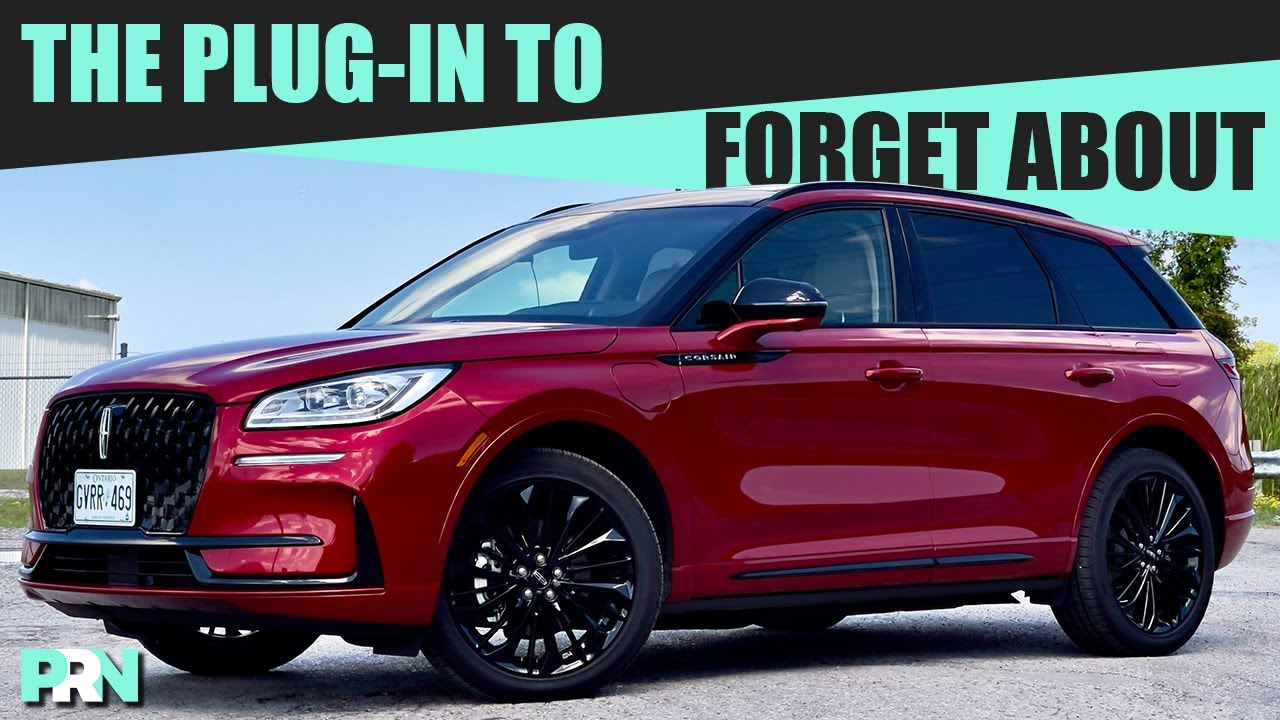
The Plug in Hybrid You Can Forget About | 2025 Lincoln Corsair Grand Touring Review
So, about a year and a half ago, Victor and I featured the Lincoln Corsair Grand Tour, the plug-in hybrid, and found that that vehicle, while is a good compact luxury crossover, wasn’t a very good plug-in hybrid. Now, I wasn’t expecting Ford to make any major changes in just one model year, and they haven’t. But today, we’re going to be talking about how this stacks up compared to some of the other vehicles you might be considering if you’re in the market for a compact luxury plug-in hybrid crossover. This Grand Tour starts at about $59,000 Canadian or about $54,000 in the US and we’ve got pretty much all the options that you could ask. We’re bringing the total up to just over $80,000 Canadian or a little over $70,000 in the US. Now, one of the major changes from the previous one that we drove is this new jet black appearance package that’s optional and I think really complements the red paint here, giving you two-tone red and black mirrors. You have almost a two-tone look with the paint with the black roof as well as the trim around the windows. And then we have these beautiful 20-in alloy rims again finished in black with a blacked out grill. Overall, looks really sharp. You got a couple color options. I think that this might be one to go with. Now, why are you going to be considering the Lincoln Corsair? Under the hood, we have a 2.5 L 4 cylinder Atinson cycle engine that alone produces 163 horsepower and 155 pound- feet of torque. There’s also an electric motor up front that produces 129 horsepower or 96 kW. And then in the back, we have another electric motor good for 50 kW, giving us a total system output of 266 horsepower or 198 kW total. So, the front powers the front wheels through a planetary gear set ECVT with the rear wheels being controlled exclusively from that rear motor. Now, we have a 14.4 kWh battery. Ford says that that’s good for 45 km or 28 miles of electric driving. We will talk about that right now as we hit the road. All right, my friends. Before we get into the nitty-gritty review of this, let’s talk a little bit about the overall efficiency of this. Now, when I picked it up, unfortunately, the vehicle wasn’t fully charged up. I only had a couple kilometers of range. Even though there is a preserve EV mode here, it wouldn’t have done anything for me to be able to do my usual 100 km test loop. So, what I did was see how this vehicle operates without battery power. And we completed our test loop in 6.3 L per 100 km, which isn’t too bad overall because as I mentioned, overall range on this is supposed to be about 45 km. When I get up and get going for the day, it will tell me between like 42 and 44 km, but for example, it’s at 36 right now. The drive from my house to where I film this is maybe 4 km total. So, we’ve lost some range. And it’s not like I had the car running. As soon as I actually I started it remotely to get the car going and, you know, get the AC going and everything while it was still plugged in. unplugged it and then yeah, so overall range hasn’t been great. Uh, and that’s going to be one of the things that holds you back a little bit because, you know, this is a little bit more than a very well equipped Mercedes-Benz GLC 350e plug-in hybrid. Yeah, I took a quick look to see, you know, if I were to build one that’s kind of the same sort of look as this, you know, black appearance package and nice paint job and all that, you’re looking at like $78,000 Canadian. So, this at 80 is a little bit more. Now, what are you getting for that? And that’s the key difference between a Mercedes-Benz or BMW or Audi or any other luxury brands that offer plug-in hybrids. This is different because they’re all going for more of a sporty gadget oriented experience. Lincoln is taking a completely different approach. We’ve talked about that plenty of times over the years here on test drive and it’s one of the reasons why Lincoln still has a pretty decent market share here in North America because they’re offering something different. Not necessarily going to be for everybody and that’s fine. Whole point of having different choice is not everybody wants the same thing. So what Lincoln says is we’re going to get rid of all the excess sort of complication that comes with driving and owning a vehicle. The vehicles are extremely comfortable, super smooth, and very quiet. I mean, we use a little bit of noise isolation for the microphones, but for the most part, I mean, when I’m driving in here, no problems having conversations with people. I can crank the music up and listen to it. I don’t have to worry about the outside world. It’s extremely quiet. But some of that simplicity takes away from the data that I look for when I want to drive an electric vehicle. Like for example, the default setup on my gauge cluster screen doesn’t really show me a lot of information. It shows me the gas meter. You know, my gas tank is currently just under 3/4 of the way full. It show me the gas range as well as the electric range, but it doesn’t show me on that screen the battery percentage. You know, how full the battery is. I could go here and you can see even with the electric driving screen doesn’t show me really what’s going on in terms of the battery. If you stop the vehicle, it’ll sometimes pop up and tell you because I was actually a little disappointed. I only took this around the corner the other day to get a coffee from Tim Hortons. It used up 11% battery to do that. 11% battery to go from my house a kilometer and a half up the street to get a coffee and back. It was like a 10minute experience. It used up 10% of the battery. But again, if you’re looking for more of a simple experience, if you’re not too worried about how much electric range you have, you just want to offset your overall driving consumption from gas to electric, then this might be good for you because it it is a lot simpler, right? It kind of takes away the stress of, oh my god, I have 30% battery left. What am I going to do? Well, I think the people who are buying this don’t necessarily care about it. Maybe your commute is really short. If you’re in town, like I do a lot of my stuff, 40-ish km would be fine, especially if you’re doing a lot of regen braking. And the way that the system set up, you know, the the logic that the computer uses to determine when the electric is working is good enough. I mean, I don’t have it in the pure EV mode right now. when the vehicle starts up, even if it’s fully charged, it’s just in the normal mode, but it is still prioritizing the overall battery use over bringing on the gas engine. So, I’d say that this is going to be a vehicle for somebody who doesn’t care as much about knowing what the car is doing. If if what you’re interested in is having a plug-in hybrid, you do some stuff in town, you maybe want to have access to the HOV lane if you’re here in Ontario, so you want to have that as a benefit and you don’t mind, you know, plugging it in for a longer period of time because that’s the thing that Victor and I talked about last year. This only charges at a maximum of 3.6 kW and I’m seeing more like 3.2 at my house. I have a 7.1 kW maximum from my charger at home. So, I’m only getting half of what it’s rated for because the car can only accept that. So, that means from empty to full, this is going to take you around 4 and 1/2 hours. But, I suspect that most people aren’t going to worry too much about that because I suspect that most people who are going to be buying this are buying it because again, they’re going out maybe once or twice a day. they’re not going too far or you just aren’t too worried about the overall percentage of charge you have. Your state of charge doesn’t matter. That’s a word you’re never even going to use when it comes to owning this vehicle because you just want to offset how much gas you’re using. And you will absolutely do that with this vehicle because it has been pretty efficient. I mean, I’m currently sitting at 5.1, which is my overall since resetting it for the test loop. So, if we were at 6.3, I haven’t done a lot of driving. I mean I I I think that at the most I’ve done an extra 40 km since we did our test loop. 61 I’ve done 61 km. So those 61 km I’ve done pretty much all electric because the total out of 162 km as of right now 74.3 km have been fully electric because I’m in town. Plug it in, don’t really worry about it. So, it’s not going to be necessarily for the same type of buyer who’s buying a GLC. It’s not going to be somebody who’s looking at, you know, most the other luxury brands out there because Lincoln does do things differently. And I really like these vehicles because I, you know, as much as I enjoy driving the performance cars and ripping around and stuff, I have a family and my family doesn’t like when I do those things. So, they are much happier when I’m driving something like this that’s calm, comfortable, massaging seats, ventilation, everything. I mean, there isn’t anything really missing from this vehicle. Uh, one other downside is the screen, your gauge cluster screen. I don’t know what they put on it, but they put like Vaseline because it reflects so much sun, it’s really difficult to see in some situations. You’ll see some B-roll that was just like, I don’t know, middle of the day, went to go drive it and it’s really difficult to see. So, small little detail like that. I think that’s a bit of a downside. But the rest of the experience has been great. The head-up display, one of the best ones on the market. Tons of information from it. The overall blue cruise worked out great for me on my drive to to come home with this. And then the comfort and everything is good, too. Even as a bigger guy, I actually fit in here pretty well. So, if you want to know a little bit more about our experience with this vehicle, I highly suggest taking a look at the 24 model that we did just at the end of 23. Victor and I go over all of our thoughts on that vehicle to give you an idea of how it is. And if you really want to know more about the Corsair, I did do a video when it first launched back in 2020. That was the gas version, so you can see how that is. Both of those will be linked at the end of this video. But if you have any questions about the 2025 Lincoln Corsair with this plug-in hybrid system, please let me know in the comments below. We do try to get back to everybody, and we also encourage you to subscribe to the channel if you haven’t done so already, as we’d like to have you on board. And hopefully you enjoyed the video. So you want to see more content that we’re doing here. We have three fulllength videos a week, so you don’t want to miss any of it. Thanks for watching and until next time, take care. [Music] [Applause] [Music]
In this video, Nile reviews the 2025 Lincoln Corsair Grand Touring, a plug-in hybrid luxury SUV he drove about 18 months ago and found to be adequate. With no major updates for this year, the main change is the addition of the new Jet Black Appearance Package featured on this tester.
Nile briefly covers the specs before heading out on the road to talk about fuel and energy efficiency, what it’s like to live with, and who this PHEV is really for. He also compares it to the 2025 Mercedes-Benz GLC 350e 4MATIC that Victor reviewed, including how the pricing, features, and driving experience stack up.