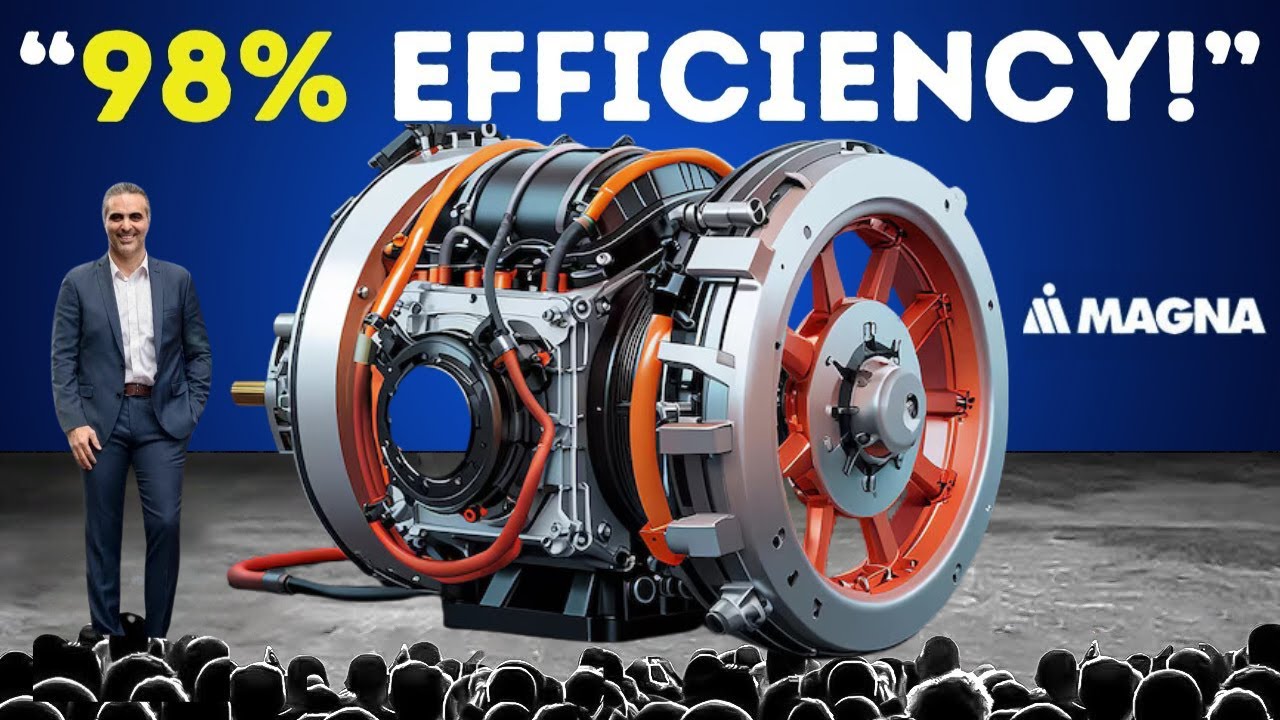
This New EV Motor Will Become The GOD of Electric Cars
EV manufacturers, beware. There’s a new powerhouse on the block. Canadian automotive giant Magna has just unveiled a breakthrough that could disrupt the entire electric vehicle industry. A high RPM electric motor that’s lighter, more powerful, and significantly more efficient than what most EVs are using today. Before we dive into this gamechanging motor, let’s talk about Magna. If you’re not familiar with them, you’re not alone. But make no mistake, Magna is one of the largest and most influential auto parts manufacturers in the world. Headquartered in Canada, Magna supplies everything from seating and mirror electronics to full powertrains for some of the most well-known automakers, including Mercedes-Benz, BMW, Ford, Volkswagen, and Jaguar. They’ve been in the industry for decades. But once the EV revolution started, Magna made a strategic move. They began investing heavily in EV components and today that investment is paying off in a big way. Magna isn’t just playing in the EV space, they’re dominating it. Their e drive powertrain system is already in use in cars like the Jaguar IPACE, Fisker Ocean, and even Volkswagen’s ID. 4. The beauty of their e drive platform, it’s modular and versatile. It can be integrated into electric cars, plug-in hybrids, and even adapted to platforms originally built for internal combustion. Brands like Stalantis, Hyundai, Rivian, and countless startups are either partially or fully relying on Magna for EV solutions. In fact, Jaguar trusts them so much that Magna is fully responsible for building the F-Pace and Ipace at one of its Austrian plants. Now, let’s talk performance. Magna’s original erive motor was solid, but not a standout. It operated on a 400vt architecture, had a respectable 91% efficiency, a power density of 2 kW per kilogram, and a 16,000 RPM limit. In vehicles like the IPACE, two of these motors delivered a combined 400 horsepower, which was decent, but it couldn’t compete with something like the Tesla Model Y performance, especially in terms of range and battery optimization, an area Magna has historically struggled with. So, Magna went back to the drawing board. And what they’ve built now is truly revolutionary. Introducing Magna’s new high RPM electric motor. A complete overhaul designed to dominate the competition. Here’s what makes it special. RPM limit boosted from 16,000 to a staggering 20,000 RPM. Power density upped to 3.3 kW per kilogram, a massive 70% improvement. Weight just 75 kg. Output up to 250 kW, which translates to 335 horsepower. Voltage upgraded to 800 volts, double the previous motor. Yes, you heard that right. An 800 volt system means faster charging, smaller wiring, lower heat, and greater efficiency. It can now support charging speeds up to 350 kW, putting it on par with or ahead of Tesla’s supercharger ready setups. Magna didn’t stop at power and voltage. They’ve also made the new motor more compact and lighter, thanks in part to the increased voltage. And the best part, it’s now rated at 93% efficiency. A major leap toward the holy grail of 100% efficiency that EV engineers around the world are chasing. So why does this matter? Because EVs are at a tipping point. Automakers are desperately searching for ways to increase range, reduce cost, boost performance, and streamline manufacturing. And Magna’s new motor delivers on all fronts. It’s powerful, lightweight, efficient, scalable, and built to integrate into a wide range of platforms without needing major design overhauls. Magna may not be a household name like Tesla or BMW, but with this new motor, they’ve quietly positioned themselves as one of the most crucial players in the EV race. And if major automakers begin to adopt this high RPM motor as their new standard, we could be looking at a seismic shift in EV performance and manufacturing over the next few years. What do you think? Will Magna’s new motor become the industry benchmark? Let us know in the comments and don’t forget to like and subscribe for more tech and auto deep dives towards this. It means that only 7% of all electrical energy isn’t being converted and is lost, which translates into a bit more power and a bit more range from a vehicle outfitted with a more efficient motor. Just so you have a better understanding of how important energy efficiency is. Modern internal combustion engines are on average three times less efficient. Oh, and let’s not forget these motors will heat up much slower than a 400V motor, which means they’ll be far more durable and have a higher projected lifespan. Let’s be real, nobody really cares about more power anymore. Electric vehicles are already incredibly powerful, and adding more power means very little to most people. However, the real benefit of this motor lies in its range. First of all, the increased efficiency of the motor will bring about 3 to 5% more range. That’s not a huge amount, but it’s a definite improvement. In addition to this, because the motor is significantly lighter, the vehicle will require less energy to move and the powertoweight ratio will increase marginally. This will also contribute to a slight increase in range. Also, the fact that the motor heats up much less frequently means the cooling systems won’t have to work as hard. Again, helping to extend the range a bit. Now, all of these things individually may not seem like much, but combined they result in around a 10% increase in range on a full charge. And since we’re talking only about a motor change, not a full powertrain overhaul, this is a very solid improvement. Recharging the vehicle will also take a massive step forward. It will now take practically half the time to recharge a vehicle with the same battery. Another benefit that often gets overlooked is interior space because the new motor is much more compact. Interior room and cargo space will increase as well. Are there any downsides to using this new erive system? Yes, there are. But they’re not practical downsides. Instead, they’re financial. You see, 800VT powertrains similar to this new E drive have already been used by manufacturers like Porsche in the TCON, GMC in the Hummer EV, and Tesla in the Cybert truck. Essentially, 800 volt architectures are significantly more expensive to produce. That’s because the supporting electronics like inverters, converters, and onboard chargers need to handle much higher voltages, which drives up the cost. Additionally, the battery packs themselves are more expensive. They require adaptations for stronger insulation, better wiring, and enhanced safety measures to handle the higher voltages. Also, though not always required, manufacturers often increase battery size to extend range, which further increases the vehicle’s price. As a result, 800VT E drives are noticeably more expensive than 400VT versions.
#magnamotor
EV manufacturers beware: A new kid is on the block! Canadian electric car parts manufacturer Magna has recently revealed the all-new secret weapon they’ve been working on, which is their new high RPM electric motor! This new motor promises a lightweight package, double the power, and significantly better efficiency than most other motors currently in use!