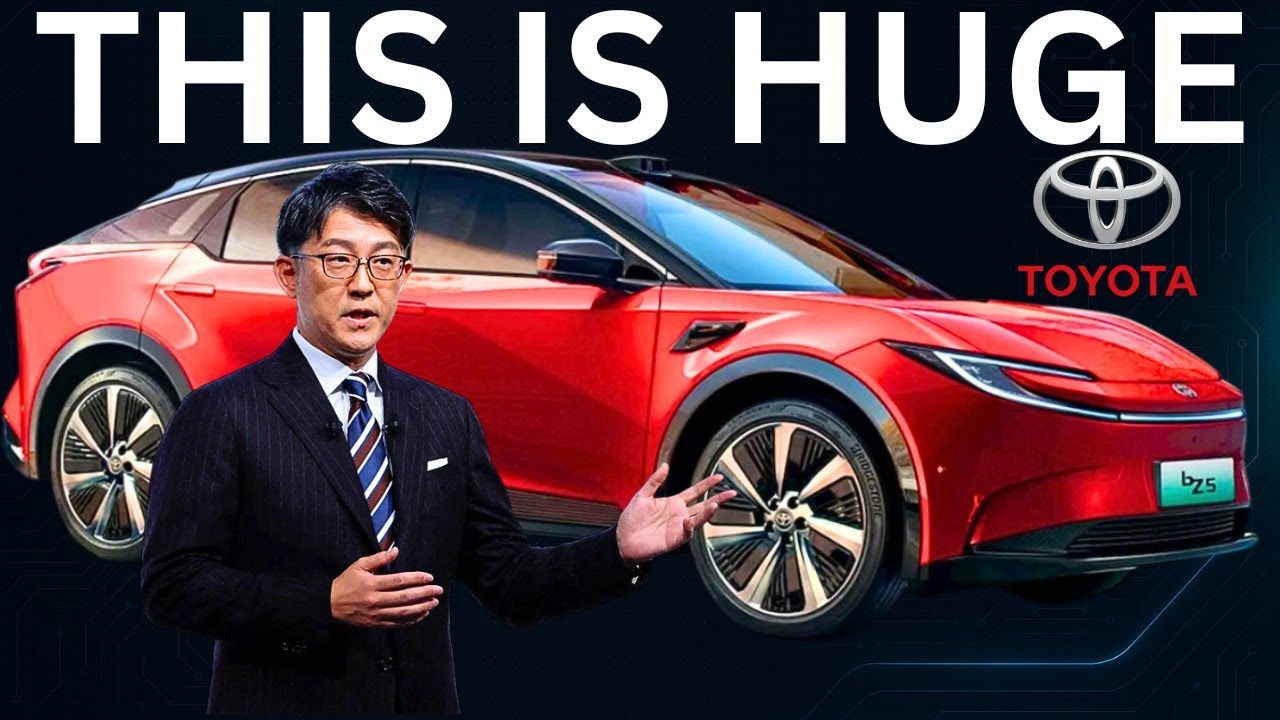
TOYOTA $18,000 Car Shakes The Entire EV Industry
While brands like General Motors, Ford, Tesla, Mercedes, and BMW continue to focus on high-end electric vehicles with jaw-dropping price tags, Toyota has flipped the script entirely. The Japanese automotive giant just shook the EV world with a game-changing announcement. A brand new electric car priced at just $18,000. You heard that right, $18,000 for a fullfeatured electric car that meets the standard expectations of modern drivers. This move has sent shock waves through the industry and raised serious questions about what consumers really want. futuristic luxury or practical innovation. To understand the seismic shift Toyota is causing, we have to rewind and appreciate what Tesla and Elon Musk have already accomplished. In the last decade, Tesla has gone from being a niche startup to one of the most valuable car companies in the world. Tesla didn’t just sell electric cars. It sold a vision of the future. With models like the Model S, Model 3, Model X, and Model Y, Tesla introduced autopilot capabilities, overthe-air software updates, and unprecedented acceleration and range that made gas-powered cars feel outdated. Elon Musk became the poster child for green innovation, turning Tesla into a global status symbol from California to China. Tesla’s Supercharger network expanded rapidly, giving it a major advantage in long-distance travel. Countries like Norway, the Netherlands, Germany, and even China embraced Tesla’s models. The brand became synonymous with EV excellence. But now, while Tesla continues to push boundaries with semi-autonomous driving and cyberpunk style trucks, Toyota has entered the scene with a reminder. Practical, affordable, and reliable cars still have massive market appeal and can still shake an entire industry to its core. Let’s not forget this isn’t Toyota’s first time revolutionizing the auto market. While it may surprise some, the Toyota Prius wasn’t the first hybrid car in history. That title goes back to 1901 when Ferdinand Porsche developed a hybrid powertrain. However, it was Toyota’s Prius, launched in Japan in 1997 and globally by 2000 that defined the hybrid movement. The Prius brought hybrid technology to the masses. It was affordable, practical, and had a reliability rating that gave it global popularity. By 2021, Toyota had sold over 6 million Prius units globally. The car became a symbol of eco-conscious driving, and for years, it remained the gold standard of hybrid vehicles. The Prius may not have been flashy or futuristic like a Tesla, but it offered something every car owner wanted: reliability, low maintenance, fuel efficiency, and lower emissions. This is the same philosophy Toyota seems to be reactivating with its new $18,000 EV. What makes Toyota’s entry into the EV game even more compelling is their lead in solidstate battery technology. This is where the real power play begins. Unlike Tesla, which still depends on lithium-ion batteries, including nickel cobalt aluminum NCA and lithium iron phosphate LFP variants, Toyota is going all in on solid state batteries, which promise to be lighter, faster charging, safer, and have much higher energy density. Solid state batteries eliminate the flammable liquid electrolyte found in traditional lithium-ion batteries. This means they’re far less likely to overheat or catch fire. Plus, they charge up to 10x faster, can last longer, and significantly reduce the need for critical minerals. Toyota has already successfully tested solid-state prototypes and plans to integrate them into vehicles by 2027 or sooner. If they succeed, it could put Tesla and every other EV manufacturer on the back foot. Toyota didn’t rush into EVs like other brands. They spent years dominating the hybrid market while watching competitors go all electric. But now, with the world ready and the tech matured, Toyota is entering the EV space with precision. They’ve begun producing new battery electric vehicles at their joint venture plan in Tanzhin, China under the FAW Toyota NEV program. These new cars target growing EV demand in Asia, Africa, and Europe. With the same Toyota promise of reliability and cost efficiency, Toyota BZ5 represents Toyota’s serious leap into the EV world. BZ stands for beyond zero, Toyota’s mission to reach carbon neutrality while still delivering exciting vehicles. Let’s talk design first. The exterior is sleek and aerodynamic, featuring sharp LED lighting, futuristic lines, and a low slim profile. It feels modern without being overly flashy. Think classy innovation. Inside, the interior is minimalist and functional. A central touchscreen infotainment hub, soft ambient lighting, and eco-friendly materials throughout. The BZ5 comes equipped with Toyota’s new infotainment system, voice control, digital gauges, and advanced driver assistance systems. The BZ5 platform is built on the ETNGA Toyota new global architecture, a modular electric platform co-developed with Subaru. This allows for different battery sizes, wheelbases, and drivetrain configurations. It comes in various variants with battery options ranging from 50 kw hours to 71 kW hours, giving users a wide range of driving capabilities. Driving range. Some models push past 310 mi on a single charge, rivaling Tesla’s Model Y and Model 3. Horsepower is expected to land between 200 to 300 horsepower depending on the trim. While it may not beat Tesla’s ludicrous acceleration, it still offers plenty of punch for urban and highway driving. The BZ5 doesn’t try to be a Tesla, and that’s its strength. Tesla sells innovation and excitement. Toyota sells value, dependability, and mass market accessibility. Where Tesla aims at premium buyers with software perks and self-driving ambitions, Toyota is aiming for the masses who just want a good EV that works. So, who’s winning the numbers game? In 2023, Toyota sold over 10 million vehicles globally with hybrid sales accounting for a massive chunk. Tesla, by comparison, sold around 1.8 million EVs. Still impressive, but not quite at Toyota’s scale. Toyota is gearing up to integrate solid state batteries into future EVs, which could give them an unmatched advantage in range, safety, and charging time. Toyota isn’t the only one working on solid state batteries. Other automakers like Volkswagen, BMW, and Ford are also investing heavily in the technology. Companies like QuantumCape, backed by VW, and Solid Power, backed by Ford and BMW, are leading the tech race in the west. However, Toyota still holds the most patents and has the longest running real world testing data. They’re playing the long game and they’re ahead. Solid state batteries are generating massive excitement across the automotive and tech industries. And for good reason. Compared to traditional lithium-ion batteries, solid state batteries offer a range of game-changing advantages. For starters, they allow for much faster charging. We’re talking minutes instead of hours. This alone could drastically improve convenience for EV owners. They also have a higher energy density, which translates to longer driving ranges on a single charge. This tackles one of the biggest pain points of electric vehicles, range anxiety. Because they use solid electrolytes instead of liquid ones, these batteries are smaller and lighter, giving automakers more flexibility in vehicle design and improving overall performance. Perhaps even more importantly, solid state batteries are safer. They are far less prone to overheating or catching fire, an issue that continues to affect some lithium ion systems. Lastly, they offer a longer lifespan with less degradation over time, meaning fewer replacements and more sustainability in the long term. However, despite these remarkable advantages, the road to mass adoption is still filled with hurdles. Cost is the biggest barrier. Solid-state batteries are currently extremely expensive to produce, limiting their feasibility for mass market vehicles. Durability also remains a concern as early prototypes have shown performance degradation under repeated charging cycles. Scaling up production is another major challenge. Manufacturing solid state batteries at volume is still in the early stages. And lastly, temperature sensitivity can affect battery performance, especially in cold climates. These obstacles must be solved before solid state batteries can become the EV standard. But Toyota, with its massive R&D budget and manufacturing discipline, is determined to make them viable at scale. Toyota isn’t stopping at just one model. They’re developing an entirely new EV platform that’s more modular, easier to produce, and compatible with future solid-state battery upgrades. This new platform could potentially power everything from sedans to SUVs and even commercial trucks, making Toyota a key player in electrifying entire fleets. While pushing into EV territory, Toyota hasn’t abandoned hybrids. Not by a long shot. Why? Because the infrastructure for EVs is still lacking in many countries. Charging stations are limited. Power grids are under pressure and many consumers are still anxious about range and battery lifespan. Hybrids offer a perfect bridge. They’re fuel efficient, reliable, and help lower emissions without demanding a complete lifestyle change. Some of Toyota’s hottest hybrid sellers today include Toyota Corolla Hybrid, Toyota Camry Hybrid, Toyota RAV 4 Hybrid, Toyota Highlander Hybrid, Toyota Sienna Hybrid. These cars dominate hybrid sales across the US, Asia, and Europe. So, yes, Toyota just released an $18,000 car that’s sent tremors through the entire EV industry. But the bigger picture, Toyota is reshaping the future of electric driving through a mix of smart pricing, proven reliability, hybrid mastery, and nextg solid-state battery tech. Tesla may have led the first wave of the EV revolution, but if Toyota’s plan unfolds as expected, they may well define the
While brands like General Motors, Ford, Tesla, Mercedes, and BMW continue to focus on high-end electric vehicles with jaw-dropping price tags, Toyota has flipped the script entirely. The Japanese automotive giant just shook the EV world with a game-changing announcement: a brand-new electric car priced at just $18,000. You heard that right—$18,000 for a full-featured electric car that meets the standard expectations of modern drivers. This move has sent shockwaves through the industry and raised serious questions about what consumers really want: futuristic luxury or practical innovation?
To understand the seismic shift Toyota is causing, we have to rewind and appreciate what Tesla and Elon Musk have already accomplished. In the last decade, Tesla has gone from being a niche startup to one of the most valuable car companies in the world. Tesla didn’t just sell electric cars—it sold a vision of the future.
With models like the Model S, Model 3, Model X, and Model Y, Tesla introduced Autopilot capabilities, over-the-air software updates, and unprecedented acceleration and range that made gas-powered cars feel outdated. Elon Musk became the poster child for green innovation, turning Tesla into a global status symbol from California to China.
Tesla’s Supercharger network expanded rapidly, giving it a major advantage in long-distance travel. Countries like Norway, the Netherlands, Germany, and even China embraced Tesla’s models. The brand became synonymous with EV excellence.
But now, while Tesla continues to push boundaries with semi-autonomous driving and cyberpunk-style trucks, Toyota has entered the scene with a reminder: practical, affordable, and reliable cars still have massive market appeal—and can still shake an entire industry to its core.
Let’s not forget—this isn’t Toyota’s first time revolutionizing the auto market. While it may surprise some, the Toyota Prius wasn’t the first hybrid car in history. That title goes back to 1901 when Ferdinand Porsche developed a hybrid powertrain. However, it was Toyota’s Prius, launched in Japan in 1997 and globally by 2000, that defined the hybrid movement.
The Prius brought hybrid technology to the masses. It was affordable, practical, and had a reliability rating that gave it global popularity. By 2021, Toyota had sold over 6 million Prius units globally. The car became a symbol of eco-conscious driving, and for years, it remained the gold standard of hybrid vehicles.