
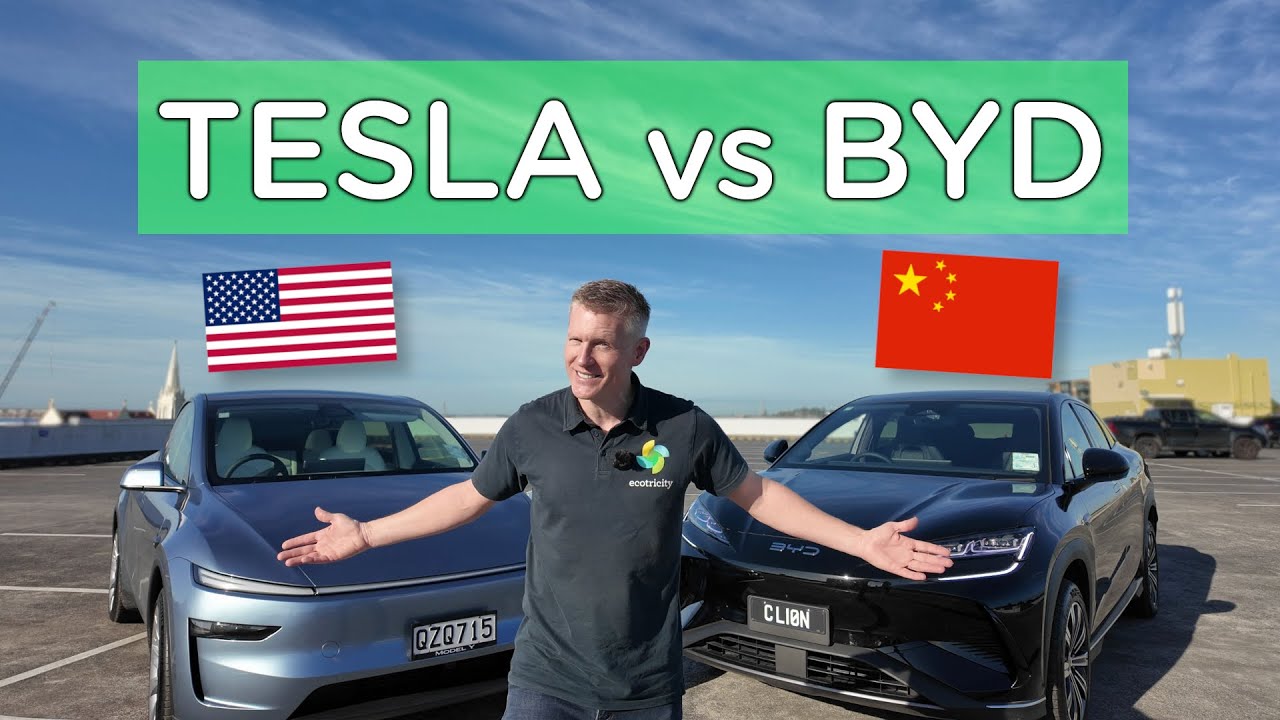
BYD vs Tesla: a BATTLE to be the #1 family car in NZ!
It’s America versus China today as we put the Tesla Model Y refresh up against that, the new BYD Cine 7 to see which of these two cars is better. [Music] Yeah, we got much to cover in today’s video, but let’s start with price. Which of these two is more affordable? And the American clocks in at $67,900. That’s not bad. The Chinese newcomer, however, the BYDC line 7. Well, that clocks in at 67,990. So, round one to the American. Yes, we have to talk onroad costs. And the Tesla, while it doesn’t have any dealerships exactly, it does have some pretty big delivery fees, more than $2,000 worth, the BYD, well, that depends on the dealership you buy it from, but typically drivers report about $1,300 in delivery costs. So, now round one goes to the Chinese newcomer. But now we need to talk about range. Which car goes further per charge? And the American clocks in at 466ks on one charge. The BYD, however, well, it clocks in with an extra 14ks of range, 480ks on a charge. So, round two goes to the BYD, but as Karen Carpenter said, we’ve only just begun. Well, we start in the Tesla Model Y, and we’re going to start with tech specs between the cars. This one, it’s a rearwheel drive car with 220 kW and 420 torquing Isax. That means its 0 to 100 time is a respectable 5.9 seconds. But is the BYD quicker? Well, the Celon 7 ain’t no slouch either. It’s also rear wheel drive just like the Tesla. However, it’s got a little bit more power, 230 kW instead of Tesla’s 220. However, it does have just a little less torque. 380 toring Isax, which means when you want to get from 0 to 100, it’s that twisting torque that makes all the difference. Torque is the kingmaker. Tesla don’t officially announce battery pack sizes for their cars. For whatever reason, they have dictated that you, the consumer, you don’t need to trouble your little brain with that sort of information. Smart people on the internet have figured out, however, that this model of car has a 60 kWh battery pack. As for the Selenion 7, it’s got the same battery pack as the Tesla, plus a little more extra 24 kW hours. It’s the same as a first generation Nissan Leaf in the battery pack. 84 kW hours, but it doesn’t give it a heck of a lot more range. does make me wonder which one then is more efficient in Kiwi conditions. We’ll figure that out in a few minutes. Right now, let’s talk design. And up until recently, I would have easily said that the Sea Lion 7 is the winner because, well, let’s face it, Tesla’s the first batch of Tesla Model Y. It’s no secret I’ve never been a fan of that design. It does look like something from Madame Tusov that’s been left too close to the heater. However, the refresh, this one now, the new one, it looks good. It’s such a more handsome, well fitted out car. Yes, here on the interior of the Model Y, it’s a little bland. It’s nicer than it was, but it’s still very bland. They’ve added some textures and textiles and the mood lighting. Now, the lighting strip does go all the way around. And of course, you should have it in potato brown as I do. And at night time, it looks good, but it’s still it’s still a little sterile. I wonder if the BYD is any better. Well, here in the Marine Mammal 7, it ain’t that much brighter. Unfortunately, being New Zealand, we’re only typically given the dark color options. We typically only get one option and it’s generally always Ford Mondo black which is disappointing because in China this car is available with all manner of colorful interiors including my favorite that sort of dark orange burnt orange sort of pudding flavor. It’s just fantastic. This one however well it is more colorful and more playful than the Tesla. I’ll give it that. The exterior yeah kind of dull. The interior however I like it more. I wish we had more color options. Speed, please, if you’re watching this, give us more color options. But as it stands, this is the more inviting interior. So, we already know there’s plenty of room in the front if you’re a normalsized human like me. But what if you are freakishly tall? This is where Dennis from Eotricity comes in. How tall are you? 6’4. Okay. I don’t know what that is in English. How many centimeters is that? I don’t know. I actually don’t know. Okay, hold on. Let me actually look that up if you’re going to ask me. Around 193 cm. Okay. Can you fit comfortably in the BYD Cine 7? Yes. Okay. How’s your headroom and your leg room and all that? Head room’s good. Leg room’s good. What about the Tesla? How well does a 6’4 freak of nature fit in that? How does that compare in terms of knee height to the steering wheel in terms of head height above you? About the same. Really about the same. Okay. So, there you go. A point to both cars. And thank you, Robert Wadler. Let’s try the back seat. And 6’4 Dennis the freak of nature. How is your leg room first of all? What about your knee room? So, you’re pressing up against the seat. Yeah, pressing up. Not really much room there. Okay. What about your head height? Head room is good. Excellent. And foot room, leg room down there? Also quite tight. It’s like being on an airplane. Okay, let’s try the BYD. Okay, now this one has a slightly long wheelbase. How, first of all, how’s your head room? Head room’s quite good. Can’t complain there. And do you have any more leg room or knee room? Yes, a lot more knee room as you can see. Okay. And foot room? Foot room same as a Tesla, obviously. All right. In terms of rear space, the point goes to the BYD. But now, let’s talk boot space. How much have we got in the Tesla? And will it pass the mafia test? Well, let’s find out. We start with the parcel shelf, which is magnetic and can be removed hopefully easily. Never. Now, Tesla engineers have thought about this. They’ve thought about some of it. If you lift up this little flap in the back, not only you’ve got more boot space down here, but you’ve got a space for the parcel shelf. All right. Now, this boot is 854 L, but will it pass the mafia test? Easy. Oh, not again. Every time. All right, but how does the BDC Line 7 compare? Let’s go find out. Oh, I think the Tesla might be the winner. This one has 520 L. Does it pass the mafia test as well? Oh well, there you have it. Yes, it passes, but the point has to go to the Americans. So, if you are a Sicilian businessman with questionable sources of income, then perhaps the Tesla is the car for you. What about camping, though? Which of these two cars has more room with the seats down? Well, to lower the seats, you lift the latches. I got this. Unfortunately, there’s no place for me to screw this. Hang on. Oh, yes, there is. I take it back. It does stow underneath there. See how well I can fit in here. Oh, yeah. There’s enough room to lie down and go camping in here. Sweet. And what about the Tesla? To drop the seats down, it’s a little easier. I just push a button. And look at that. It’s a symphony. The front seats move, the back seats move. I don’t have to lift a finger. Plus, as I climb in the back, you’ll immediately see that this car has more room. 2,158 L, which means camping is a piece of cake. If you want to go camping in your car, this one is the clear choice. It gets the point. What about a fart or front compartment? Well, we all know the Tesla has a sizable 117 Lment. Big enough for a potato enthusiast, but what about the BYD? Oh, no, no, no, no, no, no, no. Well, let’s find out. We know the Tesla’s got lots of room, but the BYD, well, it’s only Oh, boy. 58 L in capacity, which oh no point goes to the Tesla. Both cars at this point are almost neck andneck. They’re both doing a brilliant job, but there’s an equalizer round coming up very soon, which could put one against the other into the lead. But right now, I want to talk about ride quality. Which one has the smoother ride? Well, I’ve got a pretty ingenious test to figure that out. And the test involves the classic tray of water on a tray on the passenger seat. It’s fairly level. I’m going to fill this up with water. And whichever car spills the least, well, that is the one with the better ride. I’m already a little bit nervous if I’m honest. Okay, now it’s a 2 and a half kilometer test. Oh gosh, we’ve already Okay, the brakes are really sensitive in this car. You just tap the brakes and the whole thing lurches forward. We’ve already lost some water. Oh no, no, no, no, no, no. Oh, this is a disaster. The pedals are really sensitive in this car, but the ride is so soft. So maybe we’ll redeem ourselves. Oh, I’ve lost a third of my water already and I’ve only done 100 meters. Okay, here’s the next speed bump. Here we go. Oh no. Oh no. It’s a splash of water. If I can get down to the bottom and then turn around and go back to the starting point without spilling any more water, I think I’ve got a chance of winning this. Oh, it’s the tide is high on one end of that container. Oh no, we’ve lost the water. All right, now I’ve got to turn around. Oo dear. We’ve got just over a kilometer under our belt. We’ve lost a lot of water. I really tried I really tried not to lose the water. I promise. I’m trying to make this test as neutral as possible. In fact, I don’t think it’s so much the ride that’s made the water slosh. It’s the sensitivity on the brake and the accelerator. They’re so sensitive. Okay, we’re almost there. We’ve lost about half our water, but we’re almost there. Oh, that paper towel is moistister than an oyster. Look at it. Very sensitive brake pedal. I lost I really tried and I lost a lot of water. It’s about half the water’s gone. Will the Tesla be any better? Oh, see, look at this. Already I’m losing less water. Oh. Oh. Oh, no. No, no, no. I barely moved and I’ve lost all that water. What’s going on? First speed bump. Real gentle. Okay. Okay. Easy. Easy. Oh. Oh no. We’ve lost some. Oh, that bumper’s putting the rough in the Rafiti road far out. Okay. Turn it around. Turn it around. Oh, we’re good. We’re golden. Good lord. I just realized how tense I am. Like I’m sitting bolt upright. My fingers are clutching the steering wheel. This is really intense. Oh no, we’ve lost a little bit more. Oh, I can’t go too slow cuz there’s cars behind me. And I don’t think they appreciate the science involved in this test. Oh, that was good. That was a good solid break. And we didn’t lose a drop. That’s good. Oh no, we’ve lost more. How? Oh, okay. So, it seems to be the lateral wobble is the stronger the stronger drainer of water in the car, whereas the BYD sensitive brakes and accelerator make it forwards and backwards wobble that loses the water. Oh, that is close. Oh, far out. That is close. They both lost just about the same amount of water. I’m going to have to have a real scientific look at this to see which has lost more. The BYD lost about 330 ms. Gosh, it’s so close. I think this has lost a little bit less just. But now here comes the equalizer round. Starting with seated heats and the Tesla heats all four front and back. While the BYD only heats the front seats, for full heating, you need the performance model. So point to the Tesla. How about ventilated seats as standard? The Tesla has it and so does the BYD. A point to both. Which vehicle comes with a panoramic glass roof, though? Well, the Tesla does and so does the BYD. Now, that’s cool, but which comes with a sun shade to reduce the heat in summer? The Tesla does not have one, but the BYD does. Nice one, BYD. Speaking of hot seats, which has got the nicer seat material for those blistering hot summer days? The Tesla, well, it’s got a heady combination of polyurethane and polyvinyl chloride, just like grandma used to make. The BYD, on the other hand, has leather. Now, neither have got cloth, which is the least horrible in my opinion, but leather is good, so BYD gets the point. But which one’s got a heads-up display? The Tesla? Well, it does not. But the BYD does, and the definition is insane. What about air quality, you ask? Well, which one has a CN95 air scrubber? The Tesla does, of course, as does the Cine 7. Nice. A point to both. Let’s move on to a minimum turning radius. And we filmed both of these in person turning around in a typical Tjunction. And the Tesla sadly lives up to its reputation of turning like the Titanic. The BYD on the other hand has a slightly better turning circle. So the point goes to the seagoing mammal. Next up, which one has the larger screen? Now the BYD clocks in at 15.6 in while the Model Y is actually 15.4. So a point goes to the BYD just speaking of screens. Which one can be made vertical, ideal for maps? Well, Teslas cannot. It’s fixed in place. But the BYDs can with the push of a button. So the point goes to the C line. What about child presence detection? This is important. The BYD has it as does the Tesla. A point to both. But as the climate falls apart, freak storms are getting more commonplace. So which car has more monsoon friendly wiper speeds? The BYD I clocked in at 57 wipes per minute, while the Tesla, it clocked in at 60 wipes per minute. So point to the American. Let’s move on to sound system quality now. And the Tesla has its own Tesla branded nine- speakeraker system, which is very good. But the BYD has a 12 speakeraker dine audio system with a subwoofer for a little bit extra depth. Next up, which has the better mobile app? And the Tesla app is legendary. It’s basically the benchmark for all car manufacturers. You can control your climate. You can find your car exactly where it’s parked. You can turn on valet mode, even project your car’s camera footage directly to your phone. It is brilliant. BYD’s app, on the other hand, while relatively comprehensive, still doesn’t yet have all the features of the Tesla. So, the point must go to the American. Which car though has the most toys and the most games and the Tesla, it’s got basically everything you can think of. You can create your own music. You can draw pictures to pass the time. You can even play racing games. You name it in the Tesla, you can do it. Now, the BYD is good and it’s improving and you can now load apps directly into the car like karaoke and Tinder. But the Tesla system is better straight out of the box for now. Which one has a heat pump though? For heating and cooling at maximum efficiency, the BYD does, as you’d expect, and so does the Tesla. A point to both. Next, let’s talk security. And which vehicle has the better security system built in? The Model Y, well, it’s got its sentry mode with all its cameras monitoring everything constantly, day or night, with the cameras acting as dash cams in the event of an accident. The BYD, well, it’s got plenty of cameras, and you can get some third party apps that do a similar job, but it’s the Tesla that offers the most native Orwellian experience. So, the point goes to the American. But which cars have over-the-air software updates to get more apps, more games, more features automatically? Tesla does, as does the BYD. Nice. But let’s say it’s 5 years down the road. Which car has the better vehicle warranty? Well, the Tesla’s vehicle warranty 5 years from now would have expired as it’s only for 4 years or 80,000 KS. However, its battery warranty is impressive, 8 years or 160,000 KS for the battery. The BYD on the other hand has the same long battery warranty, but it gets the point because its vehicle warranty is longer at 6 years or 150,000K. Next is vehicle to load and the possibility for vehicle to grid. Now, put simply, vehicle to load is where you plug a device into the charging port on the car and it lets you turn the car into a four-wheel power station powering your potato cooking appliances or even powering your house in the event of a power cut for days or weeks. It’s brilliant. The Tesla sadly doesn’t have this option straight out of the box, but there are devices you can buy from third party suppliers which let you use vehicle to load, but some people have told me it’ll void your car’s warranty. So, my advice is to tread carefully. As for the BYD, yes, of course, it has vehicle to load and the adapters included in the price. And I should point out that vehicle to grid is ready to roll in these cars as soon as it’s available in New Zealand. It’s a big deal. What it means is that during the daytime, your solar panels fill up your BYD and at night time you can power your entire house for free or feed power back into the grid and get paid for it. In fact, EOT electricity now has the Eco Solar plan which will pay you 21 cents for every unit of electricity you put back into the grid during peak time. I’m on this plan and I am making money off it, so you should too. Sign up at eotricity.co.nz. Next up is the tero test. And you might laugh, but I drive a lot and having the map not know where a lot of moldy place names are drives me up the wall. So, let’s see which is better for Kiwi drivers. Hi, BYD. What’s up? Navigate to Kaka Papa. I didn’t find anything. Where do you want to go? It’s not what I said, I promise. Navigate to Narua. No. Next up is the camera test. Can I reverse into a spot using only the cameras? This is a great test of the definition and the camera coverage. Okay. Oh, already the definition in the screen is fantastic. Okay. Now, I’m going to try my best. I’m not looking at the mirrors, even though my natural instinct is to look at those mirrors. I’ve got a top- down screen. Plus, oh, look at that. Front front mounted cameras as well. Oh, I almost looked up. No, no. Keep my eyes down. Here we go. Parking by camera. Which one will put me in the middle of the space the neatest? And stop. Now, let’s try the American. Okay. Eyes only on the screen. Now, the screen’s not as big. The display when it comes to showing what’s behind me is not as big. And I feel as if the BYD has the definition advantage here. Oh, see. Oh, I don’t have a I don’t have a bird’s eyee camera system view here. Oh, this is hard. This is much harder than I thought it was going to be. Do I have other views? Yeah, here we go. Here we go. Yep. On my mistake. We’ve got extra views here. That I think. That looks pretty good. I think. Let’s have a look. Ooh, I think that one goes to the BYD. Next up is an ease of use test in which I need to adjust the steering wheel, set the air con to 25°, and open the glove box. Here goes the BYD. That was quick. What about the Tesla? [Music] Well, that was an easy win for the BYD. Sometimes life’s just too short for scrolling through endless menus and figuring out voice commands. But now we must hit the road. Now that we’re on the motorway, though, it’s time to talk autonomous driving. Level two autonomous driving, or autopilot, as it’s called in the Tesla. Now, if you don’t know what that is, put simply, the car does the braking, the accelerating, and the steering by itself. But you are still in control of the vehicle legally. You have to keep your hands on the wheel. To turn it on in the Tesla is a piece of the proverbial. I simply just press the button immediately. You can see it’s taking control of the steering and I’m going to set my speed. Oh, automatically my maximum speed is set to 100. And just like that, it’s doing it. And the good thing about the Tesla systems with autopilot is that it’s got more than 3 billion kilometers of road driving under its belt. So, it feels on autopilot, it feels like maybe a 20-year-old who’s relatively competent at driving. It feels good. The only downside with the Tesla system is that it’s entirely vision based. It doesn’t have LAR/ LAR. So, if there’s a bucket of potatoes up on the road and the car can’t see it for whatever reason, as far as the car’s concerned, that bucket of potatoes doesn’t exist. Here on the BYD, however, it’s a similar story. The system is fairly easy to activate. Need a couple of button presses. However, I’m going to select the speed to a maximum of 100. And now turning on the automated steering as a separate button. And now the car is basically driving itself. Now, I should add that the BYD system uses its cameras plus its radar. So, it does have a little advantage there. Although the finished product, it’s not as polished as the Tesla system. This one feels more like a 16-year-old learner driver. You know, it’s still getting a feel for it. Sometimes the steering is a little jerky. I think the Tesla is the smoother system. The point must go to the Tesla. Let’s talk cabin noise now. And this is a very Kiwi test because New Zealand’s got a lot of coarse chip roads. They’re like driving over lots of little boulders. Makes a heck of a racket. It sounds like vacuuming a sand pit. The thing is, after a few hours on coarse chip roads, you can get quite tired. So noise insulation is really important. Why are you slowing down? Why are you slowing down to 80? What are you doing? Oh, you’ve just lo Why are you stopping on the motorway? Oh, you’ve lost a point there, Tesla. I don’t know what caused that. Back to course chip road. There’s a section coming up now. Actually, that’s still excellent and a testament to Tesla’s noise inulation. They’ve used acoustic glass and they’ve added more sound padding and more sound deadening to make the ride quieter. And the result is brilliant. But is the BYD quieter? I’m looking at the sound meter right now here in the BYD Cine 7. Oh, good lord. It’s identical. Are you serious? [Laughter] What we need to do now though is an acceleration test. That is going to separate the Spuds from the Kumra. I’m in the middle of nowhere on an empty slice of road. Just me at 100k an hour zone. I’m going to drop this into sport mode. Eco normal sport. All right, let’s see which is quicker. The American with its extra torque or this the Chinese newcomer with its extra power. 3 2 1. Okay, there’s like a quarter of a second delay of nothingness when you slam your foot to the floor. But oh, it begins to ramp right up. And look at that. Okay, that was good. This is no slouch. But I want to see what the Americans like. Well, here in the Tesla, the answer is coming in just a few seconds. I’m on an empty slice of road again. Let’s see what happens. 0 to 100 in three, two, one. It feels better. It feels better. Oh, yeah. Oh, yeah. Oh, yeah. Oh, okay. Point goes with the Tesla. It is quicker. That extra torque makes the difference. But does it handle better? Let’s find out. My top secret driving road is just around the corner. And this is it. This is the top secret driving road. I’m not going to tell you where it is because I’m selfish and I want it all to myself. Now, this is the lighter of the two cars. It’s 1,921 kilos, which in theory gives this the advantage in terms of nimleness. But Tesla have softened the suspension in this car, which means that when you chuck it into corners like this, it does feel Oh, it still feels so good. But it does feel as if it’s lost a little bit of the rigidity of the original model. The problem is the original Model Y, if you’ve driven in one, you’ll know what I’m talking about. It has all the suspension travel of a forklift, which means that you’ll often get to your destination in need of a chiropractor. They’ve softened the ride on this one, but it doesn’t feel like it’s lost any cornering. They’ve done an amazing job. Air on the BYD, however, well, I have a disadvantage. I’m 300 kilos heavier than the Tesla Model Y in this thing. But, and this is what surprises me. You don’t really notice. You’d think because it’s got the softer suspension, or at least it feels softer, that it would wallow in the corners. It sort of lures you into this false sense of placidity, if that’s a word. But then when you get into the corners, it just holds on. Like, what? Somehow this feels a little more responsive. Or am I am I imagining it? But it feels like everything’s just a little bit quicker. This is sublime. In fact, if I had to choose between these, I I really don’t know if I could. Between the Tesla and the BYD, it’s with heavy reluctance. The BYD is just a little better. Oh, I’m going to get in trouble for that. You know what’s really surprising me at this point in the video is how close the two vehicles are. They’re really neck and neck. And I thought one would have leapt ahead by now. Honestly, this video is turning out to be less predictable than I expected. So, I’m going to need the next segment to equalize things. It’s called the Spud Score, and it starts with acceleration. Starting with performance, and while both cars are quick, the Tesla gets the extra potato and the extra point. Handling’s next, and both cars are brilliant as you’ve seen. So, seven spuds to both. As for comfort, it is neck and neck. Seven spuds all around. Let’s talk efficiency now. And the Tesla is easily the more efficient machine being a little lighter and sleeker, but the BYD’s results were skewed by torrential rain and heavy winds regardless. Officially, the Tesla is the more efficient car. Gadgetry is next, and I’ve covered most features already, so I’ll just say that the Tesla gets eight spuds for its extra rear screen and games, while the Cine 7 gets eight spuds for having vehicle to home and vehicle to grid built in. But is it good value? Well, yeah, both are considering how much tech you get for your money. Seven spuds each. As for charging speed, this is where it gets interesting. First, we need to know which car has battery preheating to warm up the battery for faster charging. The Tesla does, and it also comes on automatically whenever you enter your charging destination. The BYD has it, too. Although it’s manually operated and generally not required with BYD’s Hardy Blade batteries in New Zealand’s relatively mild conditions. But regarding charging speed though, to top up the BYD, I used one of Chargenet’s huge network of rapid charges to take the car from 11% to 80%. This is a common charging amount on a road trip. These hyper rapid charges can pump out 300 kW while the maximum charging speed of the Seline Neon 7 is 150 kW. This meant that charging the Canadian Singer took 35 minutes. So, six spuds there. As for the Tesla, I used one of Tesla’s superchargers capable of 250 kW. Although the car itself has a maximum charging speed of 175 kW. Bottom line is charging the same amount from 11% to 80% took only 25 minutes. Not bad, Tesla. You get eight splits. I should also add that all electric vehicles are welcome to use either Tesla’s or chargeet’s charging networks. Now, just make sure you create an account for each provider beforehand. Now, what about style? Truth is, I don’t really love either design. They’re handsome vehicles, but I’m not sure I’d consider either of them sex on wheels. So, I’m going to give them six spuds each. But are both cars fit for purpose? And in a word, the answer is yes. And I’m awarding both cars eight spuds each. We need to now figure out which is better suited to being a family car. We start with ISOIX points for child seats. The Tesla has two in the rear seat, as does the BYD, which has the wider rear seat for those big kids seats, though, and the Tesla’s is 125 cm wide, while the BYD’s is girthier at 132 cm wide. Next is the rear floor, which has a completely flat floor in the back with no exhaust or transmission tunnel. The BYD, well, it’s got a perfectly flat floor. Oh, as does the Tesla. How about towing, though? The BYD, well, it can tow up to 750 kilos of brake load. It’s okay, I guess. The Tesla, though, it can manage more than twice that at 1,600 kilos. Next is motorway traffic. And which is the most comfortable car in stop, start, Oakland traffic, and the BYD will bring you to a complete stop, and it will move off all by itself. The Tesla, on the other hand, well, it does it too. It’s such a sanity saver in Oakland traffic, and both cars have got it. Nice one. What about seat support? Which is better for long road trips and which is better for cornering? Both are absolutely comfortable cruisers to road trip in, but the seat support on the corners is better in the BYD. It hugs you a little more. But which vehicle has the better rear view when reversing? Well, like many new cars, the driving position in the BYD has less rear vision than Stevie Wonder facing forward. The Tesla, however, is just as bad. Yeah, you’ll need to use the screens and cameras when reversing, so no points for either. But now it’s time to consider the single most important factor in any car buying decision. potato storage capacity. And the Tesla has always performed well in PSC testing with the new Model Y storing no fewer than 73 potatoes. This is a 5.7% increase in tuber storage over the previous Model Y despite the glove box being practically useless. Overall, an excellent result for the Tesla. The BYD, on the other hand, has a full-size glove box. Plus, it’s got plenty of in dash potato storage as well as height adjustable cup/spud holders, allowing an industry-leading PSC of 86. Well done, BYD. Which gives the BYYD a total spud score of 70, but the Tesla a spud score of 74. Well done, Tesla. But now it’s the moment you’ve been waiting for in which we tally up the total scores including everything from warranty to efficiency to performance to handling to ride to gadgets. You name it. With the absolute winner of this competition being, drum roll please, the BYD Sea Lion 7. It’s got just enough points to be declared the winner. Well done to the Chinese newcomer. And there you have it. The ultimate winner in this arguably questionable video. Is this the BYD Sea Lion 7? just scraped ahead of the American with just enough points to be declared the winner. That being said, as you’ve seen in this video, both cars are really wellspec family cars, and there may be some things in each car that sets it as the winner for you personally, like perhaps a vehicle to load and vehicle to grid coming soon is important to you, then this is the one to get. Whereas, if you’ve got a family and you want to keep the kids entertained with karaoke and games and drawing and light shows and all that stuff, then the Tesla is king. Bottom line is treat this video as a bit of infotainment. you know, use the information in it to help you springboard your own decision to which car is best for you. But if you’ve made it to the end of the video, I want to say thank you for watching. If you would do me a solid and press those free like and upvote buttons, I would appreciate it. Otherwise, hope you enjoyed the ride. We’ll see you in the next video. [Music]
It’s America versus China in this EV challenge, as we put a 2025 BYD Sealion 7 head-to-head against a 2025 Tesla Model Y Juniper to find out which is better, which is faster, and which has more toys!
Both vehicles in this test are ‘entry level’ rear-wheel-drive models to see which has the most of everything for the lowest price, but also which has the better battery warranty, the better user interface and the best ride quality.
This comparison video ended up being much closer than expected with both vehicles performing very well, but as with any showdown, there can be only one winner! So, grab your popcorn and settle in for an entertaining, educational, and oftentimes ridiculous battle of the EVs!
📽️IN THIS VIDEO:
0:00 – Introduction
0:17 – Price + Range
1:13 – Tech Specs
2:27 – Design
3:50 – Space + Room
7:46 – Water Test
11:11 – Quick Fire Round
18:47 – Autonomous Driving
20:19 – Road Noise
21:25 – 0-100 Test
22:23 – Handling
24:21 – SPUDSCORE!
28:45 – And the winner is…
28:53 – Summary
💚MENTIONED IN THIS VIDEO:
We used a BYD Atto 3 to give a customer power after a cyclone: https://www.youtube.com/watch?v=wug6OWs12ns
⚡JOIN US:
Keen on cutting your carbon footprint? Join us at Ecotricity, New Zealand’s only climate positive electricity provider! Switch today to join the renewable energy movement:
https://www.ecotricity.co.nz
🌏MORE ECOTRICITY CONTENT:
Facebook: / ecotricitynz
TikTok: / ecotricitynz
Instagram: / ecotricity_nz
DISCLAIMER:
This video is produced by Ecotricity NZ and is not sponsored by any brands mentioned.
#BYD #Sealion7 #Tesla #ModelY #Juniper #Comparison