
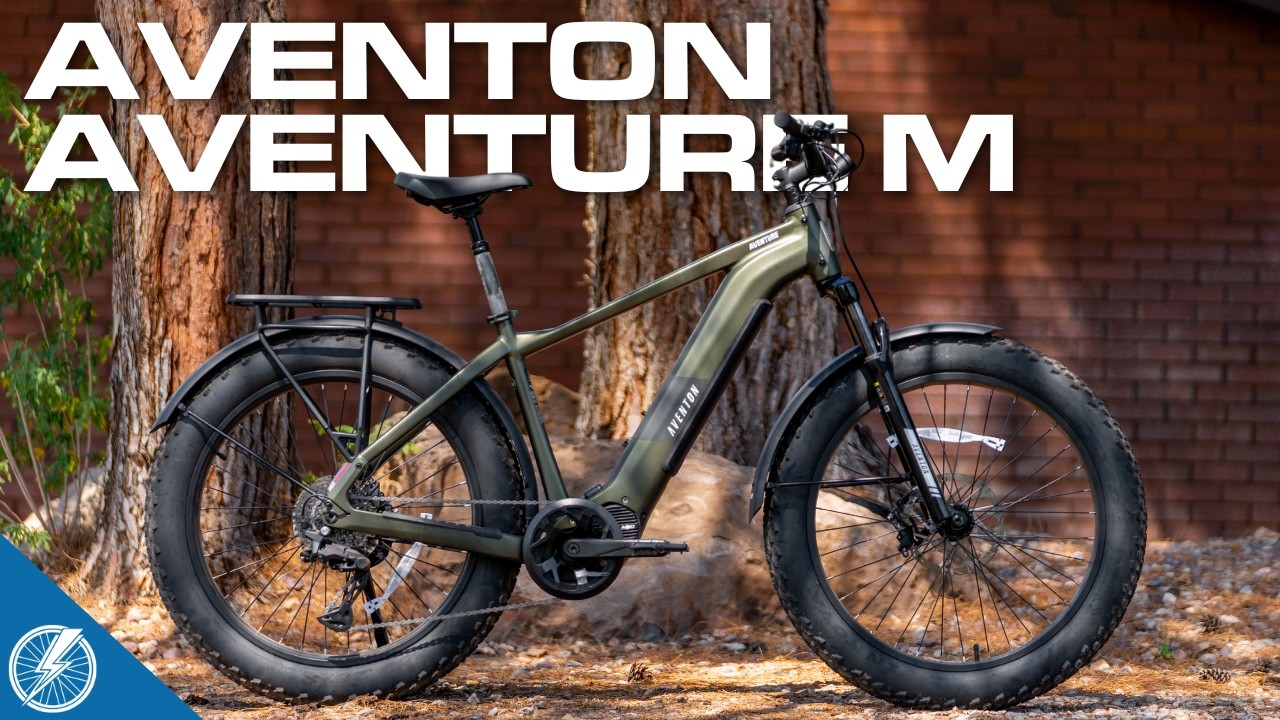
Aventon Aventure M Review | The Mid-Drive Fat Tire We’ve Hoped For?
Aventon is blending two of its biggest strengths into one package. This is the Adventure M. M as in midrive. The Aventure has long been a top performing all-around fat tire ebike, and Aventton’s A100 mid drive motor was a standout from the moment it launched. So, what happens when you bring these two together? Let’s find out in today’s review. [Music] Heat. Heat. [Music] [Music] Hi there, eBike friends. I’m Griffin and you’re watching Electric Bike Report. If you’re all about ebikes, be sure to like, subscribe, and check out our latest content, including our weekly show that covers industry news, Q&A, gear highlights, and the latest in eBike tech. There is just a lot going on with the Adventure M here. But let me give you my main takeaways. So, in the past, I have praised Aventon’s mid drive motor and said I wanted to see it on more bikes. And I’m happy to say it is a great fit on the Adventure M. With 750 watts of peak power and 100 new meters of torque, the motor delivers strong performance. But more importantly, it engages smoothly. I say this a lot, but power is only as useful as its delivery. And that smooth engagement helps keep off-road rides controlled and confidence inspiring. Plus, you can fine-tune the power profile to your liking in the event an app. And another standout feature is the upgraded component package compared to the recently released Aventure 3. So if I had one concern going in, it was that the Aventon might just throw the mid drive motor on and the Adventure 3 and call it good. But they went further than that and the spec changes feel meaningful. And that includes the Shimano Q’s 10-speed drivetrain with electronic shifting. It’s a more robust system than the 8-speed Altus on the Adventure 3. And the tighter gear steps are a welcome addition for XC trail riding. 10 speeds on an ebike feels like the right call. No need to go fancier than that. The motors got plenty of power to make all 10 work for you. Trust me. As for the electronic shifting, it worked reliably. I think it’s most useful on paved paths where you can take advantage of the auto shift feature. Now, that’s not something I’d lean on off-road or super hilly areas, but it’s a nice bit of tech to have that people will enjoy. Aventan also packed in more smart features through their new ACU system which has shown up on all their recent releases. It’s a 4G enabled unit offering advanced security like rear wheel lockout, geo fencing, alarms, and more. Now, as ebikes continue to fill the role of lightweight EVs, especially for daily use, this level of onboard security is a welcome trend. And finally, let’s talk comfort. The Adventure leans into sporty geometry, but still feels fairly upright and relaxed overall. You’ve got an 80mm coil fork, a 50mm suspension sepost, and wide 26×4 in Innova tires to help keep things smooth in the saddle. So, altogether, the Adventure M brings a unique blend of capability and comfort that should appeal to outdoor enthusiasts, fitness-minded riders, and anyone looking to stretch their range on a fat tire bike, which we’ll dive into more in the testing section later on. All right, let’s run through the full spec sheet. The Adventure M is a class one or class 3 capable ride and has the option to add a throttle for class 2. It comes in medium or large high-step aluminum frames. It is fully ULcertified and is available in green or blue. The 733Wh battery is ejectable and integrates nicely into the down tube. Brakes are Stram DB4 four piston hydraulic brakes with a 200 mm rotor up front and 180 in the back. The drivetrain, as mentioned, is the Shimano Q’s 10-speed with an 11 to 39 to cassette and a 44 to chain ring up front. The suspension fork is a Zoom spring fork with 80 mm of travel and Aventon branding on the sides. Now, the touch points include alloy pedals with pins, the Aventon sport saddle, and the Aventon lock-on grips attached to the 720 mm handlebar. Now, on the right side of the bar, you’ve got the shifter, which has controls on the back as well for cycling, some display outputs or engaging auto shift. And then the color display also connects to the event and app and includes a range of onboard settings that we’ll cover later. On the left side of the bar is the main control panel though for adjusting your speed. Now, extras include alloy fenders, a rear rack rated for 59 lb, a headlight, and integrated tail lights and turn signals along the seat stays. The bike is rated for a 400lb payload capacity, weighs 74 lb, and fits riders from 5’3 up to 6’4 depending on your frame size. MSRP as of this filming is 28.99. So, like I said, there is a lot going on with this bike, but now let’s see how it stacks up in our standardized performance tests. Test number one is all about the brakes, and it’s one I personally handle for consistency, which I’ve done across some 240 bikes up to this point. So, the process is simple. I bring the bike up to 20 mph, slam on the brakes, measure the distance, then run it two more times, and take the average for the Adventure M. That average came out to 21 f’ 9 in. And that’s better than the current fat tire eBike average of 22′ 3 in. So, overall, it’s a strong result. Now, interestingly, it didn’t quite outperform the Adventure 3 High-Step and ST models that we’ve tested, which uses a two piston setup with 180 mm rotor front and rear, but it was pretty close within half a foot of their average. Now, this was our first brake test with Stram’s DB4s, so I’ll need more data to fully understand why the result wasn’t a bit shorter, especially since I initially expected stronger performance, but don’t let that diminish it either. It’s still a very solid score in its own right. So, overall, I’m a fan of Stram products. The DB4 is their entry-level model in the mostly MTV Focus lineup, and it offers solid modulation and stopping power. I didn’t notice any brake fade even during extended descents where I was riding the brakes pretty hard. Now, since these are from Stram’s EMTD line, they don’t include brake a brake light signal. I’m personally fine with that, but I know some riders may miss that feature, especially if the bike ends up being used on the road a lot or in bike lanes. Now, aside from that one thing on my wish list item, I’d say that the Adventure M earns a good report card from the brake department. [Music] The speed test is all about seeing how fast a bike goes at each assist level. Now, with the Adventure M, you can tweak a lot of these settings yourself, but for this run, we’re sticking to the standard out of the box configuration to see how it comes up when set to 20 and 28 mph. All right, so this is the class 2 speed test for the Adventure. And we’re pedaling around right now at about 10 mph without any motor help. You can see a little bit of amount of personal torque on display there. So, climbing up just about under 11 mph. Let’s kick it into eco mode, though. See how that assist does. Got to hear that motor hum just a little bit. Not sure if it’s picking up on my camera or not. Definitely give me like a little bit of push. You know, you can feel a little bit of surge of energy. It’s got a little power meter bar down there. You can see it is, you know, cranking out a little bit of assistance. Nothing too crazy, but it’s definitely lightening the load of an otherwise heavier bike. So, let’s go ahead and kick that now into sport. There was an immediate difference I could feel kind of kick in. You know, the bike’s like, “Oh, hey, that ceiling we’re allowed to uh that ceiling raised in terms of the power allowed to distribute. It’s going to distribute it for sure.” It’s making really light work of this going about 17 18 mph even. Shift gears one more time and go about just under 19 and a half miles per hour here. Have a pretty good cruising speed. Going to skip over auto and into turbo and it should be hitting that 20 m perph limit. No problem. Going just a little beyond backing off down to about 20.2 mph. So overall pretty easy. Let’s see how good things go on the class 3 test. All right, changed things up to a 28 mph class 3 speed limit. Pedaling along here. Going pretty easy. Um, as we’re getting about, I just feels like it’s a little bit different on this setting as opposed to what we had before. Going a little bit faster. Not significantly, notice. 13 and 12 mph. Let’s go ahead and move it back into sport mode. Same thing as before. Just a very quick, noticeable difference as soon as you hit up on that power level. It’s got really good engagement though. Like it’s a good little like tug forward, but overall a manageable one. So, moving along to the gearing gear. Just about reach the 10 speed limit, I’d imagine. Yeah, it’s having no problem going upward to 21 miles per hour. So, a little bit faster this go around. One more time. About 21 12. Let’s just see where this thing wants to climb. All right, so I’m finally in my 10th and final gear. Going about 23 mph. Let’s move things up past auto into turbo. And from here, moving really fast up to 25 mph. Going to put a little bit more leg into it just to unlock a little more reward. Still nothing overly taxing or anything like that, but moving the legs a little harder, a little faster. About 27. We get 28 before the corner. About 27 1/2 miles per hour. Yeah, overall not bad. Very, very speedy. Let’s jump back in the studio and kind of break everything down. A no assist result of 10.8 mph is solid for a fat tire eBike, especially with the added rolling resistance these bikes have and 74 lb of weight. In the default class 2 eco mode, we clocked 12 mph, then 19.6 mph in sport, and 20.3 mph in turbo. Switching to class 3 unlocked a bit more across the board. 13.4 mph in eco, 22.8 in sport, and a top speed of 27.4 mph in turbo. And that’s a strong showing for stock settings. While class two or class one and three top speeds might land similarly on flat ground, the real benefit kicks in on hills. And it’s worth reminding that you can fully customize this experience through the app. You can adjust torque response, overall power output, and even how sensitive the pedal sensor feels. One new feature on the Adventure M is auto mode. Paired with the automatic shifting system, you can essentially ride in full set it and forget it mode. You vary your pedal effort and the bike adjusts. Power changes based on how hard you’re pedaling, and gearing adjusts automatically based on your cadence and the speed you’re traveling at. Personally, I still prefer manual shifting for trail riding or steep terrain. It gives me better control and lets me plan ahead rather than relying on the systems reaction time. But on flatter roads or casual commutes, auto mode is a slick feature that works well and adds some convenience. As for the electronic shifting itself, it was overall a positive experience. I did notice it seemed to limit gear changes to two at a time, which could be a built-in safeguard or a slight lag in communication. It’s not a dealbreaker or anything, but it’s something I’d like to see refined in future updates if I need to move through three or more gears at a time in a hurry. But the bottom line here though, with a solid gear ratio, responsive power, and tons of customization options, the Adventure M speed test left us pretty happy. To find out how much mileage you can get from the Adventure M with its 733Wh battery, we put it through two standardized range tests. Both were run in class one mode at 20 mph to maintain local compliance and keep results consistent with the rest of our database. And one test is done using the highest level turbo and the other using the lowest, which in this case is eco. And as always, we kept the stock settings in place. And honestly, I wasn’t entirely sure how the Adventure M would perform here. We’ve seen the A100 motor once before on the event in Ramblas, where it set a then all-time high in our range testing. So expectations were pretty high to start, but the Adventure M comes with some trade-offs compared to the Ramblas. It has extra weight and less efficient tires, so I figured it might not reach those same lofty numbers. But apparently the Adventure M didn’t get the memo. It squeezed every last drop out of its 733Wh battery, logging a massive 110 mi in eco mode and a strong 37 mi in turbo. Now, eco mode isn’t the fastest. You saw in the speed test that it only nudged speeds above unassisted pedaling just a bit, but it did enough to offset the bike’s weight and then some. So, if you prefer mellow cruising and max range, it definitely delivers. Most riders will probably use sport or turbo for more momentum or will tweak eco mode, but the fact remains 110 miles is currently the fifth best low power range result we’ve ever recorded, and that’s out of more than 300 ebikes we’ve range tested. As for the turbo result, 37 mi is nothing to sneeze at either. It is the sixth most efficient result we’ve seen from a fat tire bike in terms of watts per mile. It even edged out the Adventure 3 by a couple of miles in the same test. So, the bottom line here, the Adventure M has serious range at both ends of the assist spectrum. Whether you ride it hard or cruise it slow, you’ll likely get a few days or maybe even a couple of weeks out of a single charge depending on how you ride. All right, next up is the big one, our hill test. We recently launched version 2.0 of this test at our new location, the Devil’s Backbone. It’s a half mile climb with an average 8% grade and over 200 f feet of elevation gain. Our dedicated tester, Justin, took the Adventure M up the hill in turbo mode. Let’s see how it went and we’ll break down the results back in the studio. Okay, we are out on the Adventure M. And so that is the Adventure Midrive fat tire bike. We’re doing the pedal test set to Clash 2 in turbo mode with the pedal responsiveness and motor output all the way to 100. And this is with the same mid drive motor that you get with the Ramblas. So, going to be very interesting to see how this compares given it’s obviously a heavier. It’s a fat tire bike. Um, feeling pretty good so far. So, bottom about 50 mph that second that first section about 17 12 and 15.4. Going to shift just once. 14.8. kind of bottomed about 14.8 there. Going to shift before this turn and shift back up. I don’t know actually which gear it’s got. The electronic shifting is not telling me what gear I’m in. Sorry. Um but that lamp post right about 14 15 12 um miles per hour. So, as far as like motor noise, kind of ride at average for mid drive. Hear it a little bit. Not bad. I’ll let you listen. So, you can hear it. Maybe a little louder than some of the new motors from Bosch and Specialized, but overall pretty darn good. And as far as responsiveness, very impressive. much better mid drive motor than I would expect um on this kind of priced bike. So, we’ll go check and see how it did. But that motor feels very smooth, very powerful. Didn’t have to push much to get up to this hill. The Adventure M handled the climb really well. Justin reached the top in 1 minute and 56 seconds, averaging 15.6 mph. That puts it in a virtual tie with the Ramblas on this hill. Not a huge surprise since both use the same A100 mid drive motor, but again, fat tires I thought would slow it down, but here we are. Now, our Devil’s Backbone database is still growing. We’ve tested around 30 bikes there so far, including only six with mid drives, but the Ramlas was already one of the fastest climbers on our previous hill test course at Hellhole, and they scored the same just now on this new hill. So, if you compare across both locations, that makes the Adventure M one of the fastest mid drives we’ve seen, period. And honestly, the data backs up just how it feels to ride it out on the trail. With the A100 motor paired to fat tires, the Aventure M isn’t just a comfortable fat tire cruiser. It has enough muscle for more aggressive off-roading and some light technical climbs. So, whether you’re exploring the backwoods or tackling serious hills in the city, this bike has the power to handle it. This bike handles a lot differently depending on the setting you ride it in. So, let’s head out and see how it stacks up on pave paths and off-road terrain. I’m really happy that Aventon didn’t just slap the mid drive motor on and they went a little bit further, did a little bit more to make the Adventure M distinct. It’s familiar but distinct. So, if you’ve been an Adventure fan in the past, you’re going to appreciate how this is staying true to its roots in a lot of ways, but there are just a lot of noticeable upgrades. You know, the spec, of course, breaks a little different, drivetrain a little different, shifting obviously the electronic shifting wildly different, but overall it’s still the adventure. It’s just got a a little bit different uh motor power, but it still translate to a really nice ride. So, let’s break it down part for part. So, starting things off, it is, you know, two frame sizes. Avent says it’s going to fit riders from 5’3 up to 6’4. As a 6’1 rider with a 32 in inseam, I feel very comfortable. The reach isn’t overly long. It’s just about 17 in on a 720 mm bar with a slight rise to it. So, I mean, really, I’m leaning forward slightly, but it’s largely fairly upright and relaxed and comfortable and just handles really nicely. I do like the weight distribution of the motor between the cranks as opposed to with the hub driver. Makes it a little bit more weighted in the back. Just feels very well balanced overall. A really good down the middle type of handling characteristics. And then of course it’s very comfortable that the 80 mm of travel on the suspension fork. Spring travel there helps soak up some of the bumps. You’ve also got that 50 mm of suspension seat post travel. Slightly reworked saddle too on the Adventure M versus the Adventure 3. a little bit sportier like in its shape and design, but I think it’s a little bit more plush. I really got to go back to back and check them. But overall, nice and comfortable ride. And then the motor engagement really I just I like the A100 motor. I’ve tested it now on the Ramblas and on this. Looking forward to seeing it hopefully on more bikes in the future. It’s got a good dose of power. It still is fairly natural to intuitive. And of course, you know, now that you have the auto mode and you have the ability to do auto shifting as well. Well, if you’re the type that just wants a set it, forget it experience. I want to do some cruising, let the bike think of how and when to shift, you can absolutely do that if that’s kind of what you’re into. So, let’s go ahead and go find some dirt now. Show you where I really think this shines as it makes this bike a little bit more, you know, cross country trail friendly. All right, so this is where I really appreciate the ride of the Adventure M just out here on, you know, our local little dirt test track that we have. And this is where I really appreciate just that extra, you know, step or two of control that you get off that mid drive motor. Some of the nice crisp shifting and things like that because if you are going over something, you know, a little more technical. Now, don’t get me twisted. Don’t get it wrong. I’m not advocating this for like intensive single track or anything like that. You can do some very light cross country with an 80 mil suspension fork, but it is just nice to kind of have as you approach hills, things like that. You just find it’s a little bit more purposeful of the climb. It’s a little bit better executed and I just appreciate the weight displacement a lot more. I you can always feel a hub motor being a little heavy in the rear, especially compared to having a direct mid drive counterpart. And so I really just do like overall the ride that you get here with the Adventure M. Just that bit of more dialed in control. And then of course everything that you need. Good, you know, reliable and quality brakes. Really balanced handling to it. Now I am riding around here with the fenders and the rackons. Two things I would probably ditch if I was doing a lot of off-road riding. It’ll get a little bit clangy. You know, some of those rocks kick up into the metal fenders. But if you ditch those though, just kind of make this, you know, a little bit more of a naked ride over the tires. Really is a fun experience. Now, when it comes to shifting, I do like the electronic shifting. It is pretty nice and effective. There are a couple of times I noticed if I try and move through three gigs rapidly, it might not do all three. It might just do two. So, I like to shift a little more in advance. You know, I don’t really do too much of the auto shifting out here. It’s all about the anticipation of getting into that lower gear before a climb, but of course, once you do shift properly, you can easily go into a controlled descent with all the power that you really need from those brakes. So, this is going to be a pretty fun, you know, type of overlanding vehicle. Something you really, it’s always sounds like such a cliche, but it’s always just what comes to mind. Type of thing you can go and have an adventure with here on the Adventurum. Like I mentioned earlier, I’m really glad Aventon didn’t just slap a mid drive motor on the Adventure and call it a day. They made several upgrades that help justify this as a premium setup. There are subtle tweaks to the frame, but it still retains the solid handling the Adventure line is known for. I also appreciate the upgraded drivetrain, the electronic shifting, and even the fact that they opted for a different brake set. If I had one lingering wish, it would be a dropper post. This bike already has the bones of a capable fat tire XC rig. And for steeper descent, a dropper post would take it to the next level. Now, when I asked Aventon, they said internal cable routing might be possible, but it would be a tight fit. I might have to do a little bit of tinkering and see if I can make it work. But putting that aside, what it does include is impressive. And of course, the ACU system is a huge part of that. So, let’s take a closer look at how it all functions. All right. So, really quickly, I want to kind of walk you through the display here and show you some of its functions as well as some of the extra settings that you can access. So, this time I’m actually going to start on the right side of things. So, as I mentioned, the electronic shifting actually has a couple of different things you can toggle through. So, right here, it’s showing me what gear we’re in at gear six, and it’s here on the back of this uh shifter. It’ll show you your power level, how much uh input you’re putting on applying uh or actually sorry, the torque is where you see your personal input. The power setting will just show you in terms of like the watts that it’s blasting out. And then if you hold that down for a couple of seconds, that’s what will enable or disable your auto shift uh ability. From there, it’s going to measure your cadence and your overall speed to dictate which of the gears it should shift into. Now, over on the lefth hand side with the display pad here, that’s the more uh traditional thing. Uh this will cycle you through your eco, sport, and auto, and turbo modes. does have a little like range adjustment as you go. These things are never super accurate, but at least kind of gives you some sort of ballpark. It’s better than nothing. Now, from there, the rest of the display, you have your speed here, of course, battery percentage up top. This right here is kind of like a little power meter showing you how hard the motor is working. And then you can toggle through a couple of the different metrics that you have on display here. Odometer, look at your average speed, your max speed, things like that. If you hold down on the plus and minus buttons, you can get a few more options through the menu. So, here’s where you can do like the um the battery lock. You can lock out the battery, make it so people can’t access it. You can lock the bike out entirely. You click that, click adjust. A little beep lets you know that it’s working, that you locked the rear tire. You can adjust how you uh the display unit functions, the brightness, set your auto power uh time for on and off. Here in the auto shift mode, you can uh enable or disable that here as well and kind of uh make some further adjustments to the system. Here’s where you can enable a password. So, if you don’t want somebody to just be able to power on your bike, eject the battery or something like that, you can enable just a traditional passcode. This will even give you an error history. So, if you ever have to speak with someone from Aventon, or go through some of the error codes that pop up here, you can kind of have a history log of that to get that diagnosed, which is really nice. Um, this is also where you’ll come to connect to the app. And then from within the app, you get a lot more functionality. So, let’s walk through that next. All right. So, here is just a quick run through of the app because eventually really does give you access to a whole lot of different features if you do choose to use the app. So, starting with the basic uh layout of the home screen here, you can see title of your bike up there. You can actually change that to say something else. You have a notifications tab up in the top right. And then right here is really nice because you can power the bike on and off through the app, but you can also lock it. That little click right there is the sound of the rear wheel locking out entirely. It won’t be able to spin or rotate, so it’s not going to be going anywhere. Tap the unlock button and it’s ready to ride. Once again, you can do that from anywhere just with the access of your phone. So, that is pretty cool. Toggle the light on and off. I’m going to skip settings for now and come back to that. We’ll talk a lot about that. You get a little battery readout display here. You can toggle the power settings from your phone if you’d rather do that here than the control pad for whatever reason. And then you get a quick breakdown of your stats right here. You have some handy quick access to various things you might need. A dealer locator, some maintenance reminders. I really like this to remind you to every few days check certain components on the bike. And then even run diagnostics on the different electrical components of your ride as well to make sure everything is up to snuff and you’re riding well. Uh sport options with the ability to access a help feature. And then again, yeah, just really helpful, handy stuff at a glance. Now, here’s a breakdown, kind of a ride log, see how much mileage you’re getting daily, monthly, or annually. A few more advanced stats, calories burned, riding times, things like that. This main button right here is where you pull up your map. So, here you can kind of map things out. Again, if you have a handlebar mount for your phone, give you a little bit greater access. You can switch that over to portrait view if you’d rather have that instead. Really handy though to log your rides that way. And then there’s this right here is the discover tab. This is the event community, other event owners. A lot of people sharing pictures of their ride here or maybe some of the stats they’ve gotten. A great way to like engage with the event community, even ask some other like, you know, some questions you might have from other Avent owners or some other owners in other vent bikes. Final tab is just a breakdown of your profile, a little bit of redundancy on some of the apps. This all where you can go through and connect things like Strava. Um, you know, set passwords. Optimize trajectory is actually kind of cool. kind of like set um the ability to, you know, track out your ride, really get what you want in terms of mileage. Pretty neat to see. And then let’s jump back over into settings. So, this is where things get really nice and detailed. You can adjust the screen brightness, um how many minutes your bike remains idle before you want it to power off, and the assistant level right here. So, this is the ride tune app. Let’s pull this one up. And from here, you can see um you know, you have your eco, sport, and turbo. You can adjust the torque assistance and pedal responsiveness or the sensitivity of the pedal sensor there. You can play with those however you want. Make the, you know, uh, settings really true to you. Get some like visual, uh, breakdowns of how that kind of looks across a graph. You can save and apply that to your bike. Again, just kind of making it more of what you want. Now, the speed limit and metric is kind of a little bit funny to me because it moves in one mile per hour intervals and then saves every time. It’s not just like 20 or 28 or anything like that, but it will move one at a time and let you save it. Now, the alarm function. So, if anyone moves the bike when the alarm is on, it will give a little bit of a beep. you’ll get some notifications there. So, let so people will hopefully leave your bike alone. Uphill start assist kind of cool. So, this has to do specifically with one rotation of the crank. So, if you make that, you know, higher, it’s going to be a little bit more of an extra boost in that first uh pedal crank rotation if you want a little extra help, you know, getting started on a hill. So, you can toggle the auto shift on and off here. Or, of course, you can just do that by toggling uh the actual shifter itself. And then you can calibrate your crank and your shifter through the app as well. So you can actually enable it to be locked fully when you power the bike on or off and then have security verifications as well. So there’s bike passwords. Let’s jump into the geo fencing really quick. So this is, you know, you can look at it one of two ways. You can have it in restricted zones or allow zones. So if you’re a Philadelphia Eagles fan, you don’t want your, you know, kid or whatever associating with Pittsburgh Steelers fans, you can actually set up areas where the bike cannot travel to. Or you can do it the other way and look at the zones allowed. And so if we kind of jump into editing this zone right here, you see anywhere within the green space can be operated. The bike will run, but if it goes beyond that, it will lock the bike out. Um, not allowing it to go any further. And then vice versa. On the other one, you get a red screen. So you can set that up for a certain area of town you don’t want to access for whatever reason and then lock things out that way. So kind of like really cool and that definitely works. We’ve had several instances where we enable this, share the bike while we’re doing testing and someone gets locked out. It happens a lot. So it definitely works. I can promise you that. And then from there, just some like uh firmware updates and some other handy things to have just for, you know, if you do plan on using the bike frequently, it’s good to just check in and see if there’s any updates. The Adventure M was a bike that I and several others out there had hoped to see for a long time, and it feels like it was worth the wait. It delivered fantastic results in our range and hill tests, and it was genuinely a blast to ride. It opens up even more off-road potential for fat tire fans while still being versatile and practical enough for everyday use. With comfort focus features and the always helpful ACU system for added security, it really covers a lot of ground, literally and figuratively. I really like how it handles. The motor feels smooth and powerful, and the shifting is clean and easy. The combination of the automatic motor output and automatic shifting creates what feels like an ebike automatic transmission, and it works great. But if you prefer full control, you’ve still got the option to customize motor behavior and just shift manually. If you’re looking for an even more active adventure experience, a more premium ride, or something with legit overlanding potential, the Adventure M is well worth checking out. That’s it for our review of the Aventure M. Do you have any questions or thoughts? Drop them in the comments below. We always love hearing from you. And if you haven’t already, hit that like button and subscribe for more reviews and updates. I’m Griffin with Electric Bike Report. Thanks for watching and I’ll see you on the next ride. Heat. Heat. N. [Music] [Music]
Pricing:https://ebrdeals.com/AventonAventureM
Written Review: https://electricbikereport.com/aventon-aventure-m-review/
The Aventon Aventure M delivers one of the most versatile and high-tech rides we’ve tested—powered by a punchy mid-drive motor, packed with smart features, and backed by data-driven performance.
In this video, we break down how the Aventure M performed across all our tests:
🔋 Range testing (and how it nearly cracked the top of our leaderboard)
🧗♂️ Hill climbing on Devil’s Backbone
🛞 Ride quality on and off-road
🚦 Tech features like auto shifting and the Aventon Control Unit (ACU)
🛠️ Components, comfort, and what we’d like to see improved
Whether you’re looking for a single do-it-all e-bike or just want a fat tire machine with real off-road chops, the Aventure M is well worth a look.
✅ Highlights:
– A100 mid-drive motor with 100Nm torque
– Exceptional range: 110 miles in Eco, 37 miles in Turbo
– Aventon Control Unit with GPS tracking, locking, and alerts
– Auto-shifting Shimano CUES 10-speed drivetrain
– Suspension fork, suspension seatpost, and 26×4.0” tires for comfort and control
One of the fastest mid-drives we’ve tested up steep hills
#AventonAventureM #ElectricBikeReview #FatTireEBike #EbikeRangeTest #OffRoadEbike #Aventon
00:00 – Intro
01:07 – Overview
05:21 – Brake Test
06:50 – Speed Test
11:55 – Range Test
13:47 – Hill Test
17:05 – Ride Quality
22:13 – Display
24:16 – App Walkthrough
28:40 – Conclusion