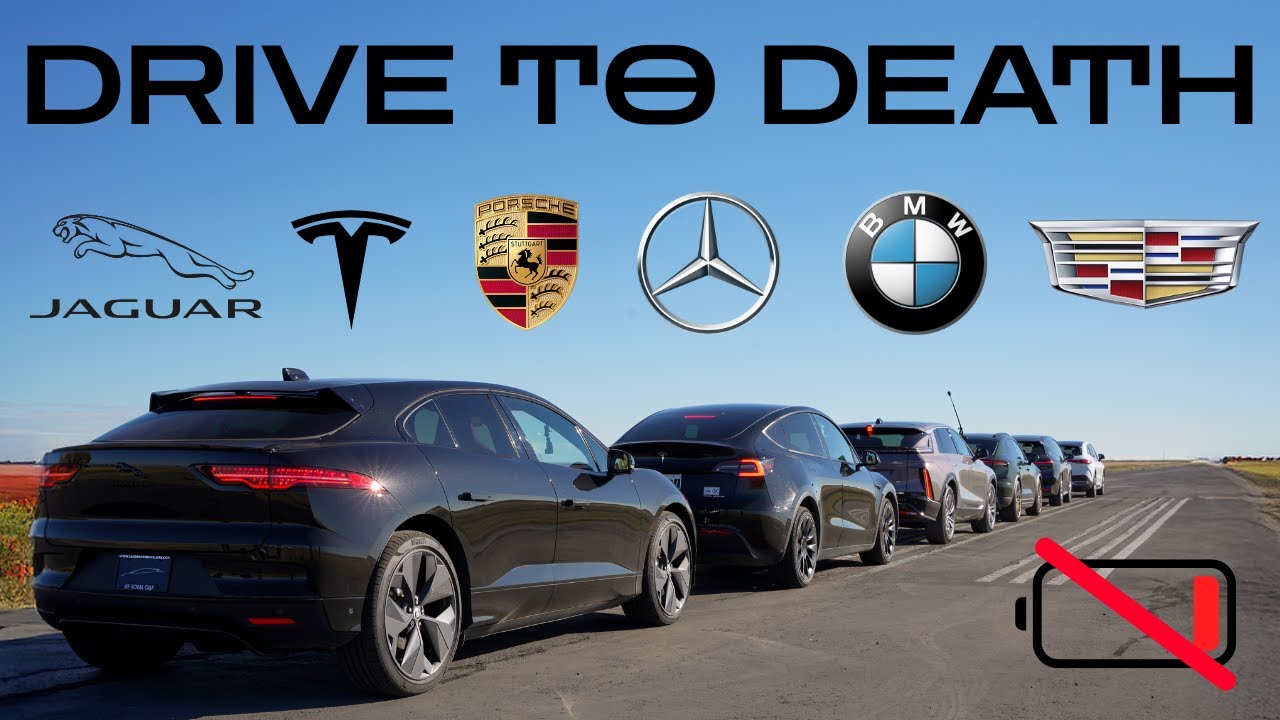
We drove these EV’s until they DIED so you don’t have to….
Today is the drive it to the death challenge. We took six premium electric vehicles that are all SUVs starting with 15 kWh power in each battery. We’re running them around a course that simulates real world driving with speeds of up to 110 km an hour until they die. And I mean dead. We’ve even brought a special guest star with us today right from the factory who’s going to show us what he can do. 2023 Jaguar Ipace has a 90 kWh battery, which means we’re starting it today with a 17% charge, makes 394 horsepower and 512 lb feet of torque. It weighs just under 4,800 lb, making it one of the lighter electric vehicles here today. Let’s see if that plays a part in its efficiency. 2024 Porsche Macon 4 EV is all new for this year, has a 100 kWh battery, and makes the math pretty simple. Starting at a 15% charge, it makes 402 horsepower and 479 lbft of torque, weighs just over 5,000 lb, and might actually win this range test today given the fact that it’s got the newest technology. 2024 Mercedes-Benz EQE 350 SUV is one of the most aerodynamic vehicles here and has a 90.6 kWh battery, which means it’s got a 17% starting charge to be at 15 kWh. It makes 288 horsepower and 564 lbft of torque. As aerodynamic as it might be, it’s a little heavier than some of the other cars here at 5600 lb. Let’s see how it does in this range test. The 2024 BMW i40 has the smallest battery here at a 76.6 kWh, which means it’s getting rounded up to a 20% charge at takeoff. It makes 326 horsepower and 465 lbft of torque. Although it’s got the smallest battery, it’s still not the lightest one here at just about 5,400 lb. So, let’s see how it does on this range test. All new for 2024, the Cadillac L all-wheel drive has 102 kWh battery, which means today it’s starting with a 15% charge. It makes 500 horsepower at 450 lb feet of torque, but tips the scales at just about 5600 lb. Wondering how this is going to do with that size of battery and that much weight. 2023 Tesla Model Y dual motor long range has an 82 kWh battery, so they say. There’s nothing to verify that or publish on the Tesla website, but we’re going to entrust what researchers told us out there and give it a 19% charge to begin with. It comes in at only 4363 lb, which actually makes it quite possibly the lightest vehicle here. With 384 horsepower and 475 lb feet of torque, it moves pretty good, too. Let’s see how it does on the runway with this range test. [Music] And we’re off. Each vehicle has only 15 kWh power. That’s equivalent to about 15 L of fuel in a gas vehicle in a simulated real life course that simulates highway driving, school zones, roundabouts, traffic lights, and more. It’s going to come down to which one’s the most efficient today to see which one’s going to go the furthest. But to keep everyone honest, when we get to the highway portion, we even set up a radar gun to make sure that everyone is maintaining the same speed that we’ve set out. Adding to that further, no one’s going to benefit from drafting because the first car is always going to become the last car after every single lap. So, everyone gets a chance to carry the weight of the win. Everyone was feeling pretty confident for the first three laps and everything was going pretty smooth. By the sixth lap, things started to change a bit. Power started to come down. Some of the vehicles started to reduce some of their power to maintain further efficiency. The ambient temperature that day was 12° C or 54° F. The cabin temperature required was 21° C or 70° F. That means the heaters had to run to maintain that temperature. And heaters, as we all know, aren’t the friend of an EV. That did play a part on each and every vehicle, some more than others. And you’re going to start to see how that range diminished much more quickly as a result. [Music] My drag coefficient in the EQE 350 had to play a big part in cutting through the wind. As lead vehicle, I was taking the weight of the wind for everyone. With nine lives, every cat should be able to recover from its death.
That’s it for me, guys. I’m toast.
Not the Jaguar. The recovery was a lot more difficult than any other vehicle here. And if you want to see how that went, you got to hang tight until the end of the video. It’s going to shock you. With Kevin off to the side sitting in a pretty Jaguar, it was nice to look at as we passed by. But that’s all we could do with it. Because the oldest technology here was in the Jag, it only made sense that it was the first one to die. So, by that very measure, the newest, latest, and greatest here, the Porsche Macon, should be the longest lasting. Nope. It was the second one to die. That’s it. But it had a really cool technology when it came to recovery. You got to stay tuned till the end to see exactly how it saved the day for Jay. With Jay down, first of the three Germans, it was up to me and Fred. Carry the weight of the group. Okay, guys. I’m at officially 0%. It says stop immediately. Drive will be deactivated. Charge high voltage battery. The birds of the feather stick together. Fred was carrying the weight of the Germans now with me and Jay down and out to the side, but not for much longer. I think he just missed us and wanted to get close to us again. It’s all up to team America now. Which one of these two American EV SUVs was going to make it to the end? Only one can draft off the other at a time now. So, there’s a few disadvantages here. The Cadillac, as good as it is, wasn’t able to stand up to the range of the Tesla. out of energy charged vehicle. Now, the Shinook told us that the Tesla had all of its power right until there was nothing left at the end, which is pretty impressive how strong it ran right to the very last drop of power. This video was made possible only because our wallbox chargers were able to put enough charge in for some of the vehicles to drive home that same very day. They were installed in our hanger by Shereech Electric. Thank you for making it happen. And now the part you’re all waiting to hear. What happened when each one of these died? How did they recover? How did they survive? Let’s start with the Jag. Kevin probably had the most difficult time reviving that vehicle. We couldn’t get it started and he couldn’t drive it home that day. We flat decked it back to the store for him and his technicians had to spend quite a bit of time figuring out how to get it back to life. The next one that died was the Porsche Macon. Jay didn’t even have to use a flat deck. Shortly after it died, it asked Jay, “We have 200 ft of electric range available for you to move the vehicle around. Would you like to use it now?” He selected it and there he had it. Next one was my EQE 350 SUV. Although it died a little quicker than I was hoping for, what was really impressive is all of my functions were there the entire time while I waited for the flatbed to come and take it away. And I was able to put it in neutral as a result and get it pulled back up. Next one on the list, the BMW EX. Equally impressive. It was able to be put into neutral, put up on the slap deck, charged up enough to be driven home that same day. Now we get to Aaron’s Cadillac. That vehicle didn’t quite recover enough to drive it home that same day. We got it charged up eventually in time, but only once it was back at the dealer and diagnosed. So, how did the champ far out? Well, the Chinook told us it went from having full power to literally nothing. Completely dead. No auxiliary power, no nothing at all. And here to tell us all about it is the champ himself. Thank you to our sponsor, Firefly Solar, who is accelerating the future of energy on and off the track each and every single day. Don’t stand there staring at me with that smug look on your face. You’re so proud of yourself that you won today’s challenge. Well, there’s more to that story than anyone here knows. We did some research before we did this test today. And in order to have each vehicle start with 15 kWh of power, we had to know the size of each battery in order to come up with that calculation. Well, guess what? Tesla itself does not publish the size of its battery. It’s estimated to be 82 kWh, which is what we base it on, but it could have very well been just a little bit more, which would have given it the edge to actually take everything out today. And it did do really well if it truly did have 15 kWh power in the battery. But there’s no way for us to truly measure it without looking at that gauge. Now, as far as everything else was concerned, you know what? They were all really close to one another. Each lap’s approximately 3 1/2 km. When you look at when what the first vehicle died, which was the Jaguar, to what the last vehicle died, which was the Tesla, there wasn’t a big variance when you actually count the laps in between, and formulate the amount of kilometers that that actually is. So all in all, I think what we have to really appreciate today is that 15 kWh in today’s electric vehicles goes quite far. And you probably wouldn’t start your day doing a bunch of laps like this with only 15 L in your fuel tank. That’s about a/4 tank of fuel. But today, what we saw with 15 kWh from these electric vehicles was pretty impressive. The one thing that we all had a great takeaway from today was none of us have ever experienced the death of an electric vehicle. What exactly happens? what safety mitigations come into place, how the power gets dialed back, dialed down, how the vehicle behaves at the very end. But the one thing that we did come to appreciate is that all of the vehicles in today’s test were fairly easy to flat deck tow except for this guy here behind me. We had to end up having to dolly it and pull it up because we couldn’t get it into neutral. We Googled it, tried to figure out how to get into neutral. It just wasn’t having it. The other vehicles did get into neutral at the end of the day, which made it really easy to get them off of the runway or wherever they ended up dying. So, lots was learned today. We hope you learned something there, too. Please comment below. Let us know what your thoughts were on today’s test and if you want us to do other tests like this. We had a lot of fun making it, and we’d love to do it again. [Music]
How far does 15kWh take you in any of the 6 premium EVs in this test before they totally die?
We brought together the Jaguar I-Pace, BMW iX, Mercedes-Benz EQE 350 SUV, Tesla Model 3, Porsche Macan 4 EV, and the Cadillac Lyriq AWD for the ultimate EV survival challenge.
This isn’t your typical range test.
We designed a real-world loop blending highway speeds with urban traffic simulation, ran each car in a tightly controlled convoy, and introduced a twist: every time a lap was completed, the leader rotated to the back—forcing every car to lead, draft, and adapt under equal conditions.
No brand favoritism. No guesses. Just pure data, drama, and drive-until-you-die EV warfare.
⚡ Which EV will surprise you?
⚡ Which one gave up first?
⚡ Which one went the distance?
You won’t believe how it ended.
Watch until the very last lap.
0:00 Intro
0:25 Range Test
8:11 Synopsis
#EVRangeTest #DriveToDeath #ElectricVehicles #JaguarIPace #BMWiX #TeslaModel3 #MercedesEQE #PorscheMacanEV #CadillacLyriq