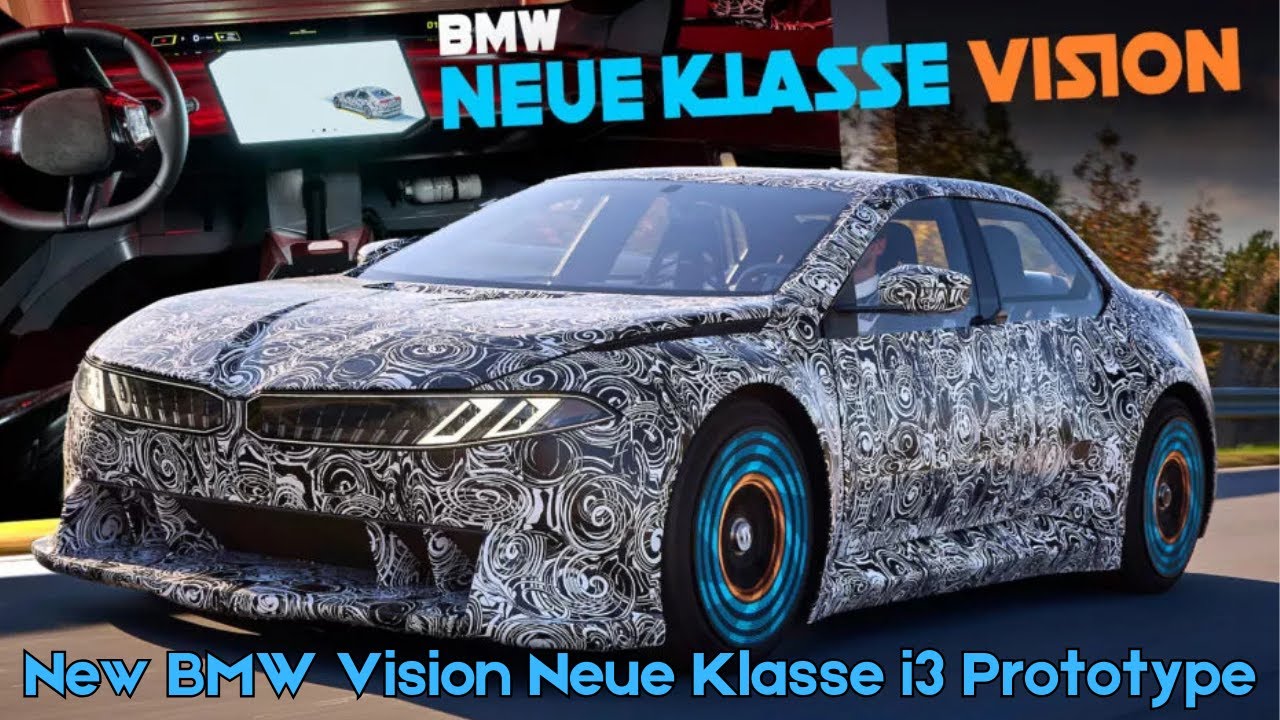
BMW’s Future Look at Electric Vehicles | BMW Vision Neue Klasse i3 Prototype
BMW Vision Vehicle Is Our Best Look Yet at the i3 Neue Klasse.
BMW is showing off its new “Heart of Joy” control unit that will determine how its future EVs will drive and feel.
BMW says the Vision Vehicle won’t go into production, but it will serve as a rolling technology testbed.
It produces up to 13,269 lb-ft of torque (presumably at the wheels) and offers advanced controls.
The “Heart of Joy” unit brings together the vehicle’s core functions to create a seamless driving experience.
BMW wants this concept to be remembered as a “Heart of Joy” showcase, but in every way, the Vision Driving Experience is more than just a prototype.
Yes, the company is quick to point out that the four-door “Vision Vehicle” is not destined for production, but there’s no denying that it looks suspiciously close to what we believe will be the next electric 3-Series s; It’s likely to adopt the i3 name, like the i5 and i7 models. And with production of the first Neue Klasse-based car metaphorically just around the corner (the iX3 is set to begin production later this year), it’s safe to assume that the Vision Vehicle isn’t just giving us a glimpse of what’s to come.
But if it’s not a production prototype at all, then what is? BMW says it’s a rolling test rig used to develop the next generation of driving dynamics technology—that is, all the electronics that not only keep the driver safe, but also ensure that the Neue Klasse EV architecture retains that signature BMW feel.
There’s serious power underneath, too. The Vision Vehicle is said to be capable of producing a whopping 13,269 lb-ft (17,990 Nm) of torque, but that number almost certainly comes from some creative measurement method. Much like GMC’s approach with the Hummer EV, BMW is likely reporting torque at the wheels rather than the crankshaft, where the gear ratio is cranked up to headline-grabbing levels. BMW claims, though, that this excessive output is for everyday driving purposes.
The test vehicle also visually demonstrates how the Heart of Joy works, with colour indicators on the wheels: acceleration is shown in green, energy recovery in blue, and braking using friction brakes in orange.
BMW’s strategy is to ensure that its ICE and EV products look similar inside and out, but each will have its own unique feel. But to make the new EVs feel as BMW-like as possible, the Vision Vehicle is used to fine-tune the new technology, while serving as a mobile test bed for its durability.
The Heart of Joy control unit is responsible for the drivetrain, brakes, charging, energy recovery and steering. Scientists want everything to work as smoothly as possible, and its computing power is said to be ten times faster than before. This means millisecond changes to the vehicle’s parameters.
BMW says a big part of this new technology is to bring the drivetrain and brake units together under a single control roof. This increases sustainability thanks to less reliance on conventional brakes, a significant amount of energy recovery and a 25% increase in efficiency. In fact, BMW claims that the “brakes” will only be required in an emergency stop, with regeneration taking care of the rest.
That’s the sustainability part. But BMW wants you to focus on the fact that all of these parameters communicate and are controlled by its “superbrain”, unlocking new levels of handling capability that were previously unattainable by separate systems.
Drivers will need fewer driving inputs, “extraordinary levels of precision” and much higher levels of traction. Then, when you’re not feeling enthusiastic, the car’s direct signals will help with low-speed driving, and Active Cruise Control, parking brake, Auto Hold and start-stop will all sort of blend together.
But all of this sounds pretty clinical. While EVs already take a certain amount of drama out of the experience, the Heart of Joy superbrain comes dangerously close to robbing drivers of the fun. BMW’s description of the driving experience as “Compliant and Quiet” at any speed doesn’t inspire confidence either. It hints at a sure feel and exceptional cornering abilities – but none of this is what we’d call fun.
Of course, it’ll be a while before we can try it out for ourselves, and the in-house development looks impressive on paper. But by the time we get behind the wheel, we hope the engineers have managed to give the Neue Klasse that traditional old-school “Ultimate Driving Machine” feel.
Source: Carscoops