A BIT OF ENVEMO’S HISTORY
Envemo (Engenharia de Veículos e Motores – Vehicle and Engine Engineering), a Brazilian car manufacturer that was founded in 1979 and had its headquarters in São Paulo, was born from Luís Fernando Gonçalves’ desire to create a replica of his Porsche. His first production was known as the Envemo Super 90 Coupe, a replica, manufactured by him in Brazil, of his 1964 Porsche 356.
The new model was very successful, including abroad, with exports to the United States and Europe. Given all this approval, Luís Fernando continued to manufacture copies of famous cars abroad. One of these was the Envemo Camper, in 1989.
THE ENVEMO CAMPER
In 1988, at the 15th Auto Show, GM presented its new pickup trucks, in two versions the Bonanza two door and five seater and the Veraneio four door nine or eight seater, they were the Brazilian equivalent to the Suburban and we’re derived from models manufactured by Brasinca, a coach building company that was known for transforming pickup trucks into SUVs, GM liked their models so much they bought the project and made it into a official GM of Brazil model.
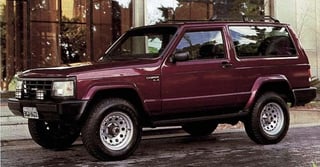
With them, Envemo would lose a significant share of this market, since Brasinca’s products were the ones that most closely resembled its own, both aesthetically and in terms of design and construction quality. In return, the company took advantage of the same event to present the first complete vehicle it manufactured and sold under its own brand: the Camper utility vehicle, a precursor to the SUV trend in Brazil, with a style clearly based on the North American Jeep Cherokee, one of the most sought-after off-road vehicles in the world at the time, along with the Range Rover.
Sold from 1990 onwards, the car used the modern Engesa 4 Jeep chassis, with an increased wheelbase, taking advantage of its excellent long-travel suspension, with longitudinal bars and coil springs.
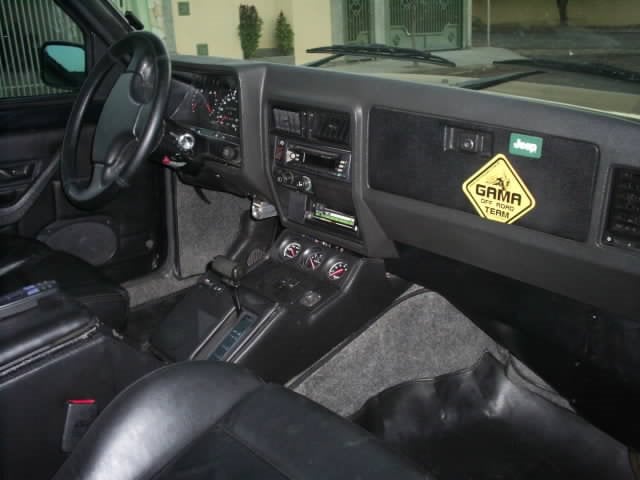
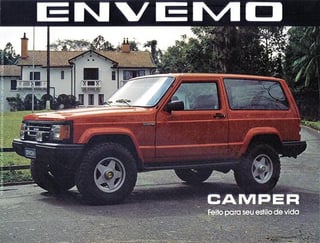
The engine was the 2.5 four-cylinder in-line 82 hp engine from the Opala, running on alcohol or gasoline, combined with the five-speed gearbox from the Chevrolet pickup. It had 4×4 traction (optionally only rear-wheel drive, with four gears), disc brakes in the front and power steering. Its body was made of fiberglass, with three doors and five seats, featuring the excellent interior finish and attention to detail characteristic of the brand: dashboard originally from the Opala Diplomata (the most luxurious version of the Opala), reclining seats in the front and folding seats in the back, leather upholstery and many accessories, including electric windows and mirrors.
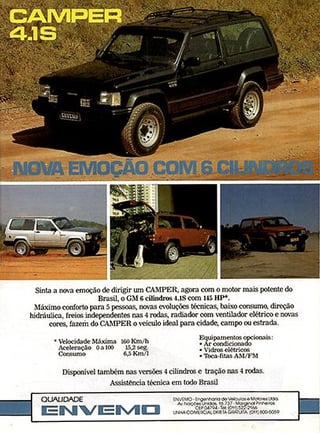
In the first half of 1991, the Camper began to have the option of a 4.1 six-cylinder in-line engine with 145 hp (also from the Opala), allowing the installation of air conditioning, a convenience not offered until then by the insufficient power of the 2.5-liter engine. The following year, it was the turn of the diesel engine, a four-cylinder, 4.0-liter Maxion with direct injection and 92 hp.
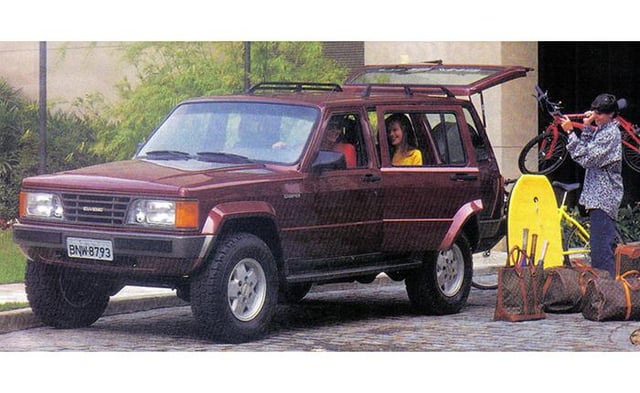
In mid-1993, the four-door Camper was launched, a little longer and wider than the previous one. The opportunity was taken to make some aesthetic changes: a new grille, with a trapezoidal Chevrolet headlights (the headlights of the old model were from the Fiat Uno), elimination of part of the side creases, a wider rear hatch, adapting to the new vertical taillights, a body-colored bumper, a new dashboard and updated interior trim.
The car received new brakes and the old four-cylinder engine was replaced by the 2.0-liter unit, with electronic injection and 116 hp that equipped the Chevrolet Monza (Brazilian name for the Opel Ascona C). Among the new optional extras were heated glass and an adjustable steering column.
Aiming to rationalize and increase Camper production, Envemo acquired industrial facilities in Manaus (AM), but the effort would be in vain. Despite its technical expertise and the quality of its products, the company was going through a turbulent period. The country was going through difficult times, shaken by the economic crisis of the Collor government. Engesa, Envemo’s controlling company, filed for bankruptcy in March 1990, motivated by reckless management and the decline in its international business. The invasion of imported cars, which began soon after, directly affected the Camper, the product in which Envemo had invested the most and in which it had placed its greatest hopes. In a short period of time, more than ten foreign brands invaded the Brazilian luxury utility vehicle market, competing for space with the Camper, where it was the pioneer and sole national representative.
PHOTOS
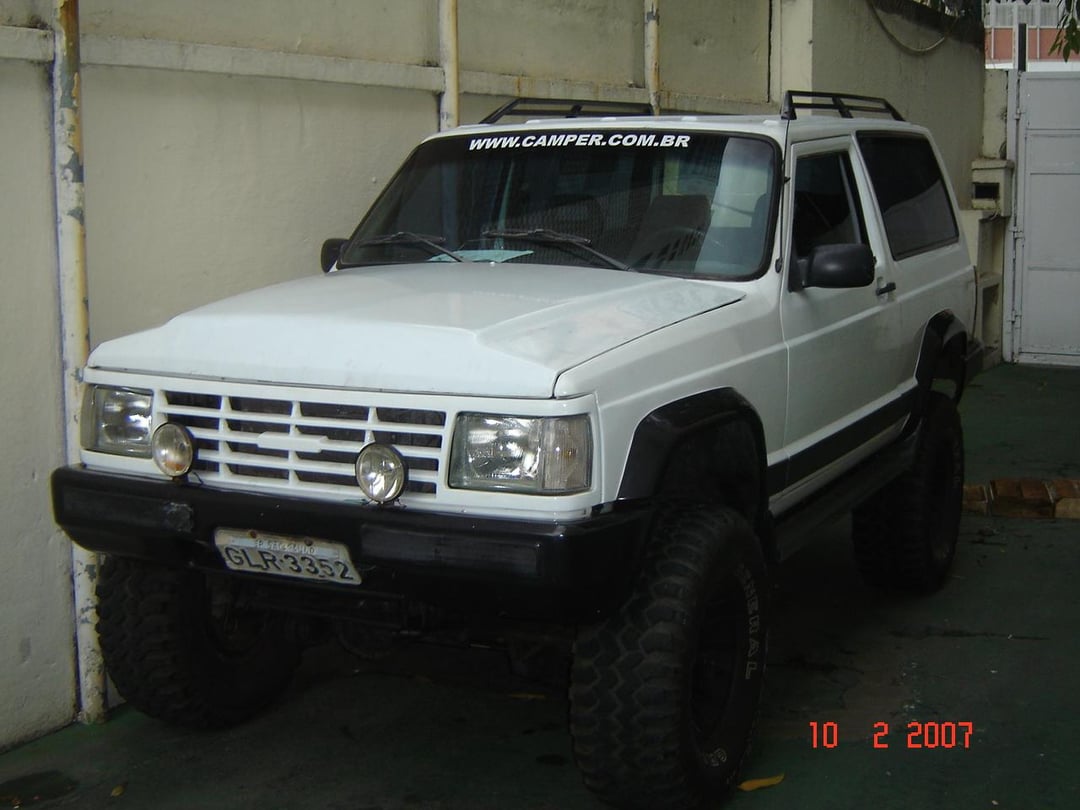
·1: The Envemo Camper first model: a late successful launch that did not prevent the company’s downfall.
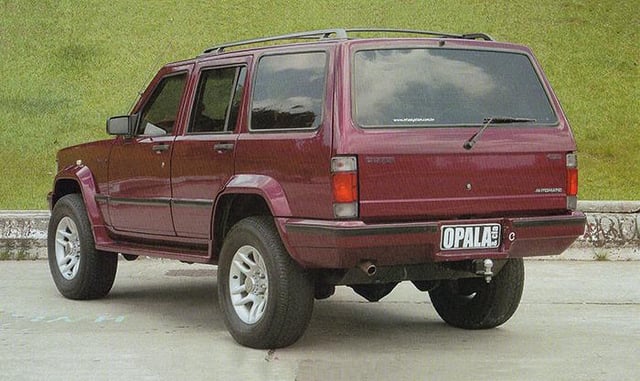
·2: Rear end of a Camper 1993.
·4: The Camper’s interior, based on the Chevy Opala.
·6: In 1993, the Camper gained a four-door version and a retouched grille.
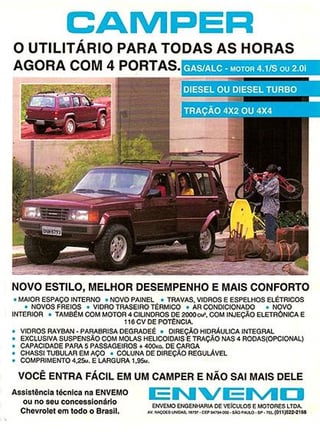
·7: Advertisement from which the previous image was extracted (source: Jorge A. Ferreira Jr.).
-Translation of what is written in the ad;
CAMPER, The utility vehicle for all hours now with four doors.
Gasoline / Ethanol – 4.1/S or 2.0 liter engine.
Diesel or turbo diesel.
4×2 or 4×4 traction.
New style, better performance and more comfort.
More interior space, new dashboard, locks, electric windows and mirrors, new brakes, heated rear window, air conditioning, new interior, also with a 2.0 liter four-cylinder engine with electronic injection and 116 hp of power.
· Rayban glass – gradient windshield.
· Exclusive suspension with coil springs and four-wheel drive (optional).
· Capacity for five passengers + 400 kg (881,849 lbs) of cargo.
· Steel tubular chassis + adjustable steering column.
·Length: 4.25 m (13 ft 11.323 in). Width: 1.95 m (6 ft 4.772 in).
You can easily get into a Camper and never get out again.
Technical assistance at ENVEMO or at your Chevrolet dealership throughout Brazil.
·8: Advertising brochure for the Envemo Camper, one of the company’s most original (and latest) launches.
·9: Advertisement from July 1991 announcing the arrival of the 4.1 six-cylinder engine in the Camper line (source: João Luiz Knihs).
SOURCES
·Wikipedia: https://pt.m.wikipedia.org/wiki/Envemo_Camper
·Lexicar: https://www.lexicarbrasil.com.br/envemo/
by OriginalPapaya8
![Beautiful [Alpina unknown] at the car wash in Bath](https://www.evshift.com/wp-content/uploads/2026/04/kr4gn7ar2rsg1-770x515.jpg "Beautiful [Alpina unknown] at the car wash in Bath")