Toyota Ceo Tells FINALLY THE TRUTH About EVs! HUGE NEWS!
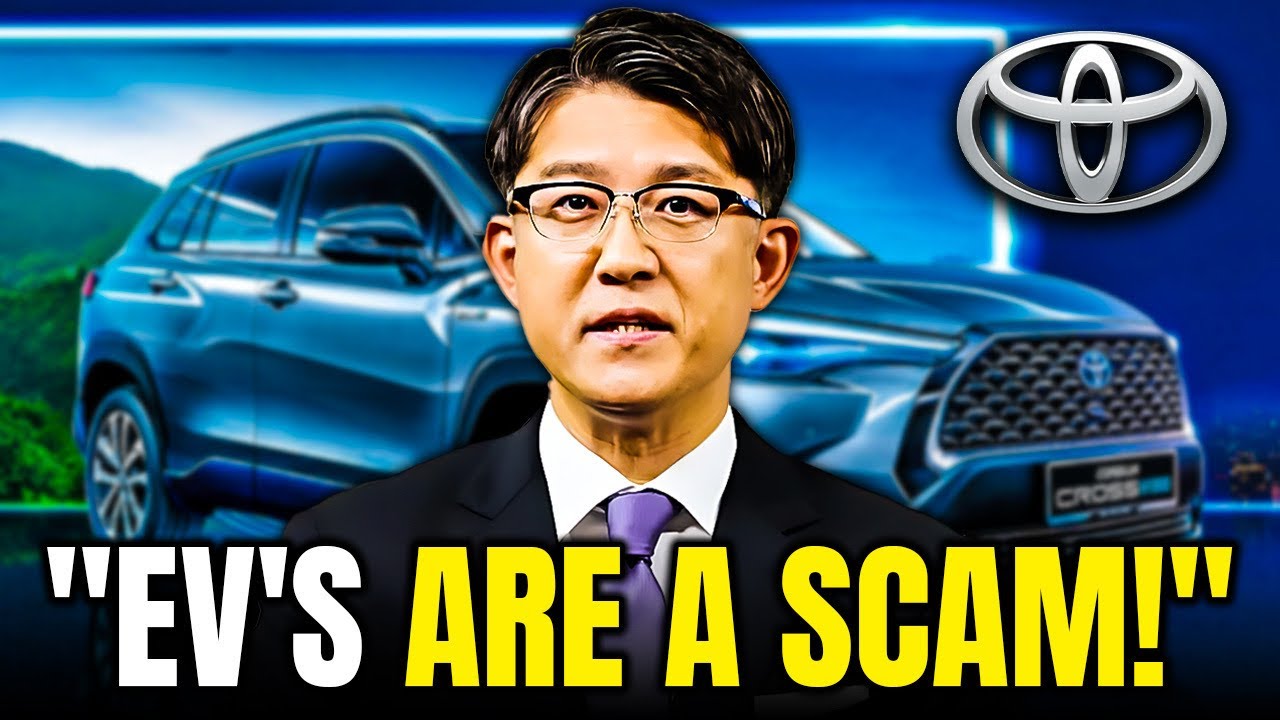
Is it possible that the CEO of Toyota is spreading rumors that electric vehicles are a scam? Emotions have been stirred up among enthusiasts of combustion cars and electric vehicle manufacturers alike as a result of the CEO’s recent warning. Coji,
The newly appointed CEO, is known for his strong disapproval of EVs and his clear preference for traditional combustion engines. This is an interesting characteristic. Toyota’s sudden push for electric vehicles raises questions in light of the fact that global leaders are
Exerting pressure on the company despite the fact that they are facing opposition. In the background, Toyota has been conducting covert experiments with a completely novel kind of fuel that has the potential to shake up the entire EV agenda and prevent combustion engines
From being outlawed. Why is the CEO of Toyota so resistant to electric vehicles? What is it that the world does not want you to know about the electrification process, and more importantly, when will their new alternative fuel be released? Here is the specifics of what took place.
It was during the time of Akio Toyota, the former CEO of Toyota, who was fired because of his unwillingness to embrace EVs that everything initiated. Why would the chief executive officer of one of the largest automobile manufacturers in the world want to go against what
Many people consider to be an unavoidable trend in the future? Toyota presented a point of view that was rather proactive, claiming that it was a member of the silent majority of auto industry veterans who were skeptical about a future in which electric vehicles were the
Only option. The former chief executive officer emphasized on multiple occasions his conviction that the most comprehensive approach to moving forward would be to investigate a variety of powertrain technologies. These technologies would include hybrids, plug-in hybrids, hydrogen-powered vehicles, Toyota’s secret fuel, and yes, battery electric vehicles as well.
At one point, he was quoted as saying, “The majority of people who are involved in the automotive industry are largely silent.” There is a silent majority that is questioning whether or not electric vehicles are truly acceptable to have as a single option. However, because they believe
That it is a trend, they are unable to speak out loud. It is not yet clear what the correct response is. It would be unwise for us to restrict ourselves to a single choice. Despite the fact that many people believed that electric vehicles were the only way to achieve carbon neutrality,
The true adversary was carbon itself, not the type of powertrain. In addition to this, everyone went absolutely insane when the new CEO issued a terrifying warning to the leaders of the world about the consequences of prohibiting internal combustion engine automobiles. There will be further discussion on that. The company Toyota stated that battery
Electric vehicles, also known as BEVs, were not the only solution to the problem of achieving carbon neutrality on a global scale. On the contrary, they advocated for the necessity of a varied portfolio that included hybrids, plug-in hybrids, battery electric vehicles, and fuel cell
Transportation vehicles. As for the attachment angle, I concur with the statement that he had spent his entire life working on the production of internal combustion engines. In addition to that, he raised some practical concerns. In addition, as you will soon discover, Toyota is receiving
Support from a number of major automobile manufacturers regarding this matter. The impending tremendous shortages of essential materials such as lithium and battery-grade nickel were a source of concern for him, and he anticipated that there could be problems with
The supply chain in the following ten years. Furthermore, Toyota was critical of the rate at which regulators anticipated the widespread adoption of fully electric vehicles. Among the potential obstacles that he mentioned were factors such as infrastructure limitations, varying consumer preferences across regions, and difficulties with pricing.
When he was in charge of Toyota, the company did not completely avoid electric vehicles, despite the fact that its position might give the impression of being resistant to change. Although the amount is relatively low in comparison to that of some of the company’s rivals,
The corporation has set aside a substantial $70 billion for the development of electric vehicles over a period of nine years. In spite of this, Toyota’s emphasis was unmistakable. A goal of Toyota was to diversify its business. They wanted to offer a wide variety of powertrains
So that they could cater to a multitude of different types of passengers. Nevertheless, an unfortunate event took place after that. The removal of Akio Toyota was a result of concerns regarding electrification. It was not enough for the grandson of Toyota’s
Founder, who was 66 years old at the time, to serve as the company’s CEO; he was also the personification of the company’s philosophy. He desired for the average person to have the ability to choose what they truly desire, rather than being forced to purchase electric vehicles. On
The other hand, as a result of his viewpoints, Toyota was ranked among the most obstructive companies in the world in 2022, competing with oil giants such as Exxon Mobil. For the purpose of highlighting the gap even further, the launch of Toyota’s first electric
Vehicle, the BZ 4X, was marred by safety recalls. Although many automobile manufacturers boasted double-digit sales of electric vehicles, Toyota’s sales of zero-emission vehicles accounted for less than one percent of the company’s total sales in the United States. During the initial phases of
The program, Toyota sold only about 1,200 units. According to the former chief executive officer, “I am an old-fashioned person when it comes to digitalization, electric vehicles, and connected cars. This is because I have a strong passion for automobiles.” My limitation is that I am only able
To be a car guy. I cannot go beyond that. After that, Koji Sato arrived, and everyone anticipated that he would steer Toyota in the direction of an all-electric future. However, not long after he was appointed, he made a statement that every single world leader who was passionate
About electric vehicles dreaded the most. It is true that Sato is interested in speeding up the production of electric vehicles; however, he has stated that Toyota will also be concentrating on the new fuel source that they have been working on. I’ll elaborate on that in a moment.
During the annual general meeting of the company, Toyota was subjected to a significant amount of pressure from shareholders who demanded a more substantial transition towards electric vehicles. There was no ambiguity in Toyota’s response. In addition to the widespread adoption of electric
Vehicles, their goal is to achieve carbon neutrality. When asked about Toyota’s mission, Executive Vice President Masahiko Maida emphasized that the company’s objective was to offer a variety of vehicle options. As a result, they continued to launch hybrid vehicles, which was contrary to the shareholders’ wishes. On the other hand, it appears that
Hedge funds in the United States and European investors do not share his vision. Academy Cenin, a significant Danish fund, was one of the individuals who voiced their anxiety about the situation. The fund had taken the initiative to challenge Toyota, calling into question the
Company’s ongoing negative climate lobbying and accusing the automaker of attempting to dilute the efforts of the government to phase out combustion engines in favor of electric vehicles. Many other major players, such as AP7, the Storebrand group, and the Church of England, shared their concerns
And expressed their agreement with them. A growing number of shareholders, environmentalists, and members of the general public have expressed their dissatisfaction with the company. Specifically, Greenpeace Japan organized a demonstration at Toyota’s headquarters, where they demanded that the company stop manufacturing automobiles that
Run on fossil fuels. Given that Greenpeace gave Toyota the lowest grade possible in its 2021 annual analysis of global automakers’ efforts to reduce carbon emissions, it is safe to say that the company’s reputation in environmental circles has suffered as a result.
Despite the fact that Toyota has set a goal of selling 3.5 million battery electric vehicles annually by the year 2030, the company is still behind its competitors in terms of the percentage of total sales that are comprised of electric vehicles. Despite the
Fact that Toyota’s leadership has maintained a consistent approach to the transition to EVs, it is clear that they are facing pressures from both within and without the company. It is also important to note that Toyota is not the only company of its kind to oppose electric
Vehicles. Stellantis, BMW, Porsche, Honda, and Mercedes are just some of the companies that voice their agreement with this sentiment. Zipa, the CEO of BMW, warned against concentrating solely on EVs because doing so could lead to an increase in dependence on a select
Group of nations, particularly China, which controls the majority of the raw materials used in battery production. He emphasized that there is still a market for automobiles powered by internal combustion engines for people who are unable to make the switch
To electric vehicles right away. In order to provide an alternative to older vehicles that may have a lower fuel efficiency, combustion engines are utilized. Throughout its history, Zipa has also been vocal in its opposition to total bans on the sale of combustion engines.
A dogmatic ban on combustion vehicles could have social consequences that could be unmanageable, as Carlos Tas, the head of Stellantis and Jeep, cautioned. He also warned that such a ban could have undesirable consequences. It is possible that the sole transition to electric vehicles,
Which are currently more expensive than their counterparts that run on fossil fuels or hybrids, could make car ownership unaffordable for many people, particularly those in the middle class. The Chief Executive Officer of Honda, on the other hand, who has worked in
Engine development for more than three decades, admitted that although the transition might feel threatening to him personally, decisions must be based on what is best for the company. And now for the most significant news, which has the potential to completely eradicate electric
Vehicles: the introduction of Toyota’s ammonia engine. It is true, folks; you did hear that correctly. All of the problems that are associated with combustion engines are resolved by this engine, which was developed in conjunction with another company known as GAC Motors. The best part
Is that this could be installed in any existing internal combustion engine vehicle, which means that you will be able to keep your vehicles for a longer period of time without having to worry about the government prohibiting them. Ammonia , which is made up of one nitrogen molecule
And three hydrogen molecules, is an intriguing possibility for internal combustion engines. Because it does not contain any carbon atoms, it guarantees to produce low levels of carbon dioxide emissions when it is burned. It was previously only possible for ships and heavy machinery to
Run on liquidized ammonia, but the prototype that GAC and Toyota have developed together is capable of doing so. It is indisputable that the discovery that a two-liter four-cylinder engine is capable of producing 161 horsepower while emitting 90 percent less carbon pollution is a game-changer.
It is possible that this idea has the potential to completely transform the landscape of the automotive industry by reducing emissions. A full-fledged dedicated video that covers all of the features of this revolutionary engine was also produced by us; the link to that video will
Be provided at the conclusion of this video, allowing you to watch it after the fact. A vehicle that has garnered a lot of attention all over the world is currently being tested by Toyota, which is another piece of evidence that supports the anti-narrative. The new
Chief Executive Officer of Toyota, Kizato, recently addressed the company’s perspective on hydrogen cars and electric vehicles while the company was competing in an endurance race at the Suzuka Circuit in Japan. In spite of the fact that he acknowledged the necessity
For Toyota to adopt an EV-first mentality, he still emphasized the significance of maintaining hydrogen as a viable option for the future. An evolution in the production and transportation supply chain of hydrogen is required, according to Sato, in order for hydrogen to become a
Significant player in the industry. Although they are unquestionably moving in the direction of EVs, with plans to launch a new dedicated EV platform by the year 2026 and an objective to sell approximately 3.5 million EVs across the globe by the year 2030, they are not yet prepared to
Give up on hydrogen. The comments made by Sato provide a hint at a more comprehensive aspect, which is that Toyota wants to be ready for any and all possible future energy scenarios. On the other hand, they are currently conducting tests on their brand-new hydrogen racing fuel
Cells, which promise to be both efficient and powerful. A Corolla that is powered by liquid hydrogen was introduced by Toyota, marking the first time that hydrogen-fueled vehicles have been used in the world of auto racing. This was Toyota’s most recent foray into environmentally
Friendly technology. A hydrogen-powered Toyota Corolla was entered into the Super Taikyu 24-hour race at the Fuji Speedway. This event served as a representation of the company’s dedication to environmentally friendly technology. The race car, on the other hand,
Is more of an experiment than a product that is currently available for purchase. In contrast to conventional electric vehicles, the hydrogen Corolla is powered by a combustion engine; however, it burns liquid hydrogen rather than gasoline. Toyota’s recently revealed roadmap is ambitious, despite the fact that it has been criticized for its gradual
Approach to electrification over the years. They envision electric vehicles having an incredible range of over 600 miles by the year 2026 and approximately 900 miles after the year 2028. Under their luxury brand Lexus, the first of these NextGen electric vehicles will be introduced to
The market. This vehicle will make use of the most advanced lithium-ion battery technology currently available. The implementation of Giga Casting Technologies for the purpose of accelerating vehicle production and the achievement of ultra-aerodynamic car designs are among the
Future objectives of Toyota. Although it is clear that Toyota is putting more of its attention on hydrogen and electric technologies, the company is not giving up on internal combustion engines. In order to provide customers all over the world with a varied selection of products,
They intend to continue their development. In this race to find an alternative solution to the energy crisis, do you believe that Toyota should completely abandon combustion engines, or do you agree with them that they should continue to pursue this solution? Leave a
Comment below and let me know what you think. The electric vehicle industry as a whole may suffer as a result of the groundbreaking news that we have just uploaded. If you want to be truly surprised by what is going to happen with electric vehicles, you should definitely check it out.
SHOCKING NEWS! Toyota Ceo Tells THE UGLY TRUTH About EVs!
—————————–
Is it possible that the CEO of Toyota is spreading rumors that electric vehicles are a scam? Emotions have been stirred up among enthusiasts of combustion cars and electric vehicle manufacturers alike as a result of the CEO’s recent warning. Coji, the newly appointed CEO, is known for his strong disapproval of EVs and his clear preference for traditional combustion engines. This is an interesting characteristic. Toyota’s sudden push for electric vehicles raises questions in light of the fact that global leaders are exerting pressure on the company despite the fact that they are facing opposition.
—————————–
📺 Watch the video here:
🔴 Toyota Ceo: ‘’Our New Engine Is The End For The EV Market” WATCH HERE 👉 https://youtu.be/XDMYj_Cx368
—————————–
😁Hey guys, let us know in the comments below what you thought of this video and what kind of videos and topics you would like to see. Give us feedback so that we can continue to improve our videos according to your wishes! Thank you for your support🙏🏻
Don’t forget to like and subscribe to our channel for more content like this! ❤️
—————————–
🔴For copyright matters please contact: Lucasfuturecars@gmail.com
🔴For Business matters please contact: Lucasfuturecars@gmail.com
—————————–
#toyota #evs #electricvehicle
—————————–
toyota,toyota ev,toyota ceo,toyota electric car,toyota electric,toyota hydrogen,toyota hydrogen engine,toyota ammonia engine,toyota bz4x,toyota mirai,toyota news,toyota new battery,toyota ev 2024,toyota new model,ev,electric cars,ev news,no more evs,electric vehicles,electric car,chargedrive,velocity,scotty kilmer,ev 2023,ev cars,ev car,cars,evs,toyota new ev,toyota evs,ev makers,koji sato,toyota corolla,toyota rav4,new ev,bz4x,corolla