
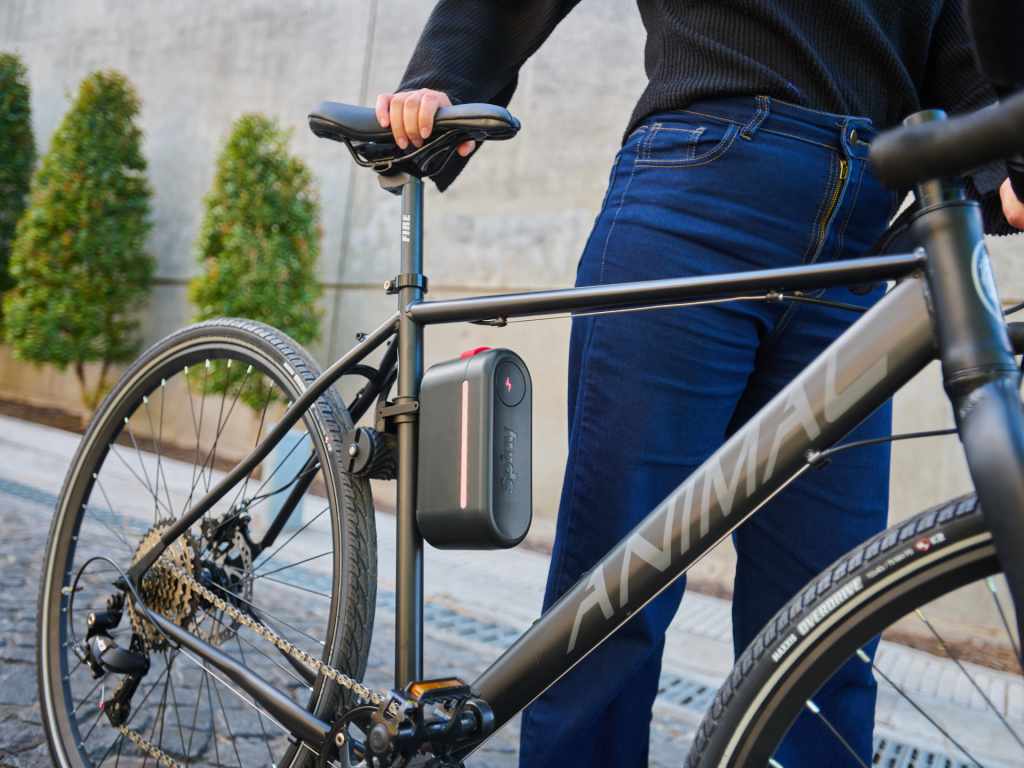
Spanish mobility company Spiny has launched an e-bike conversion kit which lets riders turn their mechanical bikes into electrically assisted ones in seconds after initial setup.
The ‘Spiny 2’ is the second iteration of the company’s first e-bike system and is built on feedback from around 500 users across Europe. Weighing 2.2kg, riders can clip the device onto their bike when they want electric assistance and then detach it when their ride is finished.
The system is being offered through a Kickstarter campaign which launched yesterday with worldwide delivery then estimated for April 2027.
Spiny Co-Founder Marco Cocchiarella said that the new generation was “developed directly” from the feedback of its riders across Europe.
“That real-world experience highlighted the importance of making the system faster to attach and remove, easier to carry and compatible with a broader range of everyday bikes,” Cocchiarella told Zag Daily. “As a result, the second generation focuses particularly on faster attachment, greater portability and broader compatibility.”
The Spiny 2 uses cadence and speed sensors to detect rider input in real time. When riders begin to pedal, the motor engages the rear tyre in what the company claims is approximately 0.25 seconds before delivering assistance according to the rider’s chosen level. When the rider stops pedalling, the motor lifts away from the tyre, removing contact and letting the bike roll without assistance.

According to the specifications, the conversion kit can deliver up to 35Nm of torque and 90 kilometres of assisted range under “ideal test conditions” though actual range will depend on terrain, rider weight, riding style and the assistance level.
Power and maximum assisted speed are configured according to the market. The U.S. version is rated at 250W nominal power with peak output of up to 750W, providing assisted speeds of up to 32 km/h. For Canadian customers, the system is configured to deliver peak output of up to 500W. In most other markets, the system is rated at 250W with assistance limited to 25 km/h.
Riders need to initially set the system up – attaching the mount and sensors and ensuring correct positioning – before they can attach and remove the device in what Spiny claims is three seconds. Afterwards, riders will be able to choose between five levels of pedal assistance which can be adjusted either through the Spiny app or an optional Bluetooth remote which can be mounted on the handlebar.
As well as accessing assistance controls, the smartphone app lets riders see the battery level, current speed and performance information.
The company states that the Spiny 2 is designed around “broad bicycle compatibility” rather than a specific wheel hub, drivetrain or brake standard. The main requirement is that there’s sufficient clearance between the frame and rear wheel for the mounting system, with riders able to check their bike’s compatibility on a measurement guide before ordering.
An additional Sport Adapter can reposition the system for bikes with a tighter frame clearance such as certain mountain bikes. A Brompton Adapter can extend compatibility to folding bikes.
Rear-suspension frames, however, are not compatible with the Spiny 2 as standard and the company states that bikes with a rear fender or mudguard may need to have a small cut where the motor contacts the tire.
The Spiny 2 is priced at $339 as a 72-hour early-bird offer after which it will then become $409.
E-bike conversion kits have gained traction in recent years, positioned as an alternative to buying e-bikes that can run into the thousands of dollars. In the UK, the F1-backed Skarper began rolling out across premium bike retailers last year, again promising to turn any bike electric in seconds. Meanwhile, Brooklyn-based Clip unveiled its conversion solution which aims to “democratise” e-bike access across low and middle-income countries through a subscription model.