
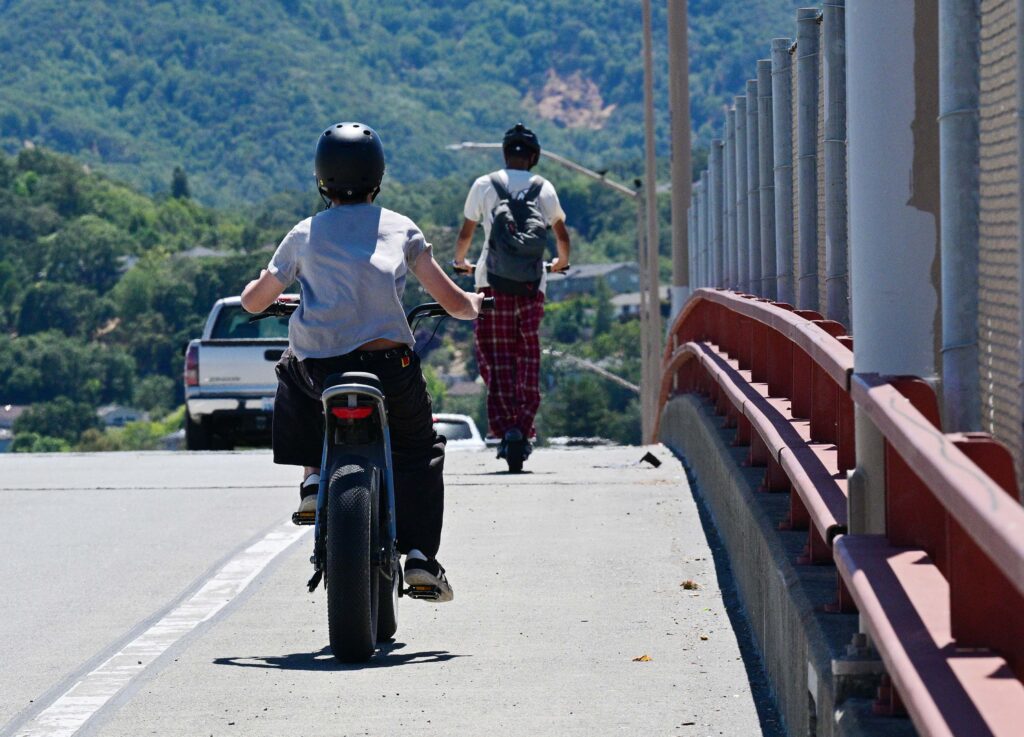
Transportation Authority of Marin leaders are raising concerns about the county’s e-bike safety dashboard data.
The data suggest that crashes involving youths riding electric bicycles in Marin County are on the decline, but some officials cautioned that there are too many missing statistics to draw real conclusions.
The discussion arose Thursday at a TAM presentation where board members flagged the dashboard data, saying they are concerned the figures do not offer a clear estimation of how many people are actually cycling in Marin.
The county data show e-bike crash rates per capita. For the 10- to 15-year-old age group, the rate dropped from 16.25 to 11.65 per 10,000 residents between July 2024 and June 2026.
Board member Yoav Schlesinger, a representative of the San Anselmo Town Council, said the crash rate does not indicate a certain number of bike trips, riders or miles traveled. Schlesinger said that without context, the data could be misleading.
Board member Urban Carmel, a Mill Valley City Council member, said measuring the rate per capita is akin to measuring the number of people injured in a football game against the number of people in the stadium “as opposed to the number of people that are on the field.”
“It is not a valuable measurement at all, because what matters is how many people are riding, not how many people happen to be in that cohort,” Carmel said. He recommended the county stop using the per capita metric, saying it was causing confusion.
The crash data also do not distinguish between classes of e-bikes or whether the vehicle involved is actually an e-moto — a more powerful vehicle that requires a driver’s license to operate and can travel in excess of 30 mph.
There are three classes of e-bikes. Class 1 e-bikes are pedal-assist only and class 2 e-bikes have a throttle. Both reach about 20 mph. Class 3 is a pedal-assisted bike with no throttle that travels up to 28 mph.
State law requires class 3 riders to be over 16 and wear a helmet. Under Assembly Bill 1778, no one under 16 may operate class 2 e-bikes, which are throttle assisted, anywhere in Marin. Helmets are required for all users.
Many class 2 e-bikes can be modified to become illegal e-motos, further complicating how to track the vehicle type.
The popularity of e-bikes and e-motos exploded during the COVID-19 pandemic, and the trend continues among youths in Marin County. According to emergency response data, the county had a 110% increase in calls about crashes involving youths and all bike types between 2019 and 2022.
In 2023, e-bike riders between 10 and 15 years old had a five times higher crash rate than other age groups.
In December, the Mineta Transportation Institute released a Legislature-commissioned study on e-bike safety that identified illegal or overpowered e-motos as the key safety concern.
The report found that of the bikes parked at Marin schools, 80% at middle schools and 90% at high schools were illegal e-bikes or e-motos.
 An e-bike parked at Redwood High School in Larkspur, Calif., on Wednesday, Oct. 15, 2025. (Alan Dep/Marin Independent Journal)
Tarrell Kullaway, executive director of the Marin County Bicycle Coalition, said she is concerned that the county’s data do not distinguish between e-bikes and e-motos because that conflates the types of bikes and is misleading, confusing parents who are buying the vehicles for their kids.
She said the county’s data are presented in a way to tell a story that “it really doesn’t.”
“E-bikes have the capacity to revolutionize the way people get around, and they’re getting a bad name because of these greedy manufacturers who are taking advantage of a loophole in the system,” she said, referring to the class 2 e-bikes that can be modified.
In March, U.S. Rep. Jared Huffman, whose district includes Marin, co-authored a bipartisan bill for tighter federal regulations on electric bicycles, electric motorcycles and other small, electric-powered vehicles to address the issue.
Acknowledging the limitations of the data, Bria Larson, a county epidemiologist, said work is underway to gain better insights.
“In the coming weeks and months, we’re going to require that all bicycle accidents, not just e-bike accidents, have an image, a picture of the bike attached to their EMS record,” Larson said. Having a picture on file will help the research team identify the class of e-bike, or whether it was an e-moto.
To better measure the risk of crashes, Marin is partnering in a Stanford study to measure the risk per miles traveled on e-bikes, Larson said.
Additionally, the county will produce a report on the number of serious crashes involving e-bikes before and after the adoption of AB 1778.
Larson said the county has been on an e-bike and e-moto safety campaign for the last few years, promoting awareness through the Safe Routes to Schools program and launching a new “E-Bikers Club” to promote safe riding habits.
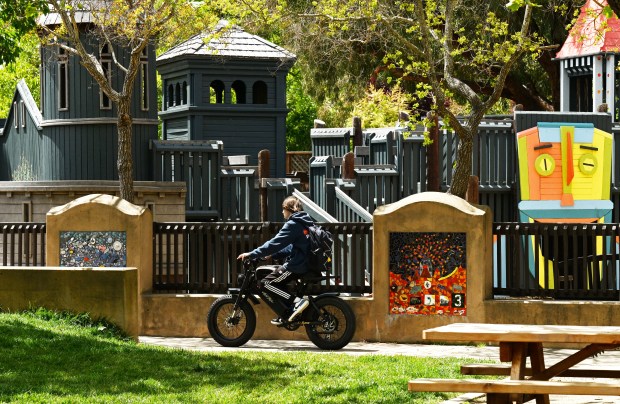 An e-bike rider passes the playground at Memorial Park in San Anselmo on Wednesday, May 10, 2023. (Sherry LaVars/Marin Independent Journal)
According to the new data, the crash rate for the 10- to 15-year-old age group is still nearly four times greater than any other in Marin.
Helmet use among youths involved in bike crashes has increased to 90% over the past year, compared to 77% the prior year, the data show.
Despite concerns, Carmel said the education, data collection and reporting are good work and he looks forward to the next steps.
“The fact that people are now using helmets much more than they were before, I think is a really important outcome of this,” he said.
Board member Mary Sackett, a Marin County supervisor, leads the Marin County Special Committee on Youth E-Bike Safety. She said the data are not perfect, but one of the primary objectives from the beginning was to get more helmets on kids’ heads.
“So if nothing else, that has been accomplished,” she said.
Sackett also said that parents are more engaged around the topic than they were four years ago, so their education to the school community appears to be effective.
“And we want to see more kids out on bikes and e-bikes, I think is also always an important message,” she said.
San Rafael Mayor Kate Colin, chair of the Transportation Authority of Marin board, said, “Good data about e-bike safety is important, and we need more of it to understand trends over time. But we’ve all seen the proliferation of youths on e-bikes, so we also need to respond to what we’re seeing on our streets.”
“I’m encouraged that the data shows more kids are wearing helmets as that suggests local bike-specific education and outreach are making a difference,” she said.