
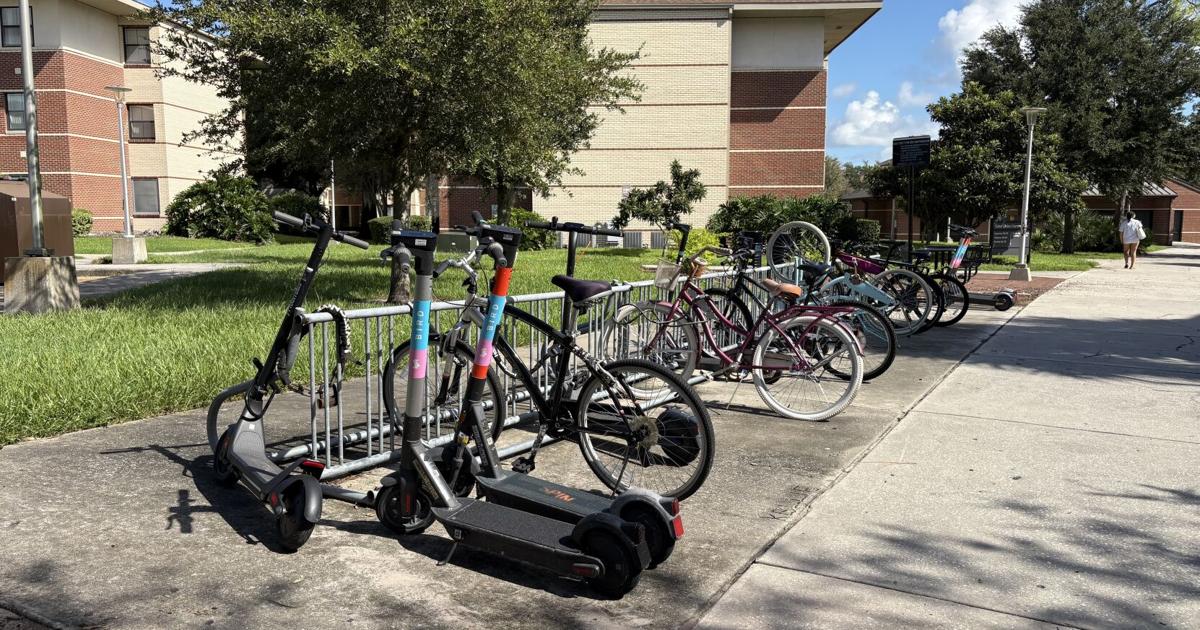

The designated bike rack outside the Nicholson School of Communication and Media secures students’ bicycles and e-scooters as they attend classes on Thursday.
Nathalie Bermudez
Shequel Dyce woke up expecting her usual ride to work to be waiting outside. Instead, she found an empty bike rack.
Dyce, junior environmental science major, said the theft of her e-bike near campus affected both her transportation and her ability to get to work. Dyce said her e-bike was stolen from a bike rack at Boardwalk at Alafaya, an apartment complex near UCF in November 2025.
“The only thing that was left was the smaller bike lock and the cover just over nothing,” said Dyce.
UCFPD warns that bicycles and scooters can be targets for theft when left unsecured. According to UCFPD’s 2025 Annual Security & Fire Safety Report, most thefts on campus are crimes of opportunity. The report encourages students to take their belongings with them and properly secure bikes and scooters.
The report does not provide a separate number for e-bike or e-scooter thefts in its published crime statistics.
Dyce said she reported the theft to the Orange County Sheriff’s Office and spoke with the apartment’s property manager. She said the manager told her the cameras were not pointed toward the bike racks because thieves had previously damaged cameras in the area.
A representative at Boardwalk at Alafaya confirmed that the cameras have since been repaired.
The e-bike cost Dyce between $389 and $400. At the time, she did not have a car and depended on the e-bike to get to work.
After it was stolen, Dyce said she had to use rideshare apps, find a ride from a roommate or consider missing work, particularly on weekends when the UCF shuttle was not an option for her commute.
Dyce said transportation is critical for her to get to school, home, grocery stores and other places she needs to go. She said working helped her provide for herself and mitigated her rent bills.
“I would have to Uber or just not go to work,” said Dyce.
At the UCF Bike Shop in the Student Union, manager Jackson LaChapelle said theft is a concern.
“We generally just work on normal bikes, not e-bikes as much,” said LaChapelle. “But across the whole spectrum, like normal bikes, e-bikes and scooters, there’s a lot of theft.”
LaChapelle said students can reduce their risk by properly securing their bikes and scooters to designated bike racks.
“Lock through the frame, don’t lock it through the wheels because they’re going to be taken off,” said LaChapelle.
The growing popularity of e-bikes made them attractive targets, LaChapelle said. With e-bikes now widely available through online retailers, he said more people have access to them and their replacement parts.
For students who rely on e-bikes and e-scooters as an alternative to driving, theft can create problems beyond the cost of replacing the vehicle. Dyce said losing her e-bike made getting to work more difficult and changed how comfortable she feels leaving an e-bike or scooter unattended.
UCFPD spokesperson Amanda Sellers said unattended property theft is the most common crime on campus and one of the most preventable. Sellers said UCFPD regularly shares crime prevention tips on its social media channels.
For bikes and scooters specifically, UCFPD encourages students to use a high-quality U-lock and park only in designated bike and scooter parking areas.
UCFPD partnered with ProtechDNA to offer free property registration services. Students can register their belongings in the database, making it easier for law enforcement to identify and return items that are lost or stolen.
ProtechDNA offers optional DNA marking kits that include specialized labels containing microscopic identification dots. Law enforcement identifies recovered items and returns them to their rightful owners through a Personal Identification Number or trace elements of the adhesive label.
The kits are available directly through ProtechDNA, not UCFPD, and users are responsible for a small shipping charge.
For students who depend on e-bikes and e-scooters for transportation, taking precautions can help protect their investment and prevent disruptions to their daily routines.
For Dyce, who now has a car and an e-scooter she said she rarely uses, the theft off-campus has left her wary of taking her scooter anywhere.
“I’m just skeptical about even bringing [the scooter] on campus, even when it probably would be easier for me,” Dyce said.