
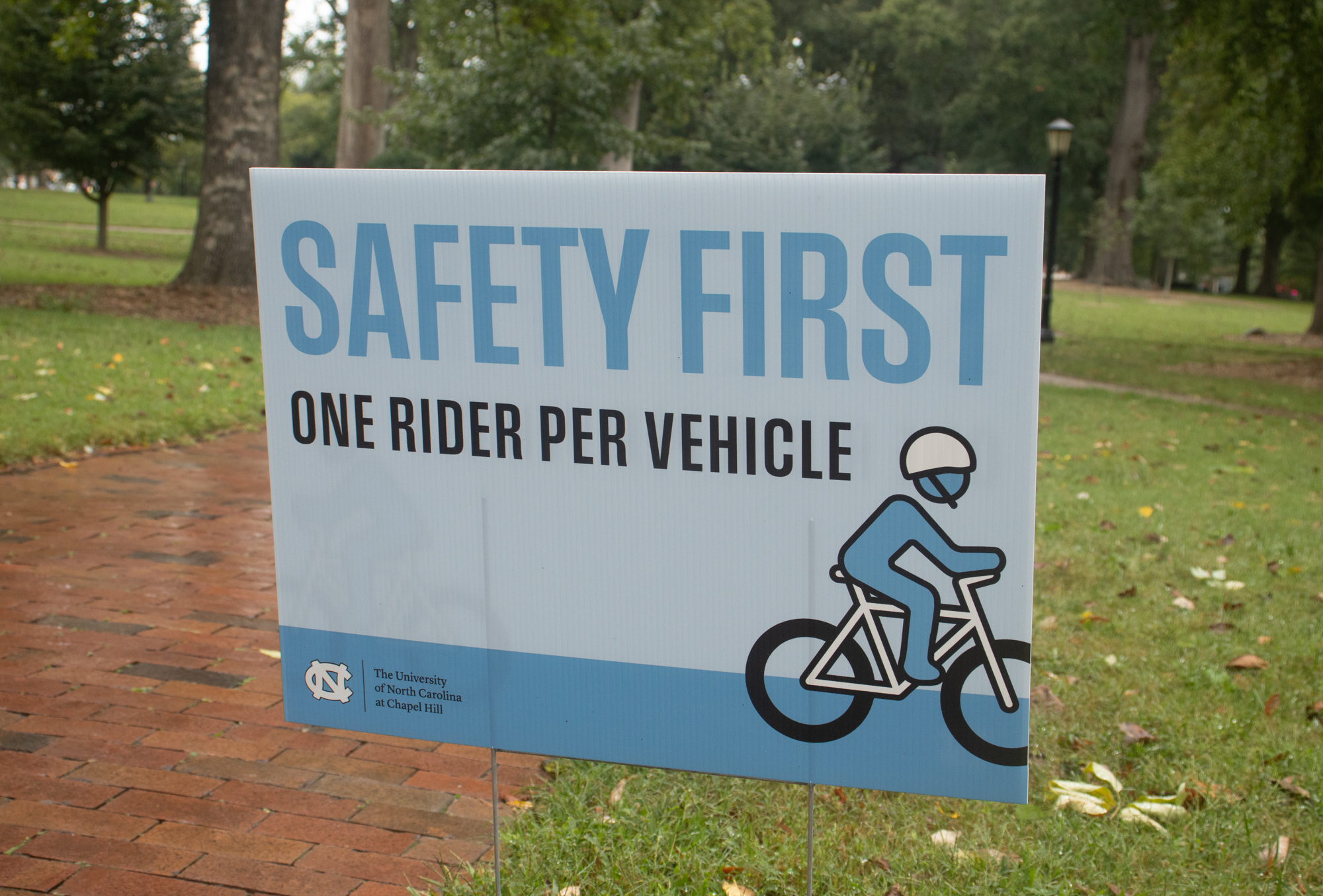
Across UNC-Chapel Hill’s campus, students and faculty may have seen signs encouraging students to wear helmets and limit bike and scooter use to one person per vehicle.
The signs are part of a new University campaign focused on micromobility safety as students navigate crowded walkways across campus.
“The University has started a micromobility transportation device campaign aimed at increasing rider safety and responsibility,” a UNC-Chapel Hill spokesperson wrote in an email statement to The Daily Tar Heel. “As a part of that, the Chancellor’s Office sponsored a table at the Tar Heel Preparedness Festival on Sept. 15.”
At the festival, students were invited to enter a raffle for a helmet. 25 students won and will receive a helmet in their chosen size. The Chancellor’s Office plans to hold another helmet raffle at the Glow and Know: Safety After Dark event on Nov. 4, where another 25 students will be selected.
The University encourages students, faculty and other members of the campus community who ride bicycles and scooters to prioritize safety by wearing properly fitted helmets and using their vehicles responsibly, according to the University spokesperson.
For pedestrians, sharing crowded walkways with bikes and scooters isn’t always easy.
“Just with the congested areas, I feel like it can be a lot and I don’t want to be in their way and I’m sure they don’t want to be in mine,” sophomore Nuala Ingram said.
Other students have witnessed accidents involving scooters and bicycles firsthand.
“Freshman year, one of my friends got fully taken out by an electric scooter,” sophomore Sonya Ramaraju said.
First-year lacrosse player Paul Wable said he hasn’t seen any accidents yet, but he has heard of some of his teammates getting into them. He said the accidents he has heard about did not result in injuries and were caused by issues like bikes getting caught in potholes.
Wable said he doesn’t wear a helmet because he thinks it’s bad style and would mess up his hair.
“Unless the University implemented an actual rule that you had to wear a helmet, I would not wear a helmet,” Wable said.
Sophomore Prithika Devarajan said some of her friends have also experienced accidents, including incidents involving damaged or missing bricks in campus walkways.
She said she does not always wear a helmet but tries to adjust her riding when she encounters potentially dangerous areas.
“Whenever I’m in walking zones or anything of danger, I slow down ridiculously,” Devarajan said.
She also emphasized the importance of bike etiquette, saying some riders are too relaxed about following safe practices. She said she would be more likely to wear a helmet if the University began enforcing the rule through fines.
The University’s campaign also comes as North Carolina law tightens restrictions on certain e-bikes.
Belal Elrahal, an assistant professor of public law and government at the UNC School of Government, said riders should be aware of when an electric bicycle may legally be considered a moped in the new statewide legislation, House Bill 1094, effective Dec. 1.
“I think the most important thing for people is that right now, if an e-bike assists you over 20 mph, that still counts as a moped,” Elrahal said. “So helmet, insurance and registration; all of those things are required.”
While the University does not currently have statistics available on bicycle or scooter-related accidents and injuries on campus, the University’s campaign is intended to provide students with information and resources to make responsible transportation decisions, according to the spokesperson.
“This is gonna sound so bad, but I actually do not know if helmets are the most necessary thing,” Devarajan said. “I think people are just so reckless when they drive around.”
@dailytarheel | [email protected]