
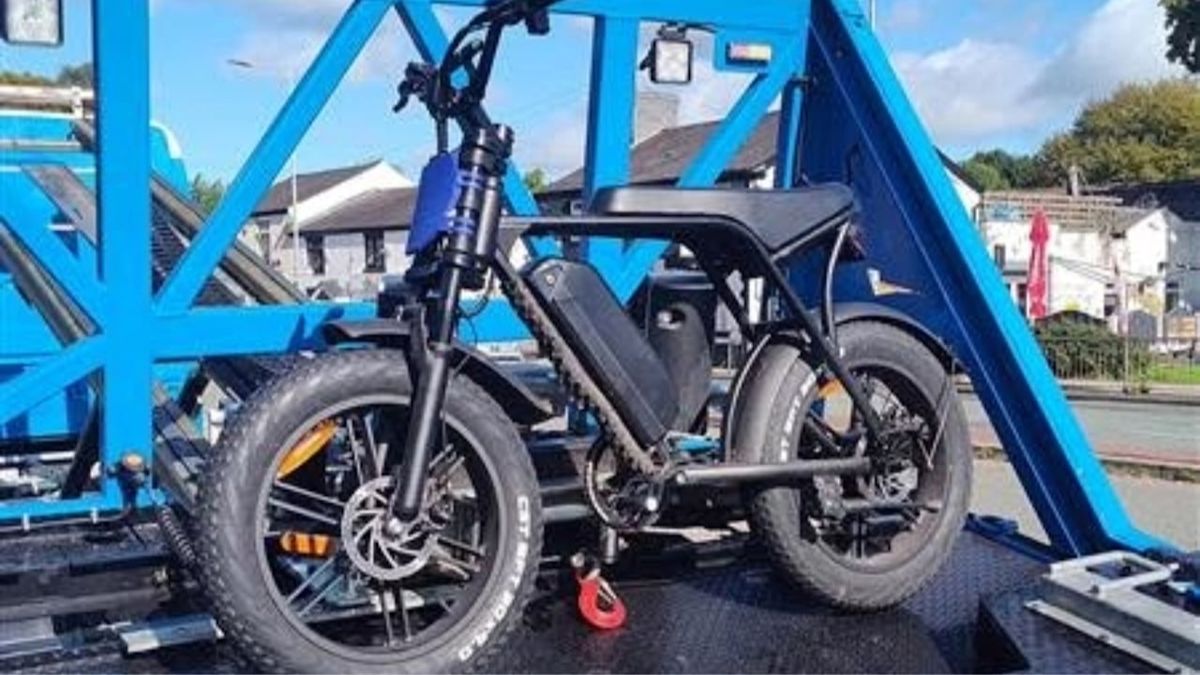
A police patrol in Whitefield, Greater Manchester, seized an electric bike that officers said had been modified with a concealed throttle and could reach speeds of up to 50 mph.
The seizure followed concerns raised by local residents about what Greater Manchester Police (GMP) described as dangerous e-bikes and e-scooters in the area.
According to a Facebook post from GMP (Bury), officers from its Neighborhood Beat Officer (NBO) patrols spotted the bike in Whitefield after the issue had been raised at a local Police and Communities Together (PACT) meeting.
Police said the bike had been fitted with a “hidden throttle” and was capable of reaching speeds of 50 mph. Officers said the vehicle was seized and removed from the streets. The 50-mph figure is a claim made by police; the department’s public statement does not provide details of how the bike’s maximum speed was established.
Why a 50-MPH E-Bike Is Different in the UK
The UK’s rules can be quite different from those familiar to American regulations.
In Great Britain, GOV.UK states that a conventional electric bicycle can qualify as an electrically assisted pedal cycle (EAPC). To meet the EAPC requirements, it must have pedals capable of propelling the cycle, a motor with a maximum continuous rated power of no more than 250 watts, and the motor must not be capable of propelling the cycle when travelling faster than 15.5 mph.
A compliant EAPC is treated broadly like a conventional bicycle. Riders do not need a driving license, registration, vehicle tax or compulsory motor insurance.
Those rules change when an electric bike falls outside the EAPC definition. If an electric bike does not meet the EAPC requirements, it is treated as a motor vehicle, such as a motorcycle or moped.
In other words, simply calling a vehicle an “e-bike” does not determine how it is classified under UK law.
What About the Hidden Throttle?
A throttle doesn’t, by itself, make an electric bicycle illegal in Britain. UK rules allow certain types of EAPC with “twist and go” functionality, subject to applicable requirements.
The more significant issue is whether the particular vehicle meets the legal requirements for an EAPC. A bike capable of being propelled by its motor at speeds substantially above the 15.5-mph limit would not qualify as a conventional EAPC. Likewise, a motor exceeding the applicable 250-watt continuous-rated-power limit can take the vehicle outside the EAPC category.
GMP’s public statement says the bike was seized under “the 165 RTA,” referring to the Road Traffic Act 1988. Section 165 of the Road Traffic Act gives police powers relating to requiring production of documents and evidence concerning matters such as insurance. Section 165A contains a specific power to seize vehicles being driven without a licence or insurance in circumstances covered by that provision.
Keeping a Close Eye
GMP said the seizure followed concerns raised by residents and described the operation as part of its proactive policing activity in Whitefield.
The force said its priority is to keep targeting people who put others at risk and to keep the area safe for residents, workers, and people traveling through the community.
For now, the publicly available police account says officers seized the bike and that GMP says it had a concealed throttle and was claimed to reach 50 mph. Details such as the bike’s motor rating, measured speed, technical specifications and the precise statutory basis for the seizure haven’t been provided in the public statement.
If you want more stories like this, follow Guessing Headlights on Yahoo so you don’t miss what’s coming next.