
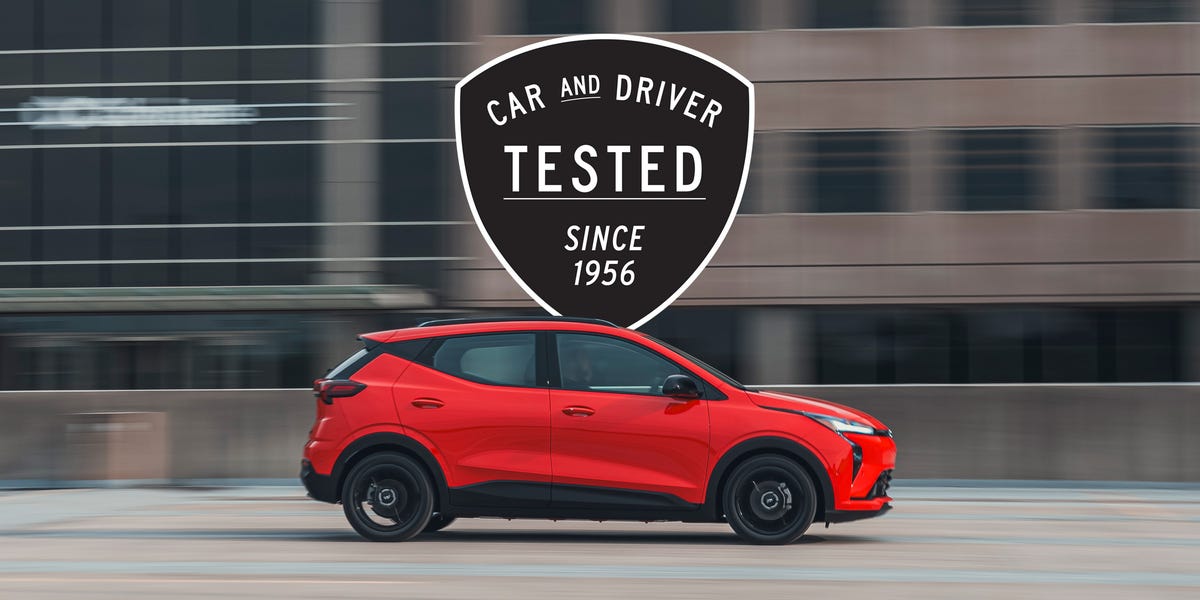
Chevy revived and updated the Bolt EUV as the 2027 Bolt, with improvements focused on one area in particular: charging.We put the new Bolt through our usual fast-charging test to find out just how much better the new Bolt is at juicing up than the old one.The result? A few more years in the oven are worth a heck of a lot when it comes to charging an EV.
Welcome to Car and Driver’s Testing Hub, where we zoom in on the test numbers. We’ve been pushing vehicles to their limits since 1956 to provide objective data to bolster our subjective impressions (you can see how we test here).
Despite strong sales figures from both models, Chevrolet put the affordable Bolt EV and EUV on ice back in 2023. After four years, the Bolt is back—though it now takes on the shape of the larger Bolt EUV. The revitalized Bolt gets modestly updated styling and an increased range, but most of Chevy’s development focused on improving the Bolt’s charging capabilities.
That focus on increasing the Bolt’s charging speed was necessary since the old model was dreadfully slow when it came to adding electrons. The 2022 Bolt EUV we put through our usual 10–90 percent fast-charge test took a lengthy 83 minutes to add just 56.7 kilowatt-hours. In that time, it averaged 41 kW and peaked at 57 kW. Adding 50 miles of highway range—based on our 190-mile range test at 75 mph—took 23 minutes, adding 100 miles took 44 minutes, and adding 150 miles took 82 minutes. In other words, the 2022 Bolt EUV is not a road trip car.
The relaunched 2027 Bolt decimates those figures. The revived model completed the test in 38 minutes, over which time it added 59.2 kWh. The new version averaged 94 kW—more than double the old car—and peaked at 148 kW, nearly tripling the original. It also goes further on a charge than before, with a 230-mile result in our 75-mph range test. Adding 50 miles of range now required just eight minutes, while adding 100 miles of range took 17 minutes—six fewer than the old car took to add half of that range. Juicing up an additional 150 miles took 29 minutes, once again making the old car’s times look extra lengthy.
The increase in speed can be attributed to a change in battery chemistry. While both packs are nominally lithium-ion, the previous Bolt’s was a nickel-manganese-cobalt (NMC) blend; the new battery is a lithium-iron-phosphate (LFP) unit. In addition to a 54 percent improvement in charging time, Chevy says the new packs are less expensive to produce. The Bolt also switched from a CCS-type port to NACS, which you may know is Tesla’s proprietary plug and accessible at the company’s vast Supercharger network.
Chevy has said the resurrected Bolt will be a limited-run model, which we’ve taken to mean it will only span a single model year. Starting under $30K, the resurrected Bolt is a great entry-level EV, and the faster charging is a big upgrade.
➡️ Skip the lot. Let Car and Driver help you find your next car.
Jack Fitzgerald’s love for cars stems from his as yet unshakable addiction to Formula 1.
After a brief stint as a detailer for a local dealership group in college, he knew he needed a more permanent way to drive all the new cars he couldn’t afford and decided to pursue a career in auto writing. By hounding his college professors at the University of Wisconsin-Milwaukee, he was able to travel Wisconsin seeking out stories in the auto world before landing his dream job at Car and Driver. His new goal is to delay the inevitable demise of his 2010 Volkswagen Golf.