
The 2027 Mercedes CLA 350 4MATIC Electric is one of the fastest-charging all-electric cars on the US market.
After analyzing two 0-100% SOC charging sessions, State of Charge presents a more typical 10-80% SOC charging session that delivers results noticeably better than the specs.
2027 Mercedes-Benz CLA 350 4MATIC Electric
Specs
The 2027 Mercedes-Benz CLA 350 4MATIC Electric features an 800-volt class battery with a net capacity of 85 kWh.
The EPA Combined range of the tested version with default 18-inch wheels is 312 miles. The EPA Highway range is 315 miles.
State Of Charge range-tested the car with optional 19-inch wheels, achieving 385 miles of range at 70 mph. We will use this result in our range replenishment calculations, along with the EPA Combined value. The large gap between EPA and 70-mph range may be related to the rear two-speed gearbox.

2027 Mercedes CLA Electric: EPA range. (Image credit: State Of Charge)
The car features a native NACS (SAE J3400) charging port for DC fast charging and a separate SAE J1772 charging port for AC charging.
According to the manufacturer, DC fast charging from 10% to 80% SOC should take 22 minutes at up to 320 kW. The average range replenishment rate (EPA) should be 9.9 miles/minute (up to 11.9 miles/minute in the base rear-wheel-drive version).
The car features a power electronics voltage booster and can easily access 400-volt-class chargers, although charging power may be significantly limited.
The onboard charger has a maximum power of 9.6 kW, so the vehicle should be fully recharged in roughly nine hours.
Analysis
The analysis covers a new 10-80% SOC charging session at an Ionna charger and compares it to the previously analyzed two 0-100% SOC charging sessions (one at an Electrify America and one at an Ionna charger).
State Of Charge tests EVs after preconditioning the battery (if available) for the best DC fast-charging results. Of the three sessions, the battery wasn’t preconditioned only at the Electrify America charger.
The car has a NACS charging port, and it was tested using a NACS charging connector at Ionna chargers. At an Electrify America charger, State Of Charge used a CCS1-to-NACS adapter.
All data for the analysis come from the charger’s display, which, along with the following calculations and estimations, introduces measurement uncertainty. Some data points were estimated, as the display does not always show the time. This does not meaningfully affect the analysis.
Results depend on many factors (the starting point of the session, the charger, temperatures, and the car itself) and sometimes might vary significantly.
Charging Curve
The 2027 Mercedes CLA 350 4MATIC Electric was tested at a 400-kW Ionna (Alpitronic HYC400) charger from 10% to 80% state of charge (SOC), without any adapters.
We believe the charger’s maximum voltage and current exceeded what the vehicle requested, so it did not limit charging performance.
The first graph below shows the charging power curve for the entire session, from 10% to 80% SOC, as displayed by the charger.
As usual, charging power jumped almost immediately to its maximum of 345 kW, but this value was available only briefly (not even one SOC percentage point).
From the peak at 11% SOC, charging power gradually decreased—slowly up to about 30% SOC and faster after that.
The average power in the 10-80% SOC window was pretty solid at 194 kW.
The consistency, calculated as the average-to-peak ratio, was 0.57, which reminds us of Tesla’s charging curves (high initial peak followed by a fast power decrease).
The charger reported 66.7 kWh of energy delivered during the charging session.

The 2027 Mercedes CLA 350 4MATIC Electric DC fast-charging test results: Charging Power Curve. (Image credit: State Of Charge)
Comparing the new 10-80% SOC charging session with the two previously analyzed 0-100% SOC sessions, we quickly see that all three curves are the same from about 62% SOC.
The beginning is different. During the 10-80% SOC session, the charging power decreases more slowly from its initial peak. That’s positive because the average power is higher (194 kW vs. 155 kW or 174 kW in the 0-70% SOC window).

The DC Fast-Charge Tests Comparison: Charging Power Curve. (Image credit: State Of Charge)
C-Rate
Assuming that the vehicle has an 85 kWh battery, its C-rate in the 10-80% SOC session peaked at over 4C. This is almost the same as in the 0-100% SOC sessions.
The average in the 10-80% SOC session was nearly 2.3C, which is noticeably higher than 1.8C in the 10-80% SOC window of the full 0-100% SOC session (or 2.0C in the 0-70% SOC window). This is a good result.
Info: The C-rate indicates the correlation between charging power and battery pack capacity. A value of 1C means the power in kW equals the battery pack capacity in kWh, and at that power (current) rate, the battery would be fully recharged in 1 hour. The higher the C-rate, the higher the load on the battery and the faster it charges. A flat 2C would translate to a 30-minute charging session (0-100% SOC).

The DC Fast-Charge Tests Comparison: C-Rate Curve. (Image credit: State Of Charge)
Charging Time
The 10% to 80% charging session took 20.5 minutes. It’s a very good result, which, by the way, beats Mercedes-Benz’s specs (22 minutes).
Previously, in the full 0-100% SOC session, the 10-80% SOC window took slightly longer, about 26 minutes (the 0-70% SOC window took about 23 minutes). In other words, starting charging at 10% SOC offers better performance.
Half of the battery capacity (10-60% SOC) recharged in less than 12 minutes, which is great.

The DC Fast-Charge Tests Comparison: Time To Charge. (Image credit: State Of Charge)
Charging Power Vs. Time
Now let’s look at charging power and SOC versus time. This graph shows that peak power was available, as usual, only for a short time.
The optimal charging session period, with a power level at or above 75% of the peak value, was 4.2 minutes (11-33% SOC). More than half of the peak power was available for 10.7 minutes (11-57% SOC).

The 2027 Mercedes CLA 350 4MATIC Electric DC fast-charging test results: Charging Power Curve and Time To Charge. (Image credit: State Of Charge)
The highest power levels were available longer in the 10-80% SOC session than in the two 0-100% SOC sessions.

The DC Fast-Charge Tests Comparison: Charging Power vs. Time. (Image credit: State Of Charge)
Range Replenishment Rate
EPA Combined Range
Given the 2027 Mercedes CLA 350 4MATIC Electric’s EPA Combined range of 312 miles, its average range replenishment rate in the first 10 minutes of the 10-80% SOC session at the Ionna charger was 13.7 mi/min (136 miles of range replenished).
The following 10-minute period was noticeably slower:
0-10 minutes: 13.7 mi/min
10-20 minutes: 7.9 mi/min
Overall, in the 10-80% SOC window, the average was 10.7 mi/min, which is better than the specs (9.9 mi/min).
70-MPH Range
When applying the 70-mph range of 385 miles, the average range replenishment rate is proportionally higher (by 23.4%). It peaks at 16.9 miles/min in the first 10 minutes.
0-10 minutes: 16.9 mi/min
10-20 minutes: 9.7 mi/min
10-80% SOC average: 13.2 mi/min (or 269 miles of range replenished)
This is a very good result.

The 2027 Mercedes CLA 350 4MATIC Electric DC fast-charging test results: Time To Charge and Average Range Replenishment Rate. (Image credit: State Of Charge)
How Long To Add Driving Range
Alternatively, we could ask how long it would take to add a certain number of miles.
When starting at 10% SOC, the 2027 Mercedes CLA 350 4MATIC Electric can add 100 miles of EPA Combined range in 6.7 minutes, 150 miles in 11.3 minutes, and 200 miles in 17.7 minutes.
Considering the 70-mph range, replenishing range is even faster (5.2 minutes to add 100 miles, 8.6 minutes to add 150 miles, and 12.6 minutes to add 200 miles).

The 2027 Mercedes CLA 350 4MATIC Electric DC fast-charging test results: Time To Charge and How Long To Add Driving Range. (Image credit: State Of Charge)
Side-by-Side Comparison
Here is a side-by-side comparison of the range-replenishment rates for the 2027 Mercedes CLA 350 4MATIC Electric during all three charging sessions.
EPA Combined Range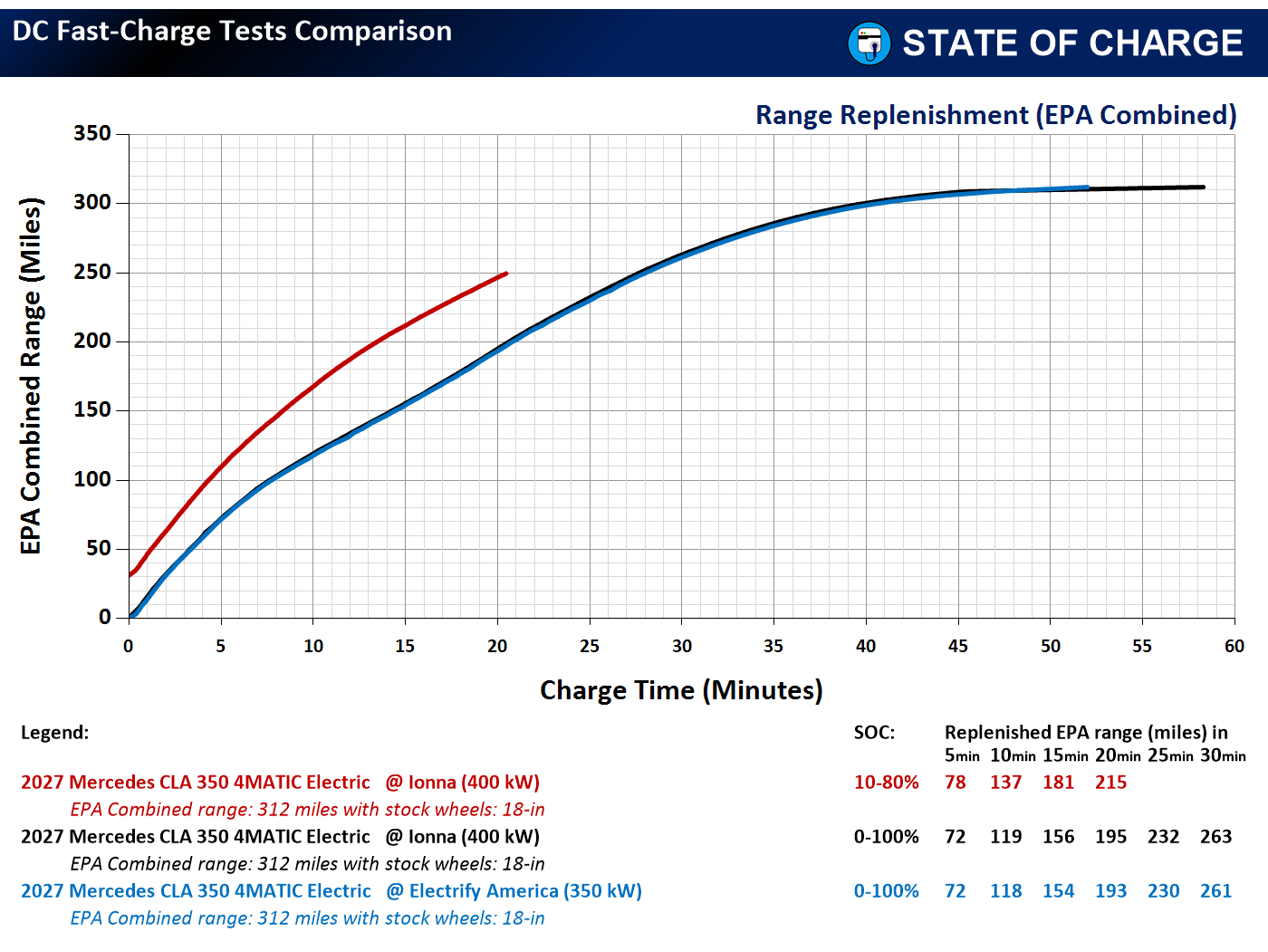
The DC Fast-Charge Tests Comparison: Range Replenishment – EPA. (Image credit: State Of Charge)
70-MPH Range
The DC Fast-Charge Tests Comparison: Range Replenishment – 70-mph. (Image credit: State Of Charge)
An additional chart shows the replenished range during 5-minute blocks. The first block of the 10-80% SOC session replenishes the most range (almost 100 miles of its 70-mph range). The following 5-minute blocks add 72 miles, 54 miles, and 43 miles.

The DC Fast-Charge Tests Comparison: 70-mph Range Replenished in 5-Minute Blocks. (Image credit: State Of Charge)
DC Fast-Charging Matrix
Here is a summary of the entire charging session in a single image — the DC fast-charging matrix. It lists several key parameters: time, average charging power, the number of SOC percentage points replenished, battery capacity (kWh), and miles of EPA Combined range added between the specified starting and ending SOC points.
The color map is green (light/dark) for much of the session, as charging power decreases more slowly than in the 0-100% SOC sessions. The yellow and orange boxes (average power) cover the later part of the charging session.
Please remember that the results might differ depending on a variety of factors, including the starting point of the session (which could shift the charging curve), charger, temperatures (ambient, that of the charger and its cable, and battery), and car (exact version, age, battery state-of-health, and software version).
EPA Combined Range
The 2027 Mercedes CLA 350 4MATIC Electric DC fast-charging test results: Matrix (EPA range). (Image credit: State Of Charge)
70-MPH Range
The 2027 Mercedes CLA 350 4MATIC Electric DC fast-charging test results: Matrix (70-mph range). (Image credit: State Of Charge)
Summary
The 2027 Mercedes CLA 350 4MATIC Electric has very good DC fast-charging capabilities.
The new 10-80% SOC charging test showed noticeably faster charging than the previous 0-100% SOC tests. The results also beat the specs in every metric.
Charging from 10 to 80% SOC took about 20.5 minutes (versus 22 minutes in the specs). During a full 0-100% SOC session, it took a few more minutes to reach 80% SOC.
Half of the battery capacity (10-60% SOC) recharged in less than 12 minutes, which is great.
Peak charging power reached 345 kW, better than the specs (320 kW). Average power in the 10-80% SOC window was nearly 194 kW (noticeably better than in the 0-100% SOC tests).
A peak C-rate of over 4C indicates that Mercedes-Benz pushes maximum power at the beginning. The 10-80% SOC average amounted to nearly 2.3C, which is good.
The most fruitful charging period, when power was at or above 75% of the peak value, was 4.2 min (11-33% SOC), about twice as long as when starting at 0% SOC. More than half of the peak power was available up to 10.7 min (11-57% SOC).
As usual in many EVs, charging beyond 85% SOC is not effective and should be avoided if not necessary. In the full 0-100% SOC sessions, it took 24 minutes to go from 80% to 100% SOC at the Electrify America charger and 31 minutes at Ionna.
When starting at 10% SOC, the 2027 Mercedes CLA 350 4MATIC Electric can replenish 100 miles of EPA Combined range in 6.7 minutes, 150 miles in 11.3 minutes, and 200 miles in 17.7 minutes.
Considering the 70-mph range, replenishing range is even faster (5.2 minutes to add 100 miles, 8.6 minutes to add 150 miles, and 12.6 minutes to add 200 miles).
The average range replenishment rate in the 10-80% SOC window amounted to 10.7 mi/min of EPA Combined range and 13.2 mi/min of 70-mph range. Both numbers beat the specs (9.9 mi/min).
The 2027 Mercedes CLA 350 4MATIC Electric features the NACS (SAE J3400) charging port for DC charging. We don’t see any difference between native NACS charging and charging through a CCS1-to-NACS adapter (in one of the 0-100% SOC sessions).
Use high-voltage chargers for maximum performance. The car has a power electronics voltage booster, so it can easily access 400-volt-class chargers, although charging power may be significantly limited.
Overall, when applying the 70-mph range, the all-electric CLA has very good (but not the best) range replenishment rates, especially over short charging sessions.
Check out more of our DC fast-charging analyses here.