
You park in a designated EV charging spot, plug in, and walk away confident you’ve done everything right. You come back to a dead charge and a ticket on your windshield. That’s exactly what one Boston Chevy Bolt EUV owner says happened to her, and the evidence she collected to fight it exposes a gap that could affect any EV driver relying on public infrastructure.
What the Session Data Shows
A 60-second gap in ChargePoint records became the centerpiece of her appeal.
The owner says she returned to a municipal lot to find her charging cord unplugged and her car cited for exceeding the non-charging parking limit. According to her account, ChargePoint session records she submitted showed one session ending at 5:17 and another beginning on the same port at 5:18.
That one-minute window allegedly corresponds to surveillance footage from a neighboring liquor store. The owner says it shows a woman in a black SUV disconnecting the cord and using it for her own vehicle.
One minute. That’s all it took to strand the car and trigger a citation.
Boston’s municipal EV-charging FAQ confirms that EV spaces are first-come, first-served. Vehicles parked but not actively charging can be hit with an overtime fee and cited, while actively charging vehicles are permitted to stay longer.
Under current Boston rules, once someone pulls your cord, your car is no longer connected and receiving power. Enforcement logic then treats it the same as any vehicle that overstayed its limit. The appeal outcome has not been confirmed publicly.
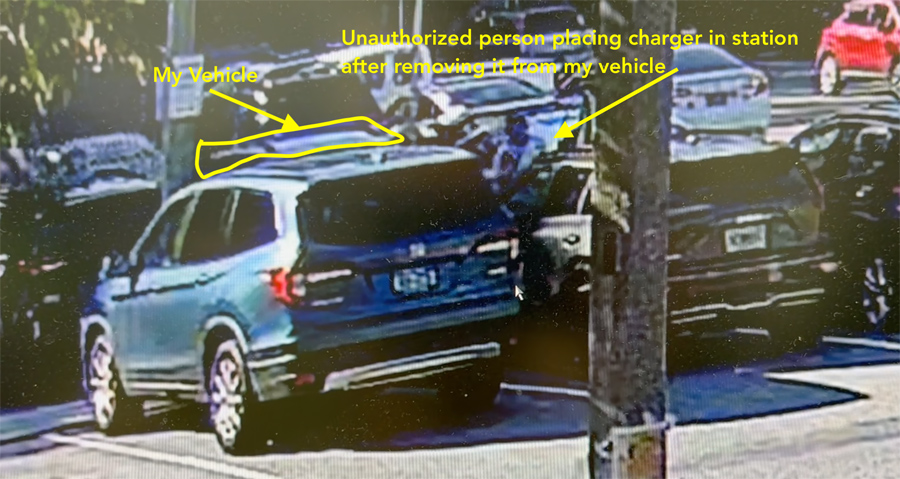 Current thief captured on liquor-store surveillance video. via UniversalhubYour Charger Has No Lock: What Every EV Owner Should Know
A design limitation in standard AC charging leaves your cord available to anyone walking past.
The 2023 Bolt EUV owner’s manual confirms the charge port locks automatically during DC fast charging. It does not provide a user-enabled lock for standard Level 2 AC charging, which is the kind most public municipal chargers deliver.
There is no mechanical lock on the inlet during a typical Level 2 session. Unless you configure the vehicle’s charge cord theft alert feature by locking the car while plugged in, someone can unplug your cord without the car physically preventing it.
That limitation is not unique to the Bolt, but it is worth confirming before you leave your car for two hours at a city lot. Other EV brands handle charge-port locking differently, and some allow drivers to lock the port manually regardless of charging type. If public charging is part of your routine, a quick look at the owner’s manual before you buy is time well spent.
Boston’s municipal Level 2 ChargePoint units now use NACS (J3400) connectors, the standard formerly associated with Tesla, which adds another layer of compatibility variables depending on your vehicle and the specific charger type at a given lot. Whether posted signage at the Jamaica Plain lot clearly explains the active-charging rule distinction remains unclear. It is also unconfirmed whether Boston parking enforcement treats a third-party unplugging as a mitigating factor in appeals.
What to Do If This Happens to You
Act fast, because the evidence you need starts disappearing within hours.
If you return to find your cord pulled and a ticket on your windshield, open your charging app immediately and screenshot the full session history with timestamps. Note any nearby businesses with exterior cameras and ask about footage before it overwrites, typically within 24 to 72 hours.
Before that, consider photographing the charging session start screen and noting the charger unit ID at plug-in, not only after a problem occurs. That kind of preventive documentation makes your appeal far stronger from the start.
File your citation appeal with every timestamped record attached. The evidence this owner assembled is a practical model for how to fight back when the infrastructure fails you.
EV adoption is accelerating faster than the rules governing public charging can keep up. Until enforcement catches up with the realities of shared charging equipment, the burden of proof falls squarely on you.