
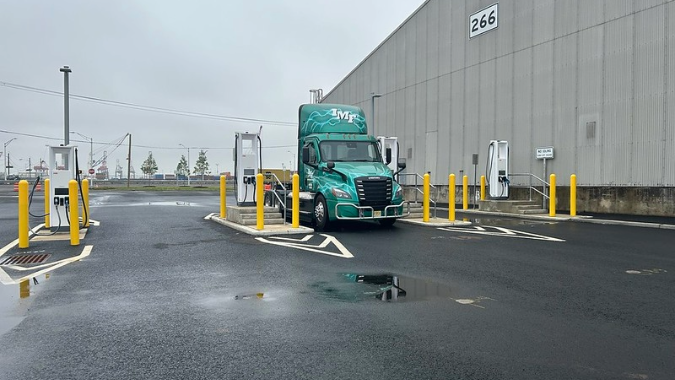
The Port Authority of New York & New Jersey recently announced a pair of incentive programs totaling $45 million to accelerate the adoption of zero-emission (ZE) drayage trucks and terminal tractors, alongside the essential charging infrastructure needed to power them.
The transportation nonprofit CALSTART will serve as the program designer and administrator for the Clean Truck Incentive (CTI) Program and Green Drayage Accelerator (GDA) as part of the effort to drive zero-emission commercial fleet adoption across the East Coast’s busiest seaport.
CTI will deploy up to $39 million in point-of-sale vouchers for the purchase of zero-emission drayage trucks, yard tractors, and supporting charging infrastructure. The $5 million GDA program aims to award up to five electric truck charging hubs within 10 miles of the Port Authority’s seaport facilities or marine terminal facilities.
The programs launching this fall are designed to advance the Port Authority’s sustainability goals by accelerating cleaner technologies while providing port operators with affordable, discounted electric vehicles and charging options.
They complement other sustainability initiatives at the seaport as the Port Authority looks to encourage all links in the supply chain, including ocean carriers, container terminals, and trucking companies to adopt greener operations. The agency has committed to reaching net-zero carbon emissions by 2050, including helping its wide universe of operating partners, tenants and contractors to reach the same goal in the same timeframe.
“The trucks that move through our gates don’t stop there. They fan out to warehouses and distribution hubs across the region, carrying the goods that power our economy,” said Port Authority Chairman Kevin O’Toole.
“This $45 million partnership with CALSTART puts zero-emission trucks, terminal tractors, and charging infrastructure within reach for the operators who serve this port every day. Cleaner trucks here mean cleaner air not just for our port facilities, but for every community along the routes these trucks travel,” O’Toole said.
Port Authority and CALSTART staff will conduct outreach with the trucking community through in-person and online presentations and informational pamphlets over the coming weeks.
To ensure transparency and measure long-term impact, CALSTART will build and launch dynamic tracking dashboards for both initiatives. These tools will monitor deployment, vehicle performance, and charger utilization across port operations before being fully transferred to the Port Authority in 2028.
The programs are funded through a $451 million grant awarded to the Port Authority through the U.S. Environmental Protection Agency’s Clean Ports Program, the largest sustainability grant in Port Authority history.
Beyond the CALSTART-administered programs, the grant will also fund the deployment of electric cargo handling equipment at marine terminals and the installation of vessel shore power infrastructure to allow container ships to plug in while at berth and shut down their auxiliary engines.
A separate $3 million EPA planning grant will fund the creation of a Port Community Advisory Council. Subrecipients of the overall award will also be positioned to pursue workforce training and job creation efforts tied to the clean energy sector.
The programs strengthen the Port Authority’s sustainability efforts. At the seaport, these efforts have taken several forms.
The Truck Replacement Program provides financial incentives to trucking companies that swap out older, higher-emission engines for newer, cleaner ones. The Clean Vessel Incentive program similarly rewards ocean carriers that voluntarily reduce speed near the port, cutting air emissions and conserving fuel in the process.
The agency has also built emissions requirements into its marine terminal rules and regulations, mandating that terminal operators shift to zero-emission cargo handling equipment as it becomes commercially available, a move designed to build market demand and push the industry toward further innovation.
Additionally, the continued expansion of the seaport’s on-dock ExpressRail system allows goods to move to the Midwest, New England, and eastern Canada more sustainably than trucking alone. The agency also opened an electric truck charging station at Port Newark last year, with four super-fast chargers located at the truck welcome center on Marlin and Kellogg streets.
The port’s tenants have pursued their own sustainability initiatives as well, among them Port Newark Container Terminal’s recently completed solar installation.