
Mary Barra is General Motors. She began working on a GM factory floor at age 18, and 46 years later, she’s now running the company. Barra rose to CEO during one of the biggest safety crises in General Motors’ history. Since then, she has transformed the company into one that generates more than $180 billion in annual revenue—GM currently ranks No. 23 on the Fortune 500. But today, she faces a whole new set of challenges.
In a new episode of Fortune 500: Titans and Disruptors of Industry, Fortune’s Editor-in-Chief Alyson Shontell sat down with Barra to discuss her approach to fierce competition from China, shifting EV policy, the rise of artificial intelligence and autonomous vehicles, and how she intends to steer the company into the next century.
Here’s some of what they discussed during their nearly 50-minute conversation.
On GM’s diverse—and resilient—vehicle portfolio
Why Barra credits GM’s product portfolio, relatively low incentives, and durable U.S. new-vehicle demand for the company’s performance amid tariffs and changing EV policy.
How GM is trying to serve customers at a range of price points.
Why Barra says GM sold more than 700,000 vehicles under $35,000 last year.
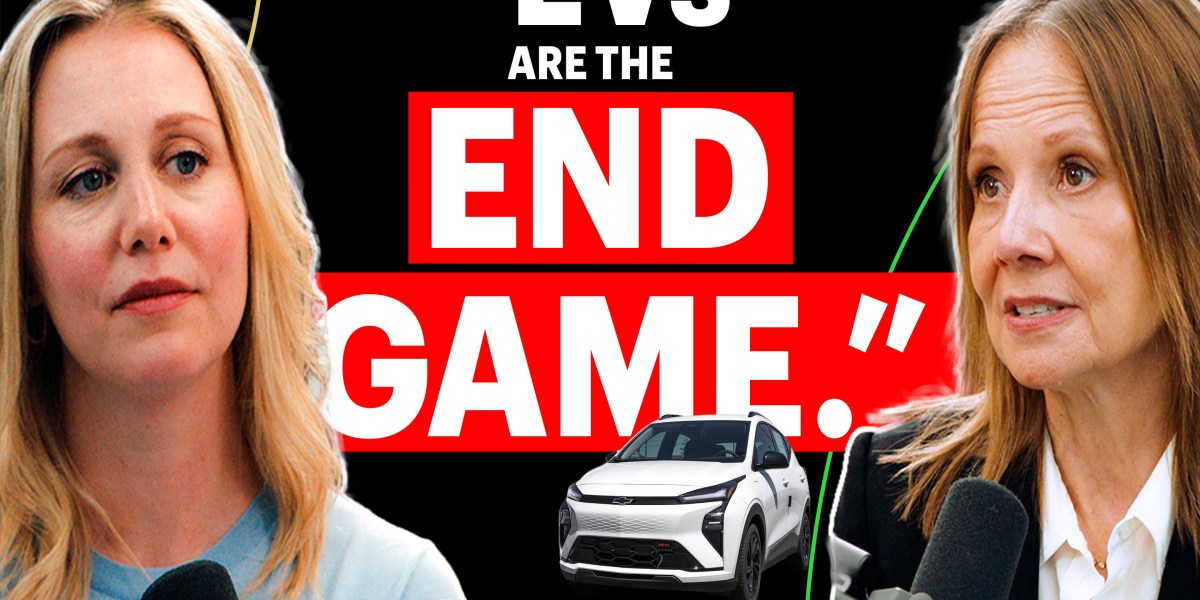
Why Barra still thinks EVs are the ‘end game’—and what is happening in the meantim
Why Barra still calls EVs the automotive industry’s “end game,” even as she expects the U.S. transition to take longer than once expected.
How regulatory changes, permitting delays for chargers, and consumer concerns about long-distance driving have slowed EV adoption in the U.S.
Why GM plans to retain its internal-combustion-engine and EV lineups while adding hybrids in selected segments, giving customers more choice.
On China, BYD, and global competition
Why Barra says GM restructured its China business in response to the rise of domestic EV makers and is now gaining share while returning to profitability.
How she views China as the world’s largest EV market—and as a proving ground for GM’s ability to compete in infotainment, battery technology, robotics, and speed.
Why Barra argues that a level trade playing field and a strong domestic manufacturing base are essential for U.S. automakers competing with heavily supported Chinese rivals.
On personal autonomy and Super Cruise
How GM plans to introduce eyes-off highway driving in the Cadillac Escalade IQ in 2028, building on Super Cruise’s current hands-free, eyes-on capability.
Why Barra says safety, simulation, customer trust, and close coordination with regulators will determine the pace of GM’s autonomy rollout.
On Cruise and GM’s software strategy
Why Barra says GM’s Cruise acquisition still produced useful technology and talent, despite the company’s decision to exit the robotaxi business.
How GM is redirecting that capability toward personal autonomy, which Barra says fits its core strengths better than running taxi or fleet operations.
Why Barra sees OnStar and Super Cruise as higher-margin, recurring-revenue software businesses that can grow alongside the company’s vehicle sales.
Read the transcript, which has been lightly edited for length and clarity, below.
Mary Barra, it is such a pleasure to be with you today in this gorgeous Cadillac facility. I’m surrounded by stunning cars that I want to buy.
I love to hear that. I love to hear that.
GM is a more than 100-year-old company with $185 billion in annualized revenue. You are No. 23 on the Fortune 500 and No. 39 globally by revenue. It’s such a pleasure to have you.
Well, it’s great to be here, and it’s so nice to spend some time with you. I’m so proud of everything that General Motors has accomplished.
And you should be—much of it under your tenure. I want to cover a lot of ground, but first I want to start with 2026. The last two quarters have brought strong financial performance in a year when that was not a given. You’ve been contending with tariff changes and an EV rollout that has been pushed back, among other things. What is behind GM’s resilience this year?
First of all, I have to give credit to the General Motors team. Agility is their superpower now, and we also have a really strong product portfolio. I’m so pleased, and you can see some of the vehicles around us right now.
When you have a really strong product portfolio, it speaks to customers, and they’re choosing us. Our incentives are much lower than the industry’s. We’re usually No. 1 or No. 2, and we’re growing share. That speaks to the strength of the underlying product, and that fuels everything.
There have been predictions for the last several years that this is the peak. I still think there’s more room. We’re seeing that this year, and new-vehicle customers have been more resilient than people thought. I look at the metrics every couple of weeks, and we still see strength in the market from a vehicle-demand perspective.
Why GM is betting on choice, not an all-EV future
It seems like customer demand, which was predicted to be waning, really hasn’t weakened in the U.S. Americans still love their gas-guzzling trucks and SUVs, which you make quite well.
One of the strengths of our portfolio is that we give customers choice—whether they want a full-size truck or SUV, or a small crossover vehicle under $30,000. We also still have more than a dozen EVs. We give customers a lot of choice and reach a lot of pocketbooks, as Alfred Sloan would say.
Wherever the customer is, we have a vehicle—beautifully styled, with the latest technology and safety features.
I want to address car affordability. GM makes a number of cars below the $50,000 threshold, but the average cost of buying a car is now hovering around that level. For someone looking to buy a car, can you explain what is going on in the industry? Why do cars feel so expensive?
If you look at the rate of inflation over several years, vehicle prices have increased less than inflation. But it also comes down to having a portfolio that offers choice. Last year, we sold more than 700,000 vehicles under $35,000, and I think that speaks to affordability.
When we first released the Chevrolet Trax, which is a vehicle under $30,000, I drove it for a couple of months. I loved that vehicle. It had safety features, great center-screen technology, and everything you could do to make your drive better. It’s about giving customers the features they want and making them affordable at different price points for the type of vehicle they are looking for.
GM’s EV ambitions—or at least the timeline—have changed. A few years ago, it was all in by 2035. There were going to be EV models all over the United States. That timeline has changed. You now think the transition to EVs will take decades, and it hasn’t been an easy road.
Why do you think America has struggled with the EV transition? What did we do wrong? When you look at China and Europe, EVs are flourishing.
I think it has a lot to do with the regulatory environment. A couple of years ago, all U.S. auto companies were moving toward a regulatory environment in which 40% to 50% of their vehicles had to be EVs by 2030. That’s where we were all headed.
As the regulatory environment changed, it allowed us to give customers more choice. Another fundamental is charging infrastructure. Although funding was passed in the infrastructure bill a few years ago, permitting has made it difficult to get chargers in the ground. Still, every quarter, the number of chargers goes up.
Over time, we believe EVs are the end game because of the styling and what they enable—instant torque and never having to go to the gas station. In Europe and China, regulation has driven adoption, along with policies that have enabled robust charging infrastructure.
When someone buys a car, for most people it is the most expensive or second-most-expensive thing they buy. They are very rational, and most people do not have multiple vehicles. If there are two people in a family, they may have two vehicles, but both need them every day to get to work and take care of their family. They assess whether an EV will meet their needs—not just in a typical week, but when they want to go on vacation, drop a child off at college, or visit their parents. They look at it holistically, and that is why charging infrastructure is so important for giving people confidence to switch to EVs.
We’ll get there. Because of policy in this country, it is going to take a little longer. In the meantime, we have a great and efficient internal-combustion-engine portfolio, a very strong EV portfolio, and hybrids in the segments we think are important. Customers can pick what they want.
You touch on an interesting point that must be at least a little frustrating as a leader. Every CEO running a Fortune 500 company has to deal with Washington in some way, shape, or form. But your efforts seem particularly tied to whoever is in the White House and to that administration’s agenda.
How do you create a nimble organization no matter who the president is? President Biden was very pro-EV and focused on creating incentive programs. President Trump has not been as focused on that, and it seems to have shifted GM’s mission. How do you navigate that?
I don’t think it has shifted our mission. We still think EVs are the end game. In conversations I’ve had with President Trump, he has talked about giving customers choice rather than forcing them into something. We can definitely do that.
We constantly remind all administrations that we are a capital-intensive, long-lead industry, and people have to respect that. We’ve tried to maintain a robust portfolio of both types of vehicles. The minute we start to sense something might change, we ask: What no-risk or no-regret decisions can we make? How can we prepare for this?
“Over time, we believe EVs are the end game.”
GM CEO Mary Barra
We did that as we started to see the regulatory front changing and as we started to see tariffs. We considered our no-regret moves and the shifts we needed to make. I’m proud of our team because they are so resilient at figuring that out. Agility is a superpower now, but it has to be paired with looking over the horizon and asking: What are the variety of regulatory environments we could face, and what is the best path forward so that we are not entirely out of position if it goes one way or the other?
That is what you see GM doing. Unlike many others that have abandoned EVs, we have not. We are proud of the EVs we have, but we are equally proud of our internal-combustion-engine vehicles. We are going to continue to give customers that choice.
On China’s EV rise and the state of the global EV market
Other decisions made in Washington have helped American auto businesses. We do not see Chinese EVs all over the U.S. in the way that we do in Europe and China.
What do you make of the international rise of companies such as BYD? It has a huge share of the EV market, but it is difficult to compete with China subsidizing a vehicle to that degree. If you sold a $15,000 vehicle, you would not make money. How long do you think those subsidies can last in China, and what is your long-term approach to waiting that out?
In China, we have taken a long-term view. We have had a successful business there for many years. As we saw the market changing dramatically with EVs and the growth of many domestic auto manufacturers, we took steps to restructure our business.
I think we are the only Western OEM growing share, albeit slightly, while also returning to profitability. We think it is an important market because, even though it is a little smaller than it was a couple of years ago, it is the largest EV market in the world.
As we look at other markets, I have often said that I am a free trader if I have a level playing field, and there has not been a level playing field. This country recognizes that. It also recognizes the importance of having a strong manufacturing base. I think many people realized during COVID that being able to make things matters.
When I look at U.S. policies, many are no different from what China does for its own market. I think we are well positioned. Europe is still sorting itself out. You have seen many established European OEMs struggling. From a U.S. perspective, recognizing and assessing the policies in China and here has helped the U.S. auto industry remain strong.
But we also have to drive efficiency across the board. We are always working on how to give customers more, do it for less, and leverage technology. That is a journey that will never end.
How do you decide when a market is worth staying in? You have had business in China for a long time, and you have made it profitable and made it work. How do you decide to lean into a market and perhaps wait until conditions improve, versus deciding to lean out?
I know you have a fruitful partnership in China. How does that compare with Europe?
We made the decision to sell our European operations to Peugeot—PSA at the time—and I think that was a really good decision for General Motors. At that time, we were subscale, and we saw a significant regulatory change happening in Europe.
When you are subscale, you have to make investments that can become difficult to justify from a shareholder and owner perspective. Selling Opel was a win-win-win: a win for General Motors, a win for PSA because it gained more scale, and a win for the Opel brand and team. I have no regrets about making that decision.
We export to Europe now, primarily with EVs, because that is where the market is going. As that market stabilizes, we can grow business there. Europe becomes an opportunity for GM in the future.
Looking at the landscape, China appears to have a clear advantage in some technologies that will shape the future—robotics and physical AI, batteries, and chips. The country is also strong in energy. These are technologies GM and other companies need. Do you worry about the long-term implications for American companies when you see the strides China is making?
As business leaders, we have to make sure we are moving at the same pace, understand what is happening, and invest in technology so we can compete.
I’m proud that in China, our vehicles are independently rated No. 1 from an infotainment perspective with the system we rolled out about a year ago and are expanding across the portfolio. That system competes with all the major Chinese OEMs. I do not see any reason we cannot do that.
We are making strides, and there are a tremendous number of robotics startups in this country as well. I believe in American ingenuity and innovation, and I think we can compete. Technology is moving quickly, and there are moments in time when others may lead. But I would bet on America continuing to lead in innovation.
GM’s next autonomy push: eyes-off driving by 2028
One of the most exciting things—I know you have been in a Waymo and a self-driving vehicle—is that, if you have never been in one, it feels futuristic. You think, “The world has changed. I might never have to drive again, or my kids might never have to drive again.”
GM has gone through a journey with autonomous technology, including acquisitions and internal development. Super Cruise is not a new line of business, but it is a growing one. How do you think about the autonomous-vehicle landscape and your decision to pursue personal autonomous vehicles? When will that be a reality for American consumers? When will I be buying a GM vehicle that is fully self-driving?
I’m done making predictions because I originally predicted that we would be on the road in 2019.
A lot of people did.
Exactly. Autonomy is one of the ultimate AI and robotics challenges when you consider all the different situations a vehicle encounters. I believe we will get there. I believe GM will be one of the leaders, if not the leader, in personal autonomy.
I’m excited that in 2028, we have announced that the Escalade IQ will offer eyes-off driving on the highway. We will keep expanding from there. I’m really proud of Super Cruise because we have built trust. The system is highly rated for behaving the way someone expects it to behave, and we are proud of its safety. That gates everything we do.
We will continue building, with more areas where the vehicle can operate fully autonomously and by adding the technology across the portfolio. It is going to be an exciting time.
Many people predicted in 2019 that self-driving cars would already be here. That last mile, it turns out, is really hard. I know how much you care about safety and trust, given all you have had to overcome at GM.
Do you think personal autonomous vehicles will even be cars? There is talk of drones, flying drones, little pods, and all sorts of other possibilities. Will the vehicle of the future look different?
I think it will continue to evolve, just as vehicles have evolved from where they were even 10 or 20 years ago. The technology will enable vehicles to evolve for many different use cases. That is an exciting part of it.
We have an advanced design team that is constantly imagining that future. Someday, we will have to take you in there.
We’ll take the camera crew.
When you see a major technology shift coming, a company can either build or buy. One technology GM bought was Cruise. A lot of money was spent there, and then Cruise was ultimately unwound. It was a Waymo competitor, but you decided GM is not a fleet company and would not pursue robotaxis. Instead, you would focus on personal autonomy.
What were the learnings from an acquisition like Cruise? How should other leaders think about when to acquire, when not to, and when to let the future unfold before making a large investment?
Based on what we knew at the time, I would probably make the same decision again. We learned a lot, and much of the capability we had at Cruise can be leveraged as we work on personal autonomy. A lot transferred. Much of the team is committed to achieving autonomous personal vehicles, which is great to see.
There are changes I wish I had made, but we were a generation behind on technology. We would have had to make a large investment of time and money to get to where technology and autonomy are being developed today.
It was also a major decision. We are stewards of our shareholders’ capital. When we considered investment in internal-combustion-engine and EV vehicles, we recognized that a fleet business is not something we do today. We do not run a bus fleet or a taxi fleet. We began looking at our core competency and where we need to go.
Frankly, there are significant differences between robotaxis and personal autonomy. That is where we are focused because that is where our strength is.
AI and robotics are clearly technologies GM has used for a long time—on the manufacturing floor and in roles that were unsafe or difficult for people to do. How have AI, physical AI, and robotics already changed GM, and how much change do you expect over the next few years?
As you said, we have been on this journey for a long time. It starts with our people and how we use technology to make them more effective. We use it to eliminate jobs that are hard from a safety perspective, create ergonomic issues, are dirty, or are difficult to do with the human hand—while recognizing that human agility is often so important.
We look at technology as a way to enhance what our team is doing. We give people tools to take toil out, improve quality, and improve speed, because that means we can give customers more.
We are focused on the back office as well: What tools make everyone’s life better? We want to expose everyone to these tools so they do not seem scary. They are real, and people can understand and use them.
I was in one of our manufacturing plants last week, and a skilled-trades employee showed me how they were using AI to start up new equipment faster. I was amazed because now that the technology is in their hands, they are leveraging it.
We are also looking at areas such as using AI in aerodynamics, which means we can explore more design themes to perfect a design. That is exciting. Other areas will completely transform what we do, so we will continue on that journey.
Every other week, I do a deep dive with a small team and ask, “Show me how you’re using AI.” It has been fascinating. It has far exceeded my expectations for how quickly people across the company—from the plant floor to R&D—are leveraging the technology to make GM better.
Is there an example where you thought, “Wow, I can’t believe we are able to do this now?”
One in design was really cool. We used to create a design and estimate the aerodynamics, but to know for sure, we had to put it in a wind tunnel. That meant building a physical prototype.
Now, we have a tool that allows us to explore many designs. Designers can change a small feature, and the tool will accurately predict the aerodynamics. We can explore more possibilities.
Like a simulated environment.
Yes. It is all on a screen. Designers can literally take a sketch and put it into the system, which helps them understand how a line or dimensional change affects aerodynamics. It gives them a wonderful feedback tool that lets them keep pushing and exploring.
Aerodynamics are so important, whether you are talking about the fuel efficiency of an internal-combustion vehicle or the battery range of an electric vehicle. Seeing how quickly they can do that is exciting. We will still build the final prototype and put it in the wind tunnel, but who knows? Maybe at some point the technology will be accurate enough that we will not even do that. Seeing a designer able to explore more is fun.
You are using AI to power things such as Super Cruise, which had more than a billion miles driven as of April, and the margins are better than they are for making a car.
Generally, software has better margins than hardware.
Are you looking to become more of a software company as well as a manufacturer?
Absolutely. I talked about the strength of our vehicle portfolio and customers choosing our vehicles. We have lower incentives than much of the rest of the industry. On top of that, we can leverage the people who have OnStar subscriptions and the people signing up for Super Cruise. The beauty is that we can keep making both services better.
It all comes down to talent. We have brought in tremendous talent and built on the talent we already had to create product-management capabilities and software timelines alongside the vehicles themselves. That gives us another dimension for growth, with a different margin profile.
I’m excited about that, especially when we can do Super Cruise 3 and beyond with eyes-off-the-road capability.
For people who do not know, Super Cruise is assisted driving, and you said it could potentially reach eyes-off driving in 2028.
Yes. Right now, Super Cruise is hands off the wheel and feet off the pedals, and it is available on some roads, not all roads. We keep adding roads, but we still want you looking at the road. We monitor to make sure you are paying attention.
What we plan to do in 2028 is allow drivers not to keep their eyes on the road. That is the start of getting to full autonomy. Even robotaxis today do not operate everywhere—in snow, tunnels, and every possible condition. But that is the journey we are on for personal autonomy.
You must have very strong conviction in the safety of that. As a consumer, I want my eyes on the road; it sounds scary. But when you became GM’s CEO, there was a safety crisis, and Cruise also faced a safety crisis. Given your background, I am sure you would not be comfortable saying “eyes off the road” if you were not confident in the safety. How do you develop that conviction?
It comes from all the simulation work we do. We learned many lessons from the ignition-switch crisis, and those lessons have been internalized in the way we develop vehicles now.
Super Cruise was technology we delayed until we were confident in its safety, and we have continued to add to it. It receives great customer feedback and ratings for the trust people place in it. We will take that same discipline forward.
I’m proud of GM’s safety team and the way it works hand in hand with the broader organization. We know what it takes. We have been putting vehicles on the road for more than 100 years. We work with regulators, and that is important because they need to understand what we are doing. It is difficult to regulate technology that is still being invented, which is why a strong and transparent relationship with regulators is important.
Safety will be the overriding priority as we roll out this technology.
I understand that you start most meetings at GM with a safety tip or a safety fact. Can you speak about that? Given the way you came into the company and the challenges you have had to overcome as CEO, there were times when consumers may not have felt safe in a GM vehicle.
I want to discuss how you stepped into the role and overcame that, but first: How do you think about safety in general, and why do you speak to the team about it at every chance you get?
There is so much to consider from a safety perspective—not only workplace safety for every member of the General Motors team, but also safety for our customers.
One thing we learned is that we wanted to create an environment where everyone understood that safety was our overriding priority and that, if they saw something, they should say something. We have a “Speak Up for Safety” program, safety-reporting processes, and an annual safety week where we dedicate a week to reinforce our behaviors.
Many people have joined the company since the ignition-switch crisis, but one of the commitments I made was that we would do everything in our power to never let anything like that happen again. We want everyone who joins the company—whether they have been here as long as I have or for four months—to understand that safety is important.
Starting a meeting with a safety message is a way to reinforce that. We also look at the agenda and ask whether any items in our senior leadership meeting could affect company safety or customer safety. That recognition helps build a culture where people understand that safety is important and that they should raise concerns.
Mary, you have had a long tenure at GM, and you started in an entry-level position. Even before that, your father had a long tenure with the company. Between the two of you, that is something like 80-plus years. What did you learn from your dad that got you interested in the job and, more importantly, that you carry into leadership?
My dad was so proud to work for General Motors. Every now and then, he would get to bring a vehicle home. My brother and I would climb through it, and the neighborhood would come over to look at it. That gave me an early interest in vehicles.
He was also a very dedicated, hardworking person, as was my mom. Both of my parents were shaped by the Great Depression, so I developed the instinct that we work before we play, and we work hard.
I want to address another new line of business that is beginning to show promising signs: defense. GM Defense was not on my radar until I started researching for this interview. GM has had it for a while, but it seems that in the past few years there has been a deal with the Army and about $700 million in revenue associated with GM Defense.
What is GM Defense, and what is this vehicle that the Army wants to use?
It is called an Infantry Squad Vehicle, and we are really proud of it because we were able to leverage GM’s strengths. Often, a specification is provided and companies develop a vehicle and conduct the R&D. We were able to say: “This is the vehicle you want? Okay, we are going to use a midsize truck frame.”
We could literally go into General Motors’ parts bin and put the vehicle together. We could do it faster and validate it faster with the tools we have, which means it costs less. From a serviceability perspective, we have global service through our customer care and after-sales operations.
The whole value proposition was that we used parts we had already developed, which gave us speed. The vehicle was highly rated from a performance perspective, in some cases meeting or exceeding the Army’s requirements.
It is a business we can pursue not only in the U.S. but also with our allies, and we are seeing potential there. One of the core things General Motors knows how to do is make things. You saw that during COVID, when we made 30,000 ventilators and the first one rolled off the line in 30 days.
We are considering how to leverage our manufacturing capability and our ability to scale in support of defense initiatives. That is why I am excited about the memorandum of understanding we have with Lockheed Martin and our conversations with some of the other large defense primes.
When you mention manufacturing strength, you are also doing more onshoring, creating more U.S. jobs, and reskilling workers at GM. This is important for the industry.
Ruth Porat and one of your competitors at Ford published an op-ed about the skilled-jobs gap. They projected that there could be 2.1 million unfilled skilled jobs if the industry does not change the talent proposition. How do you view that gap and GM’s role in addressing it?
I absolutely agree. I’m proud of the fact that over the last five years, General Motors has invested more than $250 million in training skilled trades for the company, and we will continue to do that.
There are many groups forming to address the issue, and we will continue to work with them. We have hands-on training on-site that we can put people through. I’m proud of what we are doing, but I also think there is a societal issue.
My dad was a die maker and a skilled-trades worker for 39 years at General Motors. He retired right as I was starting. I think Europe has much more respect for the trades and for people who do highly technical work with their hands—people who build things, make things, and service things. These can be great careers.
A dealer technician can earn in the $80,000s or $90,000s, and potentially more depending on how many hours they work. These are good-paying jobs. There is huge demand for electricians right now, and I think there will be demand for other trades, especially considering what is happening with data centers.
We will continue to develop our own talent and work with organizations that are partnering to increase awareness and ensure high school students understand that this is a great career. Frankly, it may be a little more AI-proof than some others. I take great pride in this because my father was a skilled tradesperson.
You have two children in their twenties. Would you advise them to go into the trades? People often think the path is to go to college and then work on Wall Street or pursue another white-collar career. Would you advise something different?
If they were interested in doing that, absolutely. I have a nephew who is pursuing that path, and I have encouraged him. I have also talked with some family friends about it.
My husband and I are both engineers, so my son was on that path from a young age. My daughter took more of a business path. But they saw their grandfather, knew his career, and took great pride in it.
I have encouraged my kids, as my mother encouraged me, to do what they want to do, but to be passionate about it and work really hard.
Barra’s turnaround job—and lessons as a leader
I want to step back to 2014, when you took the job. It was not easy—perhaps the most difficult job of any Fortune 500 CEO at that moment. Can you set the scene for what was happening at GM and how, in your first 30 days, you started figuring out how to turn it around?
It is probably one of the best case studies in leadership and culture change. You had to get the American public to trust GM again, and you had to completely change GM’s culture. Set the scene for us.
To backtrack a little, even before I was put in the role, we had been working on defining the company’s values, the behaviors connected to them, and what they meant. We had that foundation in place.
One of the best times to instill values is not during good times; it is during difficult times. As we understood what had happened, one thing most people do not realize is that General Motors figured out the problem and self-reported it. Then we started working on it.
I had a small team. Some days we met for 20 minutes; some days we met for two hours. When you have a problem like that, it is often like peeling back an onion. You do not have all the facts on day one. You have to keep learning, figuring out what happened, and determining what needs to be fixed.
In the meantime, we told the rest of the team to run the business. I think that was a very good way to do it. We also had guiding principles: We were going to be transparent, do everything to support the customer, and do everything in our power to make sure this never happened again. That is what guided us.
Mark Reuss, who was head of product development at the time, was instrumental in leading the engineering team through the transformation. We literally changed the way we design and validate vehicles because systems had evolved from 100% mechanical to somewhat electronically controlled to mostly electronically controlled. I give him great credit for the changes he drove in our development process.
It was that commitment. One thing I learned through the process is to ask the team, “When is the best time to solve a problem?” They look at me, and I say, “The minute you know you have one,” because problems do not get smaller. Rarely do problems get smaller.
We overcommunicated during that period. We reinforced the values we had worked on, and it grounded everybody in the understanding that we truly want people to speak up and put the customer at the center of everything we do. That has been a journey we have been on for more than a decade.
That seems intuitive, but it was not the GM you took over. We wrote a story at the time about the situation you were stepping into. The problem had potentially been found years earlier, and not enough action had been taken.
Taking action and making sure it became a “never forget” moment were things you helped instill in the culture change.
Right. I also have to give credit to the people involved. It was a very complex problem that happened very infrequently. As I said, a team had been working on it and eventually put all the pieces together. Once they had enough information, they could say, “I understand.”
After we understood the issue and conducted an external investigation, people at various levels of leadership were no longer with the company. My view was that, as an engineer by degree, engineers need to be curious. I have always said that if something is happening with a part I am responsible for designing and I do not understand it, I should not be sleeping at night. As an engineer, you should be asking, “How can I figure this out?”
“When is the best time to solve a problem? The minute you know you have one.”
One of the values Barra instilled at GM during its turnaround
We worked to drive that sense of urgency into the organization. That is why we still start meetings with safety, why we reinforce it, and why we have Safety Week every year. I never want people to forget. It is the right thing to do for our customers and for the safety of every General Motors team member. We will continue to work and improve in that area.
An early supporter of yours in the CEO role was Warren Buffett. Berkshire bought a lot of shares as you were unwinding the crisis and had strong conviction in you. Were you surprised? How did you win Warren over?
One of my board members at the time knew him, so we arranged a meeting and I started visiting him. When he understood the journey we were on and where the leadership team had decided to take the company, I think he believed in the mission and was very supportive for years.
I saw him as recently as a couple of years ago. I know he is limiting his meetings these days, but he gave me phenomenal advice. I will be forever grateful for the time he gave me, the leadership wisdom he shared with me, and his support through some pretty dicey times.
You have to share the advice.
It was basic business advice. One thing he said to me was, “Would you do anything differently if you were a private company and didn’t have to report earnings every quarter?”
I stopped and said, “No, I don’t think I would.”
He said, “Great,” because he did not want me running the company for the quarter. He wanted me running it for the long term. That is how you really create value.
It was all these pearls of wisdom. I used to love going there and either sitting in his office or meeting him for lunch.
McDonald’s?
No, it was a local restaurant we would go to. He was very humble, as Warren is, and we had wonderful conversations. I would come away with all these things in my mind to take back. I really think he shaped a lot of my leadership through his wisdom.
Amazing. Now you are like one of the Warren Buffetts of the Fortune 500. You are one of the most tenured CEOs in the Fortune 500, where average tenure is really about four years for women and perhaps seven years for men. You have overseen a lot.
What is your advice for longevity in the C-suite when there is tremendous change happening all around?
Have a great team. I am a very inclusive leader, and I have worked hard to build a great, empowered team. We work together and debate things. I understand there are times when I have to make the call, but I want to hear different perspectives because our business is so complex.
We have people from other industries with different experiences. When we look at something, that gives us a 360-degree view and helps us make the best decisions going forward. Talent is everything, and the people of General Motors are what make GM special.
Do you ever have moments as a leader when you think, “I have done a lot in this job, and there is a whole new chapter coming with AI. Maybe I am going to let someone else do that”?
We are seeing that happen with Tim Cook. He has done a tremendous job at Apple, and he may be thinking, “John, the AI era is here. Here you go. Let me set you up for success.” Is that tempting? How do you psych yourself up to lead in this new chapter, when everything needs to be reinvented?
First of all, I have so much respect for Tim and for John, and I want to put that on the record. But I still feel like I have more to give. I am still energized every day when I wake up.
Obviously, it is the board’s decision, but I still feel that I can contribute and continue building the foundation so General Motors is around and leading for the next 100 years.
I do not see the board pushing you out anytime soon. The financials are phenomenal, you are continuing to reinvent the company, and your team says you operate in founder mode despite not being a founder yourself. It has been such a pleasure to pick your brain. Thank you for spending the time.
Thank you for the opportunity. This was great.
Fortune 500: Titans and Disruptors of Industry episodes are produced by Fortune’s editorial team. The views and opinions expressed by podcast speakers and guests are solely their own and do not reflect the views of Deloitte or its personnel. Deloitte does not advocate for or endorse any individuals or entities featured in the episodes.