
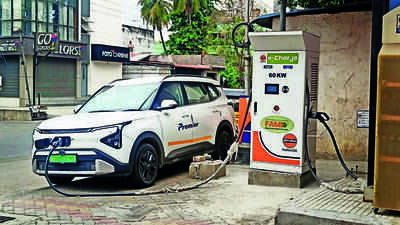
 Consumers also need reassurance on purchase costs, driving range, charging availability, and resale value. Chennai: India’s electric-car market is witnessing two distinct trends: established players such as Tata Motors are finding that EVs can generate significantly more revenue per vehicle, while newer entrants are grappling with the harder task of convincing consumers that electric cars are affordable, convenient and practical to own.Vietnamese EV maker VinFast, which has emerged among the top five electric-car brands by sales in India, is recalibrating its strategy based on a market research that points to four key barriers to wider EV adoption — upfront price, charging anxiety, ownership cost, and confidence in the brand and its network.The findings suggest that selling an EV is no longer simply a question of highlighting its environmental benefits. Consumers also need reassurance on purchase costs, driving range, charging availability, and resale value. VinFast is seeking to address these concerns through measures including incentives for switching from internal combustion engine (ICE) vehicles to EVs, buyback programmes and free maintenance, among others.The challenge for new entrants, therefore, is not just to increase awareness or interest in electric vehicles, but to make ownership sufficiently convenient and compelling to overcome consumer hesitation.For established players such as Tata Motors, however, EVs are already generating greater revenue per vehicle than their conventional counterparts. Tata Motors Passenger Vehicles sold 641,586 units in FY26, including 92,719 EVs. Based on the company’s reported revenue, its electric cars generated about Rs 14.5 lakh per vehicle, compared with roughly Rs 8.2 lakh for ICE vehicles.EVs accounted for only 14.5% of Tata Motors PV’s volumes, but contributed nearly 23% of its revenue, highlighting the significantly higher revenue per vehicle of its electric portfolio. This, however, reflects revenue rather than profitability and does not necessarily mean EVs are more profitable than ICE vehicles.There is also a clear environmental case for EVs. Tata Motors said a comprehensive life-cycle assessment found that the Nexon EV generated nearly 38% lower greenhouse-gas emissions over its lifetime than the comparable ICE version.India’s EV market is thus moving beyond the question of whether consumers will adopt electric vehicles. The next phase will be shaped by two parallel challenges: how automakers can generate more revenue per vehicle from EVs, and how they can remove the cost, charging and ownership concerns that still stand in the way of mass adoption.
