

Key Stats for Tesla Stock
Today’s Performance: 5%
52-Week Range: $297 to $499
Valuation Model Target Price: $397
Implied Upside: 8%
Analyze your favorite stocks like Tesla with TIKR (It’s free) >>>
What Happened?
Tesla stock rose about 5% today to roughly $372 per share, recovering from last week’s Cybercab-driven selloff as fresh European progress for Full Self-Driving gave investors another reason to revisit the company’s autonomy opportunity. The rebound follows a volatile stretch in which Tesla rallied about 5% ahead of the Cybercab launch before dropping about 6% after the event, highlighting how strongly the stock now responds to evidence that autonomy can become a meaningful business. Cybercab is Tesla’s purpose-built two-seat robotaxi without a steering wheel or pedals, while Full Self-Driving, or FSD, is its driver-assistance software that Tesla hopes can eventually support a much larger autonomous transportation business.
Tesla stock is up today as Slovenia’s approval of FSD Supervised added momentum to Tesla’s European autonomy push while shares rebounded from Friday’s sharp Cybercab selloff. Slovenia became the sixth European country to approve the technology, which can steer, accelerate, and brake while still requiring driver supervision. Broader European access could become financially important because Tesla can potentially sell more high-margin FSD subscriptions to vehicles already on the road without needing a similar increase in vehicle production, while a possible EU-wide decision creates another catalyst for the remainder of 2026.
Tesla’s latest earnings call shows why autonomy still carries so much weight in the investment case. Management said Tesla achieved record Q2 deliveries and exited the quarter with what CFO Vaibhav Taneja called its “largest order backlog since 2023,” while FSD reached nearly 1.5 million paid customers globally. Energy storage deployments increased 53% sequentially to 13.5 GWh, while Tesla said Cybercab production had started and its robotaxi fleet had logged more than 380,000 unsupervised miles with 0 notable incidents at the time of the call.
Competition keeps the autonomy story from being one-sided. Alphabet’s Waymo is expanding fully autonomous service to 14 cities, while Amazon’s Zoox has expanded its operating footprint to 12 locations, giving Tesla rivals that are already widening their geographic reach. Tesla’s advantage could come from using lower-cost vehicles and its existing manufacturing scale, but Cybercab still faces federal scrutiny after its limited Austin rollout, so software reliability, regulatory approval, and fleet expansion remain more important than simply producing the vehicle.
 Tesla Guided Valuation Model
Value Tesla instantly (Free with TIKR) >>>
Is Tesla Fairly Valued?
Under valuation assumptions, the stock is modeled using:
Revenue Growth (CAGR): around 14%
Operating Margins: around 7%
Exit P/E Multiple: around 105x
Analyst estimates point to stronger growth as Tesla expands beyond traditional vehicle sales, with consensus revenue reaching about $106 billion in 2026. Higher FSD adoption, broader Cybercab deployment, continued energy-storage growth, and new products are the main business levers behind the model’s longer-term 14% revenue growth assumption.
Cybercab could materially change Tesla’s earnings mix because a scaled robotaxi network would create recurring ride-hailing revenue from vehicles operating throughout the day rather than relying mainly on one-time vehicle sales. Stronger results through the rest of 2026 depend on Tesla expanding unsupervised miles and geographic coverage while maintaining safety performance and clearing regulatory requirements as Waymo and Zoox continue building competing autonomous networks.
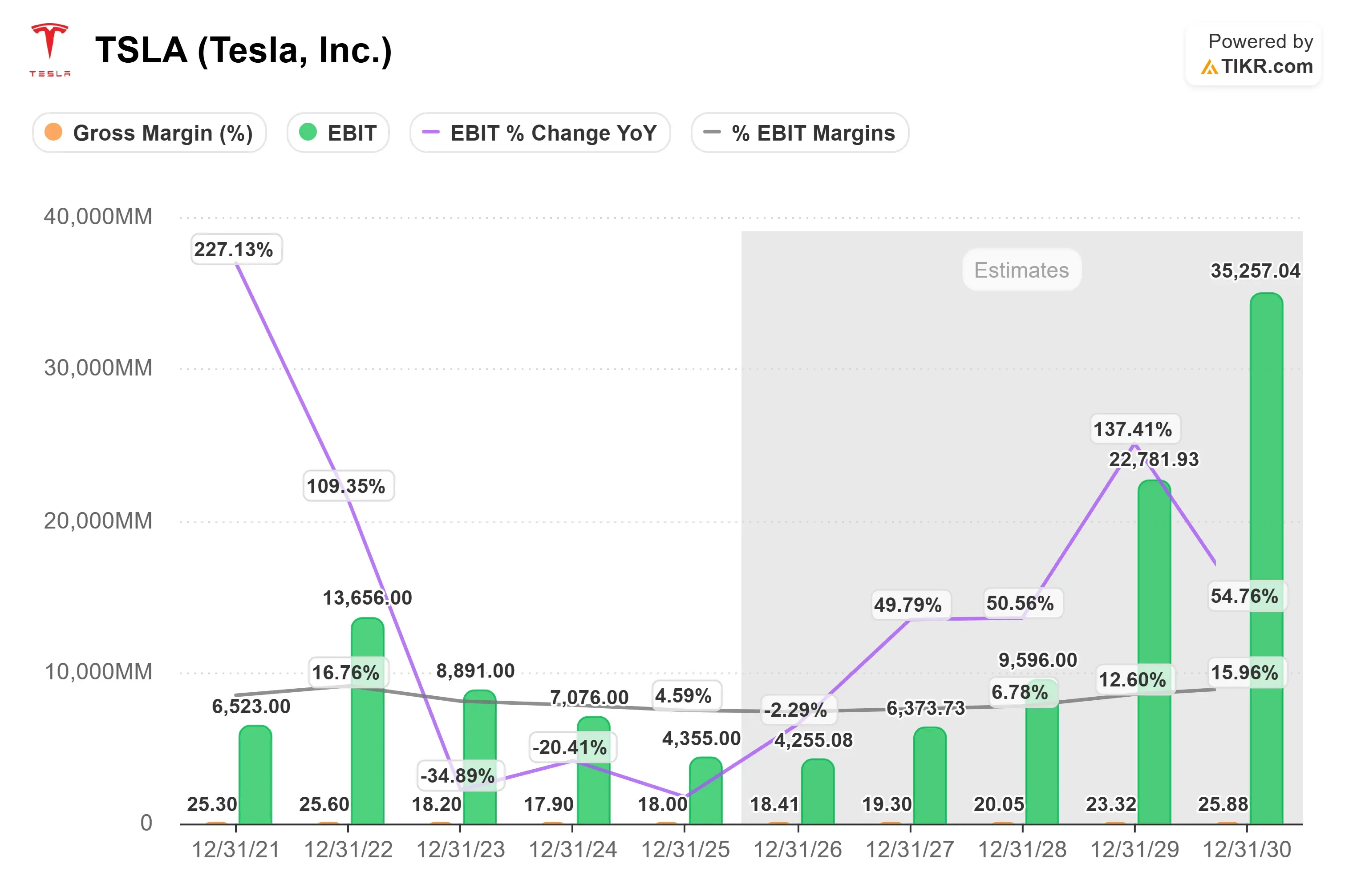 Tesla Gross Margin and EBIT Margin Estimates Over Five Years
See analysts’ growth forecasts and price targets for Tesla (It’s free) >>>
Profitability is equally important. TIKR’s margin chart shows consensus gross margin around 18% in 2026, while Tesla reported 16.3% automotive gross margin excluding regulatory credits in Q2, leaving manufacturing efficiency, FSD monetization, and a larger contribution from energy as important paths to stronger earnings. Management also highlighted battery storage as a potential beneficiary of AI data-center growth because batteries can smooth rapid changes in electricity demand.
Based on these assumptions, TIKR’s valuation model estimates a target price of about $397, implying around 7% total upside over roughly 2.3 years, or about 3% annually, from a share price around $372. The major caveat is the 105x exit P/E multiple, which remains aggressive and assumes investors continue valuing Tesla as an AI and autonomy platform rather than primarily as an automaker.
At around $372, Tesla therefore looks closer to fairly valued than meaningfully undervalued. Stronger performance through the rest of 2026 depends on FSD monetization, Cybercab deployment, energy growth, and margin improvement producing enough earnings growth to justify a valuation that already assumes substantial success beyond Tesla’s core automotive business.
How Much Upside Does Tesla Stock Have From Here?
Investors can estimate Tesla’s potential share price, or what any stock could be worth, in under a minute using TIKR’s New Valuation Model tool.
All it takes is three simple inputs:
Revenue Growth
Operating Margins
Exit P/E Multiple
From there, TIKR calculates the potential share price and total returns under Bull, Base, and Bear scenarios so you can quickly see whether a stock looks undervalued or overvalued.
If you’re not sure what to enter, TIKR automatically fills in each input using analysts’ consensus estimates, giving you a quick, reliable starting point.
Value Tesla in under 60 seconds with TIKR (It’s free) >>>