
Your support helps us to tell the story
From reproductive rights to climate change to Big Tech, The Independent is on the ground when the story is developing. Whether it’s investigating the financials of Elon Musk’s pro-Trump PAC or producing our latest documentary, ‘The A Word’, which shines a light on the American women fighting for reproductive rights, we know how important it is to parse out the facts from the messaging.
At such a critical moment in US history, we need reporters on the ground. Your donation allows us to keep sending journalists to speak to both sides of the story.
The Independent is trusted by Americans across the entire political spectrum. And unlike many other quality news outlets, we choose not to lock Americans out of our reporting and analysis with paywalls. We believe quality journalism should be available to everyone, paid for by those who can afford it.
Your support makes all the difference.Read more
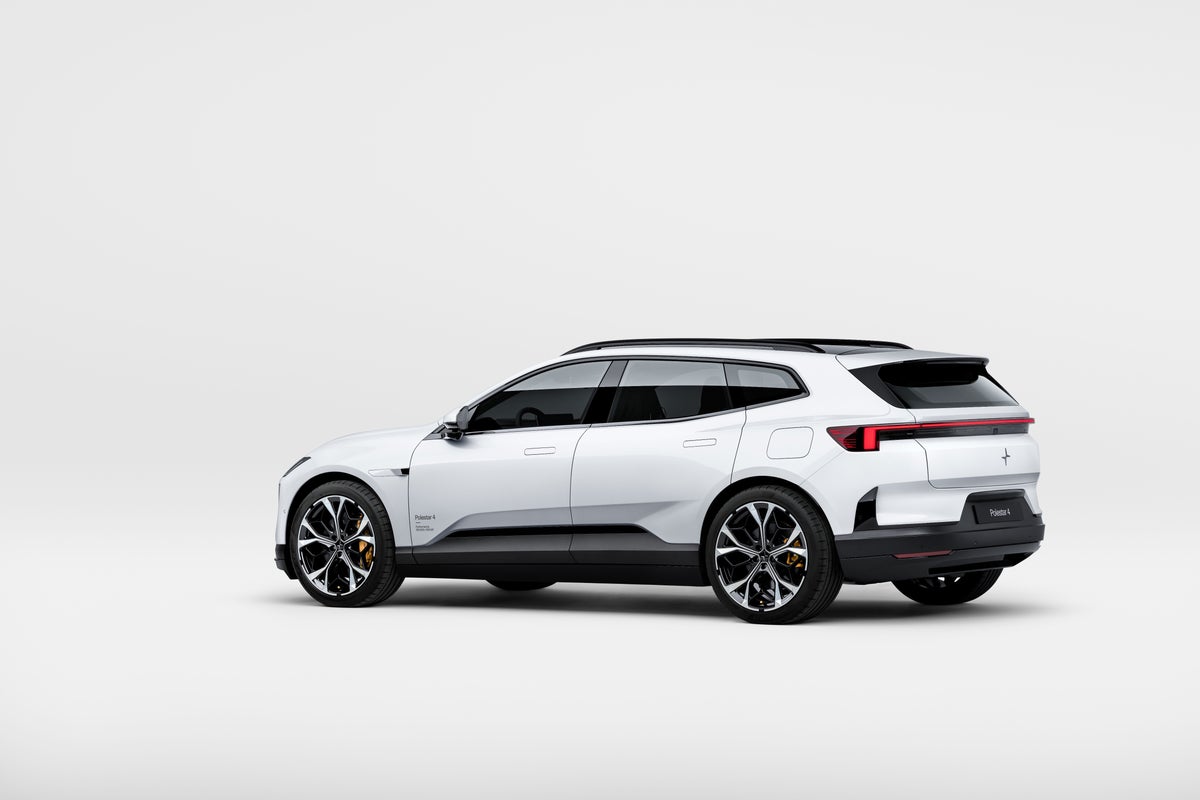
Polestar has given its 4 electric car the SUV treatment, adding more luggage space, extra rear headroom, a straighter roofline and, perhaps most noticeably, something the original Polestar 4 saloon famously went without: a rear window.
The new Polestar 4 SUV will sit alongside the existing saloon rather than replace it, with prices starting at £54,750 – a £2,000 saving on the saloon – and first customer deliveries planned in the next few months. The new model is aimed at the posher end of the compact SUV market and keeps the same basic platform, battery and choice of rear- or all-wheel-drive power as the recently updated Polestar 4 saloon, but packages them in a more practical body.
The biggest changes are at the back. The roofline is straighter and the tailgate more upright, opening up more room inside and giving rear-seat passengers an extra 25mm of headroom. There’s also a larger panoramic glass roof stretching back to the tailgate, while full-length roof rails allow up to 100kg to be carried on top.
 The Polestar 4 SUV offers up to 1,665 litres of luggage space (Polestar)
And then there’s that window. The Polestar 4 saloon did away with a conventional rear window altogether, relying instead on a camera and digital rear-view mirror. The SUV brings the glass back and gets a normal rear-view mirror as standard, although buyers can still choose the digital mirror as an option if they want a wider view or regularly fill the boot to the roof.
Boot space is a big part of the SUV’s brief. There are 530 litres behind the rear seats when measured to seatback height, or 655 litres if you load up to the roof. Fold the 60/40 split rear seats and that rises to 1,665 litres. Add the front luggage compartment under the bonnet and Polestar quotes 1,680 litres of storage in total. The original Polestar 4 saloon’s boot measures 526 litres, or 1,536 total with seats folded.
The mechanical bits are familiar from the Polestar 4 saloon. Both versions use a 100kWh battery, with the single-motor, rear-drive model producing 268bhp and 343Nm of torque. It gets from 0-62mph in 7.3 seconds and has the longest claimed WLTP range, of up to 391 miles.
The dual-motor version has all-wheel drive, 536bhp and 686Nm, cutting the 0-62mph time to 3.9 seconds while offering up to 373 miles of range. DC rapid charging peaks at 200kW, while AC charging of up to 22kW will be available in selected markets. Prices start at £60,750 for the dual-motor, with a £68,250 Performance pack version adding active dampers, Brembo brakes, 22-inch wheels and Pirelli P Zero tyres.
Polestar is also adding Vehicle-to-Load technology across the Polestar 4 range. It allows the battery to supply up to 3.3kW of power to external equipment through an adapter, so it could run camping gear, power tools or other electrical devices. Drivers can set a minimum battery level through the centre screen so the car stops supplying power before charge drops too far.
 The Polestar 4 SUV retains much of the saloon’s running gear and good looks (Polestar)
The SUV gets a new Camping mode, too, which keeps the climate control, entertainment, ambient lighting and other functions running while the car is parked. Google Gemini is also being introduced across Polestar markets, replacing Google Assistant and allowing more natural voice conversations, follow-up questions, trip planning and real-time translation.
Inside, the basic layout of the SUV stays close to the Polestar 4 saloon, with its landscape centre screen and separate driver display. The number of shortcut widgets available on the main screen rises from six to nine, while an optional Harman Kardon sound system uses 12 speakers and a 1,400-watt amplifier. The standard panoramic roof offers 99.5 per cent UV protection, while an optional electrochromic version can be dimmed through the centre display.
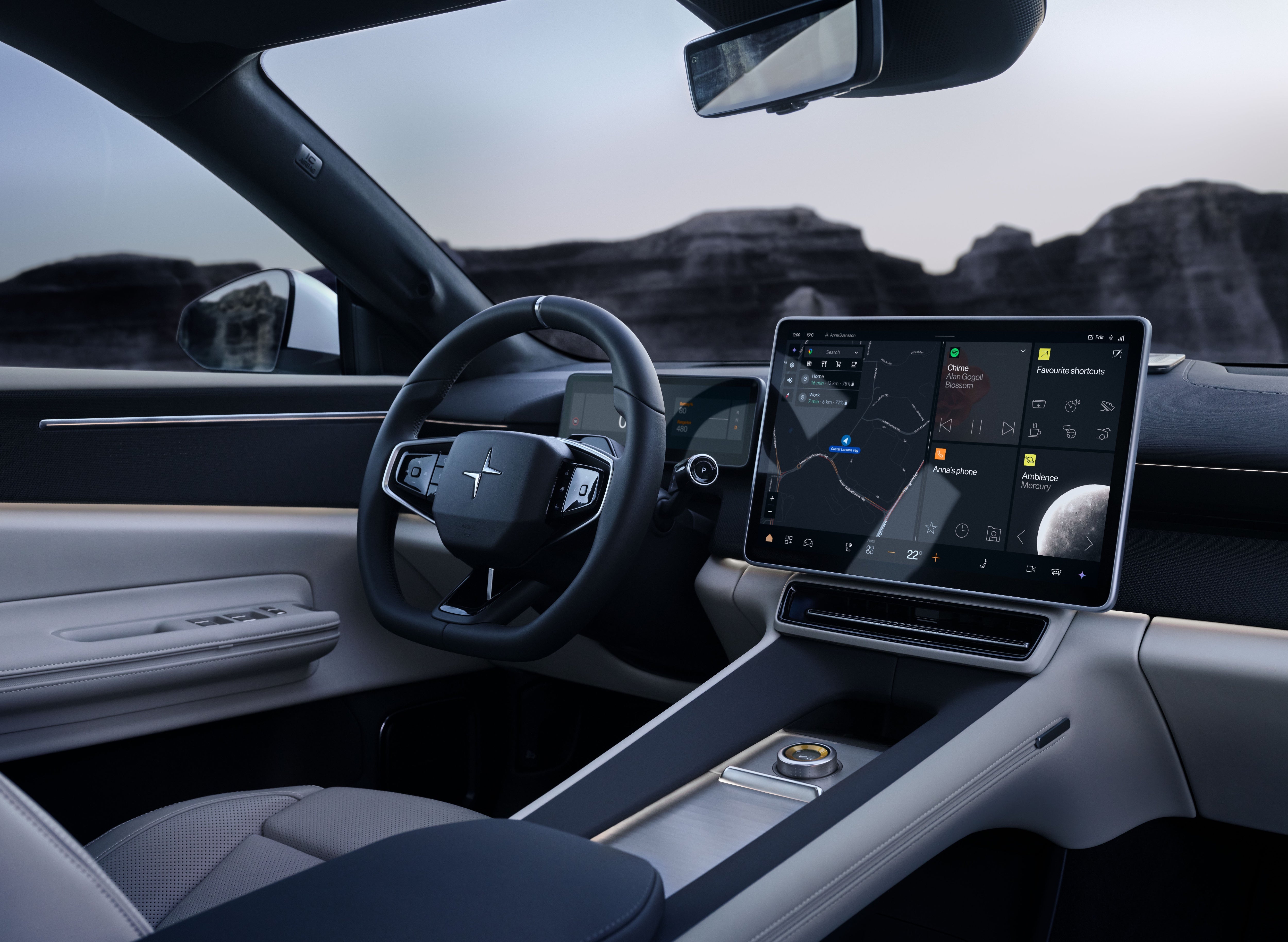 Nothing has changed in the cockpit in transition from saloon to SUV, apart from a proper rear-view mirror (Polestar)
Recycled and lower-carbon materials also feature heavily. Standard MicroTech trim has a backing made from 100 per cent recycled PET, while the optional knitted upholstery uses 89 per cent recycled PET waste. Polestar says the SUV has one of the lowest cradle-to-gate carbon footprints in its model line-up, at 20.2 tonnes of CO2 equivalent for the single-motor car and 21.1 tonnes for the dual-motor variant.
Polestar UK managing director Matt Galvin said: “The Polestar 4 SUV combines the usability of an estate with the presence of an SUV, while delivering the design, performance and sustainability drivers expect from a Polestar. It’s about taking the best qualities of both, delivering enhanced practicality for the modern family. And of course, the car has the ‘look back factor’ every time you walk away.”
Production started in Busan, South Korea, in the second quarter of 2026, with the first UK customer deliveries due later this year.