

This is it. The Range Rover is now fully electric. And we not only got a close look at it, but we also spent a bit of time behind the wheel on JLR’s private proving grounds where the terrain is far more challenging than anything most Range Rover owners will ever face.
As brief as it was, our first date with the Range Rover Electric helped us better understand the manufacturer’s approach. Basically, this SUV was designed as a true Range Rover first and as an EV second. It wasn’t about wowing people with fancy gadgets and tech. You still get a world-class off-roader with the ability to tackle obstacles that would stop most luxury SUVs. It simply happens to be near-silent, smoother and more comfortable for occupants.
Read also Photo: Land Rover
Subtle Evolution
Standing next to it, we hardly found visual differences between the Range Rover Electric and its gas-powered or hybrid counterparts. The silhouette, proportions and overall appearance remain instantly recognizable. Like we just said, the vehicle doesn’t try to put on a show and advertise its zero-emission status with a barrage of futuristic elements.
Up front, the redesigned and aerodynamically optimized grille replaces the more classic one on other Range Rovers. The wheels also have their own unique design, while the underbody has been revised to improve airflow. These are functional and intentionally subtle changes.
 Photo: Land Rover
You see, a Range Rover customer shouldn’t feel like they’re switching to a completely different vehicle simply because they’re giving up the combustion engine. As a matter of fact, the underlying architecture was designed to accommodate various types of powertrains from the start, which means ICE, PHEV and EV models can all be assembled locally in Solihull, England.
A Short Yet Challenging Off-Road Course
Our short test drive of the new Range Rover Electric took place on a closed course that’s specially designed for the development of JLR vehicles. It revealed a lot more than what several kilometres on a perfectly smooth and flat road would have.
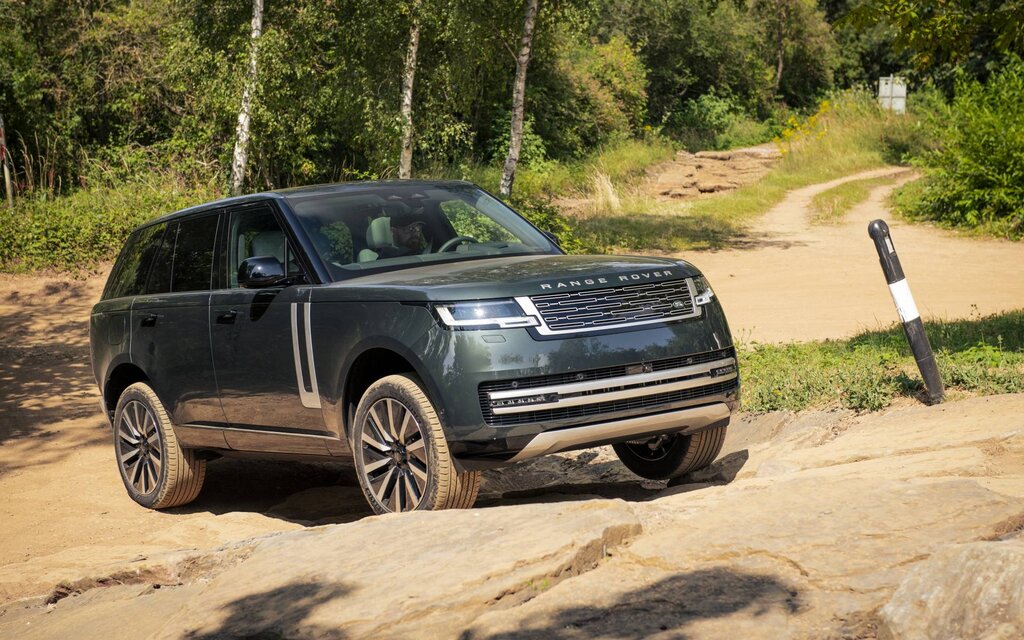 Photo: Land Rover
We first tackled a very steep incline, followed by an extremely tight chicane, which we navigated at a crawl. A bridge crossing briefly got one of the wheels off the ground, but that didn’t cause any loss of traction or sudden movement. The Range Rover Electric simply continued on its way, as if the obstacle was just a footnote.
One-pedal driving here was different than around town. The system allows for very precise torque control, so all you have to do is to apply the necessary effort to move forward, then release the throttle to slow down or stop the vehicle. On a subsequent descent, regenerative braking worked so smoothly that the exercise seemed almost too easy.
 Photo: Land Rover
This is mainly due to a traction control system that can react in less than 50 milliseconds—up to 100 times faster than a comparable system in a conventionally powered vehicle. Off-road capabilities are naturally impressive, as JLR claims the Range Rover Electric can drive off from a 33-degree incline and ford water up to 900 mm deep.
An emergency braking manoeuvre proved equally telling. Despite the vehicle’s outrageous mass, the body remained remarkably stable, without any significant nosedive or jolts. The air suspension combined the various chassis modifications effectively masked the battery’s weight.
 Photo: Land Rover
Silence as a New Layer of Luxury
The new Range Rover Electric is obviously an amazing performer. The dual permanent-magnet electric motors deliver a combined maximum output of 542 horsepower and 627 lb-ft of torque. The 0-100 km/h sprint takes 4.5 seconds, while 80-120 km/h acceleration is achieved in just 2.7 seconds.
But you know what? Speed wasn’t what impressed us the most. Rather, it was the silent cabin. The noiseless powertrain, ultra-premium materials and supreme mastery of body roll elevate the Range Rover Electric to luxury standards normally associated with Bentley or Rolls-Royce. The starting Canadian price of $200,800 will certainly raise eyebrows, and that’s without even considering the catalog of customization options.
 Photo: Land Rover
A Reasonably Sized Battery
With a usable capacity of 118.5 kWh, the Range Rover Electric’s battery is certainly not small. However, it remains fairly modest for such a large, powerful and luxurious electric SUV, using 344 prismatic cells arranged on two tiers along with an 800V electric architecture.
JLR claims an EPA-estimated range of up to 535 km. An official rating will be announced at a later date. You can take that figure seriously, though, as engineers told us they conducted range tests with a production vehicle on a standardized route, under real-world conditions, rather than purely relying on lab simulations.
 Photo: Land Rover
Now, let’s do some quick math. If we were to divide the estimated range by the usable battery capacity, we would get approximately 22 kWh/100 km. That’s pretty good energy consumption for the segment. For comparison, a similarly sized Cadillac Escalade IQ features a 205kWh battery and is said to deliver up to 748 km of range. It also makes a spectacular technological statement. The Range Rover Electric, on the other hand, banks on a smaller battery and promises superior efficiency, not to mention that the cabin has a more serene ambiance.
Using a 350kW fast charger, said battery can go from 10-80% in about 22 minutes under ideal conditions, according to the company. In other words, 10 minutes would be enough to recover up to 200 km of range. The NACS port enables direct access to Tesla’s Supercharger network in North America.
Built to Endure the Cold
For Canadian drivers, the advertised range tells only part of the story. JLR claims to have submitted the Range Rover Electric to over 1.4 million kilometres of testing and more than 250,000 hours of validation in both physical and virtual environments. Prototypes were driven at temperatures as low as -40°C in Arjeplog, Sweden, in the Dubai desert heat, and on the tough terrain of Eastnor Castle in the U.K. Inside the lab, the batteries were subjected to multi-axis vibration and shock at temperatures ranging from -40°C to 90°C.
 Photo: Land Rover
ThermAssist is one of the most interesting results of this work. Rather than allowing heat generated by the motors, battery and other components to dissipate, the Range Rover Electric recovers it and distributes it where necessary. Consequently, JLR was able to achieve a reduction of up to 40% in energy used for heating, which could preserve up to 40 km of range under certain conditions.
Make no mistake: the company doesn’t claim that winter range will drop by 40% at most. Rather, ThermAssist reduces heating energy consumption by 40% compared to a conventional system. Only a proper winter test in typical Canadian climates will give us a straight answer, but such a focus on cold-weather performance is reassuring.
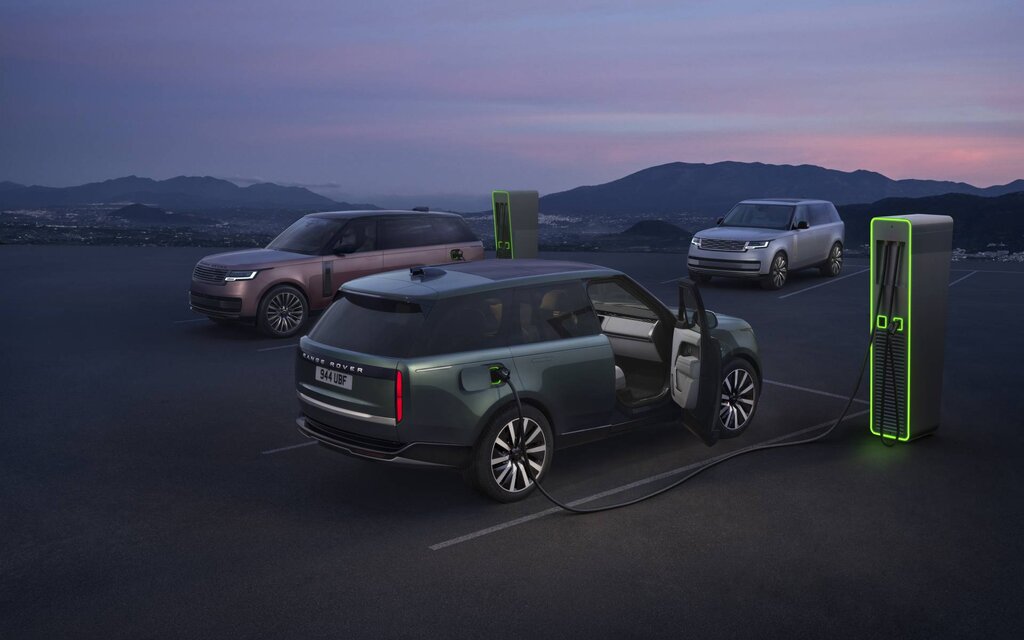 Photo: Land Rover
JLR has filed over 300 patent applications related to the Range Rover Electric, which is way more than for any other Range Rover in history. Each unit also has a digital twin of its battery, encompassing over 900 diagnosis points. Combined with over-the-air updates, this data will allow the manufacturer to detect certain maintenance needs before they become problematic. Incidentally, the battery and electric powertrain are covered for eight years or 160,000 km.
Sounds Promising… For Now
This first encounter with the new Range Rover Electric doesn’t answer all our questions yet. We haven’t driven on the highway, faced a harsh Canadian winter, taken a long road trip, towed a trailer or plugged the vehicle into a fast charging station. Therefore, we can’t confirm its real-world energy consumption, range, charging speed or comfort over several hours.
 Photo: Land Rover
The Range Rover Electric did make a great first impression, though. On difficult terrain that would have pushed most luxury SUVs out of their comfort zone, it seemed to move forward almost effortlessly, modulating torque with remarkable precision, effectively concealing its hefty mass and maintaining a calm interior environment at all times, even when a wheel momentarily went airborne.
In short, this is all very promising for now, but let’s wait after we take it for an extended spin back home to make a final judgement.