
Written by Emily J. Thompson, Senior Investment Analyst
Source: Fool
Updated: 6 minutes ago
0mins
Source: Fool
Declining Profitability: Tesla’s earnings per share fell from $4.30 in 2023 to $2.04 in 2024 and is projected at $1.08 for 2025, indicating a two-year decline in profitability that undermines market confidence in future earnings potential.
Operating Margin Decline: The company’s operating margin decreased from 5.8% in Q3 2025 to 1.4% in Q2 2026, primarily due to a 47% year-over-year increase in operating expenses, negatively impacting overall profitability.
Surging Capital Expenditures: Capital expenditures reached $5.8 billion in Q2, up 142% year-over-year, and despite having over $40 billion in cash and investments, the negative free cash flow of -$1.1 billion indicates short-term profitability pressures.
Growth in Software and Services: Despite challenges, Tesla’s Q2 revenue rose 26% year-over-year to $28.2 billion, with active software subscriptions reaching 1.48 million, a 56% increase, demonstrating strong demand in the software and services sector.
Trade with 70% Backtested AccuracyStop guessing “Should I Buy TSLA?” and start using high-conviction signals backed by rigorous historical data. Sign up today to access powerful investing tools and make smarter, data-driven decisions.Sign upAnalyst Views on TSLA
Wall Street analysts forecast TSLA stock price to rise
Wall Street analysts forecast TSLA stock price to rise
Current: 345.820

Current: 345.820
About TSLA
Tesla, Inc. designs, develops, manufactures, sells and leases high-performance fully electric vehicles and energy generation and storage systems, and offers services related to its products. Its segments include automotive, and energy generation and storage. The automotive segment includes the design, development, manufacturing, sales and leasing of high-performance fully electric vehicles, and sales of automotive regulatory credits. It also includes sales of used vehicles, non-warranty maintenance services and collisions, part sales, paid supercharging, insurance services revenue and retail merchandise sales. The energy generation and storage segment include the design, manufacture, installation, sales and leasing of solar energy generation and energy storage products and related services and sales of solar energy systems incentives. Its consumer vehicles include the Model 3, Y, S, X and Cybertruck. Its lithium-ion battery energy storage products include Powerwall and Megapack.
About the author
Emily J. Thompson
Emily J. Thompson, a Chartered Financial Analyst (CFA) with 12 years in investment research, graduated with honors from the Wharton School. Specializing in industrial and technology stocks, she provides in-depth analysis for Intellectia’s earnings and market brief reports.
 Tesla Denies Shutdown Rumors of Shanghai Data Center
 1 day agostocktwits
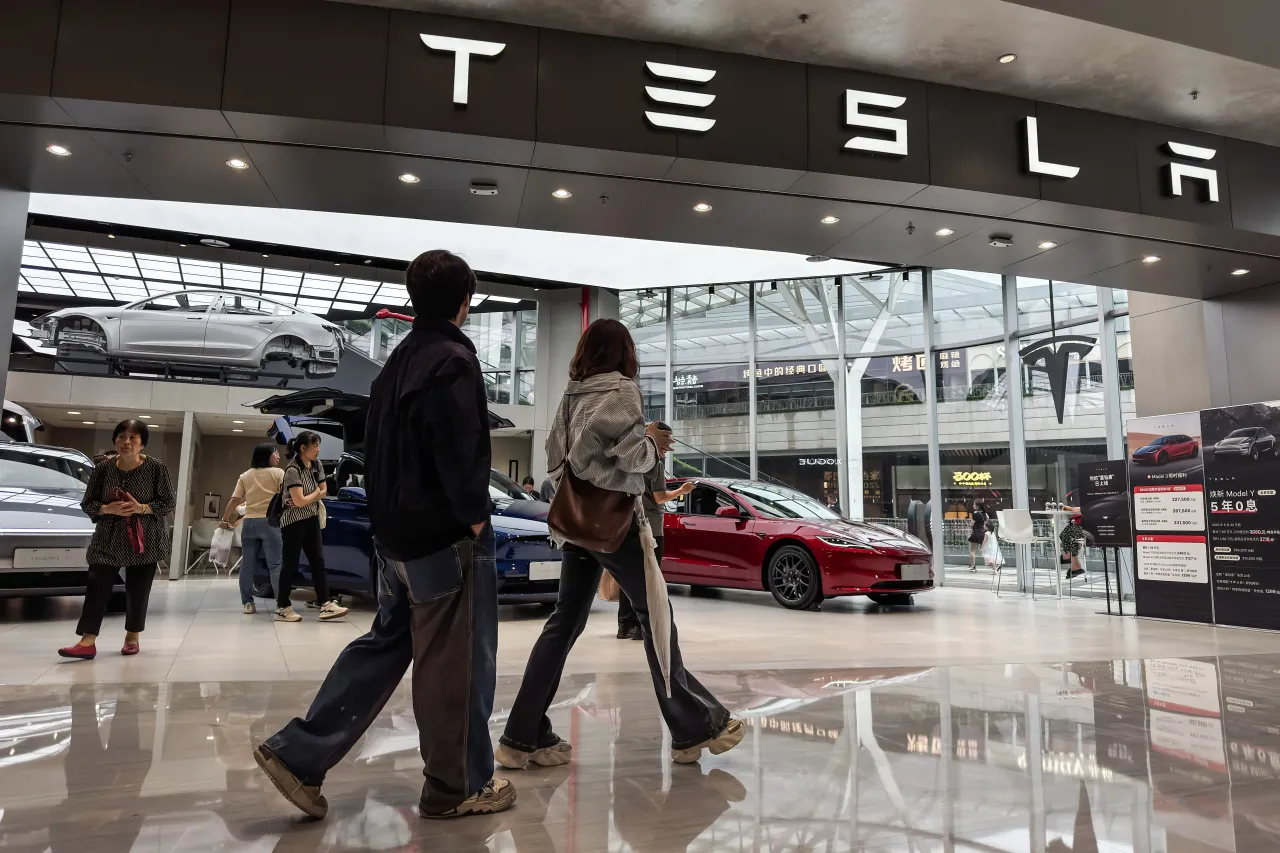
Data Center Operations: Tesla’s China team has denied rumors regarding the shutdown of its Shanghai data center, asserting that the facility is operating normally and accelerating related hiring to support the localization of Full Self-Driving (FSD) technology, thereby ensuring compliance and data security in the Chinese market.
FSD Approval Progress: During the earnings call in April, CFO Vaibhav Taneja mentioned that the company hopes to gain broader approval for FSD in China by Q3, which could positively impact future market demand and revenue growth.
Market Reaction Analysis: Although TSLA stock traded 1% lower at the time of reporting, retail sentiment on Stocktwits remained ‘bullish’, indicating confidence in Tesla’s future performance despite a 23% decline year-to-date.
FSD Subscription Market Limitations: Tesla’s U.S. site listed 12 markets for FSD Supervised subscriptions, excluding China, even though the company maintains that FSD is available in the country, highlighting challenges in commercializing FSD while reflecting market expectations for the feature.
 Musk Drives Transition to Sustainable Energy Amid Rising Natural Gas Demand
 17 hours agoFool
Sustainable Energy Goals: Musk articulated in his 2006 and 2016 blog posts that Tesla’s mission is to expedite the transition from a hydrocarbon economy to a solar electric economy, emphasizing the necessity of sustainability to prevent potential civilizational collapse.
EV Production Capacity: Tesla is currently producing over 1.5 million electric vehicles annually while also manufacturing large-scale battery systems to support renewables, underscoring its pivotal role in the global energy transition.
Rising Natural Gas Demand: SpaceX is constructing a dedicated natural gas pipeline to support rocket launches, and its rapidly expanding AI infrastructure increasingly relies on natural gas for power, a shift that could negatively impact nuclear energy investors, particularly in small modular reactor (SMR) stocks.
SMR Industry Challenges: While small modular reactors are seen as the future of nuclear energy, the rising demand for natural gas from the AI sector may delay SMR adoption, posing significant financial uncertainties for companies like Oklo and NuScale, which remain unprofitable and may take years to achieve meaningful cash flows.
 Tesla Maintains Lead in Digital Automaker Index18 hours agoNASDAQ.COM
Tesla’s Ranking Improvement: In Gartner’s 2026 Digital Automaker Index, Tesla’s score increased from 79.3% last year to 82.7%, maintaining its top position and showcasing its technological advantage and innovation in the electric vehicle market.
Competitor Performance: Nio and Xiaomi followed closely with scores of 73.1% and 69.2%, respectively, while XPeng, Li Auto, and Rivian scored between 55.5% and 57.7%, indicating that emerging EV manufacturers are gradually narrowing the gap with Tesla in technology application.
Legacy Automakers Lagging: Despite significant investments in software and AI, traditional automakers like General Motors, Ford, Stellantis, and Volkswagen have fallen further behind in the rankings, reflecting their delays in technological transformation.
Challenges in Technological Transformation: Gartner Vice President Pedro Pacheco noted that many automakers are unprepared to adapt to rapid tech adoption, which poses a threat to their future competitiveness in attracting talent and innovating vehicle architecture.
 Tesla’s Major Transformation in the Automotive Industry
 19 hours agoFool
Market Leadership: Tesla once again secured the top position in Gartner’s Digital Automaker Index, improving its score from 79.3% last year to 82.7%, demonstrating its sustained leadership in the electric vehicle market despite fierce competition.
Competitor Performance: Nio and Xiaomi followed closely with scores of 73.1% and 69.2%, respectively, while XPeng, Li Auto, and Rivian scored between 55.5% and 57.7%, indicating that emerging EV manufacturers are gradually gaining an edge in technological innovation.
Traditional Automaker Struggles: Despite significant investments in software and AI by legacy automakers like General Motors, Ford, Stellantis, and Volkswagen, they have fallen further behind in the rankings, reflecting their inadequate preparation for technological transformation.
Future Business Uncertainty: Tesla’s future robotaxi business may account for nearly half of its valuation, and although it faces high operational transformation costs and uncertainties, the company’s technological development advantages may help it stand out in the competitive landscape.
 Musk’s Innovation Drives Investment Risks and Opportunities
 20 hours agoFool
Portfolio Risk: Cathie Wood’s Ark Invest holds a 10% stake in both SpaceX and Tesla, and while these companies excel in innovation, their high volatility significantly increases investment risk, especially in the current market environment.
Tesla’s Market Performance: Since its IPO in 2010, Tesla has performed exceptionally well with a current market cap of $1.4 trillion; however, its forward P/E ratio of 178.6 indicates high market expectations for future growth, prompting investors to be cautious of potential pullback risks.
SpaceX’s Growth Potential: SpaceX achieved a remarkable 92% year-over-year revenue growth in Q2, reaching $7.8 billion, while cutting its net loss to $541 million; however, its price-to-sales ratio of 63.7 reflects optimistic market expectations, necessitating careful evaluation of its valuation.
Market Volatility Analysis: Since going public, SpaceX has experienced significant price fluctuations, with shares rising from $150 to $225.64 before dropping back to around $135, indicating high uncertainty regarding its future performance, and investors should be prepared for potential wild swings.
 Market Volatility and Investment Strategy Analysis
 22 hours agoFool
Valuation Warning: The current CAPE ratio of the S&P 500 stands at 41, significantly above the historical average of 18, indicating a potential overvaluation in the market that investors should be cautious of regarding future corrections.
Buffett Indicator Overload: The Buffett indicator is nearing 236%, suggesting that the total market capitalization of U.S. stocks relative to GDP is well above the 100% threshold, historically signaling overpriced market conditions that warrant investor caution.
Concentration Risk in Tech Stocks: The market’s gains are heavily concentrated in a few mega-cap tech companies like Apple and Microsoft, which, despite their strong profitability, pose a concentration risk that could exacerbate market volatility.
Long-term Investment Strategy: Investors are advised to utilize low-cost S&P 500 ETFs for dollar-cost averaging, leveraging the compounding effect of reinvested dividends and the market’s long-term growth potential to capitalize on buying opportunities during market fluctuations.