

The 2027 Toyota C-HR online configurator for the US market went live earlier this month, revealing pricing and specs of the smallest all-electric Toyota. According to the Japanese company, the first units will arrive at dealerships this September.
The new 2027 Toyota C-HR is a carryover model year with the same features and specs as the outgoing 2026 model year. The prices increased marginally.

2027 Toyota C-HR (Image credit: Toyota)

2027 Toyota C-HR (Image credit: Toyota)
2027 Toyota C-HR
Versions
The Toyota C-HR is a compact crossover, based on Toyota’s BEV-dedicated e-TNGA platform. It has two trims (SE and XSE), both with a dual-motor, all-wheel-drive (AWD) powertrain.
With a peak power output of 252 kW, the car can accelerate from 0 to 60 mph in 4.9 seconds.
It’s worth noting that the Toyota C-HR has a direct cousin: Subaru Uncharted, which, by the way, has an additional front-wheel-drive (FWD) version.
2027 Toyota C-HR trims:
SE
18-inch wheels with black inserts
Power liftgate back door
Rain-sensing wipers
Low-profile roof rails
Fabric/SofTex-trimmed seating with 8-way power driver seat and 6-way manual passenger seat
Heated front seats and steering wheel
14-inch touchscreen with Toyota Audio Multimedia system
Two front wireless Qi phone chargers
Four USB Type-C ports
Toyota Safety Sense 3.0
Front and Rear Parking Assist with Automatic Braking
Blind Spot Monitor
XSE
20-inch gunmetal-finished wheels
SofTex and synthetic suede-trimmed seats
8-way power passenger seat
Driver memory seat
Traffic Jam Assist*
Lane Change Assist
Panoramic View Monitor

2027 Toyota C-HR (Image credit: Toyota)
Battery and Range
The 2027 Toyota C-HR has only one battery pack type — a 74.7-kWh battery (391 volts), known from many other Toyota/Lexus and Subaru EVs.
The manufacturer-estimated range is 287 miles (SE with 18-inch wheels) and 273 miles (XSE with 20-inch wheels), matching the official EPA Combined range for the 2026 model year. The 14-mile (or 4.9%) difference is mostly associated with the larger wheels, we guess.

2027 Toyota C-HR: EPA range. (Image credit: State Of Charge)
Energy Consumption
The EPA energy consumption ratings are not yet published for the 2027 Toyota C-HR, but we assume that the results will be the same as for the 2026 model year. Thus, we present the 2026 results below.
Depending on the trim, the 2026 Toyota C-HR averages 112-117 MPGe, or 3.3-3.5 miles/kWh (roughly 288-301 Wh/mile), including charging losses.
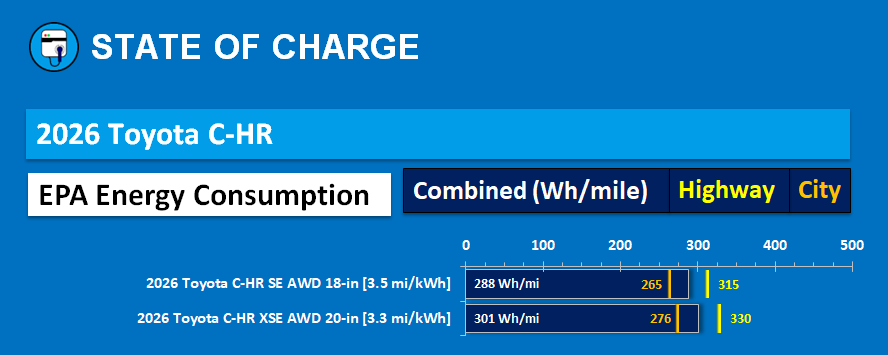
2026 Toyota C-HR: EPA energy consumption (including charging losses). (Image credit: State Of Charge)
Charging
Charging Port
The 2027 Toyota C-HR, just like the 2026 model year, features a NACS (SAE J3400) charging port for AC and DC charging.
The model can directly access NACS charging points (AC or DC), including Superchargers (Toyota EVs gained access to the Tesla Supercharging network in October 2025).
Access to CCS1 DC fast chargers is possible through a CCS1-to-NACS adapter. Similarly, the car can use SAE J1772 AC charging points with an AC adapter (J1772-to-NACS).
The charging port is located on the front-right (passenger’s side). This should help with DC fast charging at Tesla V3 Supercharging dispensers (the ones with short charging cables). On the other hand, it might not be the most convenient location when parking in tight garages.

2027 Toyota C-HR (Image credit: Toyota)
AC Charging
The 2027 Toyota C-HR features an 11-kW onboard charger. It should be enough to fully recharge the battery in roughly 7.5 hours.
To fully use the onboard charger, you’ll need an 11.5-kW home charging station (up to 48 amps at 240 volts) installed on a 60-amp circuit.
The car comes standard with a dual-voltage (120- and 240-volt) charging cable.
DC Fast Charging
The 2027 Toyota C-HR can recharge from 10% to 80% state of charge (SOC) in around 30 minutes. During this time, the car can add roughly 191-200 miles of EPA range, depending on the version.
The peak charging power is 150 kW. We estimate that the average charging power in the 10-80% SOC window should be close to 105 kW.
Assuming a maximum range of 273-287 miles, the average range replenishment rate in the 10-80% SOC window is 6.4-6.7 miles/minute, which is “okay”.
The Toyota C-HR supports the Plug & Charge feature (available on select charging networks).

2027 Toyota C-HR: Range replenishment rate during DC fast charging from 10% to 80% SOC. (Image credit: State Of Charge)
Power Export
The Toyota C-HR features a 120-volt AC outlet (1,500 W) in the rear cargo area.
Pricing
The 2027 model year is $80 more expensive than the corresponding 2026 model-year versions. Additionally, the obligatory destination fee increased by $145 to $1,595. In total, the 2027 cars are $225 more expensive.
The 2027 Toyota C-HR SE starts at an MSRP of $37,080 ($38,675 including the obligatory destination charge of $1,595). The better-equipped XSE trim costs $2,000 more ($40,675 with DST).
For reference, the 2027 Subaru Uncharted AWD starts at $41,270 (with DST). However, it has a noticeably more affordable FWD version, which costs $36,470 (with DST).
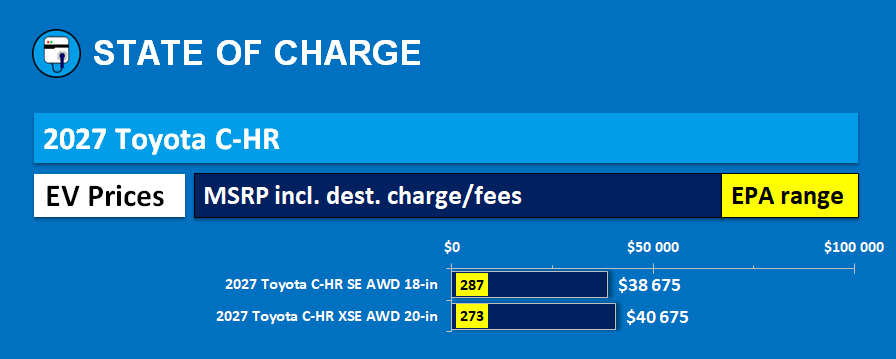
2027 Toyota C-HR: Prices and EPA range. (Image credit: State Of Charge)