
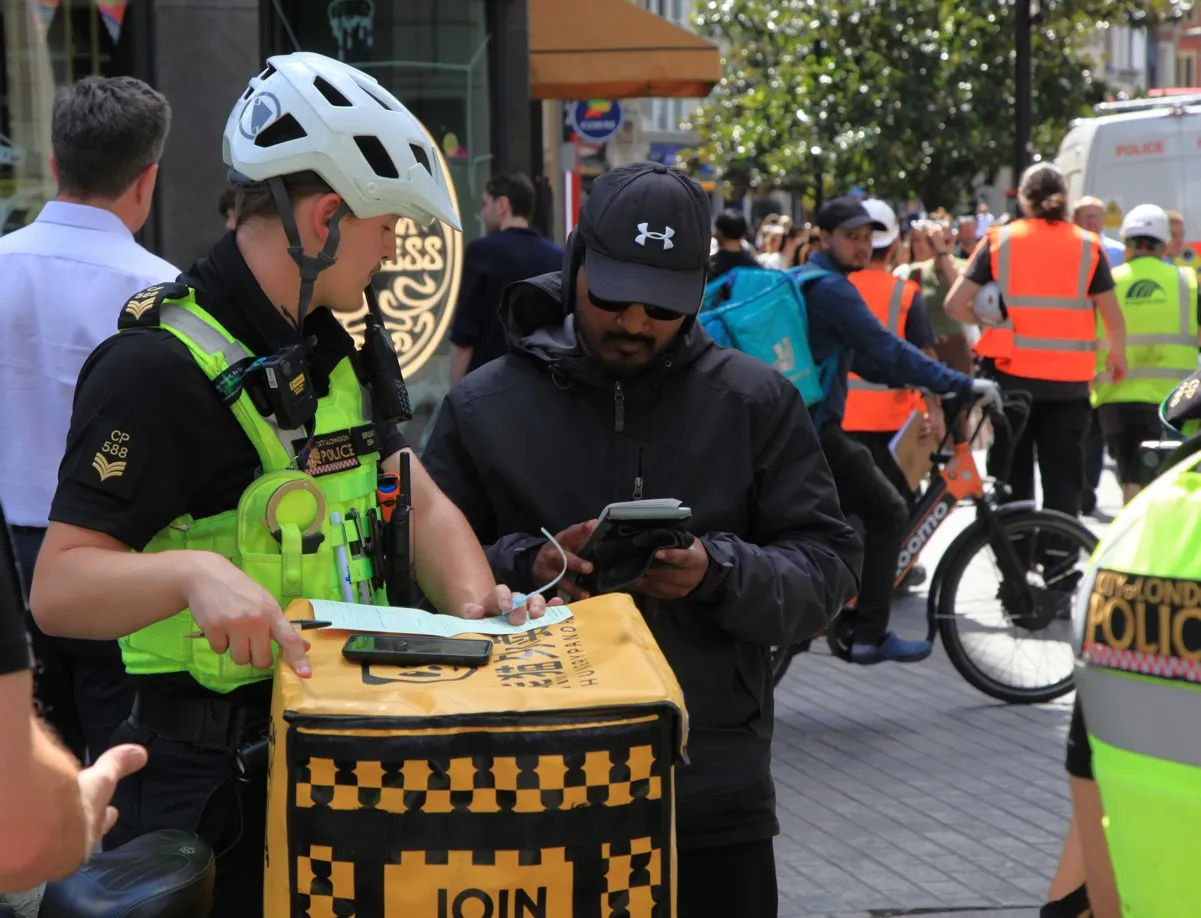
Standing at the roadside on Bishopsgate, the City of London Police’s Cycling Team are constantly passed by riders who seemingly are all aboard electric bikes. It’s a busy north-south thoroughfare that links Shoreditch with London Bridge, and if you’re looking to get quickly through the area by bike, it’s hard to avoid. Yet, increasingly those on illegal ‘e-bikes’, which, legally speaking, are motorbikes, know to swerve the area.
Sergeant Stuart Ford, and his ten-person team, know this and are here, outside the police station, looking for illegal e-motorbikes of the kind often mislabelled ‘e-bikes’ by UK media.
Ford’s eyes flicker up and down the street as he talks – occasionally sending instructions or suggestions to his team through the radios – four uniformed officers are in the vicinity, and others are stationed in the surrounding streets. Two more are in plain clothes, spotting and flagging riders headed our way. They usually deploy at once like this, but their tactics vary: some officers like to stand beside the road, some cycle, pulling up alongside riders and guiding them towards the pavement, as they might in a patrol vehicle.
They’re looking for one thing, initially – the rider is not pedalling enough to merit the speed. It probably takes three seconds to identify in most cases whether the bike looks legitimate, or if it might be a twist-and-go motorbike kit on a bicycle frame. By law, an EAPC (electrically assisted pedal cycle) needs to assist a rider who pedals, up to 15.5mph. Any throttle is only legally allowed to propel the bike up to 3.7mph – known as walk assist. Things like big handlebar mitts in the middle of summer are usually a giveaway that there might be buttons on the bars people are trying to hide. Then again, the gig workers also ride long hours in colder months, so it’s not a given that they’re hiding something.
Testing illegal ‘e-bikes’ at the roadside

While the Metropolitan Police have deployed expensive mini ‘rolling road’ type devices to test the exact speed of potentially non-compliant cycles, the City team prefers the versatility of being able to roll up to any location, with no heavy kit and no vans, and to test cycles on the spot.
Once Ford’s team stops a rider and gets them off the bike, they will lift the rear wheel and test the throttle themselves.
“We can tell by looking at it,” he says. “If it’s going more than the 3.7 miles an hour, which is fairly clear if it is, then we know it’s not going to be on the road legally.”
“So we seize it on that basis. We have gone to court for a few and we haven’t lost any of them when it comes to those sort of issues. We’ve won every case. So we do explain to people that if you go to court, you could end up with a lot more costs, a fine, points on your driving license.”
The first suspect rider is quickly pulled in, then a second, then a third. Two are riding cycles from brands known to Ford and his team to sell non-compliant, as well as legal models – Engwe and Allegra. Both machines in this particular case are legal, with none of the hidden tricks known to switch an apparently compliant bike to an illegal motorbike – and no twist-and-go function that goes above the walk assist speed. One rider is so curious he sticks around to watch what happens next.

Since launching just over three years ago in July 2023, the Cycling Team have become a common sight on the streets of the Square Mile. In that time they have seized more than 800 non-compliant vehicles. It’s a substantial part of the team’s work – Ford describes it as “like shooting fish in a barrel”.
Today is a good example. It’s only mid-morning, and the Team have already seized five non-compliant bikes from around Ludgate Circus; just 90 minutes’ work, including travel time. These are put in a yard at the rear of the police station, before being taken away by the local pound and destroyed. Today there’s an Allegro, a non-compliant Engwe and a Starsfly impounded from the earlier shift, and several others, as well as several electric scooters.
For private owners of e-scooters, these remain a private-land-only vehicle as successive Governments have promised legislation around the vehicle class, but ultimately failed to deliver. For now, only share scheme electric scooters are legal and these are supposed to be data-collecting to advise Government policy; yet even the numbers of these are dropping.
Ford says on the larger-wheeled products: “These are not the sort of bike you’re going to go to your local reputable bike shop and buy. These are generally online purchases.”
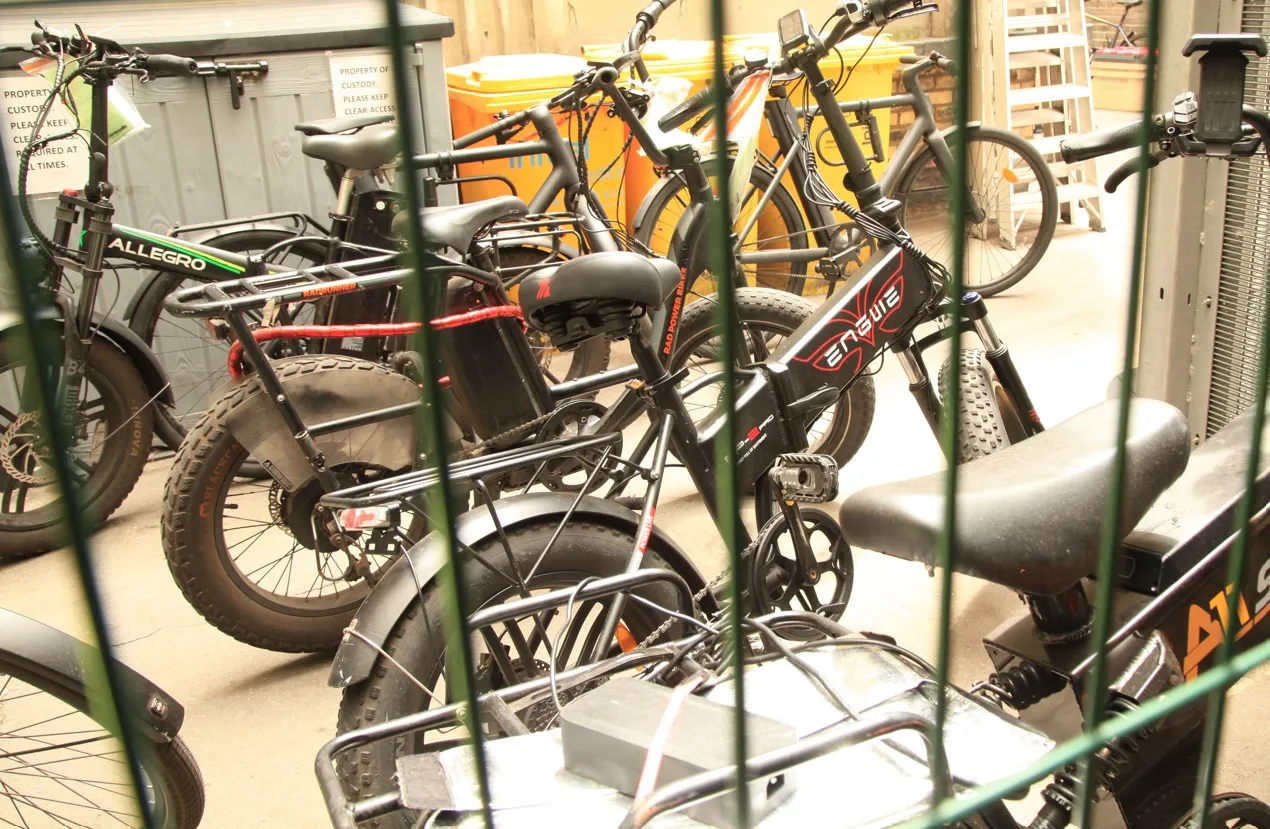
Sgt Ford talks about the grey area that exists in products found online. “Sadly we see on the various platforms them being advertised by people and there’s not really a huge amount we as police can do about that because it’s a ‘found committing’ offence”. In other words, it’s only when someone rides the bike on a public road that Sgt Ford and his team can act.
The demographics using them have changed though. While last year most non-compliant models the Team seized were being ridden by gig economy delivery riders, this year Ford believes it’s a 50:50 split between commuters and couriers. Some, he believes, have even been bought on the Cycle to Work scheme. Though we do not have evidence of this, if this were true, then the spirit of the salary sacrifice scheme is being abused, and the third-party facilitators may have questions to answer about what they’re letting through.
Sgt Ford says: “I think generally people don’t realise; they buy something that’s quite cheap, think ‘this is good, I can ride to work, I’m not going to get all sweaty when I get to work, brilliant’. And then you’ve got some that clearly do realise, so it’s a mix.”
I ask him if he can tell the genuine mistakes from the chancers. “If you’ve been a police officer as long as I have, you sort of get to know quite quickly when someone’s lying or not; you know.”
The team deploys during daily rush hours, as well as during the lunchtime rush. In the latter, like today, it’s mostly gig economy riders. Ford believes most couriers now know the difference between compliant and not. In at least one case a person whose (unwittingly) non-compliant bike was seized by police came back to the station the next day with a legal one to have police check it over.
Ford and the team use their judgment in these cases. “He didn’t realize it was illegal. We didn’t prosecute him for it, we just seized it off of him. I’m not going to necessarily prosecute somebody who’s on minimum wage, struggling to feed their family; we’ve got a sensible approach. However, if they do it again then they will get prosecuted.”
As Cycling Electric revealed earlier this week, achieving minimum wage may be a long shot for some delivery riders and we have found instances of gig economy workers returning less than half the London Living Wage even at peak times. This shortcoming in pay can be true even if riders use modified to be illegal ‘e-bikes’ and there appears to be evidence that faster vehicles are preferred suppliers to the algorithms that many delivery companies use. This incentivises bad practice on road safety, as well as the sourcing of likely non road-compliant kit.
The Team also deals with organised crime gangs using Sur-Ron-style fast e-motorbikes, capable of doing 50-60mph – though some now use slower hire bikes to blend in with the crowds. “[It’s an] easy way for criminals to get around undetected, that’s what’s causing it. That’s a problem across all of London and other major cities and towns,” says Sgt Ford.

The fourth cyclist pulled in is a delivery rider on a battered Zoomo bike with a big yellow Hungry Panda box bag on the back. One of the plain clothes officers, Sybill, spotted him earlier and, just as he passes the uniformed police, the rider reaches back under the bag. Jake pulls him in, and it takes seconds to find two buttons back there that switch a twist-and-go mechanism on and off. It turns out the rider has been stopped and fined before, by Sybill – meaning another £300 and another six points on his ‘ghost license’ – as he only carries a provisional license.
“If he’s not intending on driving, he’ll just rack the points up,” says Sgt Ford. “Again, we talk about the low wage earners trying to do their bit, and I get that, but do it legally. These things are not a huge amount faster and better than just a normal e-bike.”
The bike has clearly been modified before, with various unused wires poking out and dangling from the frame. One of the brake levers has snapped. The bike, needless to say, is seized. The man protests, and tries to claim it’s a legal bike, despite the evidence against him.
Sgt Ford is proud of his team on this one. “That’s the officers’ skill that has picked up on that and seen him lean back to the switch. We’ll come back as a team later, we’ll debrief there, so I’ll get Jake to show everyone, explain this is what we saw. So the team now all know if you see someone doing that, look for that. And that’s where having a core team of officers that work together all the time works really well.”
“It’s a massive team effort, as you can see. I could not do this on my own,” says Sgt Ford.
He adds: “That’s why I say everyone on the team is sort of an expert on this, because they know what they’re doing and they know what to look for. Other forces haven’t got that privilege; they haven’t got that luxury because of their priorities and what they are.”
Tactics change, and police knowledge has to keep up – as this incident shows. Sgt Ford adds: “As the [illegal] industry’s grown sadly, we’ve grown with it.”

Harry, another plain clothes officer, turns up as we start to wind up the session. He’s spotted several riders on dodgy-looking bikes who, the moment they spot the officers in the high vis body armour, they’ve turned around. “I think we’ve had today already about three to four turnarounds”.
As we stand there, another rider comes, asking Sgt Ford to check his bike is legal.
Elsewhere in London, beyond the Square Mile’s boundaries, where there aren’t dedicated teams like this, he believes the non-compliant bike problem is even worse. Many on illegal e-motos now know to avoid their patch.
The team is happy to share its knowledge. Sgt Ford will take the new Cytech course on e-bike policing, and offer his assistance to forces who might still be catching up on the technology.
He recalls telling police in Norwich how to look out for the ‘dinner plate’ motors in bikes’ rear wheels – a common indicator of an overpowered bike. A family who live locally later complained their food deliveries were taking longer. Even those hubs are dwindling on Sgt Ford’s patch now – perhaps the riders have learned to avoid the Square Mile, or perhaps manufacturers are playing cat and mouse with the issue.
Another rider is on a twist-and go conversion whose rear wheel is slightly buckled. Officer Marty twists the throttle, with the display showing 46kph, albeit with the rear wheel elevated. As he lets the throttle go, the wheel audibly grinds to a halt. This isn’t a delivery rider, just a young man in street clothes. However, Sgt Ford, watching his body language, calls over a colleague to assist. After an identity check, the man is found to be in the UK illegally, and is handcuffed and taken to the station.
Sgt Ford explains that from there he will be taken to a cell, given something to eat and drink, and handed to immigration.
“Out of those nine e-bikes seized today, one has been someone who’s here illegally. It’s going to happen,” he adds.
Eventually, we call it a day. The team needs to do their paperwork and get on with other things. There’s almost too many bikes for everyone to bring in, with the officers’ own machines. It’s clearly a passion for the whole team, being out and being visible, helping the community and, for many, they come to the roles with a love of cycling. The bikes they pull, however, are not those of cyclists.
Sgt Ford eventually says: “I have to stop looking. I can see everywhere there’s bikes and yeah, you run out of people [to stop them].”