

Tesla has claimed the top spot in U.S. automotive brand loyalty — not for the first time, and not by a narrow margin. A mid-2026 study from LexisNexis Risk Solutions puts Tesla’s loyalty rate at 63.9%, nearly 12 points above the industry average. Here’s what’s behind that number, who’s chasing it, and why it matters.
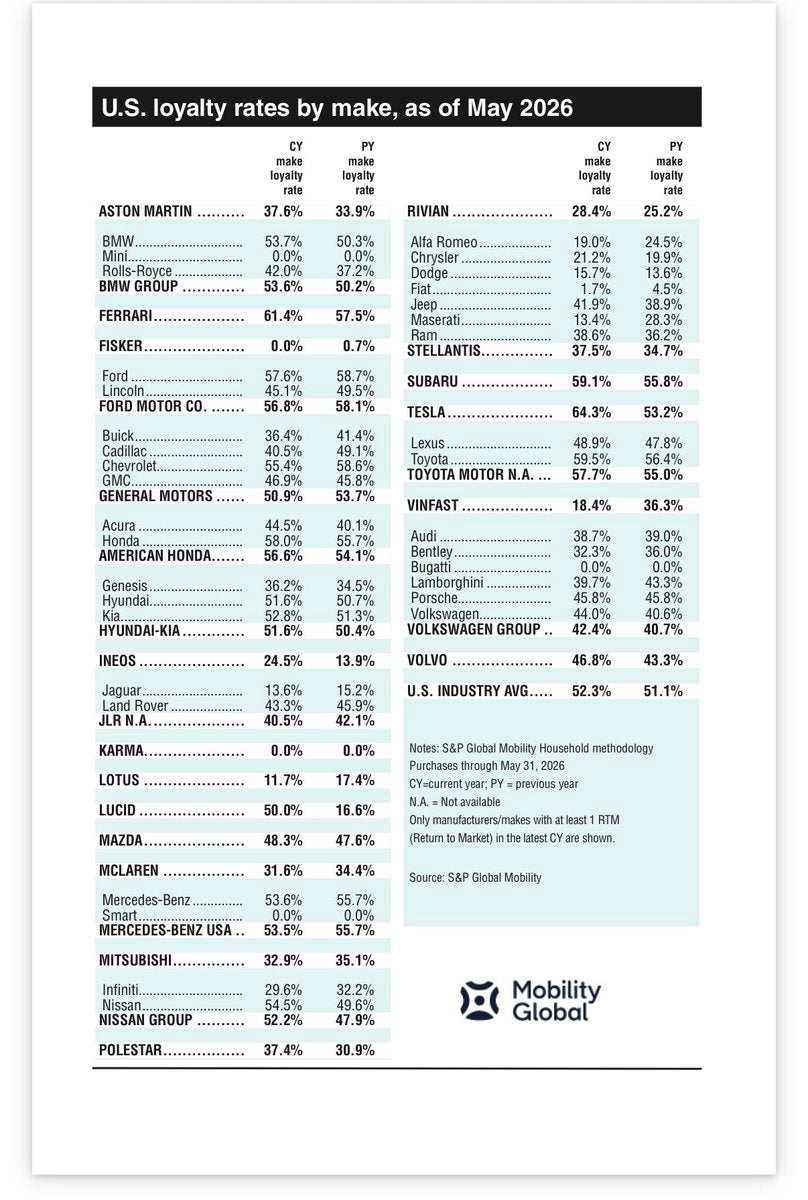 Source: @wholemars — August 10, 2026
1. Tesla’s 63.9% Rate Is an Eight-Point Jump in Six Months
According to LexisNexis Risk Solutions’ mid-year 2026 Automotive Brand Loyalty Study (published August 6, 2026), Tesla’s loyalty rate hit 63.9% in the first half of the year — up roughly eight percentage points from where it stood at the close of 2025. That’s not a gradual drift upward; it’s a meaningful acceleration in owner retention happening in real time. For context, the industry average sits around 52.7%, meaning Tesla owners re-buy at a rate more than 11 points above the typical brand.
2. Ferrari at #2 Is the Surprising Part of This List
The ranking shared by @wholemars places Ferrari second — an unusual position for a low-volume exotic brand sitting between a mass-market EV maker and Toyota. Ferrari’s high loyalty is largely structural: its customers are enthusiasts with limited alternatives at that price point, and allocation constraints mean buyers often wait years for their next car. Tesla’s loyalty, by contrast, is earned in a competitive, high-volume market where switching to another brand is frictionless. Beating Ferrari in this context carries more weight than it might initially appear.
3. Toyota and Subaru Are the Closest Mass-Market Challengers
S&P Global Mobility data from February 2026 put Toyota at 59.9% and Subaru at 60.5% — both trailing Tesla’s 61.1% at that snapshot. Both brands have decades of reliability reputation driving their retention. The fact that Tesla, a company that didn’t exist 25 years ago, has pulled ahead of them on this metric is the kind of data point that reframes the “Tesla is a niche product” narrative. Honda, Ford, and Chevrolet follow further down the list, with premium German brands BMW, Mercedes-Benz, and Porsche all ranking outside the top ten.
4. This Is the Fourth Consecutive Year Tesla Has Won S&P Global’s Top Award
S&P Global Mobility’s 30th annual Automotive Loyalty Awards, announced in January 2026, handed Tesla the “Overall Loyalty to Make” award for the fourth year running. That award is based on analysis of 13.6 million new retail vehicle registrations in the U.S. from October 2024 through September 2025 — a large enough sample to be statistically robust. Tesla also took home the “Highest Conquest Percentage” award for the sixth consecutive year, meaning it not only retains its own owners but pulls in more buyers from competing brands than anyone else. Asian household retention came in at 63.6% and Hispanic household retention at 61.9%, per S&P Global Mobility figures.
5. What Drives the Number — and What Could Threaten It
Loyalty at this level doesn’t happen by accident. Tesla’s over-the-air software updates mean the car owners bought two years ago is functionally different today — features added, interface refined, FSD capability expanded. That ongoing improvement loop gives owners a reason to stay in the ecosystem rather than shop around at renewal time. The Supercharger network creates a switching cost that’s real but often underestimated: owners who’ve built their charging habits around Tesla infrastructure face genuine friction moving to another brand. The risk to watch is whether the loyalty rate holds as more compelling long-range EVs from established brands reach the market at competitive price points — the February 2026 figure of 61.1% was already strong, and the jump to 63.9% by mid-year suggests the trend is moving in the right direction for now.
Sources & reporting notes
The links below identify the material source records used for this report.
@wholemars on X (2026-08-10T16:50:05.000Z) — Direct source
Source links are preserved as published or accessed. See our editorial standards and corrections policy.
BASENOR Newsroom
The BASENOR Editorial Desk covers Tesla, SpaceX, and related technology, curating reporting from primary sources — official accounts, regulatory filings, and software release data. Every article passes source-record and fact-checking review before publication. About the newsroom.
This report was curated by the BASENOR Editorial Desk from the sources listed above. Read our editorial standards or email editorial@basenor.com to report an error.