
Georg Teepe did not plan a quiet 84th birthday.
Instead, he set out from Southern California in a Tesla Model S with a goal no one had completed before: driving an electric vehicle all the way to the Arctic Ocean.
Two days after turning 84, Teepe reached Tuktoyaktuk, a remote town in Canada’s Northwest Territories, after a 3,800-mile journey that tested his patience, planning, and the limits of long-distance EV travel.
“I’ve traveled a lot, and I think it was the trip of my lifetime,” Teepe told me from his home in Rancho Mission Viejo, California. “It was just something that no one has ever done.”
At a time when many drivers still worry about EV range, Teepe’s trip was more than a personal adventure. It was a real-world test of how far a Tesla could go when the charging stations ran out.
How he drove a Tesla to the Arctic Ocean
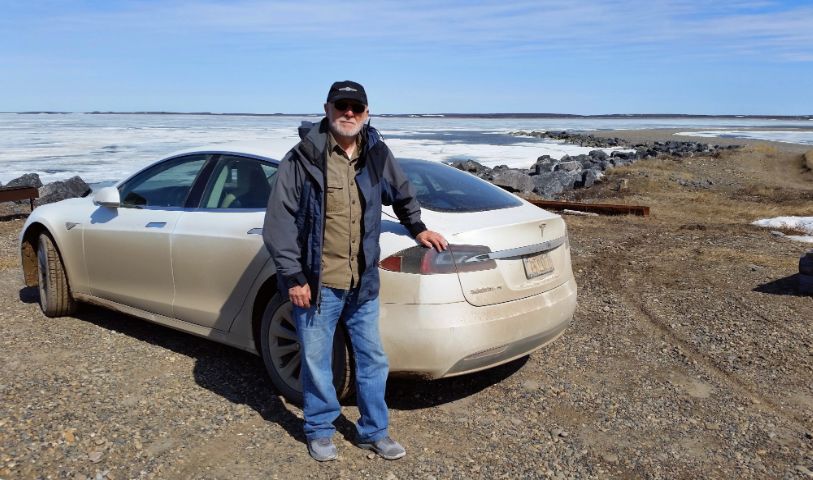
Georg Teepe arrived at the Arctic Ocean two days after his 84th birthday.
Teepe arrived at the Arctic Ocean two days after his birthday, but not before a memorable stop in the remote Peel River region. While waiting for ferry service to open for the season, he spent two days sleeping in his Tesla and sharing stories with truck drivers, who offered him food and drinks.
“Everybody was friendly, and everybody was nice,” Teepe recalled. “Some truck drivers invited me into their trucks for a drink and shared their food with me. It was really a nice experience.”
The delay did not bother him. For Teepe, it was part of the adventure.
Why the trip tested more than the Tesla’s range
Before Teepe hit the road, months of careful preparation went into the trip. He conducted test drives in the California desert to determine how far his Tesla could go between charges and at what speed he could maximize battery efficiency.
“I knew there would be one point when I had to cover 186 miles but would only have electricity for 150 miles or so,” Teepe said. “So, I knew that the only way I could do this would be to drive very slowly. So, I drove about ten hours going 32 mph, which used less electricity, so I stretched it and made it.”
It was one of the most demanding stretches of the journey. The route did not just test whether an EV could reach the Arctic Ocean. It tested how much patience, planning, and precision the driver was willing to bring to the road.
How he charged his Tesla without charging stations
After leaving charging stations behind in Alberta, Teepe had to get creative. He relied on campgrounds, welding stations, workshops, and the kindness of strangers to keep his Tesla running. He charged the car about 30 times in each direction.
“I charged wherever I could. I was in oil country, so I used places that had a welder because it lets you charge at a higher voltage, which would allow me to charge the car faster,” Teepe explained. “So, I would just ask around and see if I could charge at someone’s shop. Sometimes, people would say no, but many said yes. People were curious. They had never seen an electric car before.”
In some places, his Tesla was more than a car. It was a conversation starter. In remote oil country, where electric vehicles were still unusual, people wanted to know how far he had come, where he was going, and whether the car could really make it.
What the Alaska Highway was like in a Tesla
Teepe’s Tesla parked at the edge of the Arctic Ocean.
The trek was not just a test of battery life. It was also a test of endurance.
Teepe spent two weeks traveling just 500 miles along a gravel section of the Alaskan Highway, sleeping in the backseat of his car when motels were not an option. With 24 hours of daylight, he did not have to worry about driving in the dark, but the isolation was still very real.
The road was slow, rough, and remote. For most drivers, it would have been a difficult trip in any vehicle. In a Tesla, it required constant attention to speed, range, charging options, and distance.
What it was like reaching the frozen Arctic Ocean
For Teepe, the most unforgettable moment came at the end.
“The most memorable part of the trip was reaching the Arctic Ocean,” he said. “I had made it. The ocean was still frozen, but not frozen enough to walk on it. There were little bits of ice just floating on the water. I remember just standing there, taking it in. And at that moment, I was as elated as an old man could get.”
After 3,800 miles, the arrival was quiet but emotional. There was no finish-line crowd, no big ceremony, and no easy road behind him. Just the Arctic Ocean, floating ice, and the satisfaction of having done something no one else had.
The lifelong traveler behind the record-setting drive
Born in Essen, Germany, in 1935, Teepe’s life has long been shaped by craftsmanship and adventure. After World War II, he apprenticed as a stained-glass artist before moving to Canada in 1958 and later to Los Angeles, where he continued creating stained-glass windows for churches until retiring at 62.
In 2012, when Tesla introduced the Model S, Teepe became an early adopter. He has driven one ever since, seeing it not only as a car, but as a way to travel farther in a different way.
Teepe still drives and travels extensively, with recent trips to Denmark, Holland, and Antarctica. His favorite destination is Mongolia.
“But I enjoy everywhere I go,” he said.
His advice for anyone chasing a big goal is simple.
“Don’t think about all the obstacles; instead, think about your goal and keep going until you reach it,” he said.
Follow my page for more travel and lifestyle stories — including hotel stays, destination guides, where to eat, and traveling with a dog.