
In recent weeks, as high-powered electric motorcycles have surged in popularity and prompted growing safety concerns, cities across the Treasure Valley have been rushing to clarify their rules and crack down on dangerous riding.
But the different tacks agencies are taking reveal confusion over how state law should apply to the relatively new — and sometimes hard to identify — e-motorcycles.
Boise was first to pass an ordinance defining the powerful “e-motos” and confining them to public roads. A similar ordinance in Garden City followed, banning what it called “high-speed electric motorbikes” from the Boise River Greenbelt and places like city parks and bike paths.
Instead of following suit, other agencies, including Meridian, have said they’re relying on state law to treat the vehicles as traditional motorcycles. The Idaho Transportation Department, whose Division of Motor Vehicles is tasked with registering the e-motorcycles and issuing driver’s licenses, has struggled to provide clear statewide guidance on what riders need to do to follow the law.
So are e-motorcycles — more powerful and faster than e-bikes and with no human-powered pedals — considered “motorcycles” under Idaho law? And do they carry the same stricter requirements and legal consequences as the motor vehicles?
To better understand the shifting landscape around e-motorcycle regulation and enforcement, the Idaho Statesman reviewed state and local codes and contacted officials, attorneys and law enforcement officers at four Treasure Valley agencies and ITD.
We found that the answer depends on who you ask.
 E-bikes have become more common on the Boise Greenbelt, some reaching speeds that are uncomfortable for pedestrians. Boise City Council members recently passed an ordinance regulating “e-motos.” Darin Oswald doswald@idahostatesman.com More than an e-bike? In Meridian, that’s a motorcycle
In Meridian, officials are confident that Idaho law already has a section that explains the rules for e-motorcycles, the increasingly popular devices that can in some cases get up to 80 mph. According to Tishra Murray, Meridian’s deputy city attorney, it’s the code for motorcycles.
“In our opinion, there’s no difference in a Tesla … and a Porsche,” Murray told the Statesman in a phone interview. “… So there’s no difference in an electric motorcycle and a regular motorcycle.”
“If you’re (driving under the influence) in a Tesla, even though the motor is electric, you’re still DUI,” she said.
Murray said the Idaho legislature has “gone to great extents” to define e-bikes, like the popular green Lime bikes that riders can find throughout Boise. Under Idaho law, e-bikes have pedals and an electric motor with a maximum power output of 750 watts and the ability to travel no more than 28 mph.
Anything faster or more powerful, Murray said, is no longer an e-bike and needs to be considered a motorcycle. That means it needs to be registered and insured, and the rider needs a valid driver’s license with a motorcycle endorsement.
Riders under 18 years old are also required to wear helmets, and the vehicles aren’t allowed on sidewalks, Murray said.
“The state law is already pretty clear,” Murray said. “… Just like a Tesla is a car, these electric motorcycles are just that — they’re not bikes.”
Asked whether the vehicle could be interpreted as something other than a motorcycle, Murray doubled down: “What else could it be?”
 Members of the Meridian Police Department conduct a Q&A with people attending a community e-bike and e-motorcycle safety presentation at Meridian City Hall, Wednesday, July 15, 2026. Darin Oswald doswald@idahostatesman.com State law ‘ambiguous,’ Boise official counters
But in an interview with the Statesman, a Boise policy official said the state code is much more “ambiguous” when it comes to how e-motorcycles should be treated.
Bre Brush, senior policy adviser for the Boise mayor’s office, said that while an e-moto “shares a lot of similarities with a motorcycle, it also shares a lot of similarities with a bike.”
“That’s why this is a really weird gray area that we find ourselves in, because these are proliferating in the market very quickly, and we haven’t had time to adapt as a state,” Brush said.
Adopting a local ordinance was Boise’s way to dispel ambiguity and make enforcement easier, she said.
“Meridian feels like they have what they need in code already, and that was a different opinion than our attorneys took,” Brush said. “It could very well be that everything can be enforced exactly as is, but it is sort of unclear in state code what an e-moto is.”
“Every city can interpret (the code) differently based on their level of comfort with legal risk and their law enforcement’s capacity,” Brush said. “… This is what we felt like we needed to do to be able to enforce it clearly.”
ITD: Rules vary by jurisdiction
In two recent news releases, ITD urged riders to look to city codes for their e-bike and e-motorcycle answers, a move that highlighted Boise’s ordinance and seemed to contradict Meridian’s stance.
“Boise is currently the only city requiring high-powered e-motos to be licensed, registered and insured,” said Britt Rosenthal, a public information officer for the DMV, in a phone interview with the Statesman. “Higher-power devices may trigger licensing or motorcycle endorsement needs, and riders should check their municipal code for specifics.”
Asked whether ITD considers e-motorcycles that exceed 750 watts and 28 mph “motorcycles,” Rosenthal couldn’t definitively say.
In a statement later emailed to the Statesman, Rosenthal said that “once a device exceeds the criteria of an electric-assisted bicycle, it is treated as a motorbike and is subject to the applicable statutory requirements.”
Rosenthal said a motorbike is a “self‑propelled, two‑wheeled motorcycle or motor‑driven cycle — other than a tractor — designed for or capable of traveling off developed roads and highways.”
If a rider brings an e-moto to the DMV that exceeds the criteria for an e-bike, it would be “generally treated” as a motorbike, the statement said — “unless it meets or surpasses Federal Motor Vehicle Safety Standards, such as registered electric motorcycles intended for on‑road use.”
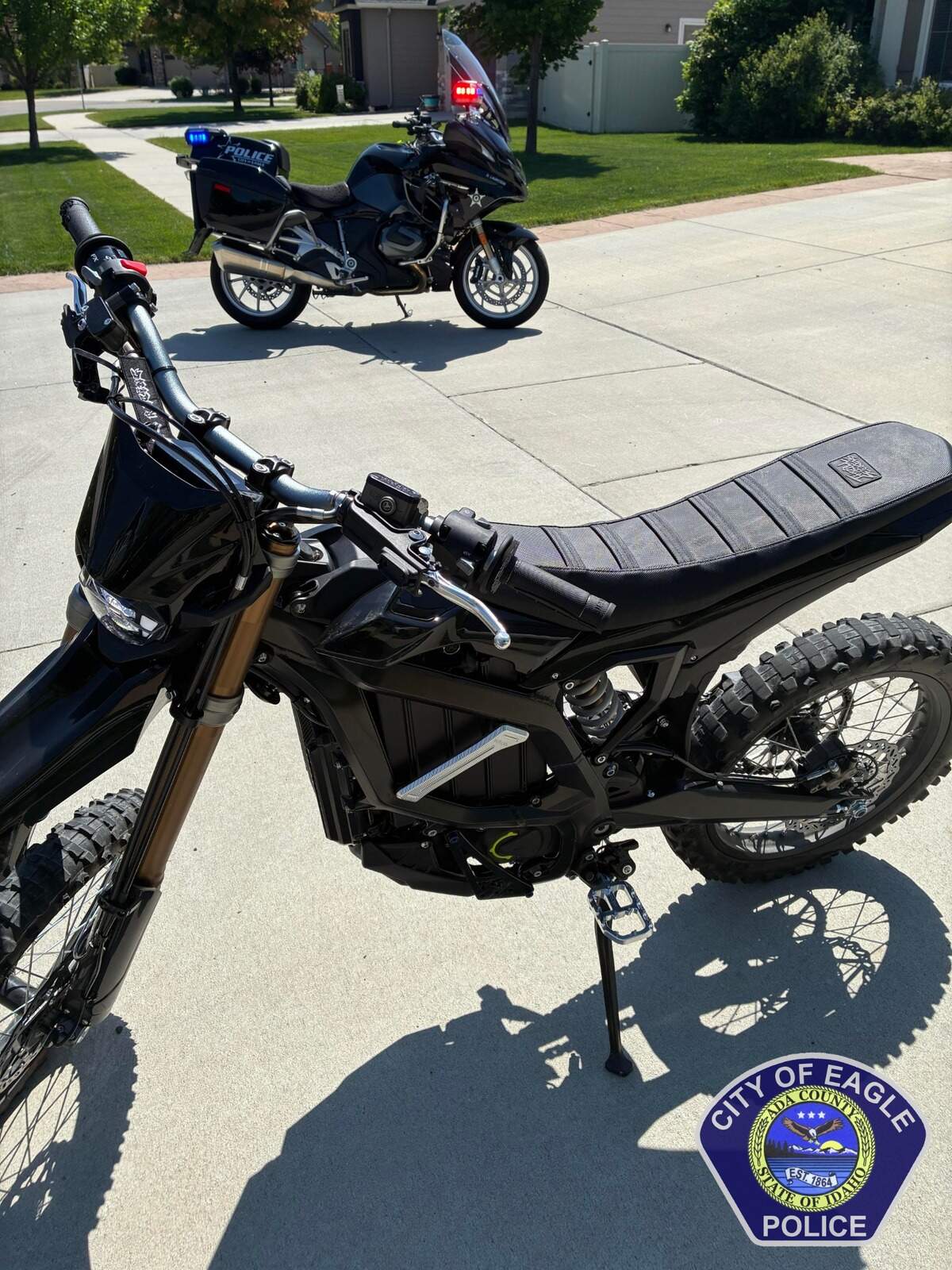 Eagle Police shared a photo of an electric motorcycle that a 16-year-old allegedly crashed into a police car in May. Eagle Police Department What agencies’ differing opinions mean for e-moto riders
In emails to the Statesman, the Nampa Police Department and Ada County Sheriff’s Office seemed to back Meridian’s take on the law.
“Any E-Motorcycle that is over 750 watts, can exceed 28 mph and has no pedals is a motorcycle,” said Nampa Sgt. Doug Harward, though he added that the city of Nampa would be exploring adding an ordinance to that effect.
“Based on public concern and following the example of neighboring cities, the City of Nampa is in the process of enacting new ordinances that will define these vehicles and clarify the use of the E-motorcycles in the city of Nampa,” he said.
Deputy Lauren Montague, a spokesperson for the Ada County Sheriff’s Office, similarly said: “If they exceed the e-bike definition, then we are treating them as motorcycles.”
Montague explained that if riders wanted to use their e-motos on public streets, they would need to get a license plate and registration from the DMV.
“If ITD refuses to register it, then it cannot be ridden on public streets. Which means the rider can find dirt trails or private property to ride them,” she said.
What this could mean for riders is stricter enforcement, according to the Meridian Police Department.
In a recent community meeting, Meridian police said they planned to use state laws to target e-motorcycle violations — going so far as to fine parents for allowing unauthorized minors to operate them or even potentially charging them with criminal injury to a child.
“Personally, I’m not a big fan of putting ordinances on the books if we’re already enforcing them under state code,” Meridian Police Chief Tracy Basterrechea said at the meeting. He argued that the recent ordinances in Boise and Garden City don’t “give them any more enforcement power than what we already have under state code.”
Though officials may not agree on where exactly the new devices fit under the law, and riders could encounter different enforcement approaches in different cities, at least a handful of Treasure Valley jurisdictions say they’ll be treating them as much more powerful vehicles than an electrified 10-speed.

Idaho Statesman
Rose covers Meridian, Eagle, Kuna and Star for the Idaho Statesman. She grew up in Massachusetts and previously interned for a local newspaper in Vermont before taking a winding path here. If you like reading stories like hers, please consider supporting her work with a digital subscription.
Support my work with a digital subscription