
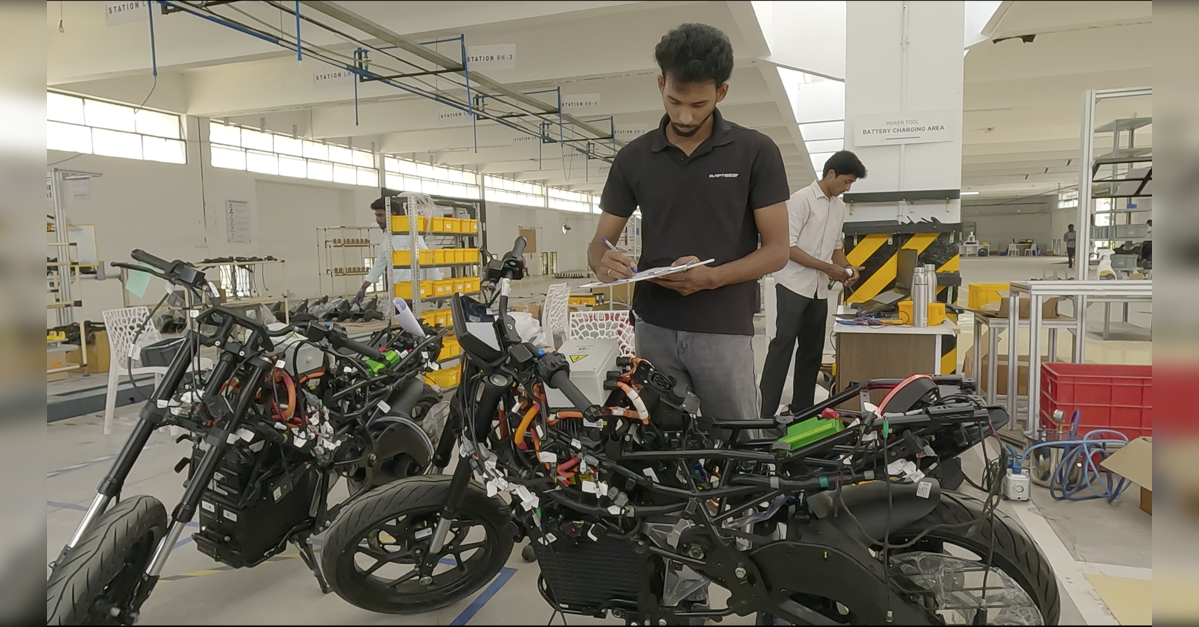
 The company is aiming to manufacture over 1,500 motorcycles in FY27, with a keen emphasis on guaranteeing an easy ownership process for their first buyers. Raptee.HV is taking a different route in India’s electric motorcycle market by betting on high-voltage architecture instead of the low-voltage systems that dominate the industry today.
The Chennai-based startup believes that the future of electric motorcycles will be very similar to what happened in the case of electric cars, wherein the preference gradually shifted to high-voltage platforms owing to its performance and efficiency.
The company is aiming to manufacture over 1,500 motorcycles in FY27, with a keen emphasis on guaranteeing an easy ownership process for their first buyers. With increased demands and a growing retail network, Raptee.HV intends to scale its production capacity to about 16,000 motorcycles in FY28.
According to Dinesh Arjun, CEO and Co-Founder of Raptee.HV, the shift towards high-voltage systems is inevitable. “Today, almost every electric motorcycle uses a low-voltage architecture, but we don’t believe that will remain the industry standard for long,” Dinesh Arjun told ET Manufacturing. “Be it 200 volts, 240 volts, even 300 volts; high voltage technology just makes more sense engineering wise.”
He believes that the larger industry will begin to adopt such technologies in the next three to five years, and Raptee.HV will be ahead of the curve in this technology. Despite having an ambitious roadmap, the startup is careful about expanding aggressively in the first year itself. “For now, our focus is not on aggressive scaling in the first year,” said Dinesh Arjun. “We want every customer to have an excellent ownership experience.”
Raptee.HV’s current manufacturing facility can produce around 1,400 motorcycles a month and has the potential to scale to nearly 9,000 units monthly, providing sufficient capacity to support its next phase of growth.
Furthermore, the company aims to achieve profitability by FY30 and intends to file for an IPO in FY31.
In addition, it plans to double their workforce from around 200 employees, with hiring focused in the fields of manufacturing, marketing and regional operations.
Exports to begin with neighbouring markets
Exports will form an important part of Raptee.HV’s long-term growth strategy.
The company intends to foray into Sri Lanka, Nepal and Bangladesh during the next financial year before delving to markets such as Turkey, Morocco and Eastern Europe.“We are already in talks with possible partners,” said Arjun.
He believes these regions offer strong opportunities because customer preferences closely resemble those in India, reducing the need for product localisation.
Built around an engineering problem
Raptee.HV’s journey wasn’t about becoming yet another manufacturer of electric motorcycles, but to find a solution to an engineering problem. “From the outset we didn’t want to be just another motorcycle company,” said Dinesh Arjun. “We started out as a component company as we wanted to address an engineering problem.”
In its time of development, Raptee.HV tried various voltages from 48 volts up to 96 and 120 volts, until finally settling on a 240 volt system. Developing the technology was far from straightforward. It took nearly six years to build the platform, largely because India lacked a supplier ecosystem for high-voltage motorcycle components. As a result, the company had to develop several critical technologies and capabilities from the ground up before it was ready to bring its motorcycles to market.
Why higher voltage changes everything
At the core of Raptee.HV’s plan lies an engineering truth: voltage is efficiency.
Using the example of the power grid in India, Arjun said that transmission of power is done at very high voltage levels because it reduces energy losses. “This is true for electric motorcycles as well,” he said.
According to him, delivering the same amount of power through a conventional 48-volt architecture would result in nearly 25 times higher thermal losses than a 240-volt system.”At the end of the day, you can’t beat physics. That’s the foundation of our architecture,” Arjun said.
For Raptee.HV, that engineering advantage is expected to translate into tangible customer benefits, including faster charging, sustained performance and improved overall efficiency, qualities the company believes will define the next generation of electric motorcycles in India.
Winning riders through performance, not subsidies
For Raptee.HV, the biggest challenge is changing how riders perceive electric motorcycles.
Arjun believes customers will not switch simply because EVs cost less to run or are better for the environment. Instead, electric motorcycles must offer a better overall riding experience than conventional petrol models.
“Instead of customers opting for the electric motorcycle due to subsidies or lower operating costs, they should opt for the electric motorcycle because it is superior to the conventional one,” he remarked.
He emphasised that the cars and scooters that use electricity have already surpassed that benchmark, where the consumer sees it as an improvement from its previous form.
Now, Raptee.HV seeks to introduce that change in motorcycles through faster charging, higher highway performance and enhanced ownership experience.
A head start in charging infrastructure
Raptee.HV believes one of its biggest competitive advantages is compatibility with the existing CCS2 public charging network.
Unlike most electric motorcycles that require dedicated charging solutions, Raptee.HV’s motorcycles can already use thousands of public chargers installed for electric cars.
Arjun believes introducing separate charging standards for two-wheelers would only create confusion.
“Customers are still learning how EV charging works. Adding multiple charging standards only makes adoption harder,” he said.
The company is also developing a plug-and-charge experience, enabling riders to simply connect their motorcycle and charging will commence on its own without multiple app downloads or authentication.
Expansion will follow service, not sales
Raptee.HV intends to expand its market presence in Chennai and Bengaluru to Kochi, Hyderabad, Pune and Gurugram; however, they will only do so once the after-sales service network is operational.
“We don’t believe in opening a sales outlet in any city without first having a service network there,” Arjun said.
He added that delivery timelines will also determine the pace of expansion. “There’s no point opening in more cities if waiting periods stretch to six months.”
R&D focus shifts to battery engineering
While the EV industry continues to discuss next-generation battery chemistries, Raptee.HV believes significant improvements can still come from battery pack engineering.
According to Arjun, the company’s motorcycles are already software-defined, connected and capable of receiving over-the-air software updates.
Future R&D, however, will increasingly focus on improving battery pack integration and manufacturing precision.
“It’s not only about battery chemistry,” he said. “How the cells are integrated into the pack can make a huge difference.”
Even small improvements in manufacturing tolerances, he added, can significantly improve battery performance under demanding riding conditions.
Backing NCA chemistry while staying flexible
Raptee.HV currently uses Nickel Cobalt Aluminium (NCA) battery chemistry and intends to continue with it over the medium term.
“We remain optimistic about NCA chemistry,” Arjun stated. He further pointed out that the company is purposely staying away from relying on one battery supplier since battery technologies are advancing very quickly.
Policy should strengthen manufacturing, not just demand
Arjun sees the FAME initiative as a way to boost the awareness of electric mobility, but he thinks that the focus of policies in the future should be directed towards manufacturing incentives.
“The next phase of policies should be aimed at the development of production capacities, strengthening the supply chain, and supporting R&D,” he stated.
Moreover, he pointed out that incentives directed at the supply side would contribute to making Indian producers competitive internationally and increase the volumes of exports.
Raptee.HV is also engaging with NITI Aayog on discussions around policy frameworks specifically designed for electric motorcycles.
Success will be measured by industry transformation
For Raptee.HV, success is not simply about becoming India’s largest electric motorcycle manufacturer.
“Our focus isn’t market share at any cost,” Arjun said. “Technology leadership is what defines us.”
For now, Raptee.HV intends to remain focused exclusively on motorcycles, betting that technology-led innovation, not price competition, will define the next phase of India’s electric mobility journey.
Published On Jul 30, 2026 at 05:46 PM IST
Join the community of 2M+ industry professionals.
Subscribe to Newsletter to get latest insights & analysis in your inbox.
All about ETManufacturing industry right on your smartphone!
