

You might think that Rolls-Royce customers are old-fashioned, stuffy traditionalists who are not too keen on doing away with the internal combustion engine, but think again. The company’s first electric car, the Spectre, which arrived in 2022, is its second bestselling model globally, and the most popular of all in Europe.
If you think about it, electric power is ideal for a Rolls. The extra weight of a battery pack isn’t a problem because these are cars that have always been similar in mass to a small planet, while the effortlessness and smoothness of electric motors are exactly what the company has been seeking from its V12 engines. And for quietness, eliminating explosions under the bonnet is a very good start.
Rolls’s customers are apparently far more concerned about the process of refuelling than the type of fuel that powers their car — or rather they don’t want to have to refuel their cars themselves at filling stations. Being able to plug in at home (or even better, have their driver do it) without ever mixing with riffraff like you and me is ideal.
The ultimate fear, of course, would be having to top up the Spectre’s battery while away from home, potentially at a motorway service station — oh, the horror. Which is why, after just three and a half years, Rolls-Royce has a new version that can go 18 per cent further before it runs out of juice; the Spectre Series II you see here has an official range of 390 miles on the WLTP cycle (up from 329 miles before), though the company is refreshingly honest that the real-world range is more like 330 miles, depending on conditions.
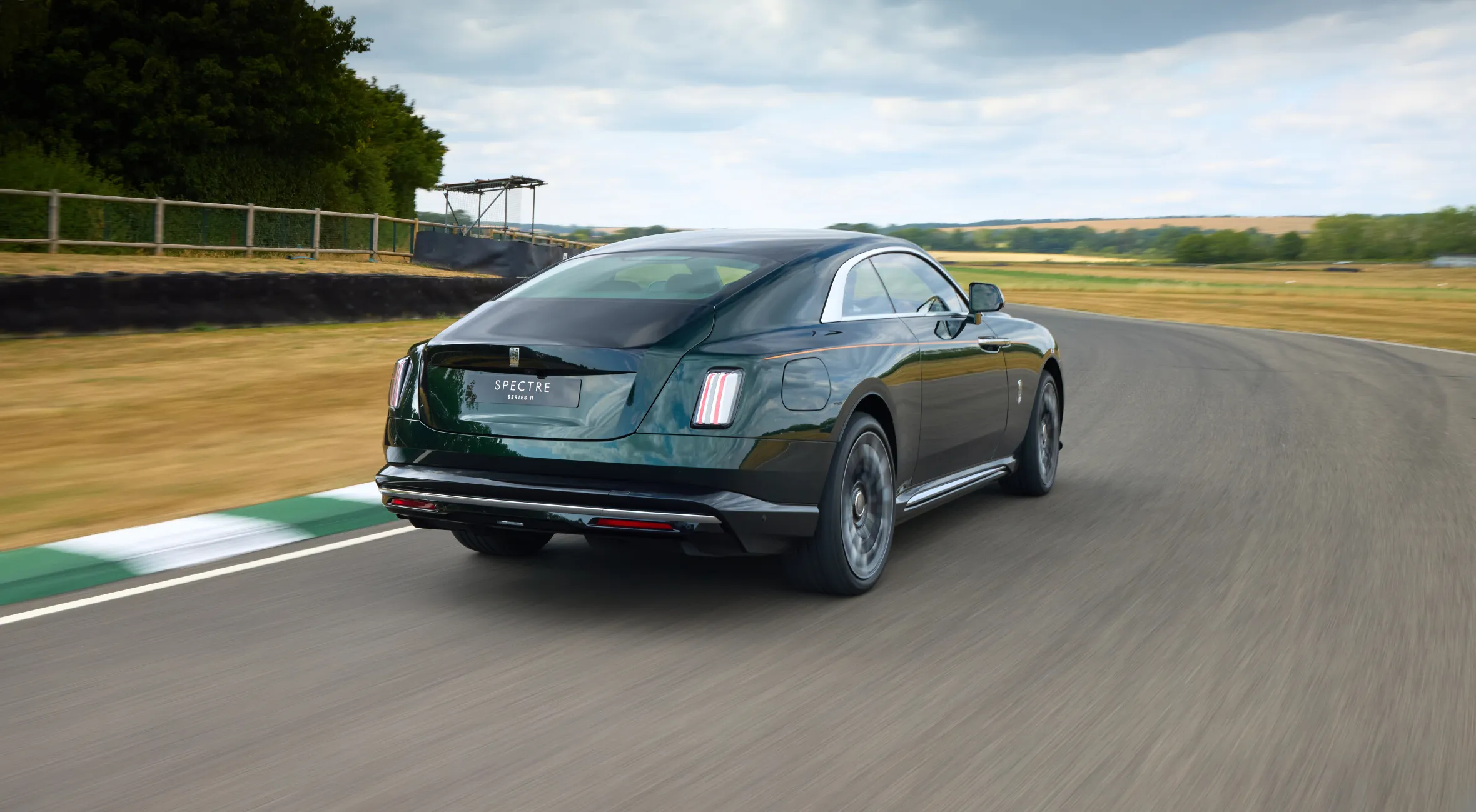 The updated Spectre can travel 390 miles per charge, according to the official test, but Rolls-Royce tells its clients to expect about 330 miles in the real worldMatt Howell/Rolls-Royce motor cars
The improved range is down to upgraded battery-cell tech, which has boosted the energy capacity from 102kWh to 112.4kWh. The upgrades also mean the Spectre Series II can be recharged 14 per cent faster, so if you were to connect to a 195kWh DC rapid charger, the 10-80 per cent time would be 28 minutes instead of 34 minutes. Though, as we’ve established, no owner would be doing that unless their executive assistant had made some kind of catastrophic error with the route planning.
Needless to say the Series II is faster than the original Spectre, with power from the dual-motor system increasing from 577bhp to 593bhp and torque jumping from 664 lb ft to 749lb ft. Those are epic levels of brute force and enough to propel this near-three-tonne lump of aluminium, steel, wood, leather and glass from 0-62mph in just 4.5 seconds. Get the Black Badge version, which has the power and torque turned up even further (671bhp/811 lb ft), and the figure comes down to 4.3 seconds.
I got to try the new car out on the track at the Goodwood Motor Circuit and found that flooring the accelerator is a surreal experience. The Black Badge models have a Spirited Mode that gives the full beans, and by stepping on both pedals at the same time and then letting go of the brake, you get a “Spirited Launch” (“launch control” is too vulgar a term for Rolls). Five seconds later you’ve hit 70mph and beyond, but you only realise this once you look down at the speedometer. There’s a sense of speed, yes, but not like in a sports car; the cabin is so ridiculously hushed and the performance so smoothly delivered to the wheels that on a wide open racing circuit, without lampposts or trees lining the road, 70mph feels like 30mph. It’s weirdly deceptive.
 The Black Badge version is the most potent Spectre and in Spirited Mode does a 0-62mph sprint in just 4.3 secMatt Howell/Rolls-Royce motor cars
The problem then is slowing the car, but that is something Rolls-Royce has covered and was keen for us to try. In a brake test from 60mph, this Spectre stopped in three car lengths, which felt like catching an oil tanker in a net. The advantage of electric is that you can use the motors to recuperate energy while slowing down, which has an engine braking effect (regenerative braking), but because the car is so heavy, Rolls’s engineers have also fitted big old brake pads and discs behind the monstrous 23in aerodynamic wheels, controlled electronically “by wire” rather than via a physical connection to the pedal.
Even in “B” mode, which activates the “regen”, the braking force when you lift off the accelerator isn’t extreme. The Spectre will eventually come to a complete stop if you’re not touching the pedals at all, but Rolls is careful not to call it a “one pedal” mode — such a thing is not considered suitable for a car of this breeding. Importantly, both braking systems work together seamlessly for a silky stop every time.
The regen from B mode works nicely round a track, where the subtle braking force helps settle the car before the hard work is done by the discs and pads, and the unchanged air suspension is adjusted automatically via the array of sensors monitoring speed, roll, steering input and even GPS — yes, if a tight corner is coming up, the Spectre braces itself and can turn amazingly accurately thanks to strong front-end grip and four-wheel steering. It’s so deftly tuned that the steering feels light and the chassis beautifully pliant without being wallowy or liable to pitch and dive.
 The air suspension is unchanged but it’s a high-tech system that adapts to the road and offers a mix of comfort and dynamismMatt Howell/Rolls-Royce motor cars
Rolls doesn’t give drivers loads of drive modes to play with, it just makes the car do it all for you behind the scenes, like a trusted butler, and it works in every scenario. This isn’t a track-focused car by any means — it’s supremely comfortably sprung — but it still possesses a dignified poise when pushed and can cover ground disarmingly quickly.
Another thing Rolls hasn’t tweaked is the exterior. Rolls told us this is because clients are still more than happy with the look of the car, though I imagine it means the powertrain upgrades can be rolled out sooner rather than later. But for my money the Spectre is the prettiest model in the Rolls-Royce line-up, so there are no complaints.
It’s inside that a lot of work has gone on. Rolls-Royce is in the process of doubling the size of its Goodwood factory, but not so that it can produce more cars; instead it plans to use the new facilities to greatly increase the customisation options available to clients. No two cars are ever alike, Rolls claims, and the bespoke division will always look into specific requests (you can easily double the price of your car, or send it into the millions if you want), but the off-the-shelf options available are increasing exponentially.
 Clients can now choose a two-tone paint scheme with a fade down the side of the carMatt Howell/Rolls-Royce motor cars
 The hand-crafted interior is infinitely customisable, but a new option for the seats is perforated leather in a pattern inspired by moonlight through cloudsMatt Howell/Rolls-Royce motor cars
The Spectre Series II already has a lot more potential for personalisation, with new materials, colours and finishes, such as a two-tone paint job with a fade down the side of the car. Some combos are more successful than others, it has to be said, so do look out for some garish results around Knightsbridge in the months to come.
Inside there’s a fabric Rolls has named Duality Twill, featuring an abstract link-like Rolls-Royce “RR” motif. The design doesn’t do it for me, but the craftsmanship is quite incredible, taking up to 25 hours to create using about 2.6 million stitches and ten miles of thread — enough to go around the Goodwood track four times, we were told.
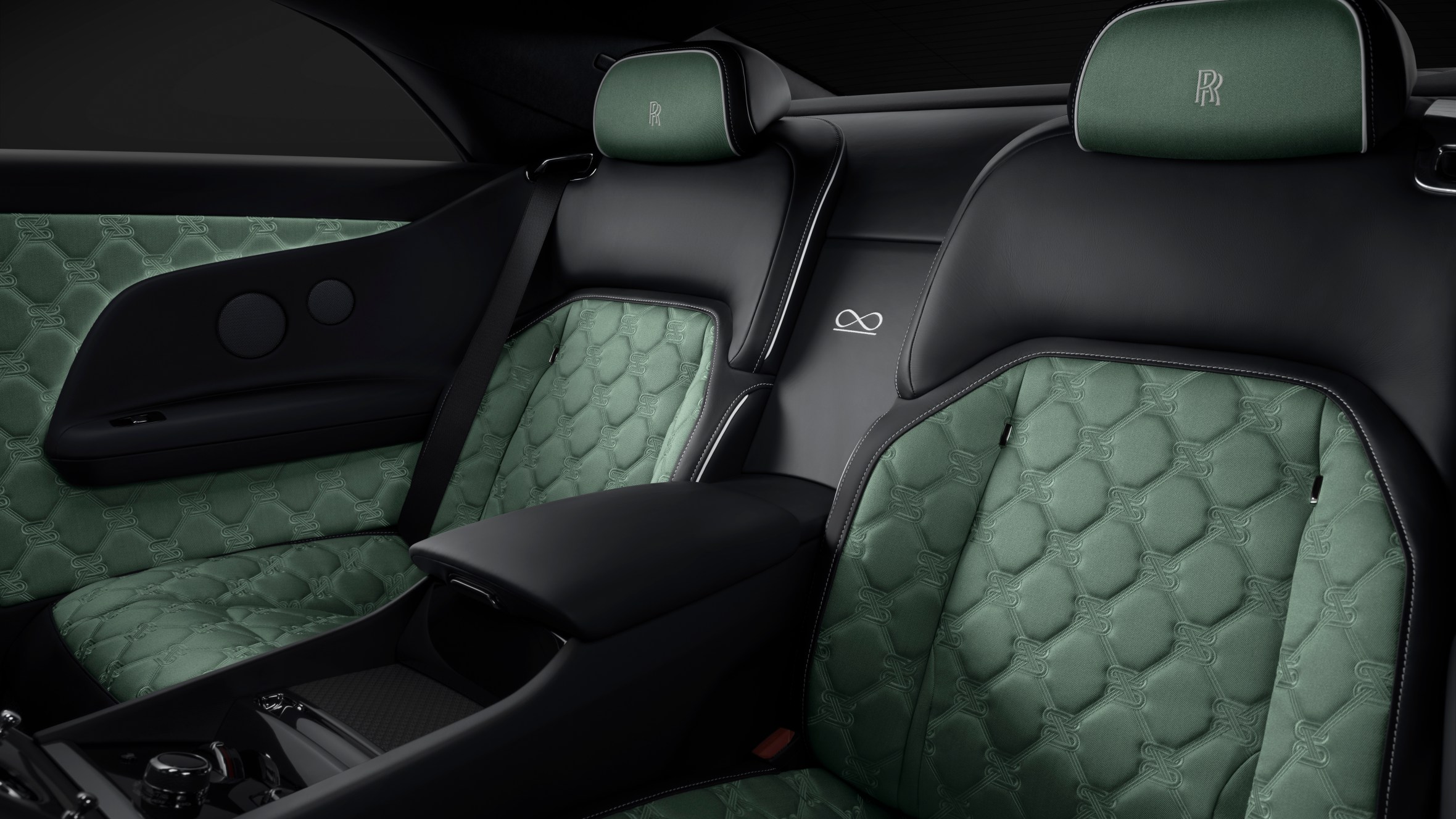 The Duality Twill option takes 25 hours to make and uses ten miles of threadMatt Howell/Rolls-Royce motor cars
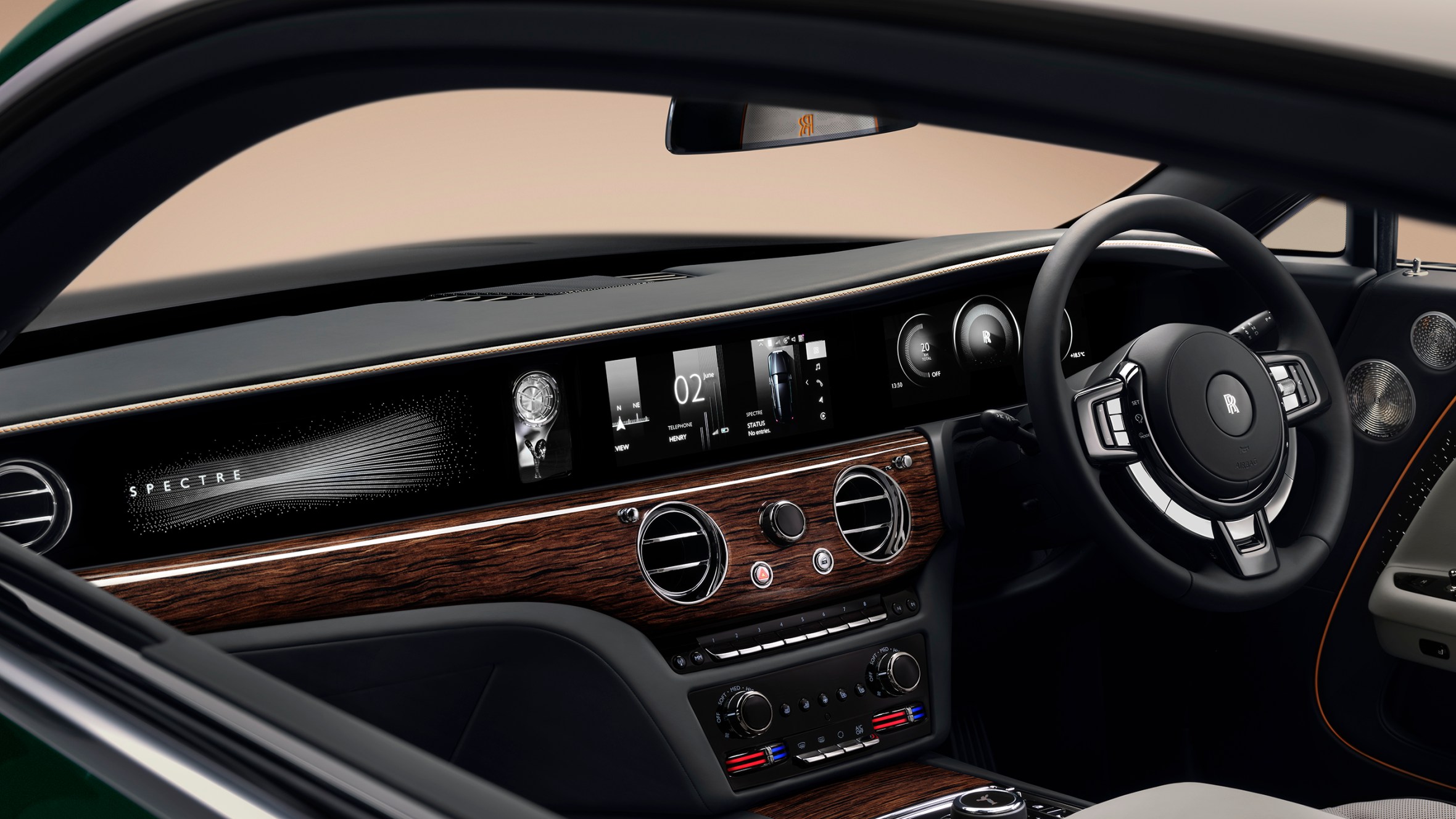 The tactile cabin is a good mix of physical and digital, and the dashboard gets a new aviation-inspired clock featuring its own Spirit of EcstasyMatt Howell/Rolls-Royce motor cars
There’s also a new decorative pattern of perforations for the leather, inspired by moonlight through clouds, using 78,138 precision-cut holes — with optional illuminated door panels extending the effect — and a new Brindled Walnut veneer that combines walnut from non-fruiting trees with recycled eucalyptus fibres. And there’s a new aviation-inspired clock with simplified graphics, cast metal hands and an illuminated Spirit of Ecstasy display in the dashboard.
Read more car reviews from Will Dron
All of which means that the Spectre Series II is subtly better than ever. Of course, with prices starting at about £325,000 (but most far exceeding that after personalisation), this is a car that is completely irrelevant to most of us. But for those who can afford one, this is now a much more compelling package; and for those who bought the outgoing model, the Series II might be tempting enough for an upgrade — this time with an even wilder paint and interior combo.