
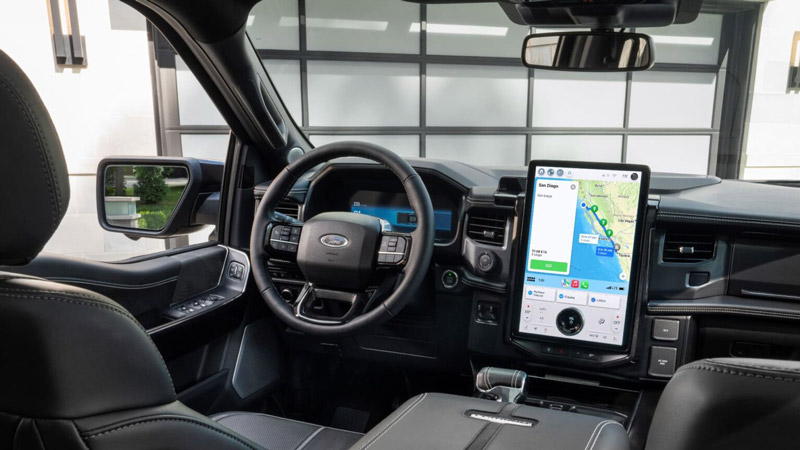
 Ford Motor Co. in Dearborn and Apple today announced that Apple Maps will be integrated directly into Ford’s upcoming Universal Electric Vehicle (UEV) Platform through Apple’s new MapKit for Automotive SDK. Coming to Ford’s UEV Platform in 2027, the integration will deliver a new navigation experience powered by Apple Maps directly to the vehicle’s displays. // Photo courtesy of Ford
Ford Motor Co. in Dearborn and Apple today announced that Apple Maps will be integrated directly into Ford’s upcoming Universal Electric Vehicle (UEV) Platform through Apple’s new MapKit for Automotive SDK.
Coming to Ford’s UEV Platform in 2027, the integration will deliver a new navigation experience powered by Apple Maps directly to the vehicle’s displays. Road-level Maps information also will enable Ford’s Latitude AI team to build a seamless hands-free driving experience.
Ford’s new electric truck, announced recently, will hit the market in 2027. Priced at $30,000, it offers a budget-friendly yet compact option. Notably, the truck’s battery can power a house for up to six days during a power outage.
Leveraging Apple’s new MapKit for Automotive SDK, Ford’s UEV Platform will offer drivers turn-by-turn directions using natural language, real-time traffic and incident information, intuitive search featuring detailed place cards, and routing options to help users easily find the best route to their destination.
Additionally, Ford UEV drivers will benefit from an intelligent EV routing functionality, including battery preconditioning. Ford also will use road-level information from Apple Maps as part of the development of its next generation BlueCruise hands-free highway driving capability to deliver a more seamless on-ramp-to-off-ramp experience.
“We’re excited to bring the power of Maps’ navigation technology to Ford’s innovative Universal Electric Vehicle Platform,” says Eddy Cue, Apple’s senior vice president of Services and Health. “With our new MapKit for Automotive SDK, we’re bringing Maps further into drivers’ daily lives, giving them an incredibly accurate and easy-to-use navigation system that is seamlessly integrated into Ford vehicles.”
Development of Ford’s next-generation self-driving technology is led by Latitude AI, Ford’s wholly owned autonomy subsidiary of 600 machine learning, robotics, and software experts, who are building Ford’s proprietary in-house advanced driving system (ADAS).
Latitude is developing the Ford Large Driving Model, which supports a spectrum of self-driving capabilities, all derived from millions of miles of real-world driving data. Ford and Latitude design both the hardware and the software, making Ford’s self-driving technology efficient and easily scalable across the Ford lineup.
“Our new midsize electric vehicle will be priced around $30,000 and redefines what advanced technology can be — simple, useful, and truly attainable for more customers,” says Jim Farley, CEO of Ford.
“We’re proud to embed Apple Maps’ navigation and mapping technology directly into our Universal Electric Vehicle Platform, giving customers the ultimate navigation experience alongside our Ford app, a full suite of software, and next-generation BlueCruise, all enabled by a new zonal architecture.