

Massachusetts is extending its residential peak demand virtual power plant (VPP) program to vehicles next. The state’s ConnectedSolutions program already includes school buses and commercial vehicles in limited amounts, but now it seeks to include residential vehicle to grid (V2G) connections.
The ConnectedSolutions program is a VPP program that operates across multiple New England states, including Massachusetts, Connecticut, and New Hampshire. The program enrolls thermostats, water heaters, and batteries at residential sites. At commercial sites, the program works with custom industrial equipment.
Massachusetts notes it has more than 150,000 electric vehicles on the road already. If they averaged 75 kWh each, they’d total just over 12 GWh. As of June 2026, the Solar Energy Industries Association sees just under 1.6 GWh of energy storage deployed across the state.
The V2G program will pay car owners that participate in the program similarly to how it already pays home batteries. For example, Mass Save lists a residential battery rate of $275 per average kW of summer event contribution. This leads to potentially $1,375 to $2,750 for residential participants. A spokesperson for the program told EV website electrek.co initially eligible vehicles include the Ford F-150 Lightning, Nissan Leaf, Kia EV9, Polestar 3, and Volvo EX90.
The Mobility House, EnergyHub, and Sunrun are participating in the program. The Mobility House helped the state deploy bidirectional chargers across residential, school bus, municipal, and commercial sites (see flag 5). EnergyHub’s Edge DERMS platform will manage dispatch for the pilot program. Sunrun currently offers a V2G program with Ford F-150 Lightning owners.
Limited other details on the program were offered.
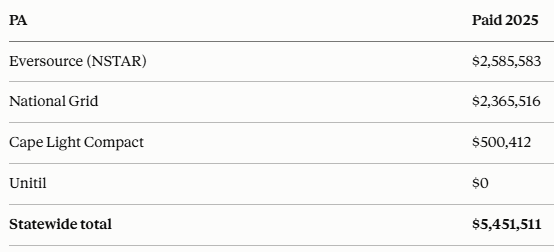
Per preliminary program administrator data filed with the Massachusetts Energy Efficiency Advisory Council, more than $5.4 million was paid to 5,251 residential battery participants for the 2025 season.
ConnectedSolutions operates alongside the state’s Clean Peak Energy Standard, and enrolled batteries can qualify under both programs.
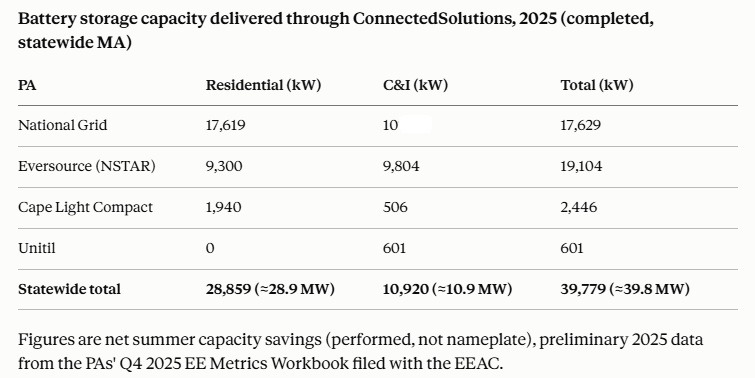
Batteries in the ConnectedSolutions program delivered roughly 40 MW of net summer capacity savings in Massachusetts during the 2025 season. 28.9 MW of the capacity came from residential systems, with almost 11 MW from commercial batteries. The program administrators’ 2025-2027 plan targets roughly 125 MW of battery performance capacity, with 93 MW residential and 31.5 MW commercial.
National Grid is already testing buses in its V2G program in Massachusetts. School buses, with their large batteries, unique use cases, and finance complexities, have been getting tested for V2G connection for years.
During a June 2024 heat wave, the utilities reported the region-wide ConnectedSolutions VPP shaved more than 375 MW off the New England power grid. Distributed batteries have been saving New Englanders energy bill money for a long while. Including Vermonters a half a million back in the 2010’s.